

Trusting 'The Process': Not Transferring from Alabama Is a Worthwhile Risk
TUSCALOOSA, Ala. — He was miserable.
University of Alabama linebacker Ryan Anderson had been considered a prize recruit, either a 5- or 4-star prospect depending on which ranking service you went by.
A cousin of former Crimson Tide defensive lineman Wallace Gilberry grew up down the street from running back T.J. Yeldon and helped Daphne High School win a state championship. He appeared destined for greatness at Alabama.
TOP NEWS
Top College Fantasy Players 🌟
QBs with the Most to Prove 📈
ACC's New Championship Game Tiebreaker
Yet Anderson sat and redshirted the 2012 season. He wondered if he had made a mistake.
"My first year I wanted to leave," Anderson admitted. "I called my mom every day talking about it. She told me, 'You're not going to do that. God sent you there for a reason, and that's the reason that you're there and you'll see before long.'
"She was right. That next year, I just stopped questioning everything. I just said I'm going to stop pointing fingers and I'm just going to show up to work every day, and that's been working for me."
Although Alabama often draws attention and some criticism when players leave the program, many of whom couldn't crack the lineup or didn't have the patience to wait for their opportunity, it's the ones who didn't depart who are now making the biggest difference on this year's undefeated team.
Anderson's story about considering leaving isn't unique, as a lot of his senior teammates had to wait for their chances as well, including defensive end Jonathan Allen, tight end O.J. Howard and linebackers Reuben Foster and Tim Williams.
They all stuck with what Nick Saban calls "The Process," and along with Anderson and junior offensive tackle Cam Robinson are now all considered potential top picks in the 2017 NFL draft.
They're also why ESPN analyst Todd Blackledge says that "Nick Saban's best recruiting job this year might have been those guys sticking around," and his colleague David Pollack calls the Crimson Tide the most "complete team" in college football.
"Yeah, everybody has those moments, but come to realize this is a family," Foster said about having thoughts of transferring early in his career.
"It's the best decision I ever made. I was a kid, I was a child as a freshman. I ain't know no better."
It wasn't until after spending two seasons as a reserve and terrorizing returners on special teams that Foster earned his inside linebacker spot as a junior. Similarly, Anderson played 42 games for the Crimson Tide before finally making his first start this season.
Thus, the trickle-down effect from Alabama having such a talented roster. Top players learn from and follow other top players, which is something that the coaches emphasize during recruiting.
Part of their pitch is if you want to fully reach your potential, you have to practice and surround yourself with the best. Chances are you'll have a good opportunity to win a national championship with the Crimson Tide, but everything has to be earned, including playing time. That's the real price of success.
"You just have to think of the bigger picture, this whole thing is a lot bigger than just you," said junior Rashaan Evans, Scout.com's No. 1 outside linebacker in 2014 who is expected to step in for Shaun Dion Hamilton after he suffered a season-ending knee injury during the SEC Championship Game. "Once I had that [mentality], as you could see year by year, your chances are going to come. You just have to wait your turn."
He added: "Timing is everything, that’s what Coach Saban teaches and preaches to us every day. You definitely don’t want to rush anything or be premature at anything because when your chance comes, either you are ready or not.
Another perfect example from this season has been true freshman Mack Wilson, who like Foster was considered a stud recruit. Scout.com rated him the nation's second-best linebacker behind Alabama's Ben Davis (who is redshirting), but he has been relegated to special teams and some fullback duty in goal-line situations.
Against Texas A&M in October, he made a brutal hit on kick returner Speedy Noil. Not only did it make everyone who saw it wonder, "How is that legal?" but Foster quipped that it was "like attempted murder. Oh my gosh."
Wilson then made another hit that was nearly as vicious.
"After the first one, I said something to him, like, 'Bruh, what got into you?'" Foster said. "It really scared me, like, where'd this come from?"
"I'm like, 'This boy is amazing. He's a man-child.'"
Funny, Foster's teammates used to say nearly the exact same thing about him. Now he's the holder of the Butkus Award as the nation's best linebacker.
It seems almost unfair for a team to have such talented players throughout the roster, but considering the way Saban lands top-notch class after top-notch class, there's no other opportunity for some newcomers to get on the field.
Others end up on the losing side of competitions. They're primarily the ones who find themselves deciding between bucking the process and taking the risk of going elsewhere, or taking the time to develop and wait their chance.
Since Saban arrived in 2007, Alabama's seen its fair share of transfers and no recruiting class has remained intact. That's the norm for any program nowadays.
According to the NCAA's most recent available statistics, the number of four-year transfers and two-year transfers in from junior colleges has remained relatively steady in Division I football (legislation allowing graduate transfers only passed in 2006).
| Year | Non-Transfers | 2-Year Transfers | 4-Year Transfers |
| 2008-09 | 9,591 (88.8 percent) | 867 (8.0) | 346 (3.2) |
| 2009-10 | 9,745 (88.8) | 881 (8.0) | 342 (3.1) |
| 2010-11 | 9,668 (88.5) | 912 (8.3) | 345 (3.2) |
| 2011-12 | 9,772 (88.5) | 905 (8.2) | 371 (3.4) |
| 2012-13 | 9,631 (87.9) | 927 (8.5) | 400 (3.7) |
Of course with Alabama almost always signing the maximum number of players, 25 per Southeastern Conference rules, there have been fewer arrivals by transfer than departures.
The occasional player is recruited out of a junior college, and the coaches have brought in a graduate transfer in each of the last three years to fill an immediate need. The most notable among them was Jake Coker, the starting quarterback for the 2015 national championship team.
Not including players who were kicked off the team (and it's impossible to get an accurate count because Saban often doesn't disclose why one left the program), Alabama is averaging about four departures a year.
Most cited playing time as their primary reason for leaving. In a few cases, the desire to play closer to home was a factor, and some weren't keeping up with their academic requirements and saw the writing on the wall.
Yet few have found success elsewhere.
Among those who did include quarterback Phillip Ely, who set some school records at Toledo. Running back Dee Hart fared well playing for former Crimson Tide offensive coordinator Jim McElwain at Colorado State, and Corey Grant became a regular contributor at Auburn.
Cornerback B.J. Scott and defensive lineman Darrington Sentimore had good seasons at South Alabama and Tennessee, respectively, but neither was able to turn it into a pro career. Defensive back Alonzo Lawrence, who transferred after redshirting, eventually bounced around the Canadian Football League for a bit.
Lawrence and Scott were both part of Saban's first full recruiting class in 2008, which included the likes of Mark Ingram Jr. and Julio Jones. Most of the others who transferred out struggled, including wide receiver Chris Jackson (Georgia Tech), quarterback Star Jackson (Georgia State) and running back Jermaine Preyear (Alabama State). None of them fulfilled their potential.
Specific to this season, only a handful of former Alabama players could be found on other college football rosters:
• WR Chris Black: He played in all 12 games for Missouri, with 17 receptions for 257 yards and one touchdown. He's also returned 12 punts for 97 yards.
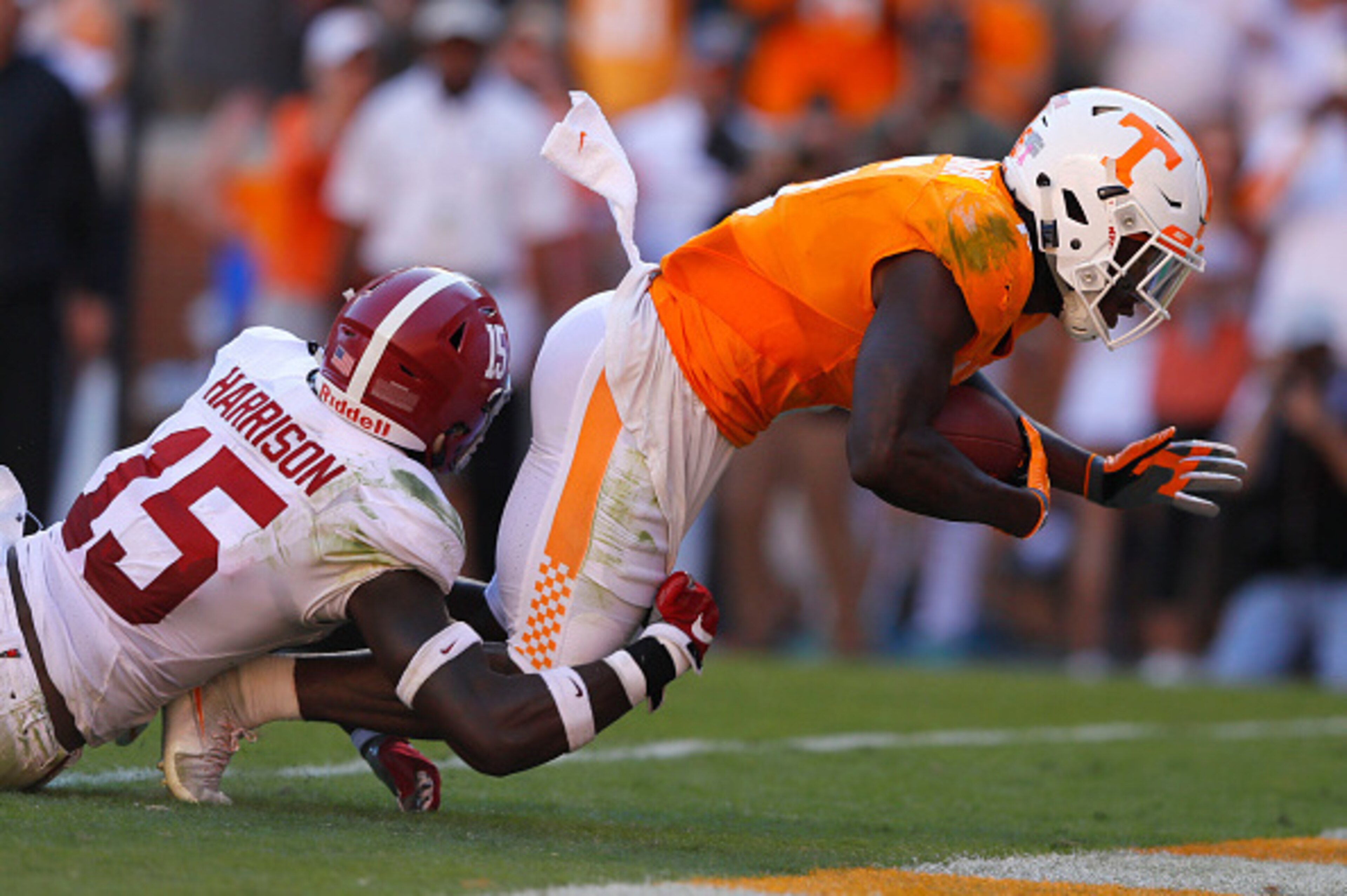
• RB Alvin Kamara: He's played in 23 games over two seasons at Tennessee, accumulating 1,263 rushing yards, 637 receiving yards and 23 total touchdowns.
• DL Dee Liner: After sitting out last season due to transfer rules, he played in all 13 games at Arkansas State this year, with 34 tackles, including 8.0 for a loss.
• QB Parker McLeod: He transferred to Western Kentucky in 2014, enrolled at Georgia last year and walked on to the team this fall.
• QB Alec Morris: Won the starting job at North Texas, but in the opener had three interceptions and was replaced by freshman Mason Fine. He completed 79 of 147 passes for 822 yards, with six touchdowns and six interceptions.
• DB Maurice Smith: After following former defensive coordinator Kirby Smart to Georgia, he played in all 12 games with 10 starts and was credited with 44 tackles, two interceptions, two forced fumbles and two fumble recoveries.
Ironically, Smith helped the Crimson Tide clinch the SEC West division title early on Nov. 12. His pick-six against Auburn keyed the Bulldogs' 13-7 victory and knocked the Tigers out of contention for the SEC Championship Game.
"I was happy for him," Crimson Tide junior cornerback Anthony Averett said. "He was my roommate before he transferred, so we were real close."
Alabama's other controversial transfer this fall was redshirt freshman quarterback Blake Barnett, who started the season opener against Southern California.
After being hailed as a top prospect in the recruiting class of 2015, Barnett redshirted just like every other quarterback Saban had had with the Crimson Tide.
But then true freshman Jalen Hurts happened, and Barnett decided to depart in the middle of the season, much to Alabama's chagrin. It wasn't so much from his leaving to pursue other opportunities, but that he did so when he was just one bad play away from being the guy.
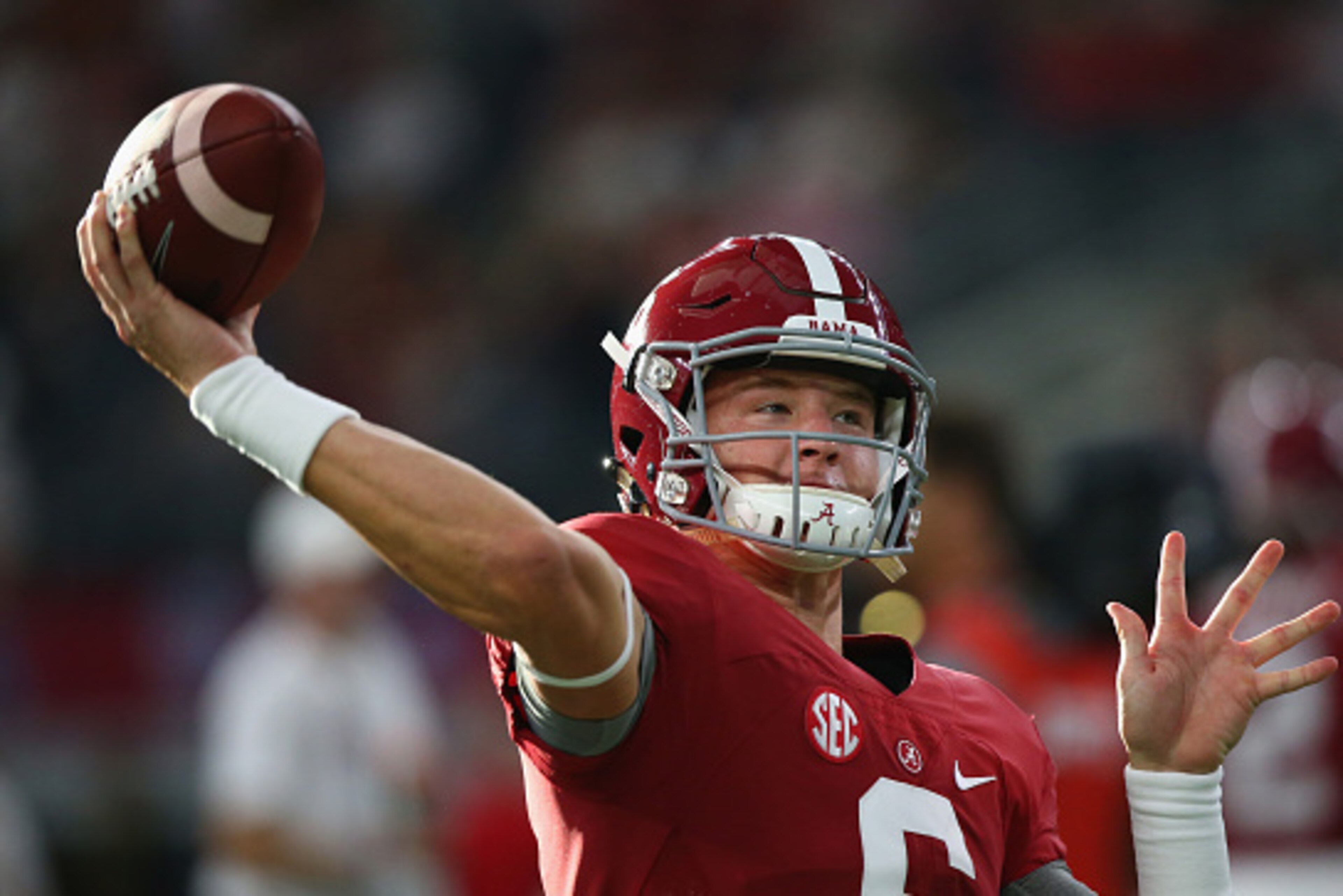
"I think the culture has changed a little bit," Saban said in general during his weekly radio show that week. "I think there's a certain pride people have in competition. There's certain things that I was taught growing up about not quitting and seeing things through. I think if I would have come home and told my dad that I was going to quit the team, I think he would have kicked me out of the house. I don't think I'd have a place to stay."
He later added:
"My dad used to always say, 'The grass is always greener on top of the septic tank.' So it always looks better someplace else. So you think, instead of facing your fears and really overcoming adversity and making yourself better through the competition, you go someplace else thinking it will be better there. But until you face your fears, you're always going to have some of those issues or problems."
Barnett was the sixth player from Alabama's 2015 class to transfer. Defensive back Shawn Burgess-Becker (UCF), wide receiver Daylon Charlot (Kansas) and linebacker Christian Bell (Wisconsin) all sat out this fall, while cornerback Kendall Sheffield (Blinn College) and linebacker Adonis Thomas (Northwest Mississippi/Florida State) went the junior college route.
So did Barnett, who enrolled at Palomar Junior College but is now heading to Arizona State for the next stage of his career.
With Hurts looking like he'll be the starter for at least two more years, Alabama's other quarterbacks are on their way out as well. AL.com's Matt Zenitz reported that reserve quarterback Cooper Bateman, from the recruiting class of 2013, has already begun the transfer process, as has David Cornwell, making him the first player to leave from the 2014 class.
That's the way it works sometimes. The departure rate is seldom steady.
Although it's especially understandable for the quarterbacks, one has to wonder what might have happened with the other players had they stayed put.
Smith was already a regular in the Crimson Tide secondary. With senior safety Eddie Jackson suffering a season-ending knee injury, he could have stepped in as a full-time starter. Sheffield would also have been a candidate for more playing time.
Instead, Averett, junior Tony Brown and junior Hootie Jones all got chances to step up.
Kamara might have been Alabama's starting running back after the departure of Heisman Trophy winner Derrick Henry and Kenyan Drake from last year's team, and Black might have had a shot to be the starting slot receiver and punt returner.
But then again, their departures helped open the door for the addition of running back Josh Jacobs, who was a last-minute signing for the 2016 recruiting class, and graduate transfer Gehrig Dieter.
Of course, those who did avoid the temptation to transfer say they have no regrets, and used the competition for playing time as extra motivation. They've since become team leaders, their draft stock is higher, and No. 1 Alabama remains on target to play for another national championship.
"You go through your ups and downs," Foster said. "You go from starting in high school to coming up here and being on special teams. It takes a toll on you. It makes you hungry. So when you get on the field, it makes you want to eat. It's like a process."
Quotes were obtained firsthand unless otherwise noted. Recruiting information courtesy of Scout.com and 247Sports.
Christopher Walsh is a lead SEC college football writer. Follow Christopher on Twitter @WritingWalsh.
.png?w=3840 "Every City's 2000s Mt. Rushmore 🤩")

.png?w=3840 "Offseason Moves Sure To Backfire 💥")
_0.png?w=3840 "Summer League Takeaways 🧐")