
Ranking the Top Defensive Stoppers in College Basketball in 2016-17
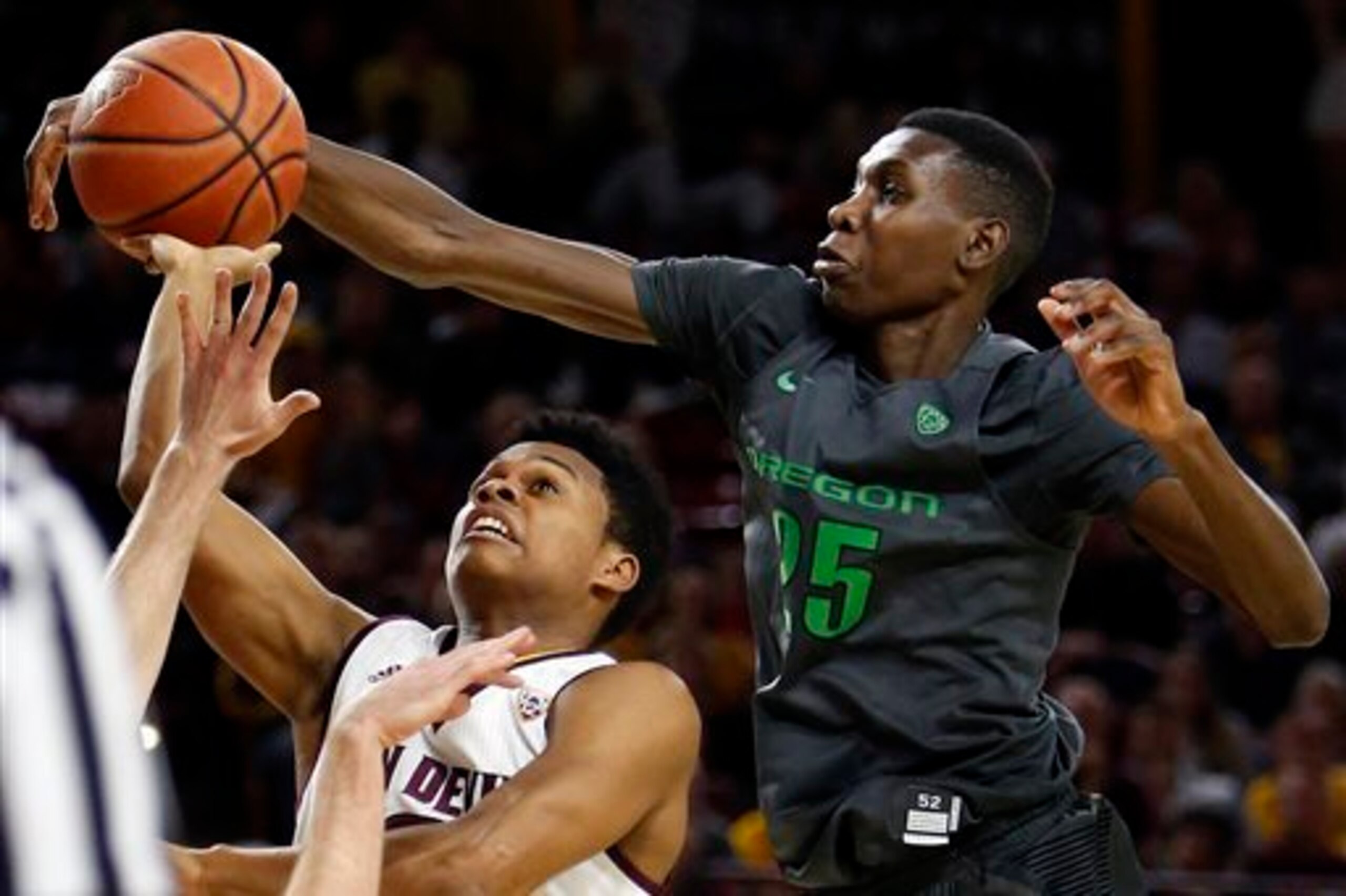
Oregon, which features Chris Boucher and Jordan Bell, and Virginia, with Austin Nichols and Isaiah Wilkins, ought to have two of the nation's best defenses for the 2016-17 college basketball season.
We've ranked the top 10 defensive stoppers to watch this year. Blocks, steals and defensive rebounds are obvious factors. However, we're also interested in advanced metrics such as D-rating and defensive box plus/minus to help identify which players make the biggest overall impact on defense.
The ranking of these players boiled down to a simple question: With a one-point lead and 10 seconds remaining, whom would you most want on your team to keep the opponent from making (or even attempting) a game-winning shot?
Considering the game-sealing block that Syracuse's Tyler Lydon had against Gonzaga in the NCAA tournament last season, it's an important question to consider.
10. Ismael Sanogo, Seton Hall
1 of 10
Seton Hall lost all of its name recognition when Isaiah Whitehead declared for the NBA draft. Yet, the Pirates have a chance for a second consecutive third-place finish in the Big East, thanks to Ismael Sanogo.
He scored just 5.0 points per game and exhibited virtually no interest in putting the ball in the hoop. Still, Sanogo averaged 27.9 minutes and started all but three of Seton Hall's games as a sophomore in 2015-16. That's because of the tireless work he put in on the defensive end.
It wasn't uncommon for power forwards to have their least efficient game of the year when facing Seton Hall. The 6'8" Sanogo finished the season ranked 10th in the nation in defensive box plus/minus, according to Sports-Reference.
Sanogo was one of just seven players in the country to play at least 750 minutes with a steal percentage of at least 2.75 and a block percentage of at least 3.75. The other six guys played for minor-conference teams. They enjoyed the luxury of not having to slow down guys such as Villanova's Josh Hart and Xavier's Trevon Bluiett a combined six times.
Sanogo may need to get a little more involved in the offense with Whitehead out of the picture. That said, his points scored will never be as valuable as the opposing points he can keep off the board.
9. Doug Brooks, VCU
2 of 10
For several years, VCU had the best thief in the country. Briante Weber was on his way to breaking the NCAA record for steals in a career. Then, he suffered an injury that cost him the final 16 games of his senior season.
According to KenPom, Weber was No. 1 in the nation in steal percentage for his first three seasons. He would have been No. 1 by a laughable margin as a senior if he had played enough minutes to qualify.
But even without Weber or coach Shaka Smart, the Rams got right back on that horse with Doug Brooks leading the nation in steal percentage this past season.
Brooks would rank considerably higher on this list if his foul issues and poor shooting didn't force current coach Will Wade to play him just 16 minutes per game.
He shot 40.8 percent from three-point range as a sophomore, but he clocked in at 28.2 percent as both a freshman and junior. Worse yet, he made just 31.6 percent of his two-point attempts last season and had nearly as many turnovers and personal fouls per game combined (3.44) as points scored (4.19).
However, as VCU loses Melvin Johnson and Korey Billbury from last season, Brooks should be headed for a significant increase in playing time.
Brooks may come off the bench behind JeQuan Lewis, Jordan Burgess and De'Riante Jenkins. But he still could play 24 minutes per game, which would put him in a position to record 100 steals as a senior.
8. Khadeem Lattin, Oklahoma
3 of 10
We finally started taking Oklahoma seriously as a title contender when Khadeem Lattin emerged as a viable scoring weapon. There was never any questioning his impact on the defensive end.
Most of the Sooners were nothing special on defense. According to Sports-Reference, among the nine leaders in minutes played, Lattin was the only one with a D-rating below 100. (With D-rating, the lower the better.) Aside from Jordan Woodard ranking 136th in steal percentage, Lattin was also the only Sooner to rank in the top 400 nationally in block or steal percentage.
But Lattin was so good at blocking shots and altering others that Oklahoma ranked 18th in the nation in adjusted defensive efficiency.
He started slow and tapered off considerably in March, but Lattin averaged 7.1 rebounds, 4.0 blocks and 1.1 steals per game in January. If he can harness that type of effectiveness for an entire season, the Sooners just might be able to withstand losing Buddy Hield, Ryan Spangler and Isaiah Cousins in the same offseason.

.jpg?w=2560)
7. Ethan Happ, Wisconsin
4 of 10
Most of the big men on the list are here because of their shot-blocking abilities. At 6'9", Ethan Happ averaged just shy of one block per game last season as a freshman. His primary value on defense, however, is his ability to force turnovers.
Happ recorded 63 steals in 35 games last season, recording at least one in each of his final 28 games. Wisconsin's starting center had 21 games with multiple steals. That included a late-February game against Illinois in which he had six robberies to go along with 20 points and 12 rebounds.
While some players feasted on inferior competition, Happ was at his best against the toughest competition. He averaged 2.4 steals in his 18 Big Ten contests. Happ also ranked 20th in the nation in steal percentage and was the only player taller than 6'7" in the top 20.
He was also a sensational defensive rebounder, ranking 68th in the nation in that category with a 5.4 average. There weren't many second chances with Happ patrolling the paint. Opponents had to capitalize on their opportunities—when they weren't turning over the ball or having Happ block their shots.
With three years of eligibility remaining, this guy could become a thorn in the side of many Big Ten coaches.
6. Tra-Deon Hollins, Nebraska Omaha
5 of 10
Tra-Deon Hollins finished just one steal shy of averaging a full 4.0 steals per game last season. He became the first player in more than a decade to eclipse 3.5 steals while appearing in at least 25 games.
Sure, it helps that Nebraska Omaha played at one of the fastest paces in the country at 79.6 possessions per game. Nevertheless, Hollins cleared that 3.5 mark by nearly 14 percent while playing just 32.4 minutes per game.
His numbers may be a bit inflated because of pace. Even on an average-paced team, he's still as far ahead of the field as Katie Ledecky swimming the 800-meter freestyle.
Unlike Brooks who gets steals and little else, Hollins is a major contributor on both ends of the floor. He averages 12.5 points and 6.1 assists per game. And he didn't just do it against Summit League foes, either.
In two November games (Colorado and Minnesota) in which UNO almost pulled off upsets, he averaged 13.5 points, 8.5 assists, 7.5 rebounds and 4.5 steals.
A quadruple-double in 2016-17 isn't completely out of the question. With the Mavericks losing four of last year's six leading scorers to graduation, he's going to become a bigger offensive factor this season.
However, even with Hollins forcing a turnover every eight or so minutes on the court, Nebraska Omaha's defense was deplorable in 2015-16.
Part of that was the misfortune of having opponents shoot 75.5 percent from the free-throw line. The Mavericks also were well below the national average in just about every category, other than turnovers forced. It's hard to call Hollins one of the five best defensive stoppers in the country when his team gave up 81.8 points per game last season.
5. Luke Kornet, Vanderbilt
6 of 10
It took a few years, but Luke Kornet finally put his height to great use as a junior.
As a freshman, Kornet averaged 5.9 rebounds, 1.5 blocks and 7.7 three-point attempts per 40 minutes. The 7'0" stretch 5 still jacks up a good number of treys, but those numbers last year were 10.6, 4.4 and 4.9, respectively.
For sake of reference, Wisconsin's Frank Kaminsky posted numbers of 9.3, 2.6 and 3.8 the year before winning the 2015 Wooden Award. Both he and Kornet played a little over 27 minutes per game as juniors.
That isn't to say Kornet is going to be in the conversation for the 2017 Wooden Award, but it's worth knowing where he stacks up against a recent great giant with range.
Kornet even had a triple-double last season, tallying 11 points, 11 rebounds and 10 blocks against Auburn. He was the only player during the 2015-16 season to record a triple-double with blocks. He was the first one to do so against a major-conference opponent since Grambling's P.J. Roberson versus Arkansas in November of 2011.
Kornet had eight games last season with at least five blocks, including three against Tennessee, which apparently never learned its lesson.
Will he remain as individually dominant without Damian Jones by his side to also create problems for opposing offenses? Kornet should get more points and rebounds this season. But we'll have an eye on early games against Marquette, Butler and Minnesota to see how well he flies solo as a shot-blocker.
4. Tyler Lydon, Syracuse
7 of 10
If Lydon isn't a massive blip on your radar for 2017 ACC Player of the Year, it's time to get that thing re-calibrated.
A rare dual-threat on defense, Lydon was one of just two players in the country last season with at least 40 steals and 60 blocks. The other was Austin Peay's Chris Horton, who went crazy as a senior with 25 double-doubles.
By reaching those plateaus as a freshman, though, Lydon is in an elite level of the stratosphere. The only other freshmen to join that club in the past decade are Kevin Durant, Anthony Davis, Nerlens Noel and Terrence Jones.
And considering what he did in the NCAA tournament, Lydon may have just been getting warmed up. He had 20 blocks and six steals in those five games—this after blocking just 11 shots in the prior 15 games combined.
Lydon is also a defensive stopper in terms of his ability to end possessions on the glass. Tyler Roberson is Syracuse's primary offensive rebounder, but Lydon led Syracuse in defensive rebounds last season, averaging more than 4.5 per game.
Whether he's a starter or a sixth man with starter's minutes this season, he should put up incredible numbers as a sophomore.
3. Amida Brimah, Connecticut
8 of 10
A broken finger suffered in December put a damper on Amida Brimah's quest to become the nation's preeminent rejection machine in 2015-16.
He ranked fifth in the nation in block percentage as a freshman and second as a sophomore. And with nine blocked shots in his first game as a junior, he was on his way to another year near the top of that list.
However, he missed 11 games due to the injury. Brimah needed another few weeks of subpar performances to regain his form as the best one-man defense in the country.
Over the last five weeks of the season, he was back to looking like his old self. Brimah recorded at least two blocks in each of his final 11 games, averaging 3.1 rejections in just 23.8 minutes during that stretch.
Because of his commitment to swatting, the 7'0" Brimah has never been much of a defensive rebounder. He has made at least 64 percent of his field-goal attempts in each of his three seasons. However, he has never been an unstoppable force on the offensive end.
It's his ability to act as a goalie on the basketball court that makes him one of the most valuable players in the country.
Perhaps this will be the year that he finally starts playing enough minutes to maximize his impact. Even before the injury, Brimah was only playing 21.2 minutes per game. If he can build up the stamina and avoid foul trouble well enough to play 30 minutes per game as a senior, it would be a huge boost to Connecticut.
2. Chris Boucher and Jordan Bell, Oregon
9 of 10
We're cheating a bit with these last two slides, but who said that "defensive stopper" can't be a two-man job?
May heaven help any player who thinks he's getting a shot off within eight feet of the rim against Oregon if the Ducks go with a presumed starting frontcourt of Boucher and Bell.
Boucher ranked sixth in the nation in block percentage, turning away 110 shots in his first year of D-I ball. Bell was "only" No. 52 on that list, but a foot injury that cost him the entire preseason. Additionally, he missed the first eight games of the regular season. As a freshman, though, he blocked 4.5 shots per 40 minutes and was one of the most impenetrable big men in the nation.
Neither one is exceptionally tall or bulky. The 235-pound Brimah is a conventional shot-blocker because of his height. Boucher is a 6'10" string bean, and 6'9" Bell looks like more of a standard power forward than an elite rim protector.
Nevertheless, they anchored Oregon's defense (and its offensive rebounding assault) en route to the school's first No. 1 seed in school history. The hope is that they'll be able to swat the Ducks to their first Final Four appearance since winning the inaugural national championship in 1939.
1. Austin Nichols and Isaiah Wilkins, Virginia
10 of 10
If any team is going to be tougher to score against in the paint than Oregon, it's Virginia.
The Cavaliers have had an outstanding field-goal defense over the past five seasons. It's only going to get more ridiculous with the addition of Nichols, a transfer from Memphis.
Nichols did pretty much everything for the Tigers two years ago, but blocking shots was his forte. He averaged 4.7 rejections per 40 minutes and finished with a flourish. He had at least six blocks in three consecutive games that he played during a five-game stretch. He missed a pair of games due during to an ankle injury.
Nichols was supposed to miss at least two weeks, but he was back in 12 days. Nichols had 16 points, eight rebounds and seven blocks in a win over Brimah and Connecticut.
But Nichols won't be alone in the Virginia frontcourt. Wilkins quietly ranked ninth in the nation in defensive box plus/minus last season, anchoring the Cavaliers with both blocks and steals. He also put up incredible defensive numbers as a freshman. But he struggled to get on the court with Darion Atkins, Mike Tobey and Anthony Gill blocking his path.
All three of those guys are gone now, leaving Wilkins as the primary power forward. How much he'll do on offense is a mystery, but he'll complement Nichols in the middle of coach Tony Bennett's pack-line defense.
National scoring increased significantly last season, but Virginia still held opponents to 60.1 points per game. Don't be surprised if the Wahoos are closer to 58 with this tandem leading the way.
Stats are courtesy of KenPom.com and Sports-Reference.com. Recruiting information is courtesy of Scout.com.
Kerry Miller covers college basketball for Bleacher Report. You can follow him on Twitter @kerrancejames.


.jpg?w=2560 "Viral Rams Coach Vid 🖕")

.jpg?w=2560 "Injury-stricken Seahawks signing veteran RB")
