
College Basketball Players Whose Stocks Have Risen the Most in 2016 Offseason
Though there sadly hasn't been a college basketball game played in more than three months, roster changes have led to higher expectations and hopes for players like USC's Chimezie Metu, Indiana's OG Anunoby and Syracuse transfer John Gillon.
Between transfers and draft declarations, nearly every team's roster for the 2016-17 season looks different than it did in early April. In many cases, individual players are in drastically better positions to succeed than initially expected.
Several of these players took matters into their own hands by transferring into situations more likely to result in NCAA tournament appearances. Others simply benefited from teammates deciding to head elsewhere, opening a door for more playing time.
Whatever the cause, these players are more of a factor on a national level than they were at the beginning of the offseason.
Players on the following slides are listed in alphabetical order by last name.
OG Anunoby, Indiana
1 of 17
After watching OG Anunoby defend and hustle over the final three months of the season, fans were already talking him up as the next big thing for the Hoosiers. With both Nick Zeisloft and Max Bielfeldt graduating, surely the wing-forward would get a bump in playing time as a sophomore.
But the Anunoby hype meter went through the roof when Troy Williams opted to enter the NBA draft rather than returning to school.
Now, the versatile spark plug is all but guaranteed a starting job.
If he keeps his rates and percentages intact while more than doubling his playing time, Anunoby could be headed for a ridiculous year. He led Indiana regulars in both block and steal percentage last season while shooting 44.8 percent from three and 60.9 percent from inside the arc. He was also one of the Hoosiers' top assets on the offensive glass.
The possibilities are endless now that Williams' departure has opened the door.
Canyon Barry, Florida
2 of 17
A shoulder injury cut Canyon Barry's final season at Charleston short, but he was averaging 22.1 points through his first 11 games. He had a sub-100 O-rating in five of those games, though, so they weren't the most efficient points in the world.
But when he was cooking, there was next to nothing the opposition could do to slow Barry down.
Meanwhile, Florida desperately lacked that type of individual firepower or assertiveness. Dorian Finney-Smith was the primary scorer for the Gators, but he only occasionally seemed interested in taking over a game. KeVaughn Allen and Kasey Hill often tried, but neither shot well enough to get the job done.
What Florida needed to add was a player who can and will shoot a lot of triples, and Barry is that guy.
He probably won't start, but "first guy off the bench for a SEC team" is still a big step up in prestige from "best scorer on a middling Colonial Athletic Association program."
L.G. Gill, Maryland
3 of 17
Duquesne is not the best place to try to get recognized for playing good basketball.
Micah Mason was one of the most efficient scorers in the country over the past three seasons.
In 2013-14, he shot 56.0 percent from three-point range. Despite becoming more of a volume shooter as an upperclassman, he still finished his career shooting 46.3 percent from beyond the arc. He's one of just seven players in the past 23 years to make at least 300 career threes while shooting 45.0 percent or better, and the only one to do so since Utah State's Jaycee Carroll from 2005-08.
But chances are you have never heard of Micah Mason and were never going to hear of L.G. Gill until he transferred to Maryland.
Even with four of Maryland's five starters from last season leaving, Gill probably won't be a starter for the Terrapins. He averaged 10.1 points and 6.5 rebounds per game last season, but Gill frequently struggled against quality opponents. He was a solid wing-forward in the A-10, but putting up similar numbers in the Big Ten will be a challenge.
However, Mark Turgeon didn't add Gill just to park him on the bench. He'll be a factor in the frontcourt for a Maryland team that likely won't be as good as it was last season, but that certainly will be on national television more often than Duquesne.


.jpg?w=2560 "NBA Gambling Charges")
John Gillon, Syracuse
4 of 17
John Gillon is about to enter his third rodeo. He played well at Arkansas-Little Rock as a freshman in 2012-13 before making the jump to mid-major Colorado State. After averaging 13.2 points per game for the Rams last year, he's getting the call up to the big leagues as a likely starting combo guard for Syracuse.
With Michael Gbinije and Trevor Cooney graduating and Malachi Richardson declaring for the NBA draft, the Orange lose nearly 20 three-point attempts per game from last year's squad. Gillon won't be plugging that hole by himself, but he and incoming freshman Tyus Battle will be relied upon for a lot of perimeter scoring.
Gillon played 31.7 minutes per game in 2015-16, and that number should only go up this year. With Kaleb Joseph transferring to Creighton, Franklin Howard is the only returning Syracuse guard who played more than five minutes last season—and he was one of the least efficient players on the team.
Gbinije averaged 37.9 minutes per game last year. If he's up to the challenge, Gillon could be headed for a similar workload for a team looking to build on a Final Four appearance.
Terry Henderson, North Carolina State
5 of 17
North Carolina State's prospects for 2016-17 have gone through the ringer this offseason.
Without a single senior who scored a point last season, the Wolfpack could have brought back everyone while adding stud point guard Dennis Smith Jr. But Cat Barber declared for the draft. Then Abdul-Malik Abu and BeeJay Anya pondered doing the same as both Caleb and Cody Martin transferred out of the program.
Within a matter of weeks, they went from potentially bringing back all six of their leading scorers to possibly only bringing back one.
Fortunately for Mark Gottfried and company, Abu and Anya opted to return for another year. After that, Omer Yurtseven signed with NC State, giving the Wolfpack a second 5-star recruit in this year's class. They also added former Arkansas signee Ted Kapita to their frontcourt and got point guard Markell Johnson to reclassify to 2016 to join the roster this season.
All of a sudden, the Wolfpack have a team capable of serious damage if their veteran shooting guard can return from injury to lead them forward.
Terry Henderson missed the 2014-15 season after transferring from West Virginia and missed all but seven minutes of the 2015-16 season due to an ankle injury. But if he can get back to shooting like he did with the Mountaineers, 2016-17 will have been worth the wait. Henderson averaged 16.6 points per 40 minutes in his two seasons with WVU and could be the perimeter weapon that propels the Wolfpack back to the NCAA tournament.
Merrill Holden, Iowa State
6 of 17
Iowa State needs height any way it can get it.
The Cyclones had six players on last year's roster taller than 6'5". Abdel Nader, Georges Niang and Jameel McKay graduated. Brady Ernst transferred. And Simeon Carter and Stuart Nezlek combined to play 49 minutes.
To put things lightly, there isn't much to stop Merrill Holden from coming in as a 6'8" graduate transfer from Louisiana Tech and immediately playing at least 30 minutes per game.
The former Bulldog averaged 13.9 points, 8.5 rebounds and 1.9 blocks per 40 minutes last season, but he only played 23.4 minutes per game. Rather than sticking it out for more playing time with a team losing a lot to graduation and the transfer market, Holden opted to join a program that gives him an opportunity to get a lot of playing time on a likely tournament team.
He's not the second coming of McKay or Niang, but it's a safe bet we'll hear about Holden at least 50 times as often as we did in 2015-16.
Isaiah Jackson, Providence
7 of 17
There wasn't a single senior on Providence's roster in 2015-16, yet Ed Cooley has been dealt one of the toughest rebuilding situations in the country.
Ben Bentil and Kris Dunn both declared for the NBA draft, taking 37.5 points per game with them. The Friars also lost Junior Lomomba, Quadree Smith and Tyree Chambers to the transfer market, leaving Providence inexperienced and under-manned.
If everyone had stayed, George Mason transfer Isaiah Jackson barely would have touched the floor in 2016-17. Instead, he could give Ryan Fazekas and Drew Edwards a spirited fight for a starting job.
Even with Bentil and Dunn, Providence was far from the most efficient offense, ranking 252nd in effective field-goal percentage. Without that duo, the Friars will have an even harder time getting the ball into the hoop.
Jackson averaged 12.6 points and 3.8 rebounds over his final nine games with the Patriots, blossoming into a go-to weapon for a team that otherwise struggled to do anything on offense. Where he fits into Providence's equation is difficult to pinpoint, but he's going to be in the mix somewhere.
That wasn't a given four months ago.
Jayce Johnson, Utah
8 of 17
It's not easy to find a picture of a redshirt freshman who joined the program during the second semester, so enjoy this photo of the coach who Jayce Johnson will be playing for at Utah.
Larry Krystkowiak needs Johnson to be a star if he's going to steer this team to a third consecutive NCAA tournament appearance.
That's because Jakob Poeltl declared for the draft, while Brekkott Chapman, Chris Reyes and redshirt freshman Makol Mawien all decided to transfer, leaving the Utes with barely any options in the frontcourt. Kyle Kuzma is the only returning player taller than 6'6" who played more than one minute per game last season, so there's plenty of room for the 7'0" freshman to immediately shine.
Will this be Krystkowiak's fourth straight season capitalizing on an unheralded stud? JUCO transfers Delon Wright and Lorenzo Bonam were excellent finds, as was Poeltl. If Johnson follows in their footsteps, he'll be putting up double-doubles in no time.
Christian Kessee, Memphis
9 of 17
Can you name a single player who has suited up for Coppin State in the past half decade? Heck, we'll even give you partial credit if you can correctly identify the state in which Coppin State is located. There's just no reason to know much about a team that has gone 17-45 over the past two seasons and hasn't even finished above .500 in the MEAC since 2011-12.
Even if Christian Kessee barely touches the floor for the Tigers, his stock would be increasing tenfold by transferring from Coppin State to Memphis. But because of the mass exodus at Memphis, Kessee—who shot better than 39 percent from three-point range in each of the past two seasons—might be the starting shooting guard for the Tigers.
Avery Woodson, Randall Broddie, Raquan Mitchell, Dante Scott and Chris Hawkins all transferred out of a program that was already losing three of its four leading scorers to graduation. The only returning players who scored at least 100 points are Dedric Lawson and Markel Crawford, and at 3-of-23 from three-point range last season, Crawford isn't much of a threat to keep Kessee from becoming the primary shooting guard.
Moreover, the incoming recruiting class is the worst that Memphis has had since 2009. Options are few and far between on this roster, and Kessee should reap the benefits of the situation.
Terry Larrier, Connecticut
10 of 17
Remember this guy?
Terry Larrier was the crown jewel of Shaka Smart's 2014 recruiting class at VCU. 247Sports had him evaluated as the No. 33 overall recruit that year, just one spot behind Melo Trimble and not far removed from a 5-star rating. Larrier was going to be the player we pointed to two decades from now as patient zero in Smart's transformation of VCU into a legitimate powerhouse.
Instead, he played just 18.5 inefficient minutes per game, bolting for Connecticut about a month after Smart took the job at Texas.
As the end of his 2015-16 season was spent watching from the sidelines, it looked like Larrier would be a part-time player. Though Sterling Gibbs, Shonn Miller and Omar Calhoun graduated, the Huskies still had Daniel Hamilton, Rodney Purvis, Jalen Adams, Sam Cassell and stud freshman point guard Alterique Gilbert clogging the path to playing time.
Fortunately for Larrier's minutes, Hamilton declared for the draft and Cassell transferred to Iona, freeing up some space for a wing-forward. He might not begin the season in the starting lineup, but Larrier should be no worse than UConn's primary sixth man.
Chimezie Metu, USC
11 of 17
For a team that didn't have a single senior among its 10 leading scorers, USC's roster went up in flames. Nikola Jovanovic and Julian Jacobs both declared for the NBA draft, while Katin Reinhardt, Darion Clark, Malik Marquetti and Malik Martin transferred out of the program.
As a result, there are only two returning frontcourt Trojans who scored more than two points last season: Chimezie Metu and Bennie Boatwright—the latter of whom already started all but one game as a freshman.
For Metu, the roster upheaval should be a blessing. Jovanovic was USC's primary center, while Clark and Martin each picked up a handful of the minutes that Jovanovic and Boatwright left behind. Now that 60 percent of last year's frontcourt equation has been subtracted, Metu will start at center and become one of the best paint presences in the Pac-12, if not the country.
Metu will need to improve as a free-throw shooter (51.3 percent last year), but his rebounding and shot-blocking will make him one of the most important pieces in USC's quest for a second consecutive NCAA tournament appearance.
Grant Mullins, California
12 of 17
After missing part of the 2013-14 season and all of the 2014-15 season due to lingering symptoms of a concussion, Grant Mullins looked no worse for the wear in his final year with Columbia. He shot a career-best 43.9 percent from three-point range while racking up points, assists and rebounds at a higher rate than either of his previous seasons.
Mullins averaged 14.3 points, 3.3 rebounds and 3.0 assists per game while leading the Lions to the CIT title. Yet, his name was anonymous on the national radar until his decision to graduate-transfer to California—largely because he hasn't been on the court against a marquee opponent since being held scoreless by Michigan State in November 2013.
He'll get plenty of TV time as the presumptive starting point guard for the Golden Bears.
Not only did Mullins move to a higher-profile team, the importance of his role on that team was enhanced by Jordan Mathews' decision to transfer to Gonzaga.
Cal still has Ivan Rabb and Jabari Bird, but there isn't much scoring prowess on this roster. Unless Sam Singer or Kameron Rooks suddenly blossoms into an unstoppable buckets machine, Mullins should be Cal's third-leading scorer and primary source of assists—as he was for Columbia.
Jalen Poyser, UNLV
13 of 17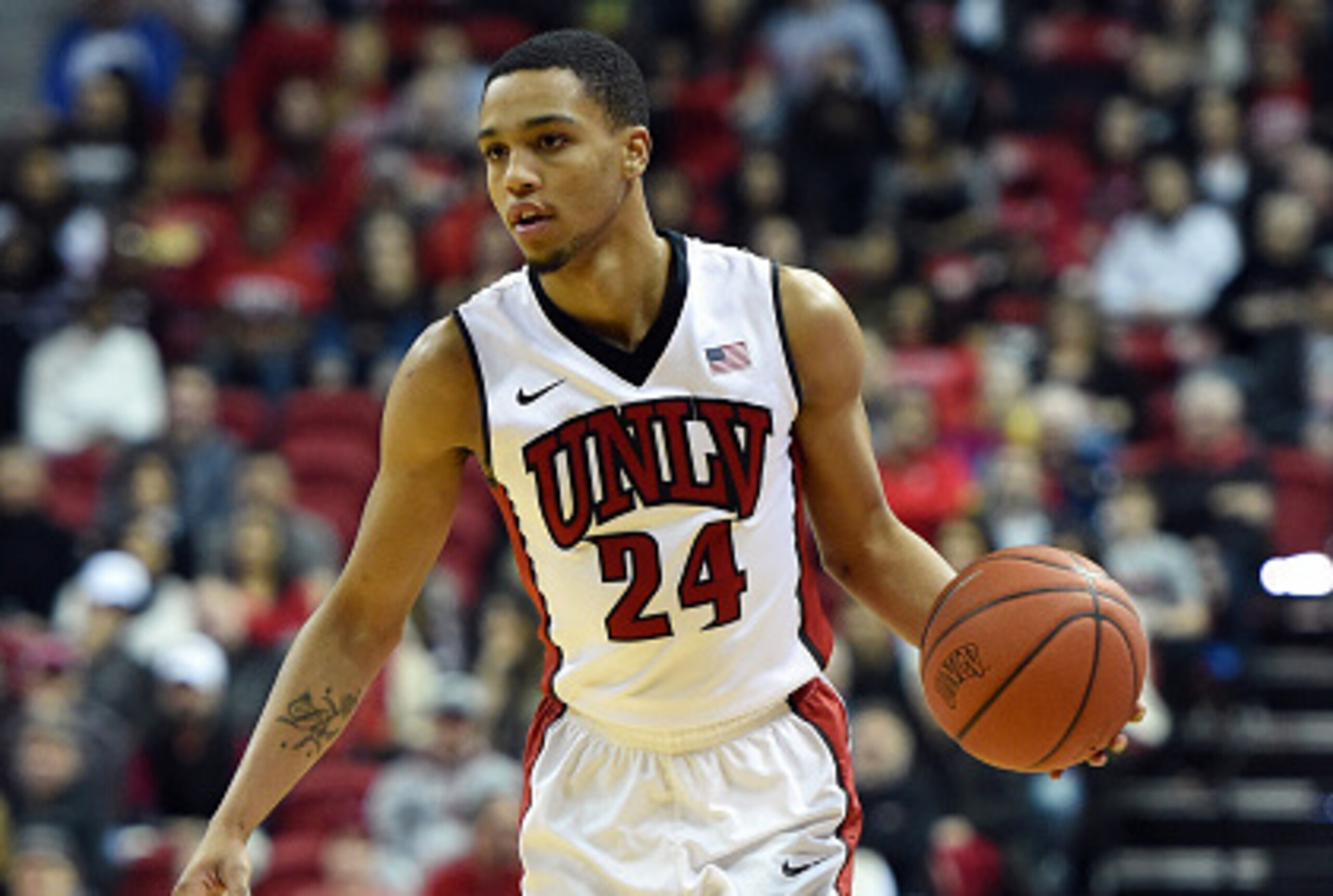
What happens in Vegas stays in Vegas, but the players from last year's roster did not.
Ben Carter, Jordan Cornish and Daquan Cook transferred. Patrick McCaw, Stephen Zimmerman and Derrick Jones Jr. declared for the NBA draft. Add in Ike Nwamu and Jerome Seagears both graduating, and all seven leading scorers are gone. Dwayne Morgan and Jalen Poyser are the only returning players who logged at least 3.0 minutes per team game.
There's little to suggest that either one is headed for a breakout year. According to KenPom, both Morgan and Poyser posted O-ratings below 90. If anything, Poyser got worse as the season progressed. In his final five games, he shot 0-of-11 from three-point range and 8-of-41 from the field while committing 10 turnovers.
But he will have every opportunity to prove himself this coming season. Even with the additions of Milwaukee transfer Jordan Johnson and San Francisco transfer Uche Ofoegbu, there almost aren't enough guards on the roster for Poyser to spend any time on the bench. He should be the Rebels' primary three-point shooter and perhaps even their new leading scorer.
Rodney Pryor, Georgetown
14 of 17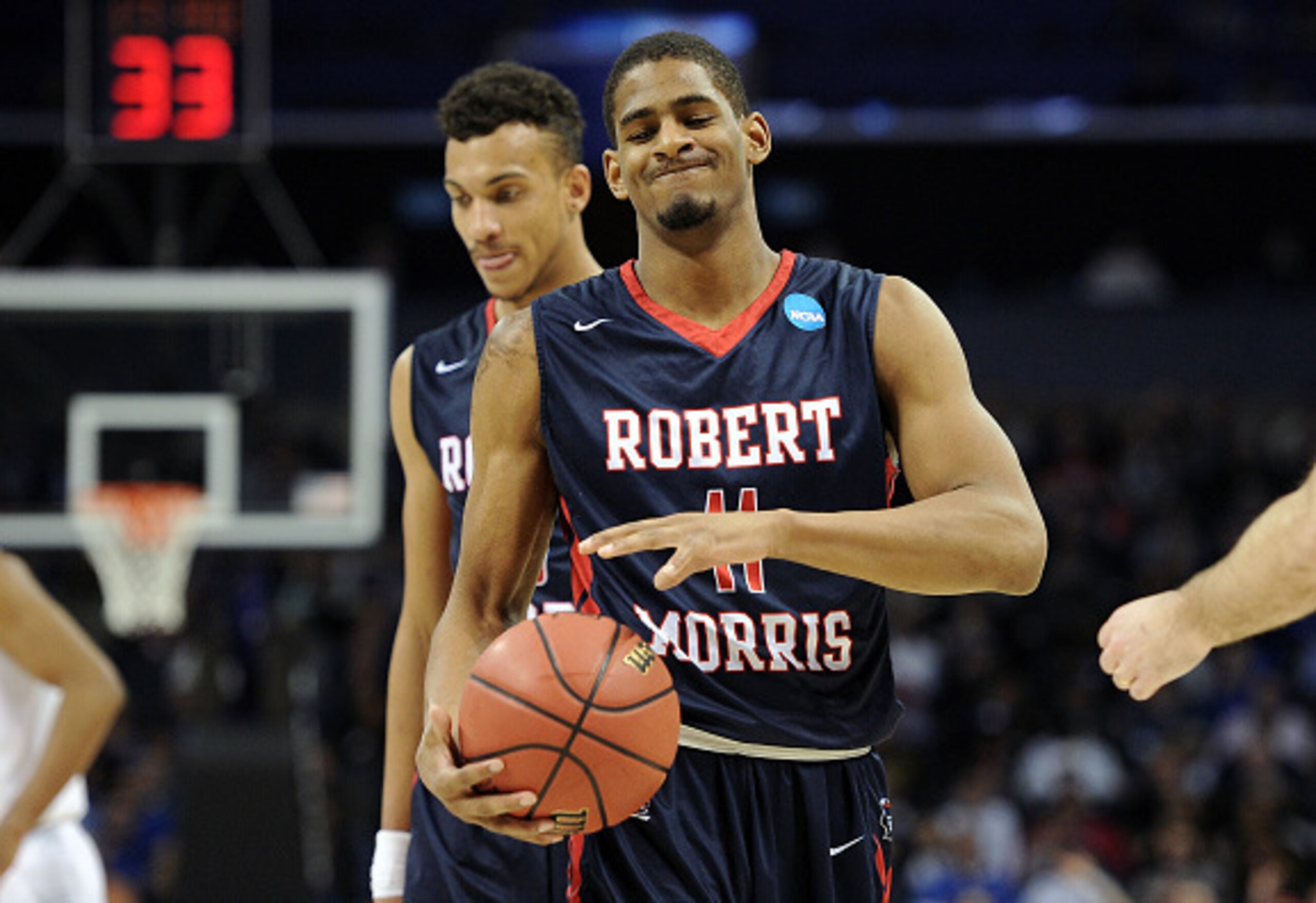
After eight consecutive strong seasons, Robert Morris dropped off a cliff last year, finishing with a 10-22 record and one of the worst adjusted offensive efficiency ratings in the nation. Rodney Pryor was one of just 14 players in the country to average at least 18 points and eight rebounds per game, but nobody noticed his good year as the Colonials sputtered their way to an eighth-place finish in the 10-team Northeast Conference.
Georgetown also had an atypically down year, but Pryor will get drastically more national attention as the graduate-transfer finishes out his collegiate career with the Hoyas.
They still have L.J. Peak and add a high-scoring JUCO guard in Jonathan Mulmore, but Pryor could immediately become the primary backcourt weapon in this offense. He struggled from beyond the arc last season, but he shot 42.9 percent from three-point range in 2014-15 when he wasn't the team's only viable scoring option.
The Hoyas won't need his rebounding with Bradley Hayes, Jessie Govan, Isaac Copeland and Marcus Derrickson to handle their interior concerns, but if Pryor can get back to scoring efficiently as a key component of a well-rounded roster, the Hoyas could have a say in who wins the Big East this year.
Jeff Roberson, Vanderbilt
15 of 17
Though rarely if ever mentioned as one of Vanderbilt's better players, wing-forward Jeff Roberson already fit that bill.
In terms of O-rating, he was the Commodores' most efficient player. He shot 43.5 percent from three, 48.9 percent from the field and 83.3 percent from the free-throw line, rebounded well and rarely committed turnovers. He was overshadowed by Wade Baldwin IV, Damian Jones and Luke Kornet, but he was more valuable than any of them.
With Jones out of the picture and new head coach Bryce Drew in it, Roberson could be headed for a monster junior year.
Over the past couple of years, rebounding was a huge emphasis for Valparaiso—Drew's former school. Last year, the Crusaders had an average rebounding margin of plus-8.8 that ranked seventh in the nation, including 12.6 offensive rebounds per game. And of the returning Commodores, Roberson was the best at crashing the offensive glass.
Vanderbilt isn't a strong candidate to reach the NCAA tournament this season, but a big bump in usage for Roberson should help keep this team in contention.
Brandon Sampson, LSU
16 of 17
Though he was one-third of LSU's best recruiting class in at least a decade, Brandon Sampson didn't have anywhere near the freshman year that Ben Simmons and Antonio Blakeney had.
Sampson played a lot early in the season, averaging 22.1 minutes through LSU's first 11 games. But once Keith Hornsby recovered from his sports hernia surgery and Craig Victor became eligible at the end of the winter semester, there was no room at the inn for Sampson.
He barely averaged 5.0 minutes per game the rest of the year and did next to nothing with his limited opportunities.
Simmons declaring for the NBA draft shocked no one, but Tim Quarterman also taking the plunge was a bit of a surprise that opens the door for Sampson as a sophomore. With Hornsby and Josh Gray graduating and Quarterman out of the picture, Blakeney and Victor are the only Tigers firmly entrenched as starters for next season.
With no incoming transfers or 5-star or 4-star recruits in this year's class, Sampson might be the third-best player on LSU's roster in 2016-17. At any rate, he'll be playing significantly more than five minutes per game.
Moritz Wagner, Michigan
17 of 17
Moritz Wagner was already moving on up in the Michigan depth chart toward the end of his freshman season. After barely touching the court for more than two months, he averaged 13.8 minutes over the final four games (two in Big Ten tournament, two in NCAA tournament) while shooting a perfect 9-of-9 from the field.
With Caris LeVert the only noteworthy Wolverine graduating, though, options for the 2016-17 season were plentiful. John Beilein still had Zak Irvin, Derrick Walton, Muhammad-Ali Abdur Rahkman, Duncan Robinson, Mark Donnal, Ricky Doyle, Aubrey Dawkins and Kam Chatman as returning players. Despite the strong finish, Wagner could have been headed for another season as Michigan's ninth-place finisher in minutes played.
But then Dawkins, Doyle and Chatman all decided to transfer elsewhere, putting Wagner in the running for a starting gig. Chatman tied for the team lead in rebounds per 40 minutes last season, and Doyle shot 64.2 percent from the field for the Wolverines. With that pair of forwards out of the picture, Wagner will be no worse than the first frontcourt player off the bench.
That's quite the upgrade for a guy who just played a grand total of 55 minutes in 18 regular-season Big Ten games.
Advanced stats courtesy of KenPom.com. Recruit rankings and info courtesy of 247Sports.
Kerry Miller covers college basketball for Bleacher Report. You can follow him on Twitter @kerrancejames.

.png?w=2560 "Week 8 Winners & Losers 📊")

.jpg?w=2560 "Aikman Blasts Cowboys WR 🫣")
.jpg?w=2560 "Jonathan Taylor Landing Spots")