If Melo Trimble and Nigel Hayes can remember how to shoot three-pointers like they did two years ago, the Big Ten will be home to two of the biggest bounce-back players of the 2016-17 college basketball season.
To qualify as a bounce-back candidate, a player must first meet these two conditions:
- Played at least 20 games in 2014-15 and 2015-16. There's a fine line between "bounce-back" and "comeback," but we're not looking for players attempting to rebound from a significant injury.
- Played well enough in 2014-15 that there's a quality form to which he is attempting to bounce back. Again, there's a difference between a "bounce-back" player and a "breakout" player, and we're only interested in the ones who have already shown us at least one good year.
From there, it's a matter of determining which players were statistically worse in 2015-16 than 2014-15 but who are in a situation to put up strong numbers once again in 2016-17.
Whether recovering from a sophomore slump or a bad junior year, these are the upperclassmen most likely to make up for disappointing years by making big positive impacts in the season ahead.
Honorable Mentions
1 of 11
Xavier Rathan-Mayes, Florida State
Rathan-Mayes put up similar numbers in each of the past two seasons, but his minutes played decreased in 2015-16. Thanks to the additions of Dwayne Bacon and Malik Beasley, Rathan-Mayes went from Florida State's best guard to its third-best.
But with Beasley going pro and Devon Bookert (9.5 PPG, 2.8 APG) graduating, Rathan-Mayes should once again shine in this backcourt. He should also get a bump in assist opportunities with the addition of big man Jonathan Isaac.
Kendall Pollard, Dayton
When Devin Oliver and Matt Cavanaugh graduated in 2014, Pollard became one of Dayton's better frontcourt options despite standing just 6'6" and averaging merely 8.5 minutes per game as a freshman. Then when Devon Scott and Jalen Robinson were kicked off the team nine games into the 2014-15 season, Pollard was one of Dayton's only options. He responded well, averaging 12.7 points while playing solid defense.
His numbers dipped a bit this past season, but with Dyshawn Pierre out of years of eligibility and the sudden death of Steve McElvene, Pollard should resume his role as a focal point of the frontcourt.
Jalyn Patterson, LSU
Across the board, Patterson's sophomore numbers were worse than what he posted as a freshman. By adding Ben Simmons, Antonio Blakeney, Brandon Sampson and Craig Victor, LSU effectively removed any hope he had of having a breakout sophomore year after averaging 6.8 points and shooting 37.3 percent from downtown in his first year.
But Simmons, Keith Hornsby, Tim Quarterman and Josh Gray are all gone. That might be enough to bump Patterson into the starting lineup as a primary ball-handler.
10. Steve Vasturia, Notre Dame
2 of 11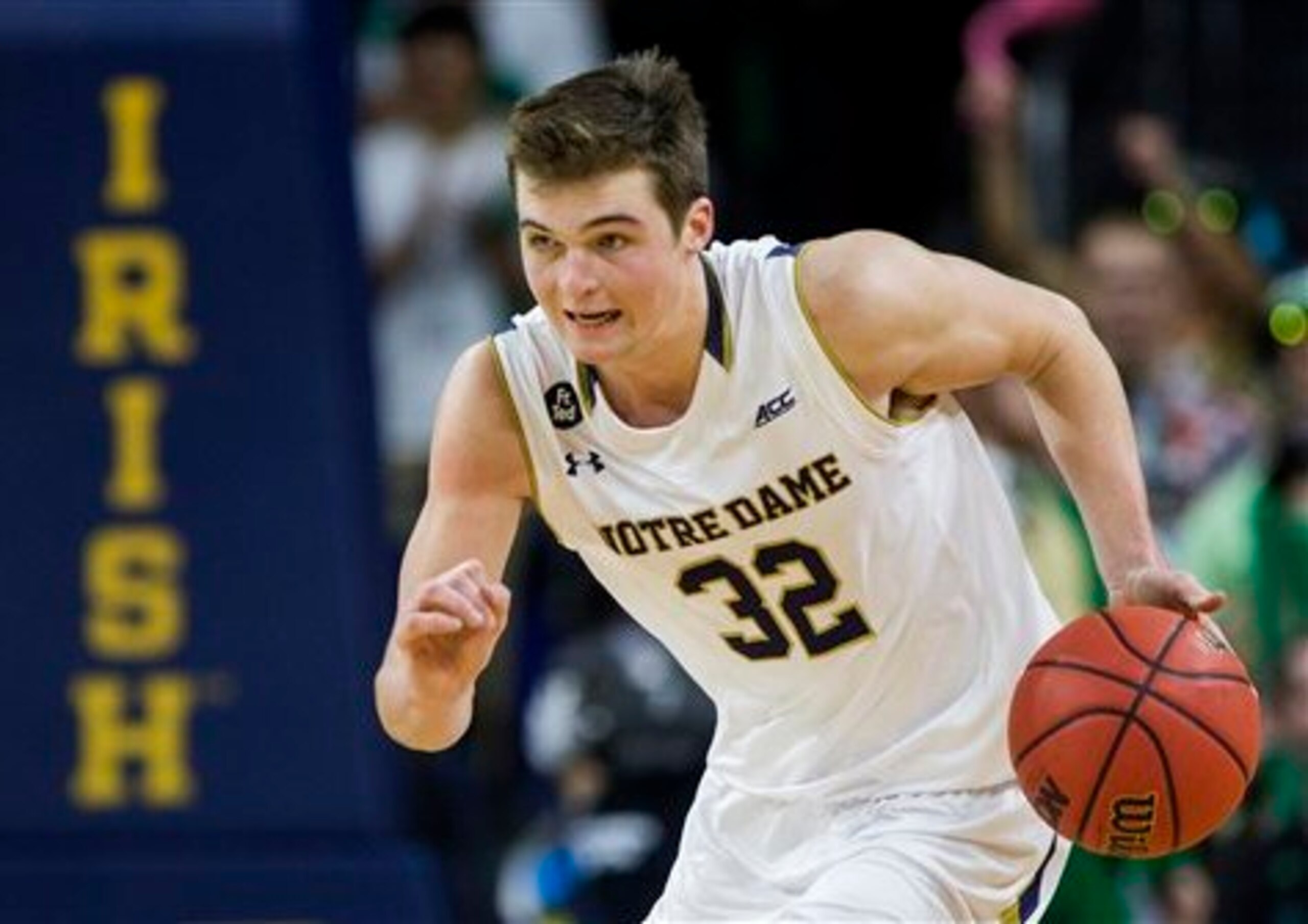
2014-15 Stats: 10.1 PPG, 1.7 APG, 1.1 SPG, 58.4 2P%, 41.1 3P%, 121.8 O-Rating, 15.6 PER, 4.0 WS
2015-16 Stats: 11.4 PPG, 3.2 APG, 0.8 SPG, 48.8 2P%, 34.4 3P%, 110.7 O-Rating, 13.1 PER, 2.4 WS
Outlook
Though his per-game points and assists increased, Steve Vasturia was less efficient for the Fighting Irish as a junior.
Two years ago, he had the luxury of serving as the fifth-best option in the offense. Vasturia spent 32.5 minutes per game on the court as the last thing opposing teams were worried about, even though he shot 41.1 percent from beyond the arc. Such was life on a roster where Jerian Grant and Pat Connaughton ran the show.
When that duo graduated, though, Vasturia became Notre Dame's secondary ball-handler and a bigger focus for opposing teams. Those wide-open looks from the perimeter became a thing of the past, as he had to work harder to get his shots. And in addition to the increased energy expended per minute, Vasturia's playing time increased to 36.1 minutes per game.
It's no surprise he looked exhausted in the process of averaging 7.2 points and shooting 15.6 percent (5-of-32) from three-point range over his final nine games.
Zach Auguste graduating and Demetrius Jackson going pro make Vasturia even more important to Notre Dame's cause in 2016-17, but he should be more prepared for that role this time around. The Fighting Irish need guys like Rex Pflueger and Matt Ryan to step up in a big way this year, but their biggest key to success will be getting past levels of efficiency from Vasturia.
9. Corbin Miller, Harvard
3 of 11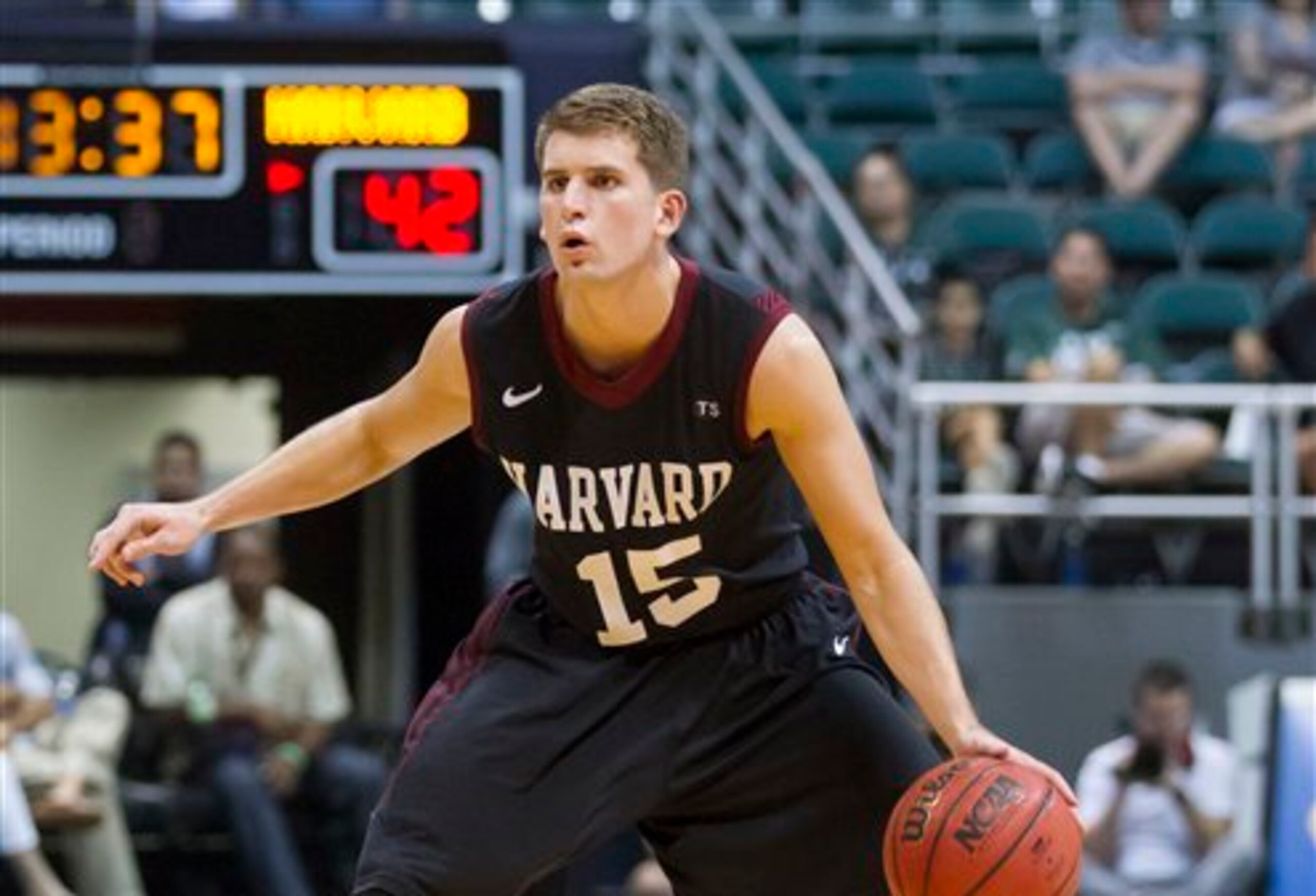
2014-15 Stats: 8.2 PPG, 0.5 TOPG, 35.4 3P%, 112.2 O-Rating, 12.5 PER, 2.3 WS
2015-16 Stats: 7.1 PPG, 1.2 TOPG, 37.3 3P%, 97.3 O-Rating, 9.0 PER, 1.2 WS
Outlook
By the time the 2015-16 season began, Corbin Miller probably didn't even recognize anyone he was playing with.
In addition to Wesley Saunders, Steve Moundou-Missi, Jonah Travis and Kenyatta Smith graduating, Miller lost his most crucial teammate on September 1 when three-year starting point guard Siyani Chambers tore his ACL. As a result, Miller's primary backcourt running mates were a pair of freshmen (Corey Johnson and Tommy McCarthy) and a senior who had missed each of the previous three seasons due to knee and foot injuries (Patrick Steeves).
That much change for a shooting guard who is little more than a three-point specialist was too much. Forced to now create his own shots on a more regular basis, Miller's turnover rate more than doubled. And when he did venture inside the arc for a bucket, he shot just 28.6 percent (compared to 44.4 percent the previous year.)
Without Chambers to set him up for open looks and without Saunders to help draw the attention of the defense, Miller struggled. But Chambers should be back this year, and Harvard has its best recruiting class ever, highlighted by Bryce Aiken and Chris Lewis. Add in the emergence of big man Zena Edosomwan this past year, and the Crimson could have their most well-rounded lineup to date.
With multiple frontcourt weapons and a trio of guys who can play the point, Miller should be in a shooter's paradise. He'll need to battle Johnson for perimeter opportunities, but when he's in the game, look for Miller to have his best shooting season.



8. Malcolm Duvivier, Oregon State
4 of 11
2014-15 Stats: 34.8 MPG, 10.7 PPG, 3.0 RPG, 3.5 APG, 92.4 O-Rating, 11.3 PER, 1.9 WS
2015-16 Stats: 25.3 MPG, 6.1 PPG, 2.4 RPG, 2.2 APG, 92.7 O-Rating, 7.7 PER, 0.7 WS
Outlook
Oregon State had its best season in decades in 2015-16, reaching the NCAA tournament for the first time since 1990.
That doesn't mean that all of the Beavers had great years, though.
Outside of Gary Payton II, Malcolm Duvivier was Oregon State's top contributor in 2014-15. He led the team in assists and ranked second in both points and steals. But he also led the team in turnovers by a wide margin while shooting just 37.0 percent from the field.
Oregon State played great defense two years ago, but its offensive efficiency was atrocious. As a result, it wasn't surprising that Tres Tinkle and Stephen Thompson Jr. got a lot of run as freshmen, taking a ton of minutes and touches away from Duvivier. Both in terms of percentage of possessions used and percentage of shots taken, Duvivier's numbers nosedived last year.
But with Payton, Olaf Schaftenaar, Langston Morris-Walker and Jarmal Reid graduating and Derrick Bruce transferring out of the program, Duvivier is suddenly the veteran leader on this roster. Given the options remaining, he should be the starting point guard, with only Thompson and incoming freshman JaQuori McLaughlin joining him in the quest for backcourt minutes.
7. Kyle Castlin, Columbia
5 of 11
2014-15 Stats: 26.7 MPG, 10.3 PPG, 37.5 3P%, 116.5 O-Rating, 19.8 PER, 2.8 WS
2015-16 Stats: 17.1 MPG, 4.8 PPG, 29.2 3P%, 103.5 O-Rating, 11.1 PER, 1.1 WS
Outlook
You probably weren't expecting to read about a pair of Ivy League players on this list, but SAT scores are irrelevant in determining a player's ability to rebound from a disappointing year.
Two years ago, Columbia was all but forced to turn to Kyle Castlin as a freshman. Alex Rosenberg missed the entire season with a broken foot suffered in October, as did Grant Mullins while he recovered from a concussion suffered during the 2013-14 season. That left the Lions—a team that typically relies heavily on three-pointers—with Maodo Lo and a bunch of question marks in their backcourt.
Though they finished the season with just a 13-15 record, Castlin filled in beautifully, becoming their second-most valuable player.
But with Rosenberg and Mullins back in the mix and Luke Petrasek emerging as a reliable stretch 4, Castlin's services were no longer needed—save for a stretch of about six weeks when senior guard Isaac Cohen was injured. Castlin's playing time plummeted, as did his effectiveness with those minutes.
Rosenberg, Lo and Cohen all graduated, and Mullins transferred to California. By sticking it out through a season in which minutes were always going to be hard to come by, Castlin will now be the featured piece of Columbia's backcourt. He's a dual bounce-back and breakout candidate, as he may well triple the 4.8 points per game he scored in 2015-16.
6. Nigel Hayes, Wisconsin
6 of 11
2014-15 Stats: 12.4 PPG, 6.2 RPG, 54.1 2P%, 39.6 3P%, 1.3 TOPG, 127.7 O-Rating, 23.1 PER, 7.1 WS
2015-16 Stats: 15.7 PPG, 5.8 RPG, 40.0 2P%, 29.3 3P%, 2.3 TOPG, 107.0 O-Rating, 18.6 PER, 4.4 WS
Outlook
Look solely at the points per game, and this makes no sense. Nigel Hayes increased his scoring average by more than 26 percent and was the leading scorer as Wisconsin returned to the Sweet 16 for a third consecutive year.
But his field-goal attempts per game increased by nearly 50 percent as he struggled to put the ball in the hoop. In fact, if we remove free throws from the equation, Hayes scored 372 points on 334 shots in 2014-15 and just 361 points on 438 shots last year.
A dip in efficiency was to be expected. With Sam Dekker, Frank Kaminsky, Traevon Jackson, Josh Gasser and Duje Dukan all leaving, Hayes went from Wisconsin's third-best frontcourt option to its best overall player. Opponents adjusted accordingly, making every look at the hoop a difficult one for Hayes.
To post a PER of 18.6 while facing such an increase in defensive attention was impressive.
Hayes has proved he can do better, though, and we expect a return to form for his senior season. After a month of going through the NBA draft workouts, he should have a better idea of what he needs to work on in order to improve his game and draft stock.
5. Zak Irvin, Michigan
7 of 11
2014-15 Stats: 14.3 PPG, 35.5 3P%, 1.5 APG, 103.7 O-Rating, 16.9 PER, 3.0 WS
2015-16 Stats: 11.8 PPG, 29.8 3P%, 3.1 APG, 98.7 O-Rating, 13.7 PER, 2.3 WS
Outlook
With any luck, Zak Irvin will bounce back to two years ago, when he shot 42.5 percent from three-point range and had an offensive rating of 118.9.
Irvin had back surgery this past September, missing the season opener against Northern Michigan and playing just 15 minutes in the following game against Elon. By the third game, though, he was back in the starting lineup, jacking up at least four three-point attempts per contest.
The back surgery may have affected his effectiveness, but it didn't have much of an impact on his ability to play. Irvin averaged 32.8 minutes per game over the course of the full season and 34.5 minutes from December 1 onward. He just wasn't making shots.
On the bright side, Irvin did become a more effective passer, more than doubling his assist rate from his sophomore year, which was already a significant improvement over his freshman season. Caris LeVert, Aubrey Dawkins and Duncan Robinson all shot 44.0 percent or better from three-point range, and Irvin had the wherewithal to occasionally set those guys up with open looks.
LeVert graduated, while Dawkins, Spike Albrecht, Kameron Chatman and Ricky Doyle all transferred elsewhere. The Wolverines still have Robinson, Derrick Walton and Muhammad-Ali Abdur-Rahkman around for perimeter jumpers, but they should also be even more reliant upon Irvin than ever before. Perhaps he'll make more than 30 percent of his threes this year.
4. Tevonn Walker, Valparaiso
8 of 11
2014-15 Stats: 27.1 MPG, 10.3 PPG, 34.2 3P%, 110.9 O-Rating, 17.2 PER, 3.7 WS
2015-16 Stats: 22.6 MPG, 8.8 PPG, 30.4 3P%, 103.0 O-Rating, 13.5 PER, 2.4 WS
Outlook
Save for a scarcely used forward (David Chadwick), Valparaiso did not lose a single player from the 2014-15 roster that earned a No. 13 seed in the NCAA tournament and nearly upset Maryland in the first round. That level of cohesion led most of us to hail the Crusaders as the Cinderella team to watch throughout the 2015-16 season.
Unfortunately for Tevonn Walker, LSU transfer Shane Hammink came in and stole 22.1 minutes per game from Valpo's returning stable of backcourt players.
Despite scoring in double figures as a freshman, Walker's playing time was reduced by one-sixth, and he was less effective with his time on the court. His two-point, three-point and free-throw percentages each dropped more than 30 points, and his foul rate increased by nearly 60 percent. Were it not for a slight uptick in assist and rebound rates, he would have been doing the team more harm than good.
But with Keith Carter, Darien Walker, E. Victor Nickerson and Vashil Fernandez graduating and David Skara transferring, Tevonn Walker is about to become the most important guard on the roster.
He's the only returning player shorter than 6'7" who scored at least one point per team game, and he should be the primary ball-handler setting up Alec Peters for a ton of buckets. If he can also get back to shooting 34 percent or better from downtown, even better.
3. Kennedy Meeks, North Carolina
9 of 11
2014-15 Stats: 11.4 PPG, 7.3 RPG, 116.3 O-Rating, 24.9 PER, 4.2 WS
2015-16 Stats: 9.2 PPG, 5.9 RPG, 115.1 O-Rating, 23.2 PER, 3.0 WS
Outlook
Kennedy Meeks was left in the dust as Isaiah Hicks had a breakout season and Brice Johnson became the most unstoppable big man in the country.
The shame of the matter is that Meeks got out to an excellent start. Through eight games, he was averaging 13.4 points, 7.6 rebounds, 1.5 steals and 1.5 blocks per game—all improvements over what he did in 2014-15.
But then he missed seven games due to a knee injury and returned to a roster that had adjusted to life without him. Even with the 23-point contest against North Carolina State in his second game back in the lineup, Meeks averaged just 8.0 points per game over the final 24 games.
Meeks still played well—his 23.2 PER was good for 16th among ACC players who scored at least 200 points—but he was barely playing 20 minutes per game. Now that both Johnson and Joel James are gone, though, Meeks should be North Carolina's primary interior weapon. A return to sophomore-year numbers is just about the bare minimum for expectations in his senior season.
2. Melo Trimble, Maryland
10 of 11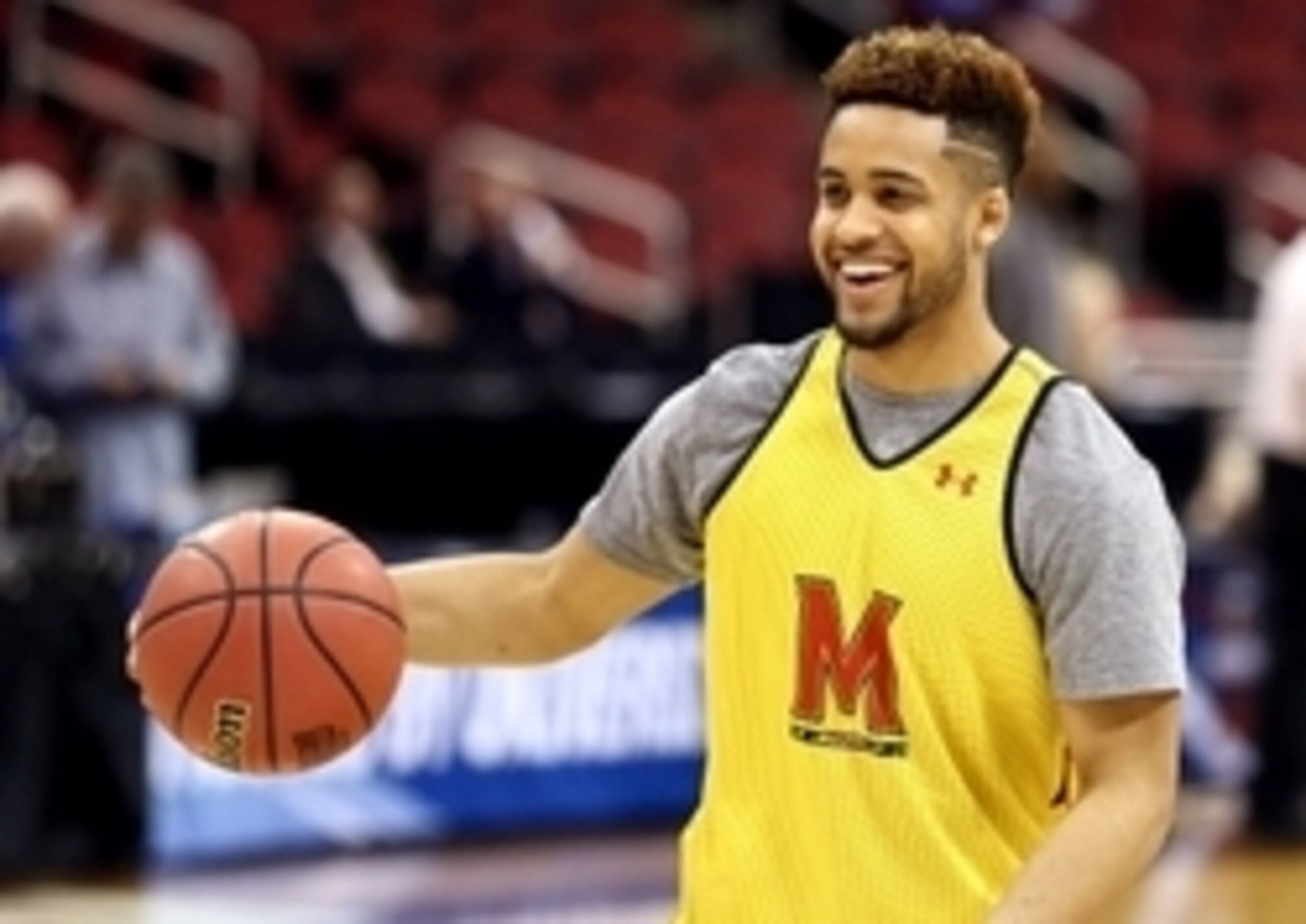
2014-15 Stats: 16.2 PPG, 3.0 APG, 41.2 3P%, 120.7 O-Rating, 22.8 PER, 6.1 WS
2015-16 Stats: 14.8 PPG, 4.9 APG, 31.4 3P%, 113.2 O-Rating, 19.9 PER, 4.9 WS
Outlook
Before we dive in here, let's first note that the downfall of Melo Trimble was one of the most overblown talking points of the second half of last season. It's true that neither he nor the Terrapins were quite as good as we expected, but you'd think Trimble was out there throwing the ball in the wrong hoop with the way some were blaming Maryland's late-season struggles on him.
In actuality, Trimble put up numbers similar to Notre Dame's Demetrius Jackson and Vanderbilt's Wade Baldwin IV.
- Trimble per game: 14.8 points, 4.9 assists, 3.6 rebounds, 1.3 steals, 31.4 3P%
- Jackson per game: 15.8 points, 4.7 assists, 3.5 rebounds, 1.2 steals, 33.1 3P%
- Baldwin per game: 14.1 points, 5.2 assists, 4.0 rebounds, 1.2 steals, 40.6 3P%
That three-point percentage was the biggest issue for Trimble. In every other regard, he was just as good or better as a sophomore than he was as a freshman, but by dropping 98 points in three-point percentage—while also increasing his rate of attempts per game from 4.2 to 5.1—his efficiency metrics suffered.
I can't sit here and promise you that Trimble will revert to shooting 40 percent from beyond the arc. In fact, he might get even worse in that department with opposing defenses focusing more on stopping him now that his supporting cast is less talented. But like Nigel Hayes, Trimble saw the NBA draft process through until its bitter end before deciding in the final hours to return for another year of school.
If there's any player in the country who knows exactly what he needs to improve this season in order to get to the NBA, it's Trimble. Whether he gets the job done is the obvious unknown, but he's in a position to have a big year.
1. Riley LaChance, Vanderbilt
11 of 11
2014-15 Stats: 33.3 MPG, 12.3 PPG, 2.9 APG, 49.4 2P%, 38.2 3P%, 118.3 O-Rating, 16.7 PER, 4.2 WS
2015-16 Stats: 24.8 MPG, 6.9 PPG, 2.5 APG, 34.6 2P%, 36.1 3P%, 97.3 O-Rating, 9.5 PER, 1.6 WS
Outlook
There's a perfectly good explanation for the drop in production by every other player on this list.
Riley LaChance, though, doesn't make much sense.
As a freshman, he led the Commodores in minutes played, starting every game and ranking second in points scored. With LaChance firmly entrenched as the primary shooting guard and Wade Baldwin IV being Vanderbilt's point guard of the future, Shelton Mitchell saw the writing on the wall and transferred to Clemson.
But after six consecutive games scoring in double figures, LaChance had back-to-back duds in mid-January and dropped out of the starting lineup. Over the final 16 games of the season, he shot 10-of-45 (22.2 percent) from three and 9-of-35 (25.7 percent) from inside the arc while averaging just 3.6 points per game. For someone who entered that stretch averaging 11.5 points through 52 career games, it was a precipitous drop.
Whether it was an undisclosed injury or just a sophomore slump, we're assuming he'll remember how to shoot and become an even bigger part of the offense with Baldwin out of the picture. Unless 3-star freshman Payton Willis is ready to start from day one, LaChance should become the primary ball-handler under new head coach Bryce Drew.
All stats courtesy of Sports-Reference.com and KenPom.com unless otherwise noted.
Kerry Miller covers college basketball for Bleacher Report. You can follow him on Twitter @kerrancejames.
.png?w=2560)


.jpg?w=2560 "Jonathan Taylor Landing Spots")