

Italy Must Continue Playing as a Unit in Group Stage Match vs. Sweden
Two nights have passed since Italy's 2-0 upset win over Belgium in Monday's Group E opener, and it still hasn't fully sunk in.
The Italians came into the game as the very definition of uncertainty. Manager Antonio Conte's squad selection had caused a whirlwind of controversy, and injuries had deprived the team of their two best midfielders in Claudio Marchisio and Marco Verratti. Most pundits thought the Azzurri would have their hands full simply getting out of the group. The Belgians were expected to make a statement win cementing themselves as tournament favorites.
Apparently no one gave the Italians the memo. A suffocating defense and goals from Emanuele Giaccherini and Graziano Pelle gave them their first opening-game win at the Euros since 2000 and put them in the driver's seat in the group.
TOP NEWS

Final Men's Ballon d'Or Rankings 📊
_0.png?w=2560 "CFB Top 25")
Unranked Teams Cause Chaos in Rankings 📊

Brown with an all-time summary of relationship with Tatum
Of course, the Italians have been here before. At the 2014 World Cup, they looked impressive in their first match against England before fading out and losing the final two by twin 1-0 scorelines, crashing out for the second straight World Cup.
This is a delicate moment for Conte's team. The biggest match of the group is now done. The potential for a mental drop-off in the remaining group games against Sweden and the Republic of Ireland is definitely there. But there are a few major differences between this team and the one Cesare Prandelli took to Brazil in 2014.
First off, they don't have to deal with the soul-sucking effects of playing a game in Manaus. The conditions in the Amazon city were horrific—after the England game Marchisio told reporters (h/t Football Italia) that he felt like he was hallucinating at the end of the match. Each team that played there saw a downturn in their form in its aftermath, especially the Italians, who looked physically spent through both of their remaining games.

The next major difference is in coaching. Prandelli never settled on a set of tactics between Euro 2012 and the World Cup. The constant shifting reduced team cohesion, and at the vital moment Prandelli spit the bit. The team lost its direction and devolved into a group of individuals running around the field, especially in attack.
It's unlikely that Conte will make those mistakes. He's conducted a few experiments in his two years in charge of the national team, but the 3-5-2 that he used at Juventus has always hovered in the background as the team's bedrock. Conte's often been accused of inflexibility when it comes to the 3-5-2, but in an international tournament like this having a solid foundation keeps a team together.
And a team like Italy needs to be kept together. It was their work as a unit that conquered Belgium. The Juventus-based back three of Andrea Barzagli, Leonardo Bonucci and Giorgio Chiellini (BBC) played, as they do at the club level, like they had one mind. Players ran down breakaways from behind, clogged passing lanes, and supported each other well to keep possession. If an Italian was put under pressure in possession, one or two teammates would appear, and a quick passing move would keep the ball out of Belgian hands.
If Italy is to have a chance at a deep run in this tournament, that kind of cohesiveness needs to be a constant. That starts with Friday's game against Sweden.
The Swedes had to take the long way to get to Euro 2016. If it weren't for the expanded format, they wouldn't be in the tournament at all.
Three wins and three draws in the first six matches of qualifying had but them into a good position, but their run-in was painful. A pair of losses to Russia (1-0) and Austria (4-1), propelled both of those teams ahead of them in the standings and dropped them to third.
That put them into the playoff round, where they were drawn with Scandinavian rivals Denmark. After a 2-1 win at home in the first leg, they went to Copenhagen and secured a 2-2 draw—good for a 4-3 aggregate win and a spot in the tournament proper.
If it feels easy to look at the Swedes as Zlatan Ibrahimovic & Friends, that's because they pretty much are. Few teams in the tournament are so dependent on one man.
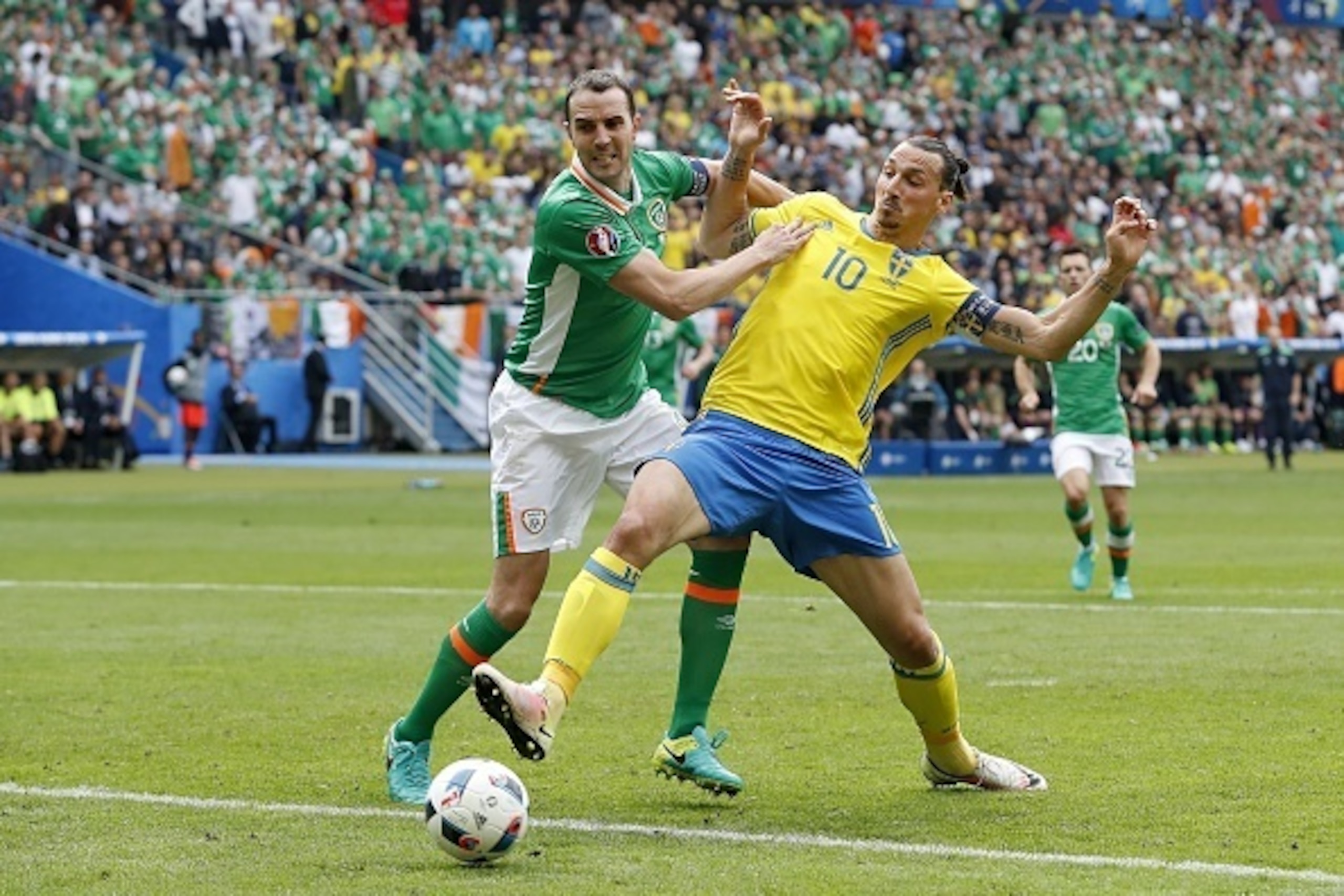
An example: Ibrahimovic has scored 62 international goals—a Swedish record. The next-highest total on Erik Hamren's squad for this tournament? Midfielder Kim Kallstrom, whose 16 strikes have come in 129 games. Their next-highest scoring forward is Marcus Berg, who's only struck 10 times for his country in 39 games.
If Ibrahimovic doesn't perform, the team goes flat. That's exactly what happened for extended periods of Sweden's opener against Ireland, when Glen Whelan was tasked with marking the star striker. His teammates had the lion's share of possession, but for much of the game Ibra wasn't able to do all that much with it.
It wasn't the only way Martin O'Neill outcoached Hamren on the night. His midfield diamond overwhelmed Sweden's 4-4-2 at times, and even though a barely-fit James McCarthy had difficulty defending on the right side of midfield for 85 minutes, the Irish had the better of most of this game. They could have been 3-0 up at halftime if they had taken their chances, and they held Zlatan & Co. without a shot on target the entire game.
The way Sweden played on Monday must have Conte licking his chops. In his only two encounters with Ibrahimovic as a coach, during his first season at Juventus, he held the then-AC Milan striker without a goal—with the exact same defensive unit that he's going to be deploying on Friday.
That was the BBC's first season together, when they were still learning to play with each other as a unit.
It's been five years since then, and their ability to play together could make man-marking Ibrahimovic with a midfielder, as O'Neill did with Whelan, unnecessary. Either the three can trade off taking care of him, or Chiellini—who has extensive experience playing against the big Swede when he was in Serie A—could be tasked to do what he did against Belgium, when he marked Romelu Lukaku out of the game.
On the other end, Italy will need to be more clinical than the Irish were. It's difficult for even a defense such as this one to totally eliminate a player like Ibrahimovic from a game, and the longer the game stays close, the more chances Zlatan will have to change it with a moment of magic.
To be fair, Thibaut Courtois was worth at least two goals to the Belgians, and Andreas Isaksson isn't at his level. But chances need to be taken, and the decision-making in the buildup play has to be much crisper. Too many times against Belgium the Italian attackers—specifically the wing backs—seemed caught in two minds about whether to pass or shoot when in dangerous positions. Those choices must come quicker if they don't want to wait until stoppage time to seal the game.
Monday's victory was an important first step, but winning the Euros is a journey of seven. Sweden may look unimpressive on paper, but any team with Ibrahimovic up front can cause a problem, even if the rest of the lineup isn't close to elite. If the Azzurri want to win, they will have to play as the same cohesive unit as they did on Monday.
If they do that, the sky could be the limit for this team.
.png?w=2560)
.jpg?w=2560 "Colts Football")





