


Their teams waged war for a spot in the 2016 Elite Eight, and now Oregon's Dillon Brooks and Duke's Grayson Allen will be battling each other for the unofficial honor of best junior in the nation for the 2016-17 college basketball season.
These 25 juniors were ranked based on a combination of (in descending order of importance) individual statistics, value and projected team success.
A big-time performer for a potential national champion would obviously rank at or near the top, but beyond our top two, it was largely a balancing act between crucial role players on title contenders and stat-sheet stuffers on lesser squads.
Make no mistake about it, though: There was no shortage of viable candidates. In addition to our top 25, there are eight honorable mentions and a few dozen other players who were difficult to cut from the list. We've grown accustomed to seeing freshmen and seniors atop the discussion for individual Player of the Year awards, but there should be quite a few juniors in the mix this season.
Honorable Mentions
1 of 26
Isaac Haas, Purdue
Haas had efficient overall numbers last season, but he struggled against quality opponents and hasn't played more than 22 minutes in a game since November 2014. He should get more playing time with A.J. Hammons now gone, but we'll have to wait and see what he does with it.
E.C. Matthews, Rhode Island
Based on what he did in his first two seasons with the Rams, Matthews deserves a spot in the top 25. But after suffering a torn ACL in November, we were unwilling to give him any better than an honorable mention. If fully healthy, there's a good chance he'll be the A-10 Player of the Year.
Thomas Welsh, UCLA
Welsh had an excellent sophomore season, blossoming into a reliable shooter and rebounder. However, he may be the fifth option in UCLA's offense this season with the addition of Lonzo Ball and T.J. Leaf. If given enough touches, though, he could be a double-double machine.
James Demery, Saint Joseph's
DeAndre' Bembry, Isaiah Miles and Aaron Brown are no longer around. Someone needs to step up for the Hawks unless they plan on scoring less than 50 points per game. Demery should get first dibs for the job of leading scorer.
Peyton Aldridge, Davidson
Jack Gibbs is the main attraction at Davidson, but Aldridge plays a strong second fiddle. He averaged 15.5 points and 6.5 rebounds last season and should be in line for quite a few more touches in 2016-17.
Jairus Lyles, UMBC
The former VCU transfer averaged 23.0 points, 5.5 rebounds and 2.5 steals per game last year. But if a tree falls in the forest, does it make a sound? Not many took notice of Lyles' big numbers for a team in the America East Conference that lost 25 games, but he should be among the national leaders in points per game this year.
Marcus Foster, Creighton
If the Bluejays get the version of Foster that shot nearly 40.0 percent from three-point range in 2013-14, they could have the most unstoppable backcourt duo (along with Mo Watson) in the country.
Andrew Rowsey, Marquette
Rowsey averaged 19.7 points per game in two seasons with UNC-Asheville, but there's a fine line between the Big South and the Big East. Moreover, Marquette doesn't lose a single backcourt player from last season and also added USC transfer Katin Reinhardt to the mix. It might be a rough transition for Rowsey, but we also can't ignore a guard who made 208 threes in just 63 games.
25. Bonzie Colson, Notre Dame
2 of 26
2015-16 Stats: 11.1 PPG, 6.7 RPG, 1.0 BPG
Bonzie Colson was good for one great game per month last season.
He had 24 points, eight rebounds and three assists in a December loss to Indiana. He exploded for 31 points (including a pair of three-pointers) and 11 rebounds in Notre Dame's marquee road win over Duke in January. Colson went for 19 and 10 in a crucial win over North Carolina in February and had 12 points, 12 rebounds, four assists and two steals in the ACC tournament against Duke.
And yet, he bounced in and out of the starting lineup multiple times throughout the season because he could also be counted on for at least one poor performance per month.
Zach Auguste graduated, though, and V.J. Beachem is more interested in shooting threes than fighting for rebounds. That leaves this 6'5" wrecking ball as Notre Dame's primary frontcourt weapon in 2016-17. If he doesn't average a double-double, he should only miss the mark by a few rebounds.
24. Rodney Bullock, Providence
3 of 26
2015-16 Stats: 11.4 PPG, 6.8 RPG, 1.3 BPG, 1.0 APG
If not Rodney Bullock, then who? In addition to Kris Dunn and Ben Bentil declaring for the NBA draft, Providence lost Junior Lomomba, Quadree Smith and Tyree Chambers to the transfer market.
The Friars do still have a strong stable of role players in Kyron Cartwright, Jalen Lindsey, Ryan Fazekas and Drew Edwards, but they're all guards who spent the bulk of their time on the court deferring to Providence's Big Three. Unless former Hoosier Emmitt Holt has a monster first season in Providence, Bullock will be the best (frontcourt) player on this roster by a sizable margin.
As the go-to scorer in Providence's offense, though, Bullock will need to be more reliable.
He consistently played well for the first two months of last season, but he was hit-or-miss the rest of the way. Case in point, Bullock had an impressive 16 points, 10 rebounds, two blocks and two steals in the NCAA tournament win over USC before committing four turnovers and missing all seven of his field-goal attempts against North Carolina two nights later.
To be fair, it was his first time playing in three years. Bullock was suspended for the entire 2013-14 season and missed all of 2014-15 with an injury. Some fatigue down the stretch was to be expected, but the Friars hope it's out of his system and that he will give them four solid months of high-volume scoring this year.
_0.png?w=2560 "CFB Top 25")

23. Gary Clark, Cincinnati
4 of 26
2015-16 Stats: 10.4 PPG, 8.8 RPG, 2.1 APG, 1.5 BPG, 1.2 SPG
Over the past two seasons, Gary Clark has been Cincinnati's most efficient weapon, but also its most passive one. He led the team in O-rating both years, via KenPom.com, and ranked dead last in percentage of shots taken in 2015-16.
Because of the impressive numbers that he put up as a freshman, Clark was a prime candidate for a breakout sophomore year. Instead, he became even less assertive, content with letting Farad Cobb, Octavius Ellis and Troy Caupain do the bulk of the shooting.
With Cobb, Ellis, Shaq Thomas and Coreontae DeBerry all graduating, Clark has to become more of a go-to weapon, right? Aside from incoming NC State transfer Kyle Washington, there's not much left in the frontcourt other than Clark.
But even if he doesn't become the type of player who puts up close to 20 points per game, Clark should continue to make a significant impact elsewhere. Not only did he lead the team in O-rating, he has been Cincinnati's best defensive asset, as well.
22. Robert Johnson, Indiana
5 of 26
2015-16 Stats: 8.1 PPG, 3.3 RPG, 3.1 APG, 44.7% 3PT
The question of what Indiana will do without Yogi Ferrell has been raised often this offseason. Both Alex Bozich of Inside the Hall and Zachary P. Osterman of the Indianapolis Star have offered their opinions that Ferrell is irreplaceable.
Why, exactly, are people so quick to rule out the possibility that Robert Johnson could star in that role?
While Ferrell started out as more of a pure point guard before becoming a dominant lead guard, Johnson begins as an excellent shooter who has proved more than capable of passing the ball.
A top-50 recruit two years ago, Johnson averaged 5.0 assists and 5.4 rebounds per 40 minutes while making threes even more often than Ferrell did. Last year, the sophomore combo guard attempted 6.1 triples per 40 minutes and made 44.7 percent of them, compared to the senior combo guard hitting 42.0 percent of his 6.2 attempts.
Johnson rarely attacks the rim or seeks out contact, so he'll need to work on his slashing to become a more complete replacement for Ferrell. But if he can add a floater and the ability to drive and dish, the Hoosiers will be in great shape to repeat as Big Ten champions.
21. Ja'Quan Newton, Miami
6 of 26
2015-16 Stats: 10.5 PPG, 2.5 APG, 2.3 RPG
Despite a strong recruiting class led by Dewan Huell and Bruce Brown, it could be a bit of a rebuilding year for Miami. The 'Canes lose five of last year's seven leading scorers to graduation and even lost reserve shooting guard James Palmer to the transfer market, leaving Davon Reed, Ja'Quan Newton and Anthony Lawrence as the only returning players to average at least 1.0 points per game.
Then again, that just might be enough for Newton to work with.
Miami's sixth man and lead guard of the future played well in relatively limited minutes, relentlessly attacking the paint in an effort to either draw contact or draw in defenders before finding the open man. He had some turnover problems in the process (3.8 per 40 minutes), but that's a small and nearly unavoidable price to pay to utilize such an aggressive ball-handler.
The addition of San Jose State transfer Rashad Muhammad won't hurt Newton's ability to drive the lane, either. Between Muhammad, Reed and Lawrence, there are plenty of perimeter weapons that opposing defenses need to respect rather than collapsing to stop the driver. As a result, Newton should have the type of impact and stat line that Tyrone Wallace had this past season for California (15.3 PPG, 5.3 RPG, 4.4 APG).
20. Emmett Naar, Saint Mary's
7 of 26
2015-16 Stats: 14.1 PPG, 6.3 APG, 3.7 RPG, 1.3 SPG, 41.8% 3PT
Though Saint Mary's has won at least 21 games in nine consecutive seasons—joining Duke, Kansas, Gonzaga, Ohio State, VCU, BYU and Akron as the only teams in that club—the Gaels have neither been ranked nor gone dancing in the past two years, so Emmett Naar is anything but a household name.
Expect all of that to change this season, as Saint Mary's should be a preseason Top 25 team with Naar leading the charge. The primary ball-handler for one of the nation's most efficient offensive attacks, Naar had 17 games with at least 12 points and six assists, including eight consecutive games of that ilk late in the season.
In addition to an assist-to-turnover ratio of nearly 3.0, Naar almost joined the elusive 50-40-90 club last year by shooting 48.7 percent from the field, 41.8 percent from beyond the arc and 87.0 percent from the free-throw line. Still, he was one of just four regulars (including Buddy Hield) to shoot at least 48.5, 40.0 and 87.0 percent, respectively, and Naar doled out 63 more assists than the other three members of that quartet combined.
19. Rokas Gustys, Hofstra
8 of 26
2015-16 Stats: 13.5 PPG, 13.0 RPG, 1.2 BPG
In the past two decades, only a dozen college basketball players have averaged at least 13 points and 13 rebounds per game for a season—a list that includes NBA stars Tim Duncan, Blake Griffin, Kenneth Faried and Paul Millsap. Cut the upperclassmen out of the mix and the only freshmen or sophomores to post those numbers are Griffin, Faried and Rokas Gustys.
That isn't to say Gustys is on the fast track to a career as one of the best power forwards in the pros, but it's worth pointing out just how dominant Hofstra's big man was this past season.
What's perhaps most impressive is that he got there while attempting just 8.6 shots per game. With seniors Ameen Tanksley and Juan'ya Green and junior Brian Bernardi doing most of the shooting for the Pride, Gustys often needed to grab offensive rebounds just to get his hands on the ball in the frontcourt.
Green, Tanksley and Denton Koon all graduate, leaving Gustys as the primary scoring weapon of this offense. It hasn't been done in at least 23 years, but 15 points and 15 rebounds per game isn't completely out of the question here.
18. DeSean Murray, Presbyterian
9 of 26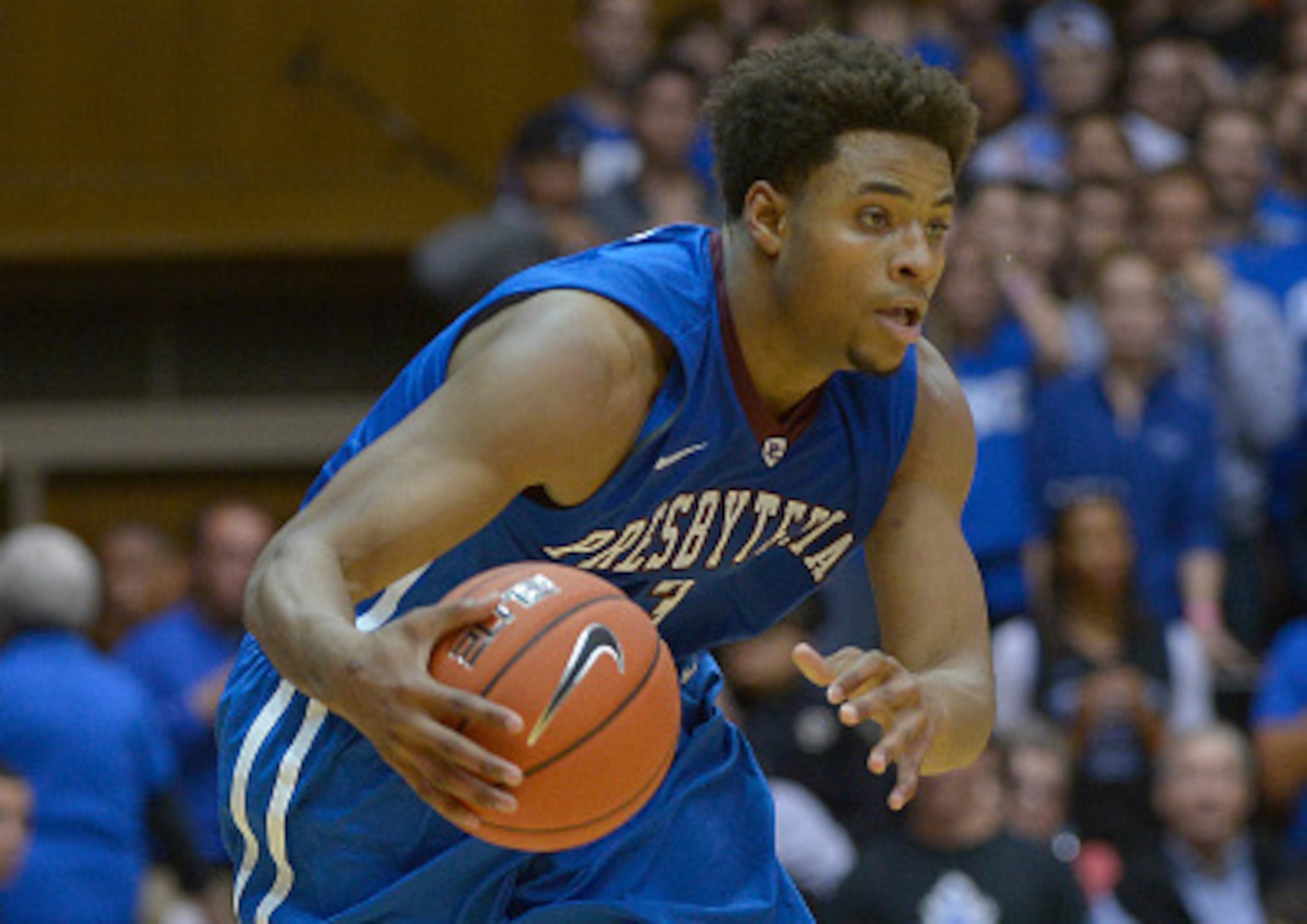
2015-16 Stats: 20.2 PPG, 7.4 RPG, 2.0 SPG, 1.7 APG
Back in the mid-1990s, it was almost commonplace to see a player average at least 20.0 points per game while failing to make a single three-pointer. It happened 23 times in a span of five seasons from 1993-98.
But as a testament to how much the game has changed since then, that's only happened 17 times in the past 18 years, including Presbyterian's DeSean Murray becoming the only player to do so in either of the past two seasons.
What makes Murray even more unique is that he's only 6'5". Most of the players to average 20 per game entirely inside the three-point arc have been traditional big men, but Murray is more of a Roosevelt Jones type of big man trapped in a guard's body.
It doesn't hurt matters that he effectively is Presbyterian's primary center. Of the team's nine leaders in minutes played, Murray tied with Ed Drew for the tallest, hence the 7.4 rebounds per game in spite of his size.
Those boards weren't accidents, though. He had 20 points and eight offensive rebounds against Marquette's front line of Henry Ellenson and Luke Fischer. Pound-for-pound, Murray is one of the best frontcourt players in the country—even though 99 percent of the country has never seen him play.
17. Vince Edwards, Purdue
10 of 26
2015-16 Stats: 11.3 PPG, 5.4 RPG, 2.9 APG, 40.7% 3PT
After spending his efficient freshman season as Purdue's primary power forward, Vince Edwards was bumped to a full-time perimeter role with the addition of Caleb Swanigan—and became an even deadlier weapon.
It took a little while for him to find his groove, but Edwards was nearly untouchable for the final two months. He shot 43.9 percent from three-point range and averaged 13.7 points over his last 18 games. In the NCAA tournament loss to Arkansas-Little Rock, he had 24 points and 13 rebounds as one of the few things that didn't go wrong for the Boilermakers.
With A.J. Hammons, Rapheal Davis and Johnny Hill all graduating, there's plenty of room for Edwards to further expand his game. He has shown the talent of a player that could occasionally flirt with triple-doubles—twice already in his career has he recorded at least seven points, rebounds and assists in a game—and now he will have more of an opportunity to make it happen.
16. Austin Nichols, Virginia
11 of 26
2015-16 Stats: DNP (Transfer from Memphis)
Unless you count the actor who plays Spencer on The Walking Dead, it has been a long time since we last saw Austin Nichols. Even in his last season with Memphis, he missed five of the final nine games due to ankle injuries.
When he was healthy, though, few were better.
From the beginning of December 2014 through the first ankle sprain in early February, Nichols averaged 14.3 points, 6.6 rebounds and 3.4 blocks per game. If maintained for an entire season, he would join Kentucky's Anthony Davis and LSU's Jordan Mickey as the only players since 2011 to average at least 14.0 points, 6.0 rebounds and 3.25 blocks per game.
Strong per-game numbers and Virginia don't often go hand-in-hand because of Tony Bennett's preferred pace of play, but Nichols should be one of the most valuable big men in the country as the shot-blocking anchor of what has been one of the nation's best defenses for the past few seasons.
15. Xavier Rathan-Mayes, Florida State
12 of 26
2015-16 Stats: 11.8 PPG, 4.4 APG, 2.8 RPG, 1.0 SPG
If he continues to embrace his role as the point guard of this team, Xavier Rathan-Mayes could have a monstrous junior year.
Every once in a while there are nights when it seems like he can't miss. Rathan-Mayes had four games with at least five made three-pointers as a freshman, as well as a 7-of-9 game against North Carolina this past season.
In the other 60 games of his career, though, he's a 22.4 percent three-point shooter attempting 4.4 triples per game. He was a great shooter in high school, but that just hasn't been a remotely reliable aspect of his game thus far in college.
In lieu of that long-range stroke, he did a much better job of passing and avoiding turnovers this past season and should only continue to develop in those areas with the addition of stud freshman Jonathan Isaac. This might be the most talented roster Florida State has had since the days of Bobby Sura, Sam Cassell and Charlie Ward in the mid-'90s, and Rathan-Mayes should benefit nicely from the players around him.
14. Jaylen Adams, St. Bonaventure
13 of 26
2015-16 Stats: 17.9 PPG, 5.0 APG, 3.7 RPG, 1.3 SPG, 43.8% 3PT
The Bonnies had a dynamite trio of Jaylen Adams, Marcus Posley and Dion Wright this past season, each of which averaged better than 37.0 minutes and 16.5 points per game. But with Posley and Wright graduating, Adams could have a downright ridiculous junior season.
The list of underclassmen in the past four years to average at least 17.5 points and 5.0 assists per game reads like an all-star lineup: Trey Burke, D'Angelo Russell, Isaiah Whitehead, Key Felder, Cameron Payne, Jahii Carson, Jalan West and Adams. Most of those players left after that magical season, but West came back to Northwestern State and put up even better numbers, increasing from 19.4 points and 6.4 assists per game to 20.0 and 7.7.
Will Adams be able to find the type of sidekick that West has had in Zeek Woodley, though?
One possible candidate for the job is Central Connecticut State transfer Matt Mobley. He averaged 17.2 points per game in 2014-15 and could be the high-volume shooting guard that a player like Adams needs at his disposal. There's also sophomore guard Nelson Kaputo, who averaged 7.8 three-point attempts per 40 minutes.
If either one can help keep the defensive focus off of Adams while also giving him a place to hunt for dimes, he could rank in the top 25 nationally in both points and assists per game.
13. Johnathan Motley, Baylor
14 of 26
2015-16 Stats: 11.1 PPG, 5.1 RPG, 1.1 BPG
Though he only averaged 11.1 points per game, Johnathan Motley scored at least 21 points seven times as a sophomore, including a pair of 27-point games against Iowa State.
But far too often, Baylor seemed to forget that he was even an option in the frontcourt. He was held scoreless three times and was limited to three field-goal attempts or fewer eight times.
That's a borderline unfathomable combination. Motley spent 20 percent of the season putting up numbers as good as Colorado's Josh Scott and another 20 percent of the season looking like Kentucky's Skal Labissiere did for most of the year.
Such is life when frequently in foul trouble and only the third or fourth scoring option in the offense. The former might not change, but Motley ought to be the go-to offensive weapon as Baylor adjusts to life without Taurean Prince, Rico Gathers and Lester Medford. A statistical jump from "good" to "great" on par with Brice Johnson's senior campaign with North Carolina could be on tap for Motley.
12. James Blackmon Jr., Indiana
15 of 26
2015-16 Stats: 15.8 PPG, 4.2 RPG, 1.7 APG, 1.2 SPG, 46.3% 3PT
It's a crying shame that Indiana's 2015-16 season took a turn for the better after James Blackmon's season-ending injury, because it gave the impression that he was a detriment to the Hoosiers. In reality, he's one of the most lethal scorers in the country, but they needed OG Anunoby's defense more than they needed Blackmon's offense.
(Contrary to what has become popular belief, Blackmon was far from a sieve on defense. He averaged 2.0 steals per 40 minutes. Per sports-reference.com, his defensive box plus/minus was better than Yogi Ferrell's and only marginally worse than Robert Johnson's, even though those two guards had the benefit of playing out the season after the team defense improved. But the collective defensive effort from that trio necessitated an infusion of Anunoby.)
With Ferrell and Troy Williams both gone, though, there's plenty of room for Blackmon and Anunoby to start and shine.
In the 13 games before his knee injury, Blackmon was averaging 25.8 points per 40 minutes and shooting the lights out from beyond the arc. Granted, he did most of his damage against Alcorn State, McNeese State and Austin Peay, so it's tough to compare his numbers to someone who actually played two-thirds of his games against major-conference competition.
But he was a great scorer/shooter in high school and in his first season with the Hoosiers, so we're hardly basing his 2016-17 outlook on six weeks of nonconference play.
11. Nigel Williams-Goss, Gonzaga
16 of 26
2015-16 Stats: DNP (Transfer from Washington)
Gonzaga spent most of the 2015-16 season desperately lacking a reliable point guard. It wasn't until Josh Perkins got into a rhythm late in the year that the Zags finally hit their stride.
Too bad they couldn't use the transfer sitting on their bench, because Nigel Williams-Goss was one of the best combo guards in the country two years ago. Despite shooting just 25.6 percent from three-point range, NWG put up 15.6 points, 5.9 assists and 4.7 rebounds per game.
Only 10 players in the past four seasons have averaged at least 15.5, 5.5 and 4.5, respectively: Kris Dunn (twice), Denzel Valentine, Kay Felder, Elfrid Payton, DeAndre Kane, Juwan Staten, Alex Hamilton, A.J. English, Nate Wolters and Williams-Goss. If Mark Few had any of those players at his disposal last season, Gonzaga might have flirted with perfection.
Williams-Goss won't have nearly the frontcourt weapons he would have had last season, but the Bulldogs do have a ton of options for him to play with—and might be getting another big one if Jordan Mathews' visit goes well. It wouldn't be surprising in the least to see NWG make the major-conference-team-to-Gonzaga type of leap that Kyle Wiltjer made after two seasons with Kentucky.
10. Justin Jackson, North Carolina
17 of 26
2015-16 Stats: 12.2 PPG, 3.9 RPG, 2.8 APG
Though effective, Justin Jackson's first two seasons with North Carolina weren't nearly what was expected. Stuck somewhere between shooting guard and small forward, he has embraced neither position, shooting 29.7 percent from three-point range and averaging just 5.5 rebounds per 40 minutes in his career.
Then again, Wayne Selden was in a similar boat after his first two seasons at Kansas, albeit with a better three-point stroke and a worse rebounding rate. Both were McDonald's All-American wings supposed to take the world by storm and potentially leave for the NBA after one season. Instead, they both played just well enough to never lose grip on their starting jobs.
But the third year was the charm for Selden, and it should be for Jackson, as well. With Brice Johnson and Marcus Paige no longer on the roster, Jackson likely becomes the primary scorer for the Tar Heels—provided he is willing and able to embrace that role.
Early in the 2015-16 season, he played it well. With Paige recovering from his broken hand and Johnson not yet racking up 20 points and 10 rebounds in his sleep, Jackson had a six-game stretch in which he averaged 17.8 points per game and was used on at least 24 percent of possessions five times—a usage rate threshold he only reached once in his final 31 games.
9. Yante Maten, Georgia
18 of 26
2015-16 Stats: 16.5 PPG, 8.0 RPG, 1.8 BPG
Yante Maten was bound to make more of an impact after Marcus Thornton and Nemanja Djurisic graduated, but no one could have possibly foreseen his scoring rate doubling.
We're not talking about points per game. After posting just 5.0 PPG as a freshman averaging 18.2 minutes per game, a significant increase in that department was to be expected because of the bump in playing time. But Maten's points per 40 minutes increased from 11.0 to 22.0 as he became both a more efficient scorer and one of the most heavily used big men in the country.
Maten ranked 57th in the nation in percentage of shots taken last season and 10th among players taller than 6'5". And he was still just warming up as the season ended. He scored at least 19 points in seven of his final 12 games, including shooting 7-of-11 from three-point range after going just 1-of-5 from downtown in the first 54 games of his career.
Trevon Bluiett and Dillon Brooks are technically listed as forwards, but Maten is the highest-ranked true big man on our projected list of the nation's top juniors. Quite the transformation from a scarcely used freshman who shot 41.6 percent from the field.
8. Kelan Martin, Butler
19 of 26
2015-16 Stats: 15.7 PPG, 6.8 RPG, 1.1 APG, 37.7% 3PT
Following a strong first month, Kelan Martin had a disappointing freshman season. From mid-December onward, he shot 6-of-38 (15.8 percent) from three-point range and had more games with a qualified O-rating below 75 (8) than above 100 (6). Despite averaging nearly six field-goal attempts per game (and more than 16 per 40 minutes), Martin only scored more than 10 points once in his final 24 games.
In a nutshell, he was an inefficient ball hog who didn't rebound well and who averaged more turnovers per 40 minutes (2.7) than assists, steals and blocks combined (2.2).
But that player was never heard from again, as the version of Martin that returned for the 2015-16 season was better in nearly every way, shape and form. He's still a bit of a ball hog—and that will probably only get worse without Kellen Dunham and Roosevelt Jones to command the ball—but his three-point percentage increased by 130 points while he became a significantly better rebounder and defender.
Up next is finding out how he performs as the primary option in an offense. He led the team in field-goal attempts last season, but there's no question that Jones and Dunham were the offensive weapons of choice for the Bulldogs. Now that Martin's the main guy, there's a good chance he'll lead the Big East in scoring.
7. Devonte' Graham, Kansas
20 of 26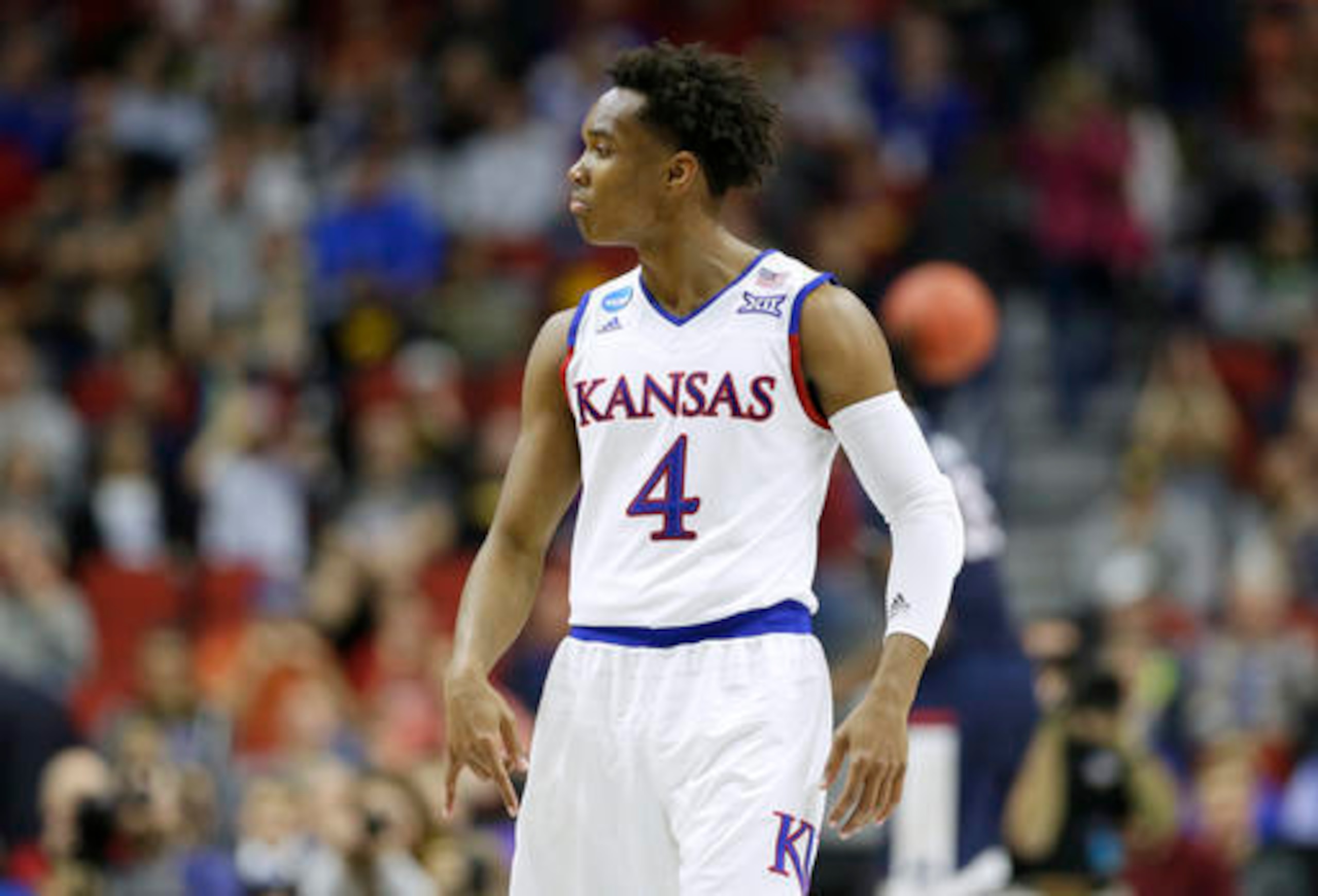
2015-16 Stats: 11.3 PPG, 3.7 APG, 3.3 RPG, 1.4 SPG, 44.1% 3PT
Whether or not you're of the mindset that the Big 12 has been the best conference in the country over the past few years, we can hopefully agree that it's a solid collection of opponents for any player to face.
But Devonte' Graham was even better in conference than out of it.
Including the conference tournament, Graham played 21 games against Big 12 teams. In those contests, he averaged 12.7 points, 4.0 assists, 3.6 rebounds and 1.4 steals while shooting 46.5 percent from three-point range.
Not too shabby for a player that most people would have considered the fourth-most important Jayhawk behind Perry Ellis, Frank Mason and Wayne Selden.
And as he displayed against normally high-scoring players like Buddy Hield and Bryce Alford, defense might be Graham's best attribute. He isn't quite a Kris Dunn or Gary Payton II type of defensive stopper and one-man offense, but Graham is the type of guy who can lead a team in scoring while also shutting down the opposing team's top player.
6. Elijah Brown, New Mexico
21 of 26
2015-16 Stats: 21.7 PPG, 5.5 RPG, 3.2 APG, 1.1 SPG, 39.4% 3PT
As a freshman at Butler, Elijah Brown did not once record more than 19 points, five rebounds or three assists against a D-I opponent.
As a sophomore at New Mexico, that would have been a below-average game for him.
Outside of one disappointing night against Loyola-Chicago in the first week of the season, Brown scored at least a dozen points in every game in 2015-16, including a half-dozen performances with at least 30 points. He averaged 7.1 three-point attempts and 8.0 free-throw attempts per game, connecting on 39.4 percent and 85.1 percent of them, respectively.
With those numbers, he became one of just six players in the past two decades to attempt at least 200 three-pointers and 250 free throws while shooting at least 37.5 percent and 85.0 percent, respectively. The other members of that elusive club are Stephen Curry, Jimmer Fredette, J.J. Redick, Damian Lillard and Reggie Hamilton.
But each of those college basketball legends got there in his final season, so what might Brown do for an encore as a junior?
5. Joel Berry II, North Carolina
22 of 26
2015-16 Stats: 12.8 PPG, 3.8 APG, 3.3 RPG, 1.5 SPG, 38.2% 3PT
As far as starting point guards at high-profile programs go, Joel Berry II's fantastic 2015-16 season flew surprisingly far below the national radar.
His two-point, three-point and free-throw percentages all increased from what was already a solid freshman campaign as he became a better passer, rebounder and defender. In fact, pick literally any category and he improved as a sophomore—and in most areas, he developed as the season progressed, blossoming into North Carolina's second-most valuable player by year's end.
Berry had 20 games with an O-rating above 120 and only five below 100. To put that efficiency in perspective, Buddy Hield "only" had 19 games with an O-rating over 120 and had eight games under 100.
Better yet, in the nine games between the ACC and NCAA tournaments, Berry had an average O-rating of 148.3, shooting 43.2 percent from three-point range with 38 assists, 12 steals and just 11 turnovers. If he can channel that month of efficiency into a full season, he'd win the Wooden Award with room to spare.
4. Trevon Bluiett, Xavier
23 of 26
2015-16 Stats: 15.1 PPG, 6.1 RPG, 2.2 APG, 39.8% 3PT
Players like Trevon Bluiett don't exactly grow on trees.
A 6'6" forward who can shoot, rebound and pass, he's one of just three underclassmen in the past four years to average at least 15.0 points, 6.0 rebounds and 2.0 assists per game while shooting better than 39 percent from beyond the arc. The others were the No. 3 pick in the 2013 NBA draft (Otto Porter) and the possible No. 1 pick in the 2016 NBA draft (Brandon Ingram).
It's kind of hard to believe that this Swiss Army knife is only projected by DraftExpress as a late second-round pick in 2017, but perhaps that will change after he steers the Musketeers to another season near the top of the Big East standings.
The wear and tear of playing power forward seemed to catch up with Bluiett as the season progressed, but he was unstoppable early in the year. Through his first nine games, Bluiett shot 47.2 percent from three and averaged 21.3 points and 10.9 rebounds per 40 minutes. If he could put up numbers anything close to that in conference play, he would give Villanova's Josh Hart one heck of a run for Big East Player of the Year.
3. Melo Trimble, Maryland
24 of 26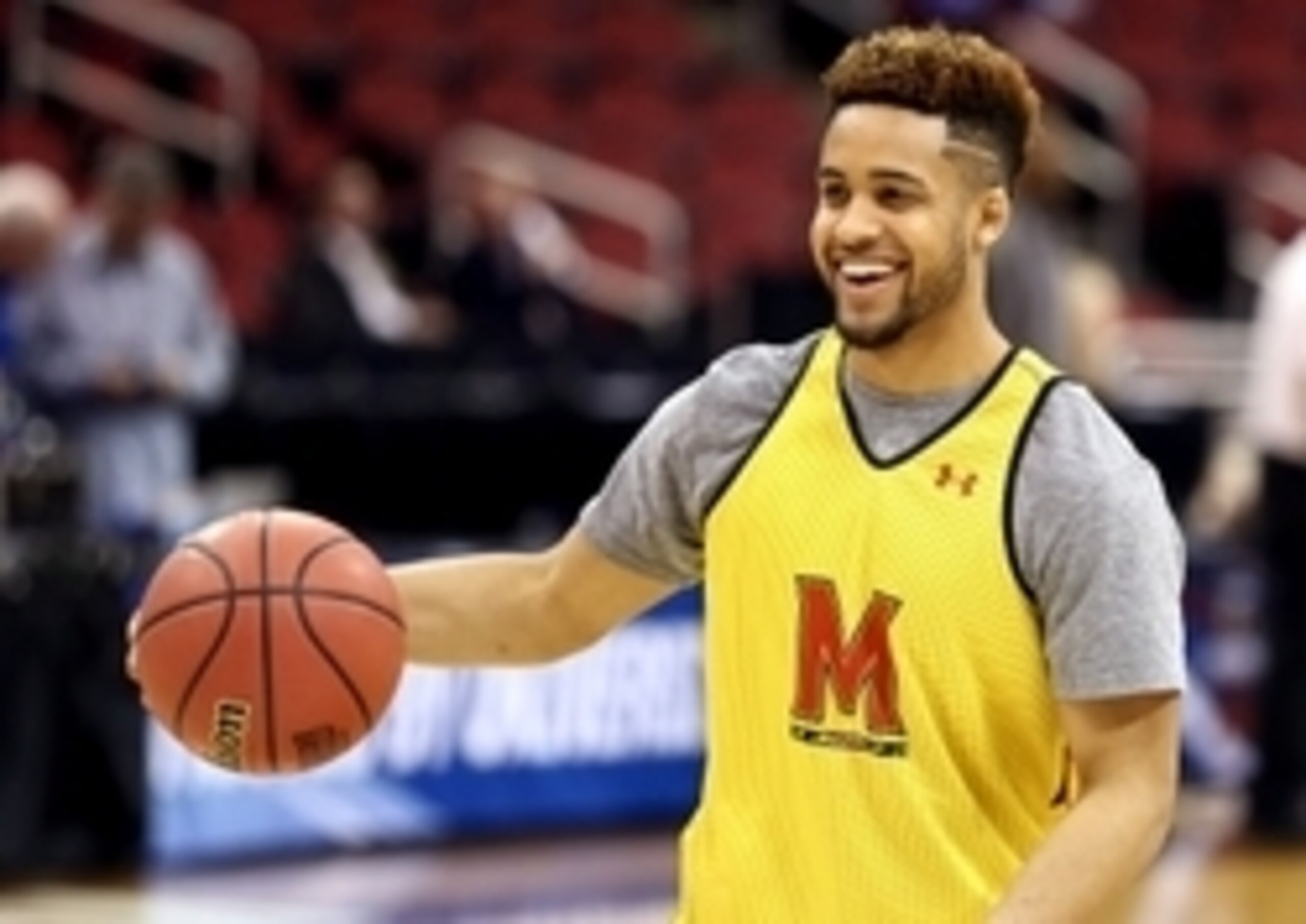
2015-16 Stats: 14.8 PPG, 4.9 APG, 3.6 RPG, 1.3 SPG
Despite losing all four of his teammates from last year's primary starting five, Melo Trimble is good enough that some people are still buying stock in the Terrapins as a Top 25 team.
If his three-point stroke returns to form, it's a reasonable assumption. Trimble shot 41.2 percent from downtown as a freshman, but he only hit 31.4 percent this past season—even though he was getting more frequent open looks in the pick-and-pop offense with Robert Carter.
In every other area of the game, Trimble was either as good as or better than he was in year No. 1. With a stud in Diamond Stone at his disposal in the paint, Trimble became more lethal as a slasher, improving his two-point percentage while also drastically increasing his assist rate. He didn't draw nearly as much contact as he did as a freshman, but he still averaged more than five free-throw attempts per game and sank 86.3 percent of them for a second consecutive season.
This year's Terrapins will be loaded with talent on the perimeter, but not so much in the paint. As a result, look for them to spread the floor, repeatedly putting Trimble in penetrating situations where he is one of the best in the business.
2. Dillon Brooks, Oregon
25 of 26
2015-16 Stats: 16.7 PPG, 5.4 RPG, 3.1 APG, 1.1 SPG
Dillon Brooks is a jack of all trades who might be the best all-around player in the country.
He's not a great shooter (33.8 percent from three-point range in his collegiate career), but he knows how to score better than most. He's not a world-class athlete, but he defends, passes and rebounds at a high level, and he does it all with a swagger that opposing coaches don't always appreciate.
Best of all, he's an even better leader than we expected. After Joseph Young graduated, there were concerns that Oregon would falter without a clear star. But Brooks rose to the challenge and carried the Ducks to new heights, earning a No. 1 seed for the first time in school history.
As Tyson Alger wrote for the Oregonian in January, Brooks is a determined, hard worker. "A player who wants to win so badly he'll do whatever it takes." And if he gets even better in his third (and final?) season, Oregon could be in the Final Four for the first time since 1939.
1. Grayson Allen, Duke
26 of 26
2015-16 Stats: 21.6 PPG, 4.6 RPG, 3.5 APG, 1.3 SPG, 41.7% 3PT
The Blue Devils are absolutely loaded with talent. Similar to Kentucky during its 38-1 season, the top five players on Duke's bench might rank in the top 10 among the nation's best starting lineups. It wouldn't be much of a surprise if Mike Krzyzewski makes more of an effort to spread the wealth than in recent years, ending up with eight or nine players who put up big numbers rather than two or three that score a ton.
But if any Blue Devil is going to separate from the pack and serve as the alpha dog, it's the junior who scored 779 points in 2015-16.
After barely touching the court as a freshman (9.2 MPG), Grayson Allen was a nearly unstoppable wrecking ball as a sophomore. He had one frustrating game against Kentucky and another disappointing output against Utah while battling flu-like symptoms, but he scored at least 14 points in every other contest. Despite playing alongside a presumed top-two pick in this year's draft (Brandon Ingram), Allen was named the KenPom MVP in 14 of Duke's 36 games.
And while we obsessed over his scoring prowess, Allen also developed into a solid passer, doling out 3.9 assists per 40 minutes compared to 1.7 as a freshman. Granted, he had Tyus Jones and Quinn Cook to shoulder that load in 2014-15, but Allen's evolution into more of a combo guard only makes him that much more impossible to stop.
Kerry Miller covers college basketball for Bleacher Report. You can follow him on Twitter @kerrancejames.
.png?w=2560)
.jpg?w=2560 "Colts Football")





