


There are only four active coaches in men's college basketball with at least 725 career wins, and they all reside in the ACC: Mike Krzyzewski (1,043), Jim Boeheim (989), Roy Williams (783) and Rick Pitino (743). Thus, power ranking this conference's coaches isn't that far off from power ranking the greatest coaches in the game today.
At any rate, that's what the top of the list feels like. And the top challengers to that quartet aren't too shabby, either, as Tony Bennett is arguably one of the 10 best head coaches in the country, while Mike Brey and Jim Larranaga belong somewhere in the top 25 on the national hierarchy.
You could try to argue that another conference is better than the ACC in terms of recent success, but only a fool would put the ACC anywhere other than No. 1 on a ranking of conferences by coaching prowess.
Before we start drooling over those legends, though, we need to wade through a handful of coaches that might be lucky to still have a job one year from today.
The Bottom 6
1 of 10
15. Danny Manning, Wake Forest
Four years, .477 career win percentage, .381 win percentage at Wake, one NCAA tournament
After two solid seasons at Tulsa, Manning was supposed to be the man to bring Wake Forest back to national relevance. Instead, the Demon Deacons have gone from bad to worse, winning five ACC games in his first year and just two this past season. We'll find out in about 10 months how patient Wake Forest is going to be with Manning, because it's shaping up to be another brutal season in Winston-Salem.
14. Jim Christian, Boston College
14 years, .570 career win percentage, .313 win percentage at BC, two NCAA tournaments
Christian's tenure in the ACC has been decidedly worse than Manning's, but what more could he have done? Ryan Anderson and Joe Rahon left the program before he could use them and Lonnie Jackson appeared in just three games before also transferring. He's doing what he can with graduate transfers and recruits, but it has to be nearly impossible to convince quality players to come hang out in the basement of the ACC.
But at least Christian had some prolonged success elsewhere. He won 20 or more games in each of his eight seasons with Kent State and Ohio. Boston College simply may be too much of a rebuilding situation for him to fix.
13. Brad Brownell, Clemson
14 years, .614 career win percentage, .552 win percentage at Clemson, four NCAA tournaments
Brownell was the toughest coach to place, but what exactly has he built? His first season at each stop has been great, going a combined 69-29 and making the tournament in each of his debut seasons with UNC-Wilmington, Wright State and Clemson. In the other 11 years, though, he's 205-143 (58.9 percent) with only one NCAA tournament appearance.
Brownell has done a great job with the rosters he has inherited and only has one sub-.500 season in his career, but there's a fine line between avoiding failure and being successful.
12. Kevin Stallings, Pittsburgh
23 years, .617 career win percentage, N/A win percentage at Pitt, nine NCAA tournaments
Welcome to the ACC, where 17 years of winning a combined 60.1 percent of games at a SEC program is only good enough to not quite be the worst coach in the conference. Stallings had a good run with the Commodores from 2007-12, reaching five tournaments in the span of six years. However, his most recent four seasons were rather disappointing. He'll need to prove he can win at Pittsburgh before we can start to consider him one of the above-average coaches in the ACC.
11. Buzz Williams, Virginia Tech
Nine years, .599 career win percentage, .456 win percentage at VT, five NCAA tournaments
Buzz Williams fell into one heck of a great situation at Marquette when Tom Crean left to take over the Indiana job, inheriting all four of the leading scorers from a 25-10 squad and signing JUCO transfer Jimmy Butler within 10 days of becoming the Golden Eagles' head coach.
His transition to Virginia Tech, though, could not have been more different. He lost six of the nine leading scorers from a team that went 9-22, but the Hokies won 20 games by his second season at the helm. If he can complete the rebuild this season with a NCAA tournament appearance, he would be well on his way to a spot in the top six.
10. Josh Pastner, Georgia Tech
Seven years, .696 career win percentage, N/A win percentage at GT, four NCAA tournaments
Like Williams, Pastner was put in a position to succeed, taking over a Conference USA juggernaut that John Calipari had led to a 137-14 record over the previous four seasons. Since Memphis realigned to the AAC before the 2013-14 season, though, Pastner's coaching career has been marred by disappointing play and a transfer epidemic.
Also like Williams, Pastner dodged the ax by pre-emptively skipping town to take over an ACC team in rebuilding mode. We shall see if he can quickly do for the Yellow Jackets what Williams has done for the Hokies.
9. Leonard Hamilton, Florida State
2 of 10
Career: 28 years, 478-397 (54.6%), seven NCAA tournaments
Tenure at FSU: 14 years, 278-187 (59.8%), four NCAA tournaments
Between his mediocre winning percentage and the fact that his teams have only gone dancing 25 percent of the time, one could easily make the case that Leonard Hamilton belongs in the bottom six—or even the bottom three. We expect more out of someone who has spent his entire career with major conference programs (Oklahoma State, Miami and Florida State).
However, Hamilton deserves some extra credit for turning those three teams around. They didn't become annual staples in the NCAA tournament, but they became much better .
Oklahoma State was 40-44 in the three years before Hamilton's first head coaching job, but he made the Pokes respectable again in just a couple of seasons, setting the stage for Eddie Sutton to take over and dominate for more than a decade.
Likewise, Miami was floundering before Hamilton's arrival, but after going 34-80 in his first four seasons, the Hurricanes won at least 15 games in each of the next six seasons before Hamilton's failed venture into the NBA (19-63 with the 2000-01 Washington Wizards).
And Florida State won just 39 percent of games in the four seasons before hiring Hamilton, but the Seminoles have finished above .500 in each of the past 11 years.
Still, seven tournament appearances in 28 seasons is tough to ignore, particularly with none of those trips coming in the past four years.
8. Mark Gottfried, NC State
3 of 10
Career: 19 years, 386-224 (63.3%), 11 NCAA tournaments
Tenure at NC State: Five years, 108-69 (61.0%), four NCAA tournaments
No. 8 is the midpoint of the ACC rankings, and "perfectly average" feels like an apt description of Mark Gottfried's coaching career.
That may seem like a harsh assessment of a coach who has had more than half of his seasons end with a NCAA tournament appearance, but only two of those 11 teams (Alabama in 2002 and 2005) received a No. 7 seed or better—and he went 1-2 in those tournaments with the Crimson Tide. In nearly two decades, Gottfried has only been to one Elite Eight.
Moreover, NC State could have been great for the past five years.
Remember the 2012-13 season? The Wolfpack were ranked No. 6 in the preseason with a returning core of Richard Howell, C.J. Leslie, Lorenzo Brown and Scott Wood and a strong incoming class headlined by T.J. Warren, Rodney Purvis and Tyler Lewis. But they sputtered all season long, earning a No. 8 seed and losing their first game of the tournament.
Even the following year should have been special with Warren putting up huge numbers and Cat Barber making a fine debut as a freshman, but they just barely sneaked into the tournament in a play-in game.
Transfers certainly haven't helped Gottfried's cause, either. Purvis and Tyler Harris each lasted just one season at NC State before leaving. Lewis, Kyle Washington, Caleb Martin and Cody Martin all left after two years.
Perhaps we should be impressed that Gottfried has been able to win games despite losing so many players from programs that aren't renowned for their ability to recruit basketball players in the first place. Instead, we're left wondering how much more some of his teams could have done.


7. Jim Larranaga, Miami
4 of 10
Career: 30 years, 560-366 (60.5%), seven NCAA tournaments, one Final Four
Tenure at Miami: Five years, 118-57 (67.4%), two NCAA tournaments
Only five current ACC head coaches have ever been to the Final Four: The four legends at the top of this list and Jim Larranaga. That magical run with George Mason in 2006 will live on in NCAA tournament lore forever and can never be taken away from Larranaga's career.
But what if it hadn't happened? How would we view Larranaga's coaching career if Denham Brown's three-point attempt at the buzzer had fallen and Connecticut kept George Mason from reaching the Final Four?
After a lackluster 11 years with Bowling Green, it wasn't until his 13th season as a head coach that Larranaga finally made it to the Big Dance. And while each of the coaches in our top six seems to get there every single year, he has not yet made it to the tournament in consecutive seasons in a career spanning three decades.
In total, Larranaga has gone to the NCAA tournament in just 23.3 percent of his seasons. Boston College's Jim Christian (14.3 percent) is the only ACC coach with a lower success rate in that category. Larranaga does have three Sweet 16 appearances, but that Final Four run—now more than a decade ago, in case you weren't already feeling old—was his only trip to the Elite Eight.
But let's not act as though he was afforded the same opportunities as a coach like Roy Williams or Jim Boeheim, each of which has spent his entire career with outstanding programs that were successful long before they took over. Larranaga spent 25 of his 30 seasons with Bowling Green and George Mason—two minor conference programs with a combined tournament record of 1-6 in the portions of their history during which he wasn't the head coach.
Larranaga is the only coach in our top nine to have spent at least 33 percent of his seasons at a non-major program, and he did so for 83.3 percent of his career. Rather than wondering where he would rank without that Final Four appearance, maybe we should build him a statue for the achievement.
6. Mike Brey, Notre Dame
5 of 10
Career: 21 years, 455-229 (66.5%), 13 NCAA tournaments
Tenure at Notre Dame: 16 years, 356-177 (66.8%), 11 NCAA tournaments
For most of his career, the postseason had not been kind to Mike Brey. Though he made the NCAA tournament 11 times in his first 19 seasons, he had just six wins and one Sweet 16 appearance to show for it.
After consecutive trips to the Elite Eight, however, it's time for more people to acknowledge that Brey is one of the best in this business.
Notre Dame has a rich history, winning at least 20 games 17 times between 1968-89, including 10 Sweet 16s and one Final Four. But the Fighting Irish were a bit of a train wreck in the decade before Brey took over. They had a combined record of 140-159 and had missed the NCAA tournament 10 straight times.
No matter. Brey came in and won 20, 22 and 24 games in his first three seasons, including a combined four wins in those three NCAA tournaments. And while the game gravitated more toward play-making guards, Brey embraced big men wholeheartedly, turning guys like Torin Francis, Luke Harangody, Tim Abromaitis, Carleton Scott, Jack Cooley and Garrick Sherman into household names.
Save for the 2013-14 season in which Jerian Grant was ruled academically ineligible after 11 games, Brey has won at least 53 percent of his games in every year since 1997-98. There haven't been many great seasons, but he has consistently built quality teams—despite only signing a handful of McDonald's All-Americans in his career.
5. Tony Bennett, Virginia
6 of 10
Career: 10 years, 234-105 (69.0%), six NCAA tournaments
Tenure at UVA: Seven years, 165-72 (69.5%), four NCAA tournaments
At just 46 years young, Tony Bennett is already as good as they come. ESPN had Bennett at No. 14 on its list of the best current coaches two summers ago—before leading Virginia to a 59-12 record over the past two seasons. An apprentice of both his father (Dick Bennett) and Bo Ryan, Tony Bennett is already the best defensive coach in the nation.
Despite a great first decade in the business, it's impossible for him to stack up against our top four, who have a combined 139 years of head coaching experience with 32 Final Fours and 10 national championships.
Among the mere mortals, though, Bennett is the head of the class and is only a few retirements away from becoming the best head coach in the ACC.
But if we just look at the recent past as opposed to the entirety of these coaching careers, isn't there an argument to be made that he's already there?
Virginia is 45-9 in ACC play over the past three seasons. The next-best team during that window is Duke at 39-15. Since the start of the 2013-14 season, Bennett is 3-1 against Jim Boeheim, 3-1 against Rick Pitino and 3-2 against Roy Williams. He hasn't quite had Mike Krzyzewski's number (1-3), but those three losses were by a combined margin of 11 points, so he's close.
The next step is a national semifinal, because until Bennett gets to the Final Four, his legacy as a head coach is unfortunately little more than that of a regular-season tactician whose teams aren't built to go all the way. At least he has a few more decades to fix that.
4. Jim Boeheim, Syracuse
7 of 10
Career: 40 years, 989-347 (74.0%), 32 NCAA tournaments, five Final Fours, one title (2003)
Tenure at Syracuse: Same as above
Hard to believe that the coach who is No. 2 on the all-time wins list* could possibly be considered the fourth-best coach in a conference, but such is life in the ACC.
In addition to the accolades listed above, Jim Boeheim has 10 Big East regular-season titles, 18 Sweet 16 appearances and a grand total of 57 NCAA tournament wins over the past four decades—good for fourth all-time behind Mike Krzyzewski (88), Roy Williams (70) and Dean Smith (65).
Boeheim has never finished below .500 in a season. In fact, he hasn't come particularly close, never finishing below .550 and only coming in below .600 three times. In 39 of his 40 seasons, the Orange spent at least one week ranked in the AP poll, including 25 seasons with at least one week in the Top 10 and five seasons at No. 1.
Though he "only" has one national championship and five Final Four appearances, Boeheim has constructed one of the most consistently dominant programs in the nation. Syracuse is currently fifth all time in wins (predictably only behind Kentucky, Kansas, North Carolina and Duke) thanks in tremendous part to 40 years of winning roughly three out of every four games.
And while many coaches have sputtered to the finish line before finally hanging up their suit and tie for good, Boeheim is going stronger than ever at 71 years old. Syracuse has been to the Final Four twice in the past four years, went 34-3 five seasons ago and opened the 2013-14 season with 25 consecutive wins.
We'll see what tricks he has left up his sleeve after losing all three of last year's leading scorers, but we might as well pencil the Orange in for at least 20 wins. Boeheim always seems to get them there.
*Technically, Boeheim is No. 3 on the list. Sports-Reference.com evidently doesn't care about the NCAA's decision to strip Boeheim of more than 100 wins as a result of his lack of institutional control. But read this slide again in mid-December and he'll be back ahead of Bobby Knight anyway.
3. Rick Pitino, Louisville
8 of 10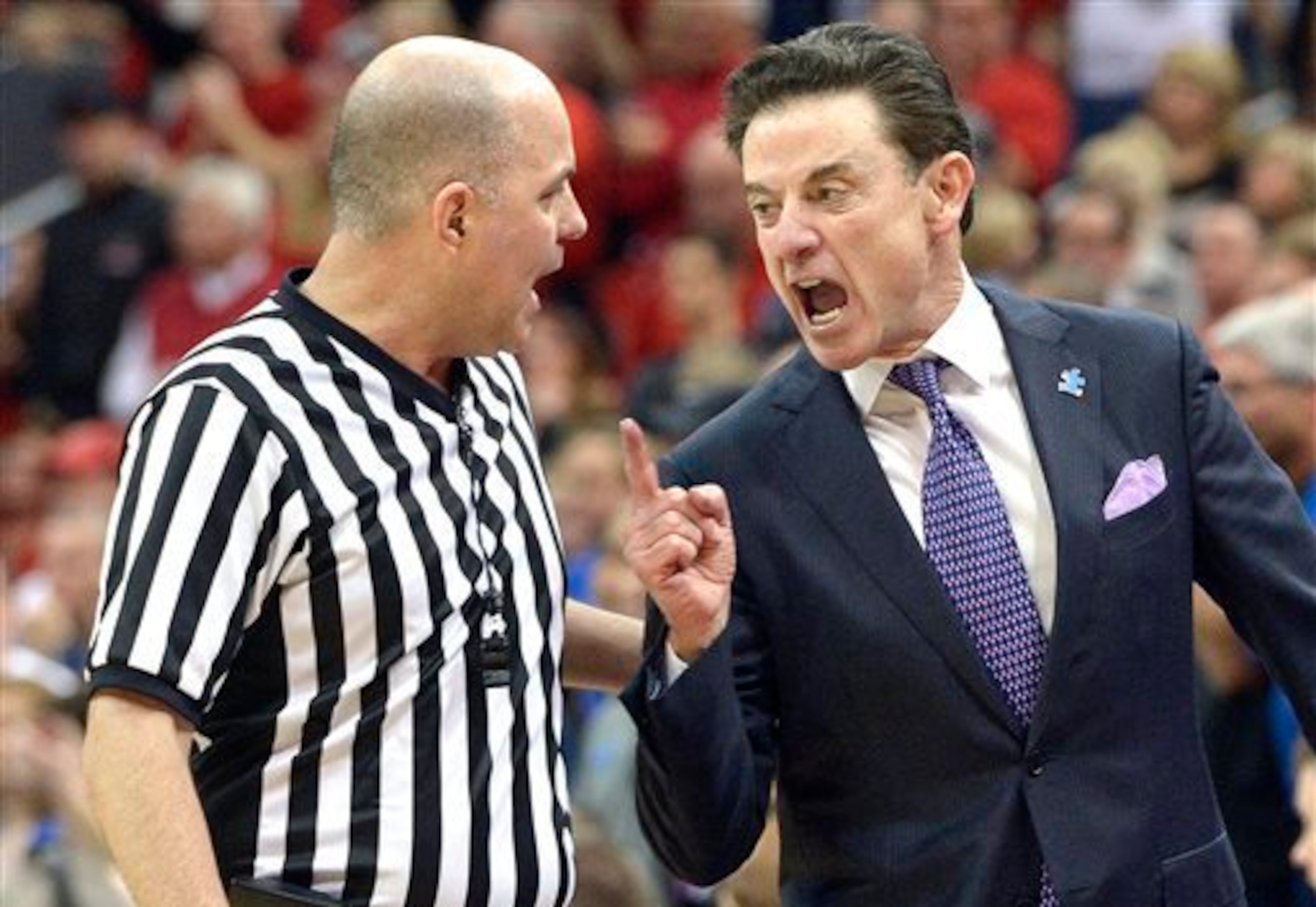
Career: 30 years, 743-258 (74.2%), 20 NCAA tournaments, seven Final Fours, two titles (1996 and 2013)
Tenure at L'Ville: 15 years, 391-134 (74.5%), 12 NCAA tournaments, three Final Fours, one title
It's a shame Rick Pitino spent eight years (over three separate stints) pursuing a career as a coach in the NBA, because he could have been the winningest coach of all time if he had just stayed in the college realm.
Pitino has averaged 24.8 wins per season in his career, but let's play it safe and assume he would have won 20 per season lost to the NBA. That's another 160 wins, putting him at 903 in his career—140 behind Mike Krzyzewski, who is older than Pitino by five-and-a-half years. It's hardly a lock, but it would have been close.
Even without those eight years, Pitino has done incredibly well—ongoing prostitution scandal, notwithstanding.
He's the only coach in NCAA history to win a national championship with two different programs (Kentucky and Louisville), and if we ignore the Final Four appearances John Calipari had vacated at Massachusetts and Memphis, Pitino is also the only coach to lead three different schools to the Final Four (Kentucky, Louisville and Providence). Just for good measure, he also led Boston University to the NCAA tournament back in the early 1980s.
Dating back to the 1990-91 season, Pitino is 596-170 (77.8 percent) in 22 seasons with the Wildcats and Cardinals, tallying at least 19 wins in each season, 25 wins in 15 seasons and 30 wins in eight seasons. In all but one of those years (2001-02 with Louisville), his team spent at least one week ranked No. 16 or higher in the AP poll.
Also, no one is capable of donning a white suit quite like Pitino.
2. Roy Williams, North Carolina
9 of 10
Career: 28 years, 783-209 (78.9%), 26 NCAA tournaments, eight Final Fours, two titles (2005 and 2009)
Tenure at UNC: 13 years, 365-108 (77.2%), 12 NCAA tournaments, four Final Fours, two titles
In literally any other conference, Roy Williams would be No. 1.
Among active coaches, only Gonzaga's Mark Few has a higher winning percentage (80.8), and Few hasn't faced anything close to the level of competition Williams has had to deal with in his 28 years at Kansas and North Carolina.
Williams has averaged 28 wins per season (let that number sink in for a moment) and has only missed the tournament twice in his career—which includes his first season at Kansas when the Jayhawks were ineligible for postseason play. He has twice as many seasons (six) with a winning percentage greater than .890 as he has seasons with a winning percentage worse than .680 (three).
Williams won nine Big 12 regular-season championships with Kansas and has seven with North Carolina. And for a coach who hasn't much cared for conference tournaments, he has hidden it well by winning seven of them—four at Kansas and three at North Carolina.
Any way you slice it, Williams has been phenomenal.
The only problem is that he didn't become a head coach until he was 38 years old.
Mike Krzyzewski, on the other hand, was the head coach of Army at the age of 28. So, even though they're only separated by three-and-a-half years in age, Coach K is 260 wins ahead of Williams, largely because Coach K had 247 career wins before Williams got his first.
Even if we cut out the 1975-88 portion of Krzyzewski's career, though, he still has Williams' number in Final Four appearances (10-8) and national championships (5-2). But if North Carolina had been able to beat Villanova this past April, there would have been an undeniable case for Williams on the Mount Rushmore of greatest college basketball coaches of all time—alongside Krzyzewski, John Wooden and Adolph Rupp.
1. Mike Krzyzewski, Duke
10 of 10
Career: 41 years, 1043-321 (76.5%), 32 NCAA tournaments, 12 Final Fours, five titles (1991, 1992, 2001, 2010, 2015)
Tenure at Duke: 36 years, 970-262 (78.7%), 32 NCAA tournaments, 12 Final Fours, five titles
We've mentioned him so many times to this point on the list that you cannot possibly be surprised with Mike Krzyzewski at No. 1.
Forget about the ACC, though. The only debate at this point is whether Krzyzewski is the greatest college basketball coach in history, and it's a debate that won't go away any time soon.
He'll never catch John Wooden for national championships. Coach K has five of them in 41 years while Wooden insanely won 10 in a span of 12 years. The Bruins went 335-22 (93.8 percent) from 1964-75, including four undefeated seasons. Even Connecticut's women's college basketball team hasn't yet had a 12-year run quite that dominant, so it's impossible to imagine a men's team doing it.
But what makes Krzyzewski's case so strong is how successful he has been through changing times and increased difficulty.
Months went by during Wooden's run where UCLA was the only ranked team in its conference. There was no three-point line and players stayed for at least three seasons. At its apex, the NCAA tournament was only 32 teams, and UCLA was always placed in the West Region, feasting on the same teams it was out-recruiting on an annual basis.
I'm not saying Wooden had it easy, but it's doggone impressive how consistently dominant Krzyzewski has been for more than three decades in what is annually one of the top three conferences in the country—while also expertly navigating the addition of the three-point line, the one-and-done era and the ongoing transfer mania.
Trying to compare the two iconic coaches is like trying to decide whether Usain Bolt or the greatest marathoner of all time is actually the best runner. But let's just agree that Krzyzewski is the greatest coach of the modern era and put the argument to rest until his next national championship.
Kerry Miller covers college basketball for Bleacher Report. You can follow him on Twitter @kerrancejames.
.jpg?w=2560 "LA Premiere of \"Chad Powers\"")



.jpg?w=2560 "Ugly Jets Scoring Stat 😳")
.jpg?w=2560 "Landing Spots for Trade Candidates 📍")