

DeForest Buckner Could Be the 2016 NFL Draft's Most Complete Defender
There’s an annual game we play in April as the days crawl by prior to the NFL draft. It starts off as a brain teaser and can end in torture.
We ask ourselves what the perfect prospect would look like at position X if we could assemble a football Frankenstein, plucking physical attributes or skills from multiple sources and then bringing them together to form one superhuman force. At quarterback, for example, maybe we would put Cam Newton’s legs with Aaron Rogers’ accuracy and Peyton Manning’s intelligence.
But at one position in the 2016 draft, we may not need to spend hours in our evil football lair, sewing different parts together. Conveniently, defensive end DeForest Buckner already comes fully assembled.

.jpg?w=2560 "Rams Eagles Football")

Just ask a coach who’s quite familiar with the chaos Buckner unleashed during his time with the Oregon Ducks.
"If you're building a defensive lineman, that's what you build,” said Stanford head coach David Shaw, via Dane Brugler of CBSSports.com.
Buckner is likely the most complete overall defender in his draft class, with both skill and physical components fitting together seamlessly. In a draft oozing with talent along the defensive line, he could quickly emerge as a versatile asset at the next level.
From a size and length standpoint, he’s cut from the standard 3-4 defensive end cloth. Buckner stands 6’7” and weighs 291 pounds with 34 ⅜-inch arms, and at 11 ¾ inches, his hands are roughly the size of your average minibar fridge.
Sam Monson from Pro Football Focus recently did a little experiment to confirm the obvious: Normal human hands are swallowed by Buckner’s mitts.
But he’s not just a one-dimensional run-stuffer. He’s also not just a brute on the inside who eats up space. And he’s not just a pass-rusher capable of causing havoc and taking up residency in the opposing backfield.
He’s all of those things, all at once.
An extra year of college football helped Buckner to mature into a dual-threat defender. He returned to the Ducks in 2015 and exhausted his college football eligibility.
A decision driven by education seemed questionable from a football perspective at first. Bucker told Ryan Thorburn of the Register-Guard that he had people telling him he could have been a top-20 pick in 2015. But he came back for a fourth and final year to finish his degree, even though that meant risking injury and potentially seeing his already rising draft stock plummet.
That effort was successful in the classroom, with Buckner earning his undergraduate degree in general social science. Of course, his education didn’t stop there, as the extra development time led to bounding strides forward on the football field. Buckner honed his technique to become a more well-rounded defender.
He was always a rampaging menace while pursuing the quarterback, frequently ripping past opposing guards and tackles for decisive penetration. Getting there and being that constant disruptor wasn’t a problem. No, finishing the job was Buckner’s issue and the chip out of his oversized armor.
Then, suddenly in 2015, that weakness evaporated as Buckner grew from pressure-bringer to play-ender.
“The first thing that DeForest really improved on was his pass rushing,” Don Pellum, Oregon’s defensive coordinator the past two seasons, told the Register-Guard. “His hands got better, his hips got better, and I think that’s one of the reasons he started to become a dominant force.”
The result of those improvements after an offseason of dedicated work showed up in the form of a ballooning sack total. Buckner went from a mediocre four sacks in 2014 to 10.5 in 2015. That was only the beginning of a leap that has him perched as PFF’s top-rated interior lineman and, even better, the third-best prospect overall in 2016.
Buckner earned those accolades by posting production that dwarfed his position peers. He recorded 67 pressures in 2015, per PFF. That led all 3-4 defensive ends and was nine more than any other interior lineman. Also filed under absurd: That pressure total was 17 more than the output from former USC standout Leonard Williams in 2014.
The New York Jets selected Williams with the sixth overall pick last spring, and it’s easy to envision a near future with Buckner hearing his name around the same draft territory. Before the Tennessee Titans traded away their first overall pick, there was chatter about the 22-year-old becoming the draft’s top selection, per Jeff Dooley of the Washington Post.
We can put that to rest now after the Los Angeles Rams leapfrogged ahead and will be targeting a quarterback at No. 1. But Buckner still might not escape the top three, as he's an ideal fit to give the San Diego Chargers’ floundering pass rush a swift kick in the rear.
He’ll be the best player available for any 3-4 defense, and the Chargers hold the highest pick (No. 3) among the pass rush-needy teams using that scheme after a season when they finished with just 32 sacks (24th).
Drafting a pass-rusher who routinely converted pressure into production would go a long way toward halting that spiral. As CFB Film Room noted, Buckner’s percentage of pressures resulting in sacks put him among the nation’s leaders—well ahead of Ohio State’s Joey Bosa:
He kept that percentage high while often using sheer strength, which Buckner has in abundance. But it’s easy to get extra giddy about his NFL potential because he doesn’t lean solely on that raw power. As Monsoon also observed, only 11 of Buckner’s 67 pressures in 2015 came when he was bull rushing.
Buckner is able to keep opposing blockers at a distance and off balance by first using his length and then alternating between charging through them and ripping around them with his quick hands. And although bending around the corner may not be his strength, he can still do that effectively enough considering his size.
You don’t have to look far on Buckner’s game film to find examples of his clawing in tight spaces and the hand work that leaves offensive linemen stumbling. One such move ended with Buckner on top of the quarterback during a two-sack game against Washington State in 2015.
Buckner’s multidimensional skill set makes him an outlet for any defensive coordinator’s creativity. He can be shifted throughout the formation, and although the 2015 Pac-12 defensive player of the year was primarily used as a 3-4 end during his final college season, he also slid inside and was even sometimes over the center as a nose tackle.
On this obvious passing down for Washington State (it was 3rd-and-18), the Ducks used a sub-package, shifting Buckner to the defensive tackle position. When he charged ahead, guard Gunnar Eklund shifted to his left and then attempted to anchor down there, hoping to direct Buckner toward the inside where help waited.
But Buckner had other plans. He sensed the guard was off balance and hadn’t yet established a firm base. He also knew there was space available on the right with a decisive swat-and-swim move to counteract Eklund’s momentum.
So Buckner went to work. He kept his powerful legs pumping through contact, moving toward that opening. Then with one mighty windup, he sent Eklund staggering.
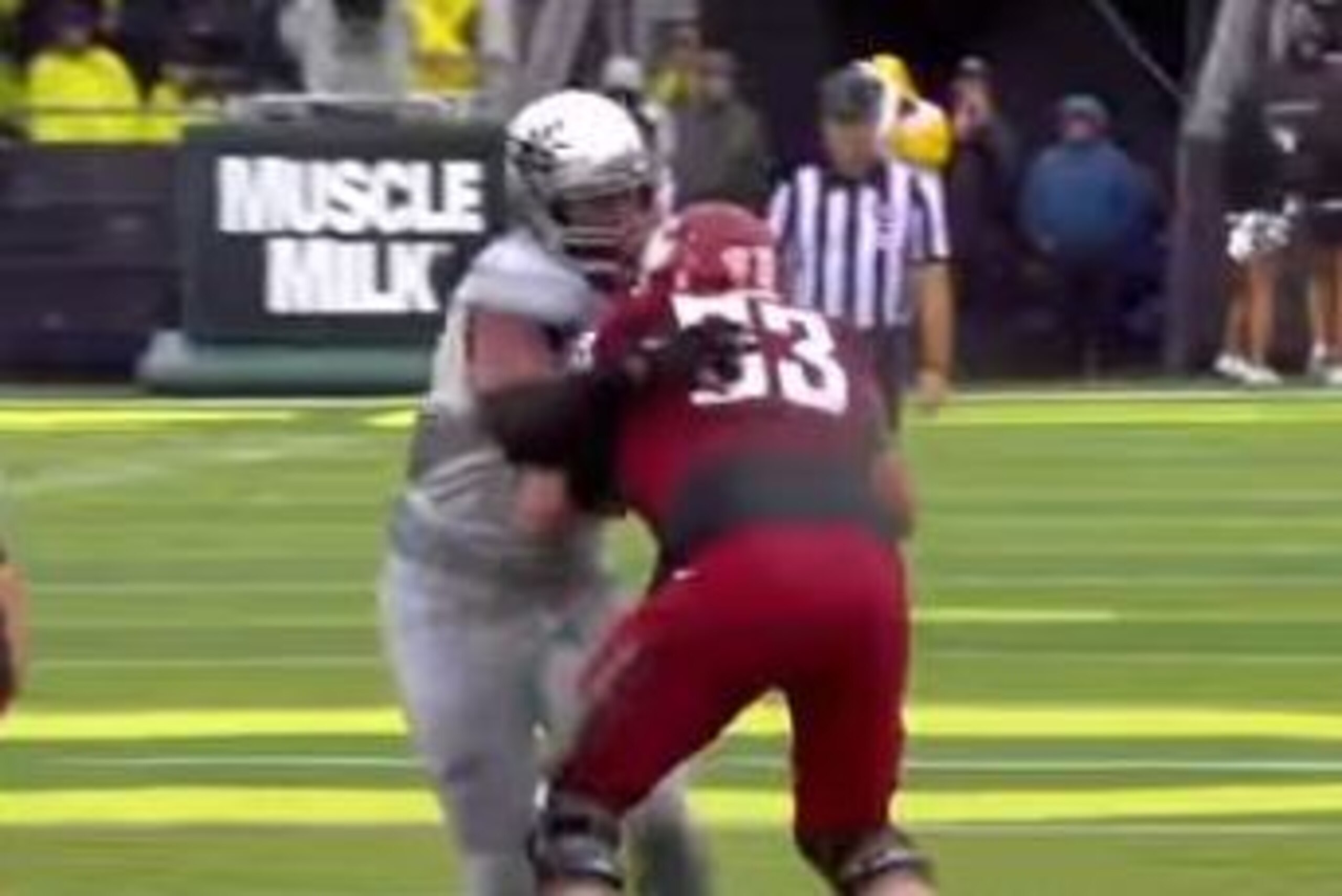
This next step was where Buckner sometimes struggled in 2014. He would collapse the pocket with either his strength or skilled hands (or both) and win easily after the snap. Then he’d lack the closing speed to finish the job.
Often, the issue lied in his angle, with Buckner taking a poor one in his pursuit. Not this time, as he stayed tight around the blocker after his swim move…
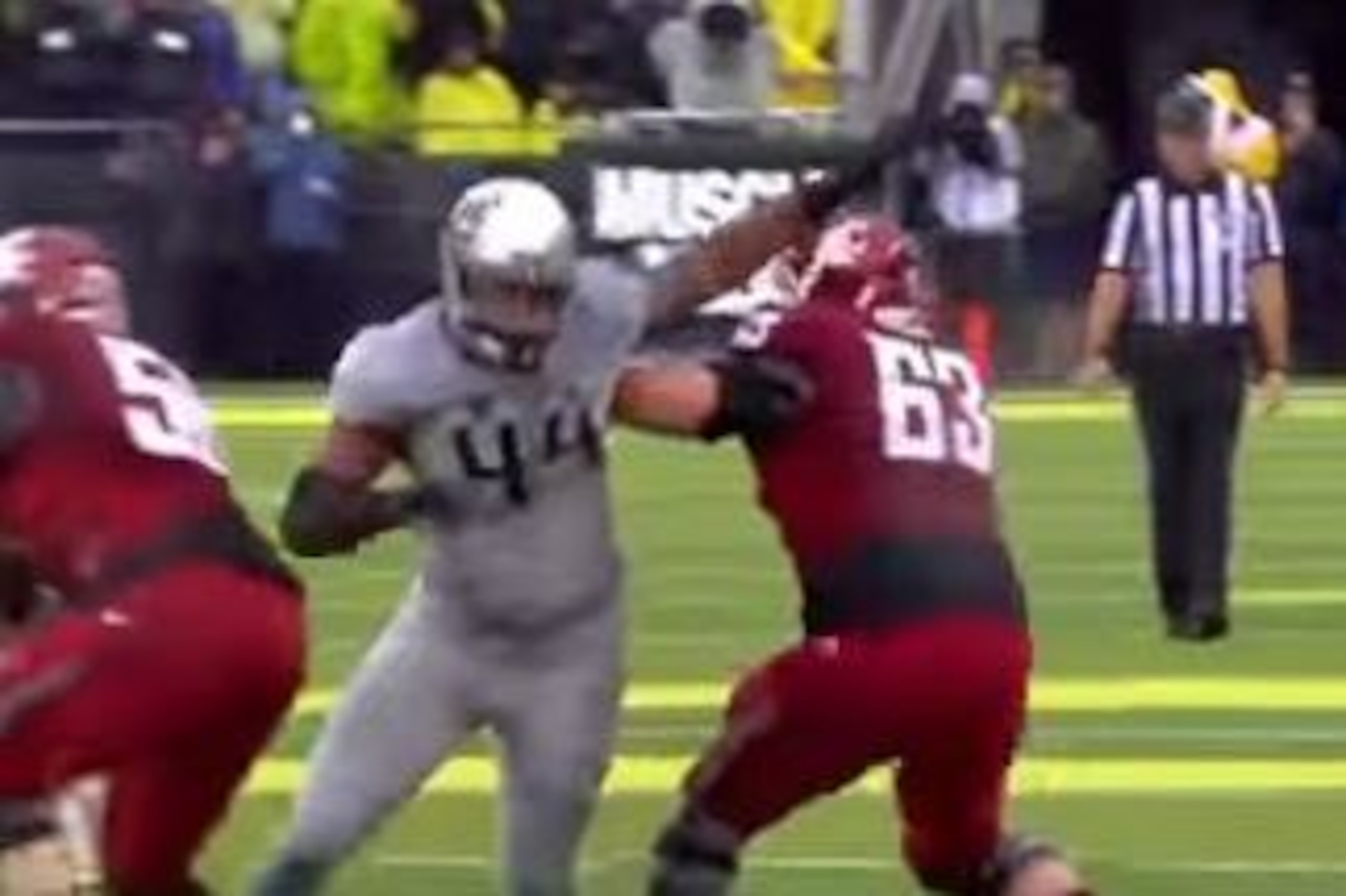
And recorded one of his 18 sacks over four seasons at Oregon.
He put his length to use there, able to engage early to take control. That’s also how he becomes a looming, lane-clogging presence against the run.
Buckner uses his long arms to create and keep leverage, driving guards deep into the backfield and forcing the running back into changing his direction early. He then utilizes that same length to set the edge, shedding blocks and sealing off the outside.
He piled up 30 tackles for a loss over the past two seasons. And he collected 36 run stops in 2015, per PFF, which led to the fifth-highest run-stop percentage among all 3-4 defensive ends.
Oh, and if that’s not enough, he's batted down nine passes at the line of scrimmage since 2014. That includes five in 2015, which tied Buckner for third in the nation.
He's not just a pass-rusher or a run-stuffer. He's whatever you want him to be. Or rather, he’s everything you want him to be.
First and foremost, he’s a quarterback-terrorizer, with the strength and quickness in close quarters to consistently reach his desired destination as a pass-rusher. Then, his skill as a run-stopper doesn’t lag far behind after Buckner posted that sparkling run-stop percentage during a season when he played more snaps than any other interior defensive lineman, according to Sports Illustrated’s Doug Farrar.
He can help to solve two problems with one pick. He’s the complete package and one of the best defenders in this draft.
He’s also one of the best players in this draft. Period.
.jpg?w=2560 "Texans-Mixon Released Football")
.jpg?w=2560 "Grading WWE Raw 🔠")


.jpg?w=2560 "Bijan's INSANE 1st Half 🤩")
