What These Hot Seat College Football Coaches Must Do in 2016 to Keep Their Jobs
Coaching stability in college football has reached an all-time low. New hires are starting out on the hot seat, and all it takes is one season where expectations aren't met to put a coach's job in jeopardy.
This isn't going to change anytime soon, not with the game's increasingly high-stakes environment. Instead, coaches have had to learn to adapt and, more importantly, survive. And even that might not be enough.
A dozen FBS coaches were fired either during or after the 2015 season, and several of them could have saved their jobs had they done some things differently. It's too late for them, but not for coaches who will head into 2016 on the hot seat.
Tim DeRuyter, Fresno State
1 of 7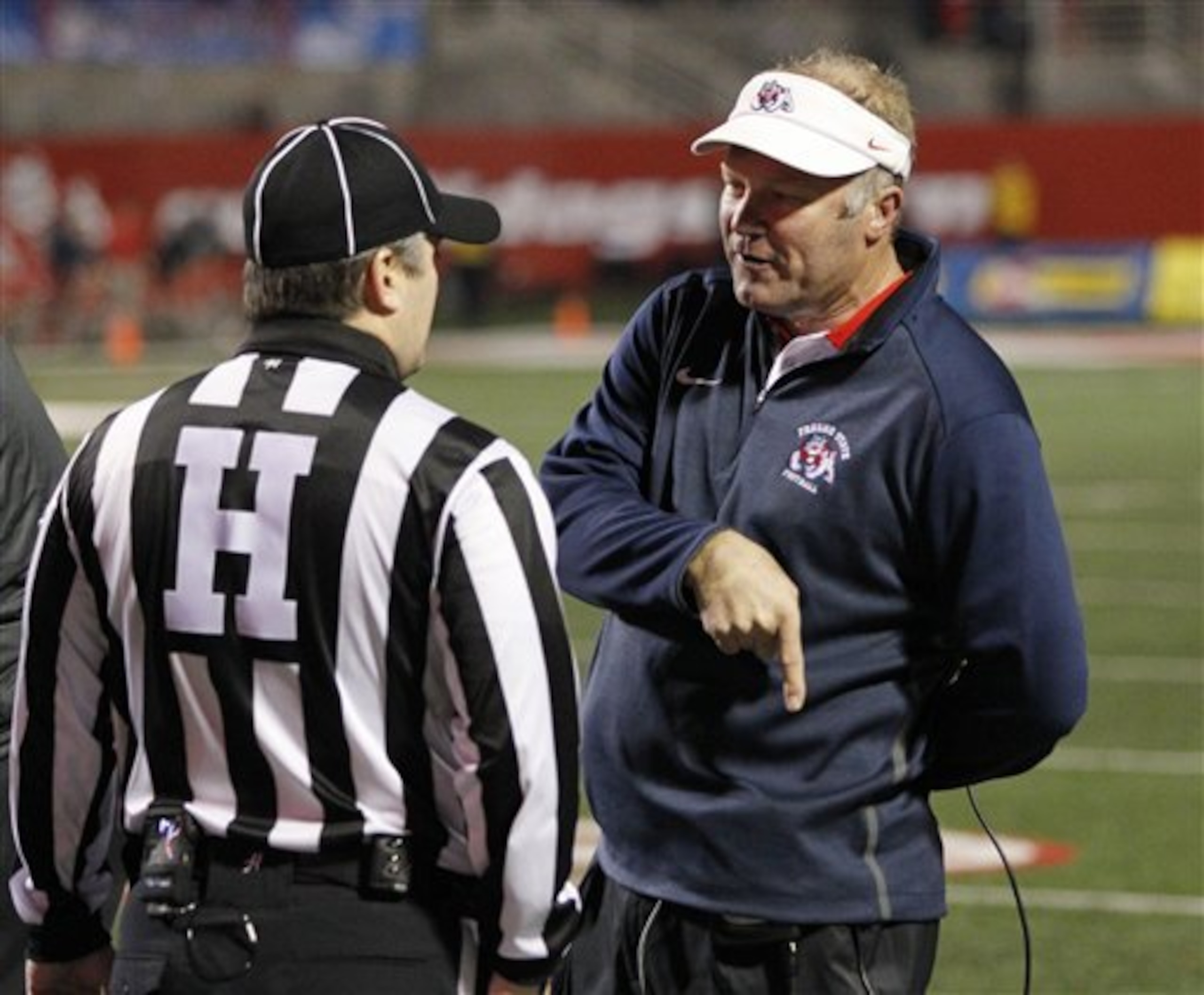
How the seat got hot
Tim DeRuyter came to Fresno State in 2012 from Texas A&M, where, like with his previous coaching gigs, he had been known for his defensive acumen. His first two Bulldogs teams were offensive juggernauts, however, thanks to the presence of future first-round NFL pick Derek Carr at quarterback.
Fresno State went 20-6 in those two seasons, including an 11-0 start to 2013.
But once Carr moved on, the lack of a capable passer to succeed him was made worse by some of the poorest defenses in the country. In 2014, the Bulldogs allowed 32.4 points per game but still managed to win a Mountain West division title. Last year, they gave up an average of 38.1 points while going 3-9.
How he cools it off
DeRuyter overhauled his coaching staff this offseason, replacing every offensive coach and adding Lorenzo Ward as defensive coordinator. But it will take more than new assistants to keep DeRuyter employed.
First and foremost, Fresno State has to identify some playmakers on offense. It used four quarterbacks in 2015—they combined to throw 16 interceptions and completed only 50.1 percent of their passes—while leading rusher Marteze Waller has graduated. That will take pressure off what will be a young defense that must replace more than half of its starters.
Fresno State's schedule won't do DeRuyter any favors. It opens at Nebraska and also visits Toledo, and in Mountain West play it faces six of the league's eight bowl teams, including division champions Air Force and San Diego State.
James Franklin, Penn State
2 of 7
How the seat got hot
James Franklin was the beneficiary of the NCAA's decision to cut Penn State's postseason ban in half, though it was already in the works before he arrived. This meant the Nittany Lions were eligible for a bowl in Franklin's first year in 2014 instead of having to wait until 2016.
Franklin got Penn State into bowls each year, but the consecutive 7-6 records he posted were worse than the ones Bill O'Brien had during the first half of the school's sanctions (and with fewer scholarships). O'Brien also made Christian Hackenberg look like a future NFL quarterback, not the version we saw the past two seasons who was constantly running for his life.
Penn State heads into 2016 on a four-game losing streak, its second in as many years. Before Franklin arrived, the last in-season skid of that length came in 2004.
How he cools it off
Some housecleaning has already happened, both by choice and through departures, with new offensive and defensive coordinators and several players leaving the program. What remains should be considered Franklin's loyal subjects, and ones he can build around.
And building is the key word. Instead of describing Penn State as a sleeping giant, Franklin should instead focus on gradual improvement and the long game. Former Sporting News writer Matt Hayes said as such last month, noting that Franklin's biggest mistake to this point is that "he has raised expectations to where they have no business being. A victim of his own relentlessly positive personality."
Penn State's 2016 schedule is set up for success, with Iowa, Michigan State, Ohio State and Temple all coming to Beaver Stadium. Instead of highlighting that, Franklin should cut down on the hyperbole and keep things internal.
Dana Holgorsen, West Virginia
3 of 7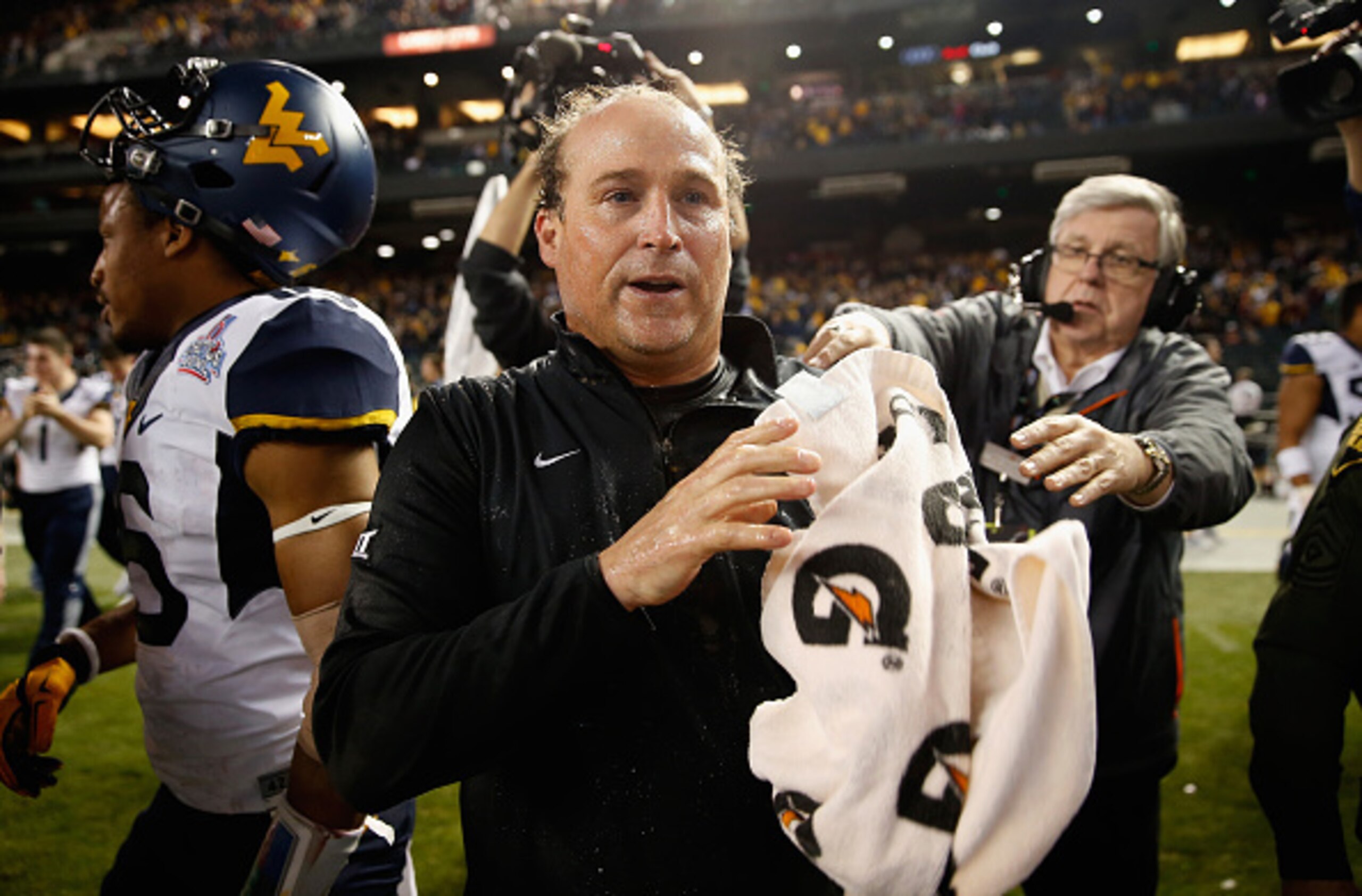
How the seat got hot
Dana Holgorsen navigated West Virginia through its move from the Big East to the Big 12. It's been a Red Bull-fueled journey that has produced three winning seasons in the last four years, but no finish better than a tie for fourth place in the new conference. That's not exactly what the Mountaineers were hoping for when they made the switch.
He's 36-28 overall, but his best season came in 2011 in the Big East. In Big 12 play, Holgorsen is 20-23, including 4-5 this past year.
The school announced in December that Holgorsen would return for 2016, but beyond that there are no guarantees.
How he cools it off
Holgorsen was hired by Oliver Luck, who is no longer at the school. Shane Lyons is the athletic director now, and Holgorsen must impress his new boss in whatever way possible. The best approach is to take care of business at home, since West Virginia should have a strong home-field advantage in Big 12 play because of its distance from the rest of the league.
In 2016, the Mountaineers get Baylor, Oklahoma and TCU at home. Last year, they lost those three games on the road by a combined 74 points, and all during the first half of the Big 12 schedule. This time around those tough matchups are spread out.


_0.png?w=2560)
Les Miles, LSU
4 of 7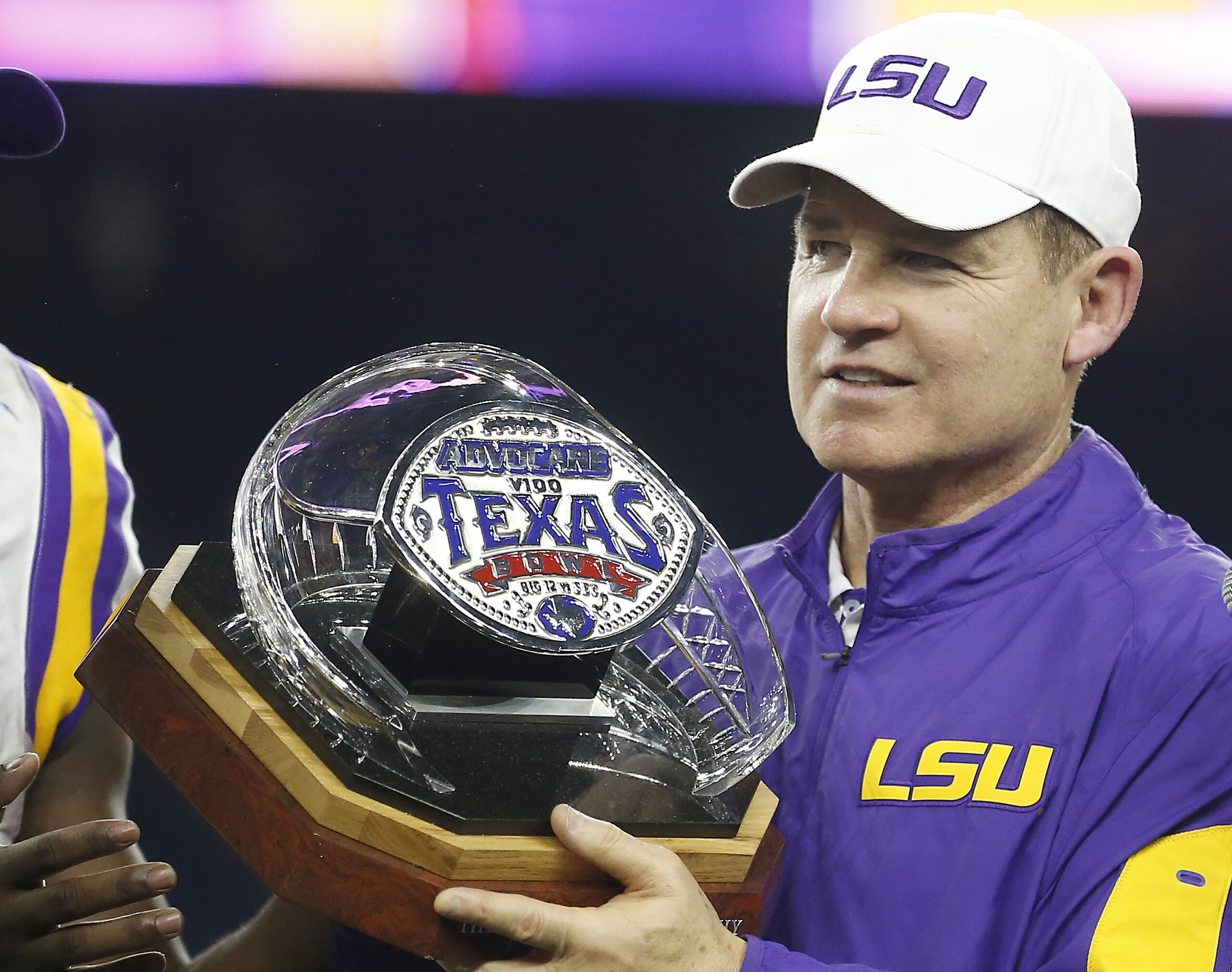
How the seat got hot
Averaging nine-plus wins isn't good enough anymore at some schools, such as Georgia and Nebraska. Each let go a longtime coach during the past two seasons, and a third nearly went that direction when all signs pointed to the Les Miles era coming to an end at LSU after 2015.
Instead, the school opted to bring back the coach who has won 112 games in 11 seasons and led the Tigers to a national title in 2011-12. Seems like it was a no-brainer, but since that championship Miles had lost 14 games, including three straight in 2015 after a 7-0 start.
How he cools it off
Miles returns arguably the best running back in the country in Leonard Fournette, who led FBS in rushing yards per game in 2015 and who was the Heisman front-runner until LSU started losing. Fournette is among the early Heisman favorites again, per OddsShark.com, but his chances for that award will likely rest on the same thing that will keep Miles around: a balanced offense.
LSU's quarterback situation has been a mess for a while, resulting in poor production the past two seasons, and it remains unsettled. Whoever emerges from the competition between Brandon Harris, Anthony Jennings and Purdue transfer Danny Etling must be made an equal part of the offense, not someone who is there to hand off to Fournette.
Last year showed that Fournette can be slowed down on occasion, and without someone else to produce on offense that one-dimensional approach won't fly.
Mark Stoops, Kentucky
5 of 7
How the seat got hot
No one really expected Mark Stoops to turn Kentucky into an SEC powerhouse, but being competitive in most games and a regular bowl participant were very real expectations.
The Wildcats are 4-20 in the conference under Stoops, winning twice each of the past two seasons, and the second half of each of those years has been a disaster. They lost six straight after a 5-1 start in 2014 and last year dropped six of seven (with the only win coming against FBS newcomer Charlotte) after opening 4-1.
Though Stoops' seat is getting hot, his job is probably safe unless the school wants to fork over a big buyout. According to Mark Story of the Lexington Herald-Leader, firing Stoops before Dec. 1, 2017, would result in a payout of at least $12 million.
How he cools it off
The buyout buffer is nice, but it doesn't make Stoops bulletproof. He'd be in better shape for 2017 and beyond by getting Kentucky into a bowl game this year, something its schedule should allow. The front half again provides plenty of win opportunities, but only one of the Wildcats' final five FBS opponents (Missouri, on the road) had a losing record a year ago.
Charlie Strong, Texas
6 of 7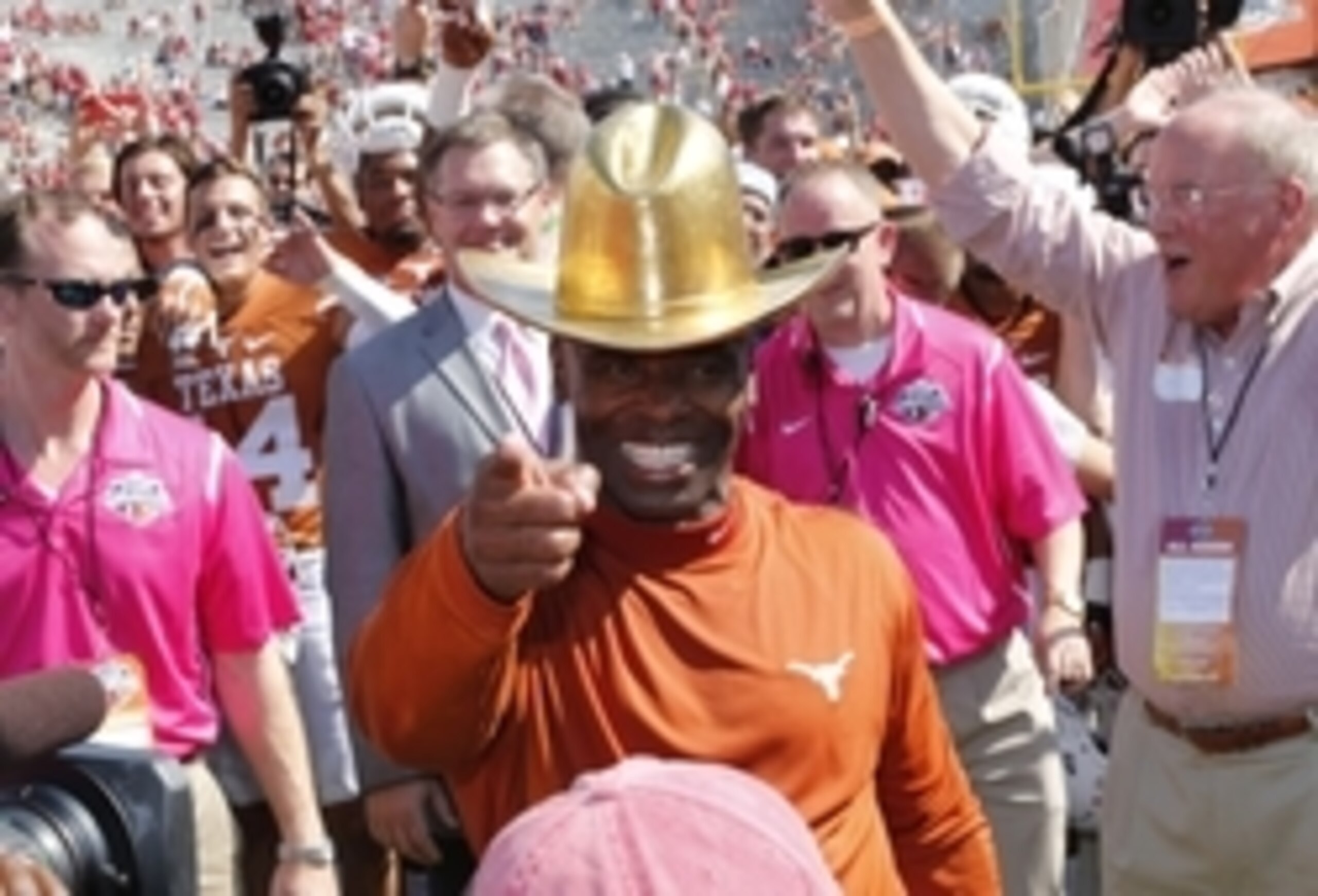
How the seat got hot
Charlie Strong's seat at Texas was heated up before he ever sat in it, the result of unrealistic immediate expectations from some associated with the program and skepticism from others. Having one of the school's biggest boosters refer to your hiring as a “kick in the face” (h/t Max Olson of ESPN) isn't the best situation to step into.
Somehow managing to get into a bowl game in his first season despite a talent-barren roster didn't help, either. The Longhorns weren't good in 2014 and weren't any better this past year, though Strong's goal of changing the program's internal culture was making great progress.
Unfortunately for him, fans and donors are more interested in results on the field and not in the locker room.
How he cools it off
Strong has accomplished the first part of a two-step process by landing another stellar recruiting class, one that included numerous late pickups on or right before signing day to rank 11th, per 247Sports. Combined with the recruits he brought in from the 2014 and 2015 classes, the majority of the roster is his own players.
Now those prospects have to start contributing, particularly on the offensive end. Texas has been ninth and eighth, respectively, in the Big 12 in total offense in Strong's two years.
A solid defense will give the Sooners something that most of their conference mates lack, but without the ability to match their scoring prowess the road to improvement and success could be too slow.
Kevin Sumlin, Texas A&M
7 of 7
How the seat got hot
It's hard to imagine Kevin Sumlin would be in this position just a few years after he and Texas A&M were the darlings of the SEC. That debut season in 2012, in which the Aggies went 11-2 behind Heisman winner Johnny Manziel, had this program on a meteoric rise.
One that feels like it's been plummeting back to Earth ever since.
A&M has lost nine of its last 14 SEC games, jumping out to 5-0 starts in both 2014 and 2015 only to fizzle in the second half to post consecutive 8-5 marks. Much of the falloff has been due to an offense—Sumlin's speciality—that became wildly unproductive and went through numerous changes at quarterback.
How he cools it off
The work is already underway, starting with a switch of play-callers.
"The Aggies hit a home run in the offensive coordinator search, first simply by letting go of former coordinator Jake Spavital and then replacing him with UCLA's Noel Mazzone," Bleacher Report's Barrett Sallee wrote.
Mazzone will get to work with quarterback Trevor Knight, a transfer from Oklahoma, after 2015 co-starters Kyle Allen and Kyler Murray both left the program.
Follow Brian J. Pedersen on Twitter at @realBJP.

.jpg?w=2560 "NFL investigating 2 referees for separate viral exchanges")
.jpg?w=2560 "Report: Chiefs Contact Hill's Agent")
.jpg?w=2560 "OBJ Calls Out Giants 😳")
.jpg?w=2560 "Tyreek makes another cryptic post amid Chiefs rumors")