
College Basketball Teams That Most Need to Get Healthy for the NCAA Tournament
Nearly every college basketball team has its assortment of bumps and bruises at this stage of the season, but some teams have been more affected by injuries than others.
Several teams would enhance their postseason chances considerably if key players who are sidelined got healthy in the near future.
We selected 10 teams that have the potential to make the NCAA tournament but have an important player who is injured. These teams could become a force in late March if those key players get healthy soon, or they could fall by the wayside if they remain sidelined or limited.
Kentucky
1 of 10
Kentucky forward Alex Poythress is out with a leg injury, and coach John Calipari told the Lexington Herald-Leader on Wednesday, Poythress with be sidelined "about two weeks." Calipari did not specify what the injury is, and would neither confirm nor deny that Poythress has a torn meniscus in his right knee. Kyle Tucker of the Courier-Journal reported Ryan Lemond of Kentucky Sports Radio said Poythress underwent a "minor procedure" to repair the problem.
The Wildcats were impressive in both games since Poythress limped off the court in pregame warmup for the Florida game, beating the Gators by 19 points and clobbering Georgia by 34. But both games were on the Wildcats' home court, where Kentucky is 14-0 this season.
Kentucky is just 2-5 in games on its opponent's home court this season, and Saturday's game at South Carolina and the Feb. 20 game at Texas A&M will indicate how much Poythress is missed if he sits out those games.
Poythress provides the Wildcats with a strong and athletic post presence that they do not have otherwise. He is third on the team in scoring at 10.0 points per game on 59.7 percent shooting and leads the squad in rebounding at 6.6 per contest.
Marcus Lee, who has scored just four points in each of the two games Poythress missed, has replaced him in the starting lineup.
Kentucky is tied for first place in the Southeastern Conference at the moment, and it would have a better chance to stay there and do some damage in the postseason if and when Poythress returns to the court.
North Carolina State
2 of 10
North Carolina State was nearly omitted from this list because, at 12-12 overall and 2-9 in the Atlantic Coast Conference, the Wolfpack do not appear to be in contention for an NCAA tournament berth. They were included because, if everyone is healthy, they might have the horses to have a strong finish or run through the ACC tournament.
One bit of medical news is encouraging, as point guard Anthony "Cat" Barber, the team's leading scorer (23.7 points per game) and assist man (4.7), is expected to play Saturday against Wake Forest after suffering a wrist injury on Feb. 7 against Duke.
The more pivotal issue involves guard Terry Henderson. A transfer from West Virginia, Henderson tore ligaments in his ankle just seven minutes into the season opener and required surgery. He has not played since, and there is no clue as to when, or whether, he will return this season.
His participation in practice is still limited, and coach Mark Gottfried told the Associated Press in a Feb. 5 report: “I don’t think he’s close right now. I don't know what day it's going to be, but he's not anywhere near me putting him in a basketball game."
Given Henderson's long layoff, it's questionable whether he could make a significant impact even if he does get back on the court soon. But the Wolfpack would certainly like to find out. Henderson is a dynamic scorer who averaged 11.7 points while hitting 37.8 percent of his three-point shots as a sophomore at West Virginia two years ago.
The Wolfpack would just like to see how good it can be with the 6'5" Henderson on the court alongside Barber.
Hawaii
3 of 10
Hawaii is a deep team that can withstand an injury and still do well in the Big West. However, the Rainbow Warriors would like to have all their key players healthy and ready to go before the NCAA tournament begins. With a 19-3 record, Hawaii looks like the kind of team that could pull a postseason surprise. You may recall Hawaii lost to Oklahoma by just three points in an early-season tournament in Honolulu, but the Rainbow Warriors need all their weapons available to be a factor in the postseason.
Just when Aaron Valdez, the team's second-leading scorer, returned from a three-game absence because of turf toe, Hawaii lost guard Isaac Fleming to a sprained ankle suffered in the Jan. 31 game against Long Beach State.
Fleming is averaging 11.2 points and had been particularly productive recently, averaging 17.0 points over the five games immediately before the Long Beach State contest. He has missed the last three games, and did not even dress for Thursday's game against UC Irvine. Hawaii won that game at home to take over sole possession of first place in the Big West, but road games against second-place Irvine and third-place Long Beach State remain.
Hawaii hopes Fleming will return next week, but a sprained ankle is an unpredictabe day-to-day injury.

California
4 of 10
California guard Tyone Wallace returned earlier than expected from his broken wrist, missing just five games before playing in the Bears' 83-63 victory over No. 11 Oregon on Thursday. Wallace did not start but played pretty well, collecting 10 points, eight rebounds and four assists in 28 minutes.
However, he was physically spent after his limited court time and showed rust with his shooting (4-of-11) and ball-handling (three turnovers). That's probably because he did not participate in a single practice between the time he got hurt on Jan. 16 and Thursday's game.
He still needs to get back into game shape and regain his offensive rhythm to be considered completely healthy, and the Bears hope that occurs sooner than later. If he is playing at 100 percent efficiency and Sam Singer can make the kind of contributions he made while starting in Wallace's place at point guard, the Bears may yet resemble the team they were expected to be.
Ranked No. 14 in the preseason AP poll and picked to finish second in the Pac-12, Cal is just 16-8 overall and 6-5 in the conference and has not locked down an NCAA tournament berth yet. What is worrisome is that Cal is 0-5 in conference road games and must prove it can win away from Haas Pavilion, where it is 15-0.
The versatile 6'5" Wallace, who is averaging 15.2 points, 5.3 rebounds and 4.5 assists, can score, penetrate and create opportunities in a number of ways from the point guard spot. Coach Cuonzo Martin must figure out the best way to utilize Singer now that Wallace is back.
Singer provided a different dynamic at the point guard position, operating as a facilitator who is less likely to score while providing a better three-point-shooting threat than Wallace. Singer had 20 assists in the last two games, which were blowout wins over Stanford and Oregon. Cal must try to maximize Singer's usefulness while Wallace works his way back into top form.
Kansas State
5 of 10
Kansas State freshman point guard Kamau Stokes is probably finished for the season after having surgery to repair a knee injury he suffered in the Jan. 30 win over Mississippi. But coach Bruce Weber did not completely close the door on a possible return.
"He'll probably be out for a while," Weber said on Feb. 4, according to Dave Skretta's Associated Press report. "It's a miracle that he could come back (this season)."
The Wildcats don't quite need a miracle to make the NCAA tournament, but they do need to chalk up some wins. The latest NCAA tournament projections by CBSSport.com's Jerry Palm listed Kansas State as one of four teams on the cusp of getting an at-large berth.
The Wildcats put themselves back into the postseason discussion by upsetting then-No. 1 Oklahoma on Feb. 6 without Stokes. However, the Wildcats lost the two other games they have played with Stokes out of the lineup, losing by 18 points to Kansas on Feb. 3 and dropping a home game to Baylor on Wednesday.
It seems obvious that Kansas State would be better equipped to make a run at an NCAA tournament berth and possibly win a game or two when it gets there if it had its starting point guard available. Stokes is averaging just 9.2 points this season, but in the five games prior to the Mississippi contest, he averaged 13.4 points while hitting 14 of 29 three-point shots (48.3 percent).
Kansas State cannot count on Stokes returning, but the Wildcats' prospects would improve if he heals faster than expected.
Michigan
6 of 10
Michigan guard Caris LeVert could return to game action any day now, and the Wolverines need him as soon as possible.
LeVert, a preseason all-conference selection, has missed 11 games since suffering a lower-leg injury in the Dec. 30 game against Illinois. Coach John Beilein and guard Derrick Walton Jr. held the team together for a while, as the Wolverines won six of their next eight games to improve to 7-3 in the Big Ten. But the Wolverines were the beneficiaries of a soft early-conference schedule, and they have struggled recently.
In Michigan's last three games, it lost at home to Indiana by 13 points, lost at home to Michigan State by 16 points and squeaked by Minnesota, which is winless in the Big Ten, in a contest the Wolverines led by just two points with 1:37 remaining.
Both Joe Lunari of ESPN.com and Jerry Palm of CBSSports.com have the Wolverines as a No. 9 seed in their latest NCAA tournament projections, so a berth is not yet secure. LeVert's return would provide Michigan with an emotional and talent boost for the stretch run and is the kind of star player a team needs to do well in the postseason.
LeVert received medical clearance to return this week, according to Mlive.com, and it is up to LeVert to decide when he wants to play in a game. It could be as soon as Saturday's home game against No. 18 Purdue, or it could be another week. Whenever he returns, Michigan will be happy to have his 17.2 points, 5.4 rebounds, 5.2 assists and 44.6 percent three-point shooting back in the lineup.
Texas
7 of 10
Texas is in an odd situation as it relates to Cameron Ridley.
The 6'10" Ridley is a senior in his third season as a starter. He is the team's second-leading scorer (12.7 points per game) and top rebounder (10.0), but he has missed the past 13 games after having surgery to repair a broken foot he suffered in a Dec. 27 practice.
It is unclear when he will return this season or if he will return at all. But now the question is whether the Longhorns might have better success in the postseason without him.
After scuffling immediately after losing Ridley, Texas is now playing as well as any team in the Big 12. It has won eight of its last 10 games, including victories over Iowa State, Baylor and West Virginia—the latter on the road. The only losses in that span were against Kansas at Allen Fieldhouse, where the Jayhawks have won 37 in a row, and a three-point loss at Oklahoma, which is unbeaten at home.
Does Texas want to disturb that?
You can make a case that the Longhorns' improvement has less to do with Ridley's absence and more to do with the fact coach Shaka Smart's coaching started to take hold after a period of adjustment. In that case, adding Ridley would make Texas that much better. After all, when Ridley was injured, Texas was riding a six-game winning streak that included a win over North Carolina. Besides, how can a team not benefit from adding an experienced big man who averages a double-double?
It is not an issue that needs to be addressed immediately. Ridley is only allowed to put limited weight on his left foot at the moment, according to a 247Sports.com report, but it was hoped that a doctor's visit this week would clear him to do more. The original prognosis was that he would be out six to eight weeks, and it has been just six weeks.
Ridley obviously won't be ready to play in a game for a while, but if he does return this season, the Longhorns will want him to play in several games before the NCAA tournament starts.
Colorado
8 of 10
Colorado found out what life is like without Josh Scott in Thursday's game against Washington State.
Even with Scott sidelined with a sprained ankle, the 17-7 Buffaloes figured to have an easy time in a home game against the Cougars, who were 1-10 in the Pac-12, riding a nine-game losing streak and winless in games on their opponent's home court. It turned out to be anything but easy, as Colorado barely squeaked out a double-overtime victory.
The 6'10" Scott is by far Colorado's best player. A first-team all-conference selection two years ago before missing eight games with injuries last season, Scott leads the team in scoring (16.7 points per game), rebounding (9.1) and field-goal percentage (55.6) while blocking 1.8 shots per game.
He sprained his ankle in the Feb. 6 game against Oregon State, forcing him to miss the game's second half, a Colorado loss, as well as the Washington State contest.
Scott's status is considered day-to-day, and the Buffaloes need him for Saturday's home game against Washington, which beat Colorado by 12 points in their earlier meeting, and next week's road games against USC and UCLA.
Both Joe Lunardi of ESPN.com and Jerry Palm of CBSSports.com have Colorado into their latest projected NCAA tournament fields. But with an 18-7 overall record, including 7-5 in the Pac-12, the Buffaloes should not feel secure, especially considering the tough road ahead. Besides the next three games, all of which will be challenging, Colorado has games against Arizona and Utah remaining—the latter on the road.
The Buffaloes had better have Scott available for most of those games, or their NCAA tournament hopes may be squashed.
Michigan State
9 of 10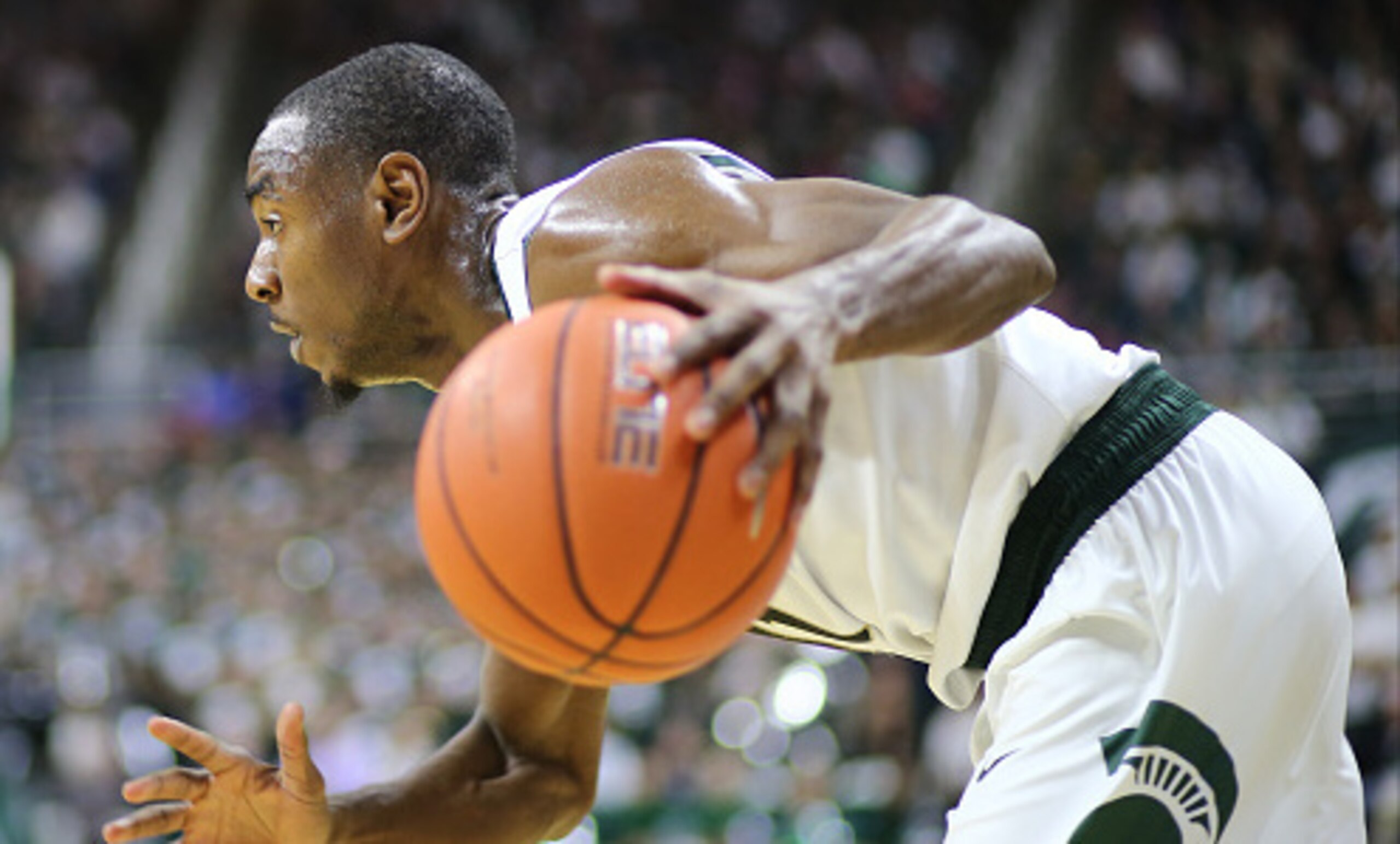
Michigan State would certainly like to have its starting point guard, Lourawls "Tum Tum" Nairn Jr., back in the lineup soon, but apparently it just is not going to happen. Coach Tom Izzo said in a Feb. 8 Detroit Free Press article that Nairn will probably be sidelined another month with plantar fasciitis in his foot. Even if Nairn does return this season, Izzo said his role would be reduced.
"I don’t see him coming back and playing any kind of minutes that are going to make us change what we’re doing,” Izzo told the Free Press.
Initially the prognosis was that Nairn would miss a few weeks with the ailment that has bothered him all season. But he has already missed seven games with no return in sight.
The Spartans are 4-3 without Nairn, including a victory over Maryland. All three losses in that span were by a single point, and you wonder whether Nairn's presence in those games might have made a difference. He is not much of a scorer, averaging 4.1 points, and is a poor outside shooter, but he is averaging 4.5 assists per game and less than one turnover per contest (0.9).
Soon after Nairn was forced to the sidelines, Izzo noted the significance of Nairn's absence.
“Most of our people don’t appreciate what he does do,” Izzo said, according to a Jan. 17 Free Press report. “The pushing of the ball, the defense, the this and that.” The this and that include on-court leadership as well as the impressive assist-to-turnover ratio—things that matter in close games.
Nairn may not be back soon, but if the Spartans do get him back for the postseason, he could provide the little something the Spartans have been missing on occasion.
Duke
10 of 10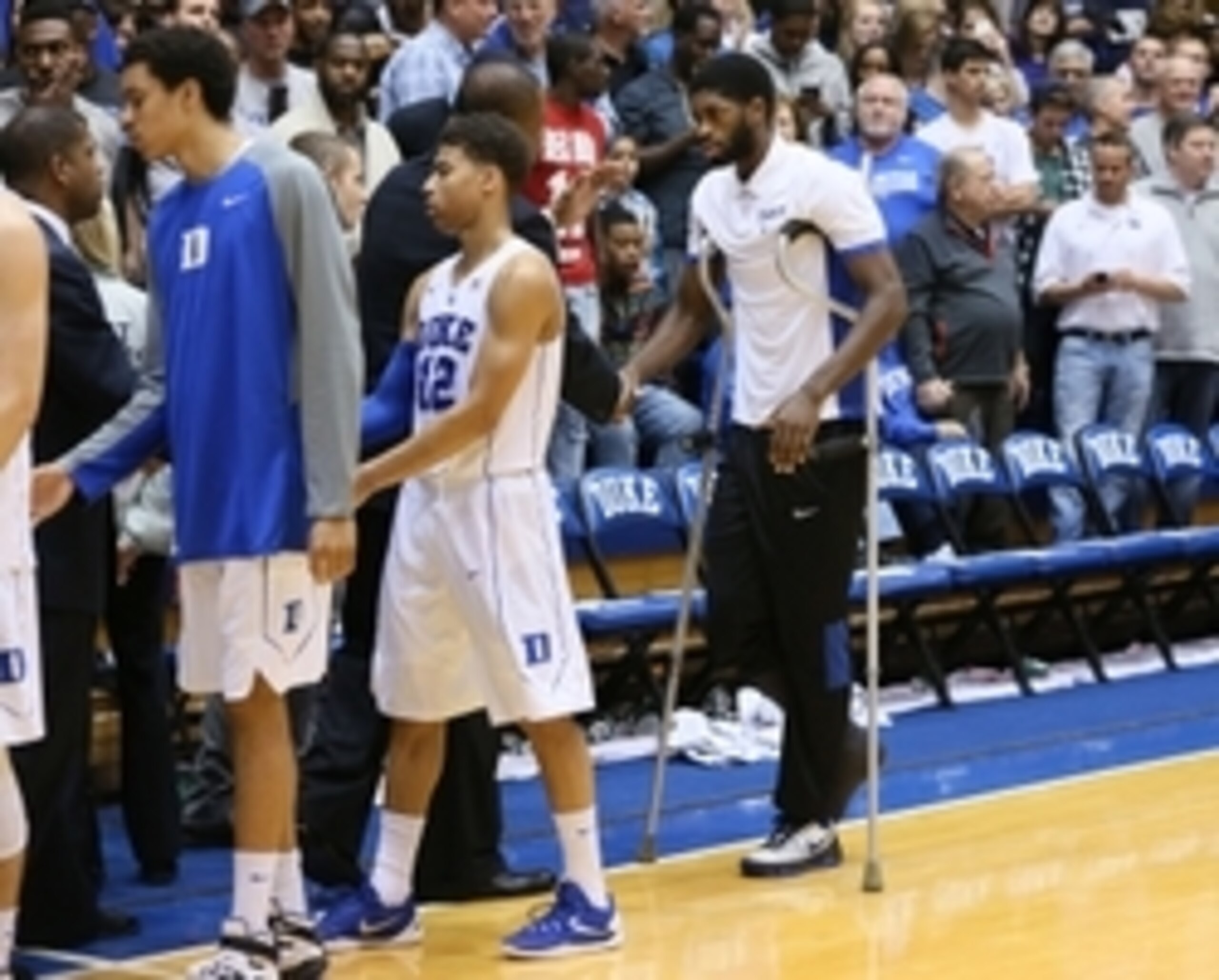
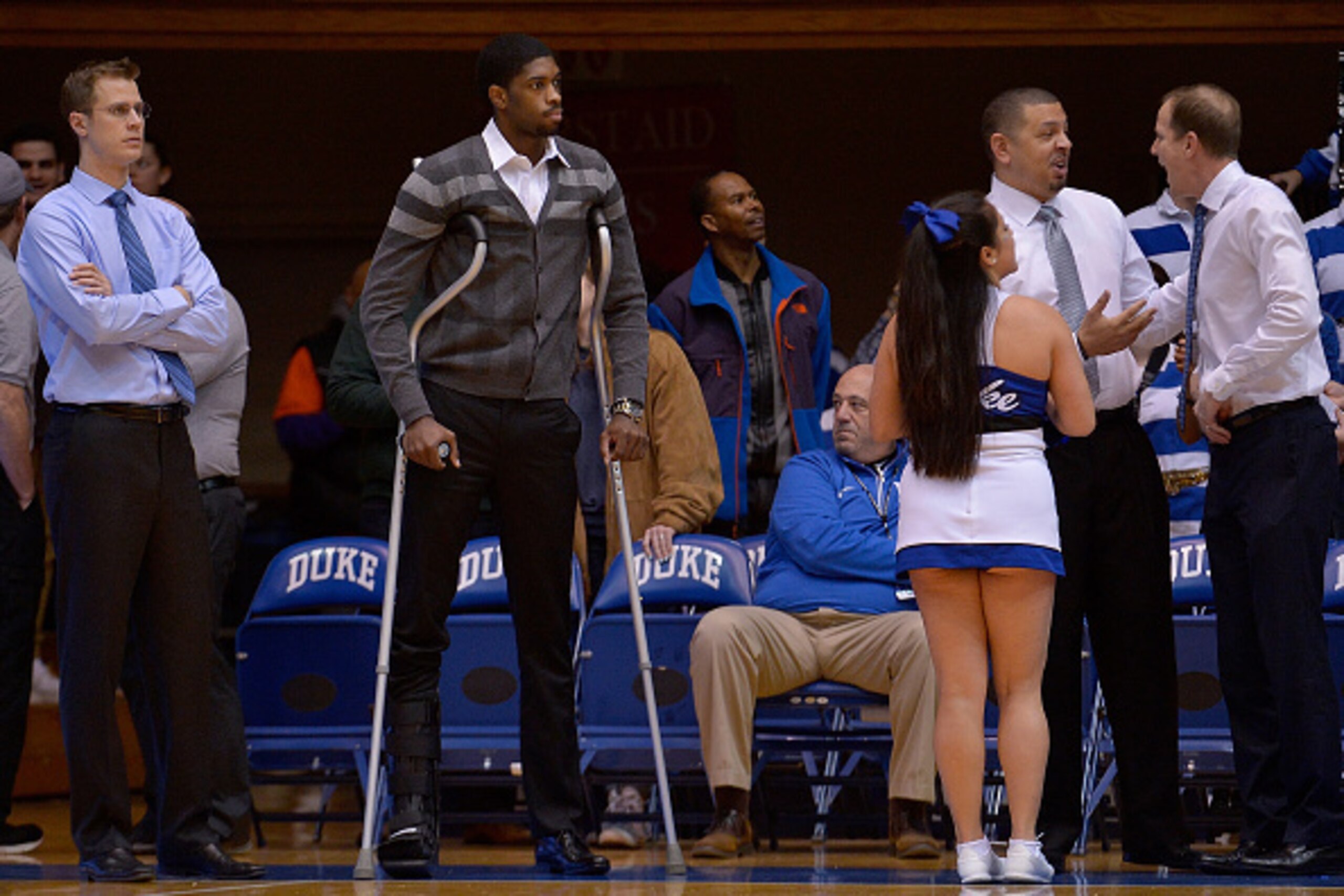
Duke is a different team with forward Amile Jefferson in the lineup, but when and whether he will return this season remains uncertain.
With Jefferson in the starting lineup for the first nine games this season, the Blue Devils went 8-1, losing only to Kentucky and beating Indiana by 20 points. They were ranked No. 8 when he broke his foot on Dec. 12.
Without Jefferson, Duke is 10-5 overall, 7-4 in the Atlantic Coast Conference and unranked heading into Saturday's game against Virginia. The Blue Devils have played better recently, having won three straight, including a victory over 13th-ranked Louisville. A berth in the NCAA tournament seems assured. However, the Blue Devils do not look like a team that can do much damage in the postseason without Jefferson.
The most recent update on Jefferson apparently came on Feb. 1, when Mike Krzyzewski told the Fayettevile Observer that Jefferson was making progress but offered no timetable for his return. The inference is that Jefferson could return sometime late this season.
If Jefferson does return, he would provide some of the things Duke is noticeably missing. The 6'9" Jefferson is a senior in his third season as a starter, so his experience in big games would be important for a team with no other returning starters from last season. He is averaging 11.4 points and 10.3 rebounds and would provide the inside muscle and rebounding Duke is sorely missing without him.
At the moment, Duke is playing with four perimeter players and center Marshall Plumlee, who is not much of an offensive threat. Even 6'9" freshman Brandon Ingram is more comfortable on the perimeter and does not have the bulk to be consistently effective in the paint.
Jefferson's presence would also give Duke some depth. Krzyzewski is giving only six players meaningful playing time, so foul trouble and fatigue are major concerns. Having Jefferson available would alleviate that a bit and give Krzyzewski a few more options.
Of course, just having Jefferson on the floor would not be enough. He would need to be in playing condition and resemble the player he was before the injury, neither of which is guaranteed.
Three season ago, Ryan Kelly, another 6'9" forward at Duke, missed two months with a foot injury and scored 36 points in his first game back on March 2. His production fell off after that, but Duke finished 30-6 and got to the Elite Eight of the NCAA tournament. That would not be a bad result for this year's Duke team, but it is unlikely to get that far without Jefferson.
.jpg?w=2560 "Cardinals Giants Football")

.jpg?w=2560 "Report: Chiefs Contact Hill's Agent")
.jpg?w=2560 "OBJ Calls Out Giants 😳")
.jpg?w=2560 "Tyreek makes another cryptic post amid Chiefs rumors")