
1 Thing We Learned About Each Top 25 College Basketball Team in Opening Month
The 2015-16 college basketball season isn't even five full weeks old, but we've already learned a ton of new things about the nation's top teams.
For instance, what Duke's Grayson Allen showed us in the Final Four last season was not a mirage. He's one of the top candidates for the Wooden Award right now, but there were some people who weren't even convinced he deserved to start for the Blue Devils.
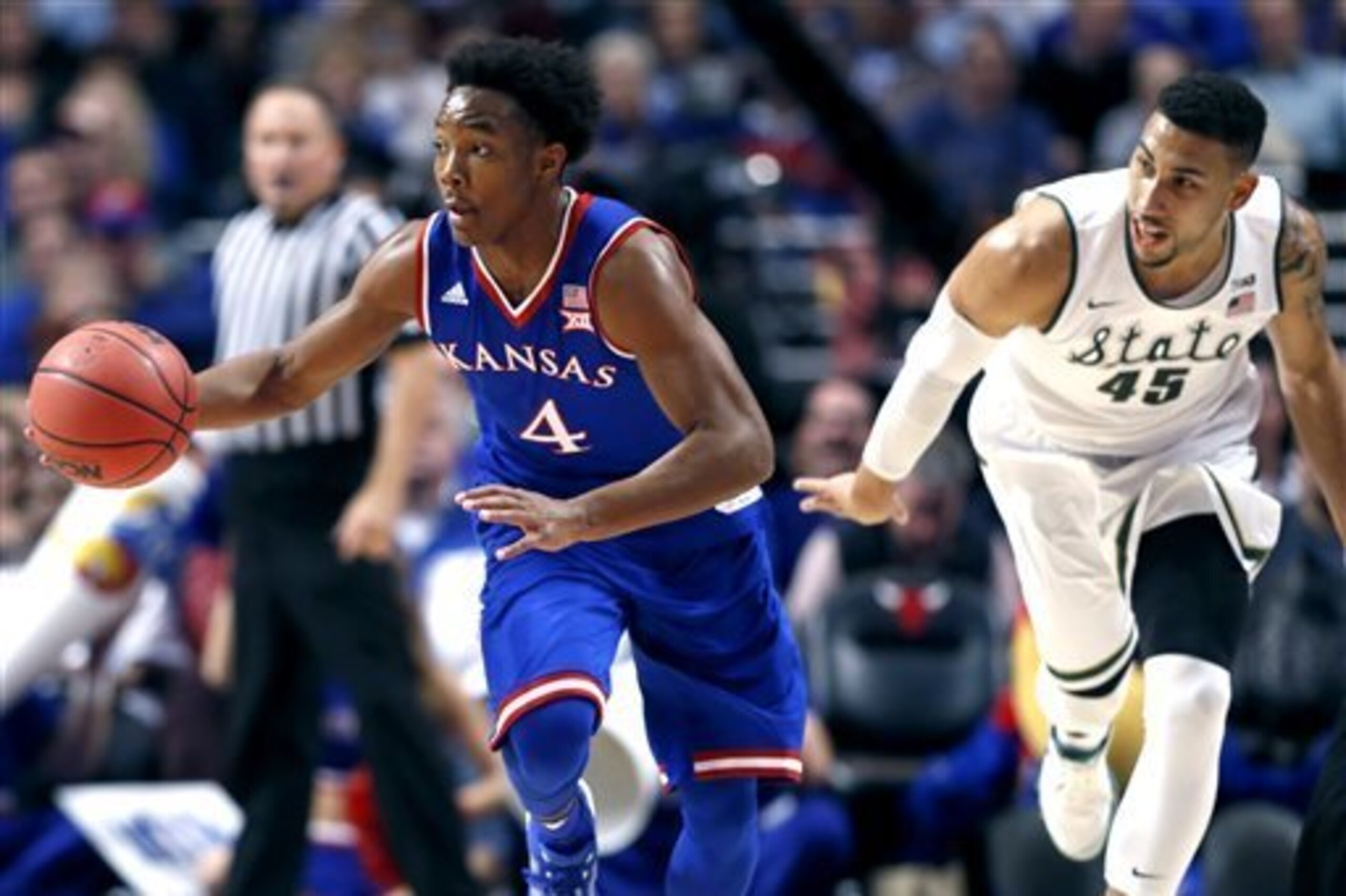
Speaking of the Wooden Award, Michigan State's Denzel Valentine is the clear-cut front-runner for that honor, but he wasn't even ranked in the top 10 in the vast majority of preseason top-100 player lists.
And alongside Valentine in the above photo, Kansas' Devonte' Graham has been one of the most valuable players on one of the best teams in the country, shooting 40.6 percent from three-point range while recording 34 assists, 20 steals and just six turnovers.
We didn't see any of those things coming, and they aren't even the biggest lessons learned about their respective teams.
What have you learned about the current members of the Associated Press Top 25?
25. Connecticut Huskies
1 of 25
What We Learned: Shonn Miller is a serious offensive weapon.
Shonn Miller scored more than 1,000 points in his three years with Cornell, but he wasn't particularly efficient. According to Sports-Reference, his O-rating with the Big Red was 104.1. He had a true shooting percentage of 53.9 and an effective field-goal percentage of 48.3.
Those aren't necessarily bad numbers, but they're nowhere near as good as what he's doing so far with Connecticut. His O-rating this year is 134.4, and his true shooting percentage and effective field-goal percentage are 65.3 and 61.8, respectively.
The big difference in his game is that he has abandoned the three-point shot that never served him well. Though he attempted more than 200 triples, Miller shot just 26.8 percent during those three years with Cornell. By forgoing that ineffective aspect of his game and focusing more on being a true power forward, Miller is also converting from inside the arc at a much higher rate, shooting 62.7 percent on two-pointers as opposed to 51.1 percent with Cornell.
Of course, you could just ignore all those numbers and watch this dunk on Ohio State center Trevor Thompson to know Miller is pretty talented.
24. Texas A&M Aggies
2 of 25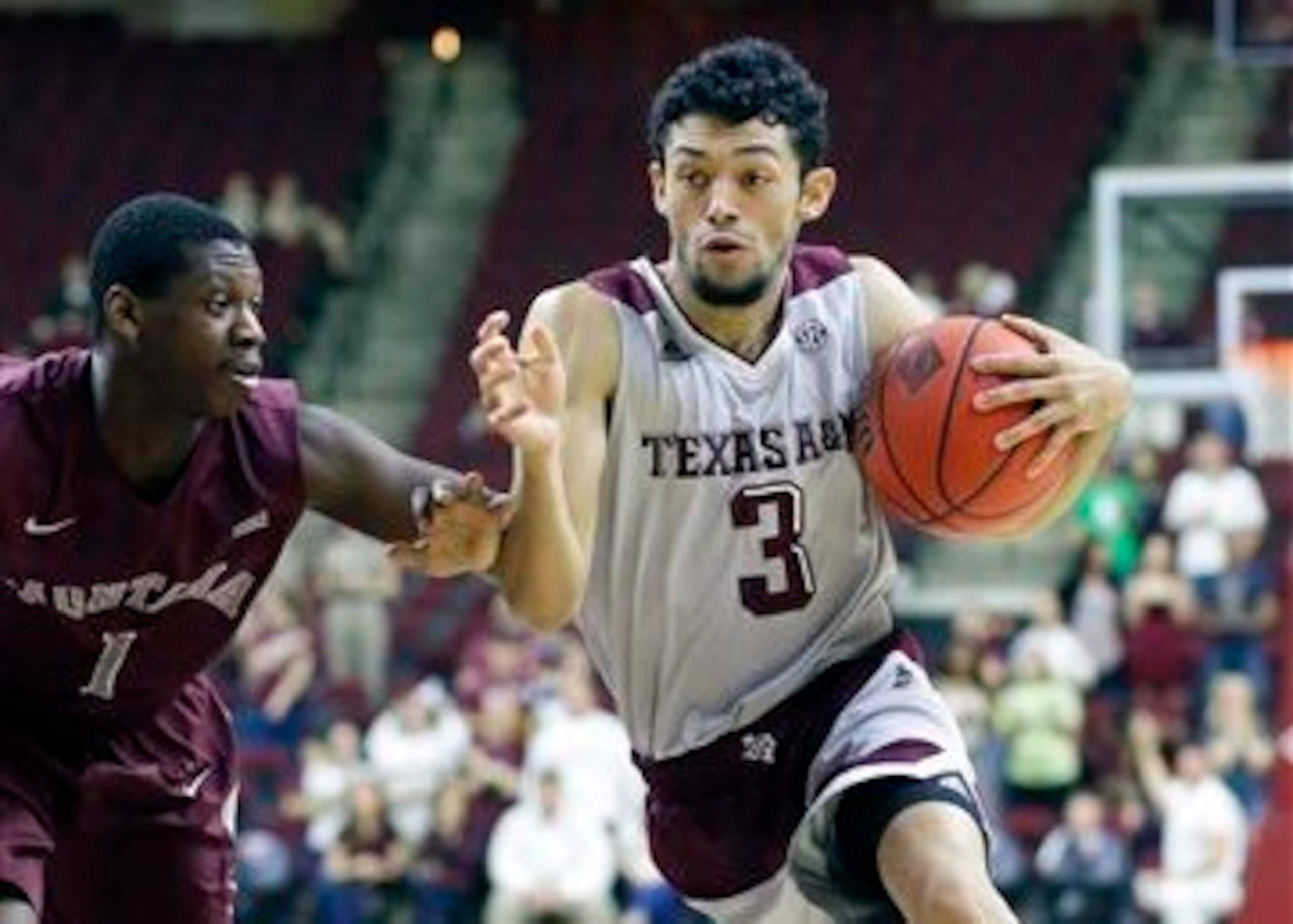
What We Learned: Guys don't like limited playing time.
The guys at Monmouth have made an art out of riding the pine, but not everyone takes so kindly to getting cozy on the bench.
We didn't make a big enough deal last year about John Calipari's ability to convince a team full of McDonald's All-Americans that it's cool to play 20 minutes per game.
It seems head coach Billy Kennedy wasn't prepared to go the same route with Texas A&M this year, even though the Aggies began the season with 10 guys worthy of at least that much playing time.
Alex Robinson was A&M's highest-rated recruit last year, but the sophomore point guard announced his intention to transfer just three days into the season. It was an understandable decision with seniors Alex Caruso, Anthony Collins and Danuel House expected to get almost all of the team's backcourt minutes—even though Robinson gave the team a strong 18.8 minutes per game as a freshman.
A similar backlog developed in the frontcourt, leading to Elijah Thomas' decision to transfer this week. Thomas wasn't the Aggies' top recruit this year, but he was ranked No. 44 overall, according to 247Sports, meaning A&M lost a very good young point guard and a very good young center in less than a month's time.
We'll see how it affects the team a year or two from now, but there's still more than enough talent left on this year's roster to make some noise.
23. Cincinnati Bearcats
3 of 25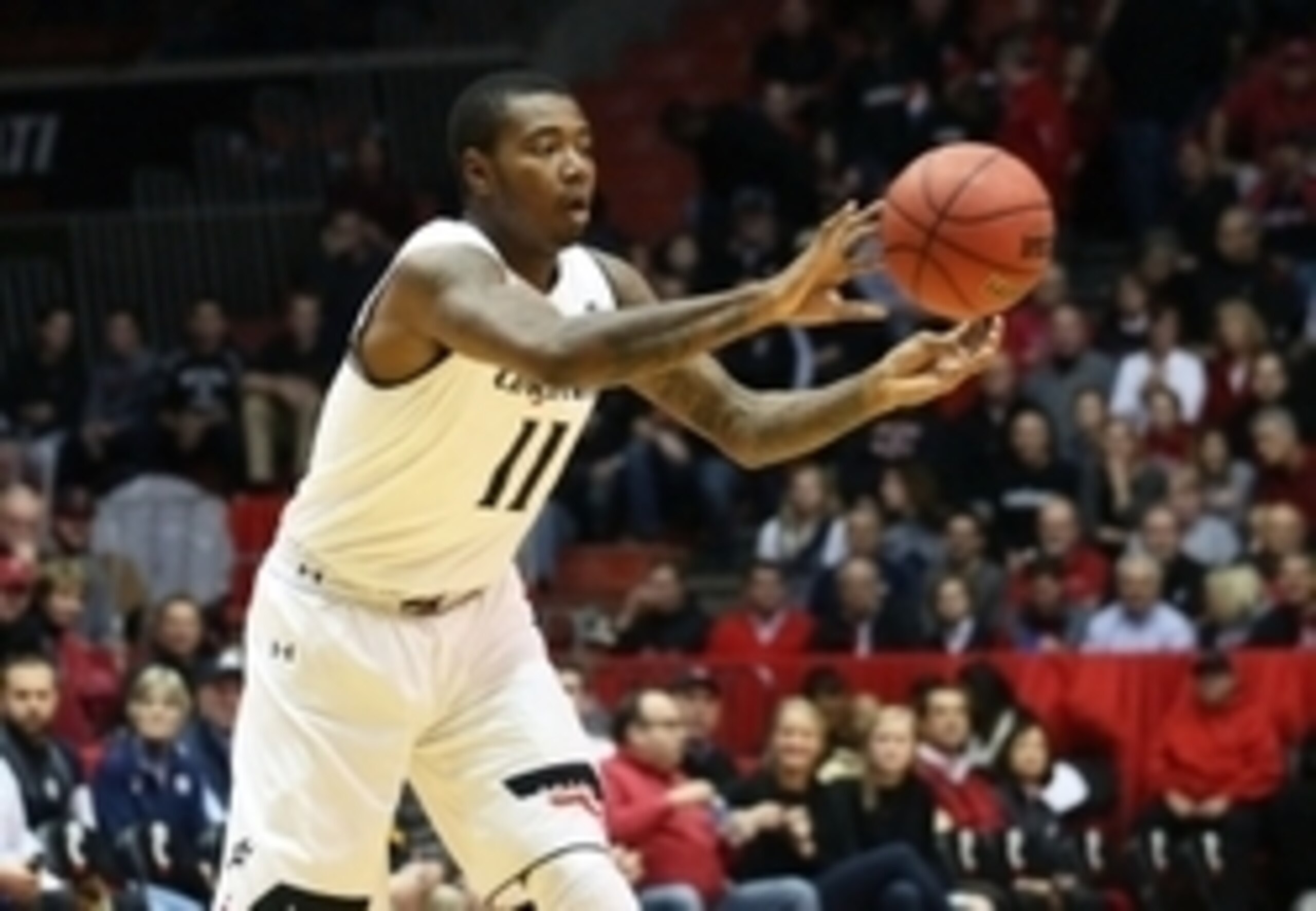
What We Learned: Gary Clark lacks the necessary assertiveness.
Are head coach Mick Cronin and Gary Clark the only people who don't realize Gary Clark is Cincinnati's best offensive weapon?
Last year as a freshman, he led the Bearcats in O-rating by a considerable margin, but he took just 18.0 percent of the team's shots while on the floor. Jermaine Sanders was the only player on the roster with a lower usage percentage than Clark.
This year, he's leading the Bearcats in O-rating by an even more considerable margin—he ranks 24th in the nation in that category—but now he's only taking 14.6 percent of the team's shots while on the court.
Here's where it gets really bad. According to Sports-Reference, Clark has a usage percentage of 14.1, which is by far the lowest on the team. However, he has an offensive box plus/minus of 6.2, which is tops among Bearcats that have played at least 15 minutes.
Every other player on the roster is averaging at least 10.1 field-goal attempts per 40 minutes, but Cincinnati's most effective scorer is averaging just 8.6.
It's absolutely mind-boggling that he isn't more involved in Cincinnati's offense. It feels like we're watching the Bearcats try to cut a steak with a spoon, even though there's a steak knife right next to the plate. Clark has the talent to average at least twice as many points per game as he currently is.
The sooner Cincinnati realizes it, the sooner we can take this team seriously as a Final Four candidate.

.jpg?w=2560)
22. UCLA Bruins
4 of 25
What We Learned: Thomas Welsh is going to be a star.
If there's ever a night to have a great individual performance, it's while you're in the process of knocking off the No. 1 team in the nation.
That's precisely what Thomas Welsh did, putting up 21 points, 11 rebounds and two blocks in UCLA's season-altering win over Kentucky.
It's not just that he put up big numbers against a great team, though. He went toe-to-toe with and absolutely dominated a supposed lottery pick in Skal Labissiere. Welsh owned the glass, dunked at will and was lethal with his mid-range jumper, showing off a simplified version of the skill sets Tim Duncan and LaMarcus Aldridge possess.
That's mighty high praise for a guy who isn't showing up in mock drafts, but I'm not sure how anyone can watch Welsh and not see a future in the pros.
We weren't sure how UCLA would fare in the post this year after losing Kevon Looney to the NBA, but the Bruins are clearly in good hands as long as Welsh and Tony Parker stay healthy.
21. George Washington Colonials
5 of 25
What We Learned: Wins come easier when you make free throws.
The Colonials have made at least 70 percent of their free-throw attempts in every single game this season.
That's a far cry from last year when they ranked in the bottom third nationally in free-throw percentage.
The addition of Wake Forest transfer Tyler Cavanaugh is one obvious reason for their improvement. Channeling his inner Tyler Hansbrough, the power forward is leading the team in fouls drawn and sinking 86.7 percent of his free-throw attempts.
But the improvement of senior guard Joe McDonald has been just as noteworthy. Among Colonials who attempted at least four free throws last year, McDonald had the worst percentage at 54.8. He must have spent his entire summer 15 feet from the rim, though, because he is 33-of-41 (80.5 percent) so far this year.
George Washington played in 10 games last season that were decided by six points or less; they missed a combined 77 free throws in those games. Keep shooting this well, though, and the Colonials should be able to secure a few more wins that probably would have been losses last year.
20. West Virginia Mountaineers
6 of 25
What We Learned: If it ain't broke, don't fix it.
West Virginia did two things exceptionally well last season: crash the offensive glass and force turnovers.
Because the Mountaineers dominated just about everyone they played in both of those categories, they ended up with 14.6 more field-goal attempts per game than their opponents. Even though they didn't shoot well and didn't often keep opponents from putting the ball in the hoop, that significant edge in number of chances led to far more wins than losses.
They certainly haven't deviated from that script, ranking first in the nation in turnover percentage and second in offensive rebound percentage. Through nine games, West Virginia is averaging 17.1 more field-goal attempts per game than its opponents.
Moreover, shooting percentages on both ends of the floor have been much more in WVU's favor. The Mountaineers still can't shoot three-pointers and aren't doing much to slow down opposing two-point attacks, but they shot 45.5 percent from inside the arc last season and allowed opponents to shoot 36.5 percent from beyond it. This year, those numbers are 55.2 and 22.4, respectively.
Last year, they averaged 1.19 points per field-goal attempt and allowed 1.44. This year, they're averaging 1.34 points per field-goal attempt and allowing 1.25.
That's quite the swing, and it explains why they're averaging 26.9 more points per game than the opposition.
Granted, those 2015 numbers include 19 Big 12 games and three NCAA tournament games, and WVU hasn't really played anyone other than Virginia thus far this year, but those improvements in the field-goal percentage department are a great start for a team otherwise playing the exact same game as last year.
19. Louisville Cardinals
7 of 25
What We Learned: They'll be just fine without Montrezl Harrell.
The Cardinals lost virtually everyone from last year's team. They reloaded in the backcourt with graduate transfers Damion Lee and Trey Lewis, but we really weren't sure what to expect out of this team's frontcourt without Montrezl Harrell.
Chinanu Onuaku, Mangok Mathiang and Anas Mahmoud were good shot-blockers and rebounders last season, but they hardly ever tried to score, each accounting for less than 9.0 percent of Louisville's shots while on the court. Jaylen Johnson was at least willing to try to score, but he only played 4.6 minutes per game. There was no telling where the Cardinals' two-point buckets would come from.
As it turns out, Onuaku is a pretty solid offensive weapon when he wants to be, averaging just shy of 10 points per game. Mathiang isn't too shabby, either, averaging 7.6 points per game and shooting 60 percent from the field. Freshman Raymond Spalding has been very inconsistent but has shown double-double potential on more than one occasion.
For Louisville, it's not going to be one dominant post presence, but rather a frontcourt by committee. And so far, it's working quite well, as the team that supposedly lost all its offense has averaged 89.4 points per game in its eight wins.
18. SMU Mustangs
8 of 25
What We Learned: The games still matter.
When the hammer came down on SMU and we learned the Mustangs wouldn't be allowed to participate in any sort of postseason, we were left to wonder how the players would respond.
Would a bunch of guys transfer? Would they complain or protest? Would they struggle because of the lack of end-of-season motivation?
Not even close.
They've banded together to make the best of a bad situation and are now more than a quarter of the way through a perfect season.
"That's our goal, to go undefeated for the whole year," Jordan Tolbert told Bill Nichols of the Dallas Morning News after SMU's blowout win over Michigan. "We know that's going to be pretty tough, so we've got to stay on top of that."
Postseason eligibility or not, Tolbert is having a stout final college season. After Wednesday night's 18-point, 23-rebound performance against Nicholls State, the Texas Tech transfer is averaging a double-double.
If he keeps playing this well and SMU keeps winning games, it will be interesting to see how those with National Player of the Year votes feel about players from teams that aren't allowed to play in the NCAA tournament.
17. Butler Bulldogs
9 of 25
What We Learned: Defense is going to be a problem.
Butler's sudden emergence as an offensive juggernaut has been one of the biggest positive surprises of the season. Even if we exclude the season-opening 144-point game against The Citadel, the Bulldogs are still averaging slightly better than 85 points per game.
The rule changes to increase the pace of play have certainly helped to some extent, but this is a team that consistently scored in the mid-to-upper 60s for two straight decades. The national scoring average has increased by about 8.0 percent, but Butler is scoring about 30 percent more than it has for the past 20 years.
It's crazy, but it's also necessary, because the Bulldogs are defending about as well as a sieve holds water—which might be even more bizarre for this program than the high-powered offense.
They were No. 7 in the nation last season in adjusted defensive efficiency, and they always ranked in the top 50 in that category under former head coach Brad Stevens.
So far this year, they're No. 129—and that even includes the game against The Citadel in which they gave up just 71 points in a 96-possession game. They allowed 76 points to Cincinnati, 85 to Miami and 86 to Tennessee. Between those three games, Butler gave up 1.19 points per possession.
Such is life when you don't force turnovers and your primary frontcourt duo is 6'7" Andrew Chrabascz and 6'8" Tyler Wideman. Expect to see plenty more Butler games played in the 80s this year.
16. Baylor Bears
10 of 25
What We Learned: Lester Medford is one of the nation's best point guards.
Early on in the season, this would have been an absolutely preposterous assertion.
Lester Medford was a disaster in Baylor's lone loss of the season. He had two points, one assist and six turnovers before fouling out against Oregon. Even the following game against Jackson State was nothing special, leading us to wonder if the Bears would be able to survive the season without a solid point guard.
Over the past six contests, however, he has been phenomenal, averaging 6.8 points, 7.3 assists and 2.8 steals against just 0.8 turnovers per game. Most of the opponents in those games were nothing to write home about, but he did have a season-high 15 points in the very important win over Vanderbilt.
Thanks to Medford, the Bears have the third-highest team assist rate in the country, tallying an assist on 72.0 percent of buckets—even though a significant number of their made field goals are the result of second-chance opportunities.
15. Miami Hurricanes
11 of 25
What We Learned: Sheldon McClellan belongs in the National Player of the Year conversation.
For reasons that I cannot possibly comprehend, much of the national media seems to believe Miami is still Angel Rodriguez's team.
That wasn't the case for the second half of last season, nor is it the case this year with Sheldon McClellan putting up downright silly numbers once again.
In the box scores on KenPom.com, an MVP is named for each game. Rodriguez has been the MVP just once—but, of course, it was in the Puerto Rico Tip-Off championship game against Butler that everyone was watching, making it seem like he's the team's most important player.
McClellan has been the MVP in five of Miami's 10 games, and he was arguably Miami's most important player in the loss to Northeastern as well. The man is shooting 59.0 percent from the field, 54.8 percent from three-point range and 87.8 percent from the free-throw line.
For the uninitiated, there's this thing in basketball called the 50-40-90 club for players who shoot 50 percent from the field, 40 percent from beyond the arc and 90 percent from the free-throw line for an entire season. It very rarely happens—Kevin Durant is the only NBA player to join the club in the past five years—but if you ever hear the term "180 shooter," it's referring to the summation of those three percentages.
So far this year, McClellan's percentages add up to 201.6.
Even Doug McDermott only put up a 183.9 total in his senior season.
The three-point accuracy will inevitably taper off by the time ACC play really gets going, but it's absurd that there aren't more people talking about one of the nation's most efficient scorers.
14. Providence Friars
12 of 25
What We Learned: All the "lost talent" made room for Ben Bentil to shine.
The start of the season was still months away, yet we were already digging Providence's grave.
The Friars lost LaDontae Henton and Carson Desrosiers to graduation, and with Paschal Chukwu and Tyler Harris both electing to transfer, they were left with just one returning forward.
Fortunately, he's one of the better forwards in the nation.
Ben Bentil is leading the Friars in scoring at 17.5 points per game and is also one of their top rebounders with 7.3 boards per game. He injured his ankle in the first half against Boston College and wasn't expected to play much in the subsequent game against Bryant, but he still recorded 16 points and eight rebounds in each of those contests.
With him in the paint, Kris Dunn's solid Player of the Year campaign and Rodney Bullock's pitching in all over the place, the Friars are a legitimate threat to win the Big East and make a deep run in the NCAA tournament.
No rational person saw this coming.
13. Arizona Wildcats
13 of 25
What We Learned: Arizona hit the transfer jackpot.
Louisville is a very close runner-up with Damion Lee and Trey Lewis scoring at will, but how about the trio of new upperclassmen suiting up for Sean Miller?
Boston College transfer Ryan Anderson is the cream of the Wildcats crop, leading the team in both points and rebounds with 15.8 and 9.6 per game, respectively. He only has four double-doubles, but he has been one of the most dominant big men in the country, single-handedly carrying this team for long stretches of games.
Arizona also picked up San Francisco graduate transfer Mark Tollefsen, which ended up being a great insurance plan after stud freshman Ray Smith went down with a torn ACL in the preseason. He hasn't shot the three ball anywhere near as well as he did in his three years with the Dons, but he's averaging 9.2 points per game and giving the Wildcats about 25 minutes of solid defense per night.
Last, but arguably not least, is JUCO transfer Kadeem Allen. He doesn't score a ton—a far cry from the guy who averaged 25.9 points per game in being named the 2014 JUCO Player of the Year—but Allen is leading the Wildcats in assists and steals and is clearly the best defensive asset on the roster.
Miller has been praised in recent years for his ability to recruit top-notch freshmen, but it's pretty hard to imagine where this team would be this season without his ability to lure in transfers as well.
12. Villanova Wildcats
14 of 25
What We Learned: Villanova is hopelessly dependent on the long ball.
When you take and make a lot of three-pointers, everyone loves you. Just look at how high Syracuse soared in the polls after shooting 46.6 percent from downtown in winning the Battle 4 Atlantis.
But when you take a lot of threes and don't make so many of them, everyone hates you. Just look at how quickly Syracuse plummeted after shooting 24.7 percent from long range in its three losses.
Such is life for Villanova, which ranks second in the nation in three-point attempt rate. Through nine games, the Wildcats have attempted more three-pointers (280) than two-pointers (271).
Of course, the percentage of attempts isn't much of a surprise. In our "By the Numbers" season preview, I noted the Wildcats might break the all-time record for made three-pointers in a season, given the fact that four of their five starters are more than capable of shooting from the perimeter.
Rather, it's the percentage of makes that is causing a problem.
Even before the infamous 4-of-32 performance against Oklahoma, Villanova was converting on just 32.7 percent of its long-range shots. The only other time in the past 14 years that the Wildcats shot worse than 33 percent was in 2011-12. It's hardly a coincidence that was the season they put together an atrocious 13-19 record.
To recap, Villanova's three-point shot is less reliable than it has been in at least a decade and a half, but the Wildcats are more reliant on the three-point shot than ever before.
You have to think that Josh Hart, Jalen Brunson and Kris Jenkins will eventually turn things around and start making those shots at a higher clip, but you also have to wonder what Plan B is if that doesn't happen.
11. North Carolina Tar Heels
15 of 25
What We Learned: Guys other than Marcus Paige can actually shoot.
Two years ago, Marcus Paige shot 38.9 percent from three-point range, sinking 86 triples. The rest of the team combined to make just 60 and shot 28.2 percent.
It was more of the same last year. Paige shot 39.5 percent and made 94 three-pointers while everyone else on the team shot 32.6 percent and made only 90 three-pointers.
At long last, he has some help for his final season.
Joel Berry II is shooting 39.2 percent and leads the team with 20 made triples. Nate Britt is shooting 43.3 percent, and Theo Pinson is hitting 42.3 percent of his attempts. Justin Jackson hasn't been very accurate, but he is averaging one made three-pointer per game.
And perhaps because he's not the only one shouldering the load, Paige has been on fire since returning from the broken hand that cost him the first six games of the season, shooting 54.2 percent from downtown. He's made at least two three-pointers in each game and is averaging 17.3 points per contest.
Yes, they have two losses to unranked teams, but throw in the great work by Brice Johnson, Kennedy Meeks and Isaiah Hicks in the post, and the Tar Heels' full-strength offense is absolutely terrifying.
About that defense, though...
10. Xavier Musketeers
16 of 25
What We Learned: Rebounding and free-throw drills are important.
With Bo Ryan's sudden-yet-not-surprising decision to retire Tuesday night, college basketball needs a new token "fundamentals" coach—one who doesn't necessarily have the most talented players in the world, but who wins a ton of games by getting those players to do all of the little things better than the opposition.
Could I recommend Xavier's Chris Mack for that job?
Mack's Musketeers rank third in the nation in defensive rebounding percentage—a staple of Ryan's Badgers—and are converting on better than 73 percent of their free-throw attempts. The latter is particularly important since the X-Men rank 14th in the nation in free-throw rate. Xavier is also one of the better offensive rebounding teams, securing 38.5 percent of its own misses.
As a result of that glass-crashing, the Musketeers have an average rebounding margin of plus-13.2 per game. And because of their propensity to get to and convert from the free-throw line, they are averaging 8.7 more made free throws per game than their opponents.
Think that might give them an advantage?
This isn't a particularly good shooting team, but there's a reason Xavier is 10-0 with every win coming by a margin of at least nine points.
9. Purdue Boilermakers
17 of 25
What We Learned: Boilermakers have the best frontcourt in the nation.
Purdue certainly opened the season in the conversation for best frontcourt in the country, but is it even a debate anymore?
Isaac Haas and A.J. Hammons have been phenomenal. They never play together, but if you combine their numbers and call it "Purdue's center," that entity is averaging 38.5 minutes, 26.1 points, 13.4 rebounds and 3.8 blocks per game while shooting 62.8 percent from the field.
Elsewhere, the first few weeks of Caleb Swanigan's collegiate career were woefully inefficient, but he's averaging 15.0 points on 57.7 percent shooting with 10.3 rebounds, 4.3 assists and just 2.0 turnovers per game over his last three contests.
And let's not forget about Vince Edwards. The 6'8" sophomore was Purdue's primary power forward last year, but he's still putting up 9.4 points, 5.2 rebounds and 3.7 assists per game at small forward.
Best of all is the team defense. Purdue is No. 1 in adjusted defensive efficiency, No. 1 in defensive effective field-goal percentage and No. 1 in two-point field-goal defense.
Teams can't stop the Boilermakers' big men and can't score against them. That's a pretty nice combination to have.
8. Virginia Cavaliers
18 of 25
What We Learned: You can lead a horse to water, but you can't make Tony Bennett change his style of play.
Last year, Virginia had an adjusted tempo of 58.4—6.4 possessions per game below the national average.
This year, the Cavaliers have an adjusted tempo of 63.6—6.6 possessions per game below the national average.
Though this year's rule changes have forced everyone to speed up a bit, the Cavaliers are still winning with their bread and butter.
"It's about playing good defense and wearing people down," Virginia head coach Tony Bennett told Bleacher Report. "Then sometimes you have to rest on the offensive end, but it's always about getting good shots. If that comes early or late, so be it, and it's worked for us."
The defense hasn't been quite as impenetrable as it was for the previous four seasons, but Virginia is still dominating the defensive glass, very rarely committing turnovers and consistently creating quality two-point opportunities, resulting in its most efficient offense in recent history.
We quickly soured on Virginia because of the early loss to George Washington, but this might be the best team Bennett has ever had.
7. Duke Blue Devils
19 of 25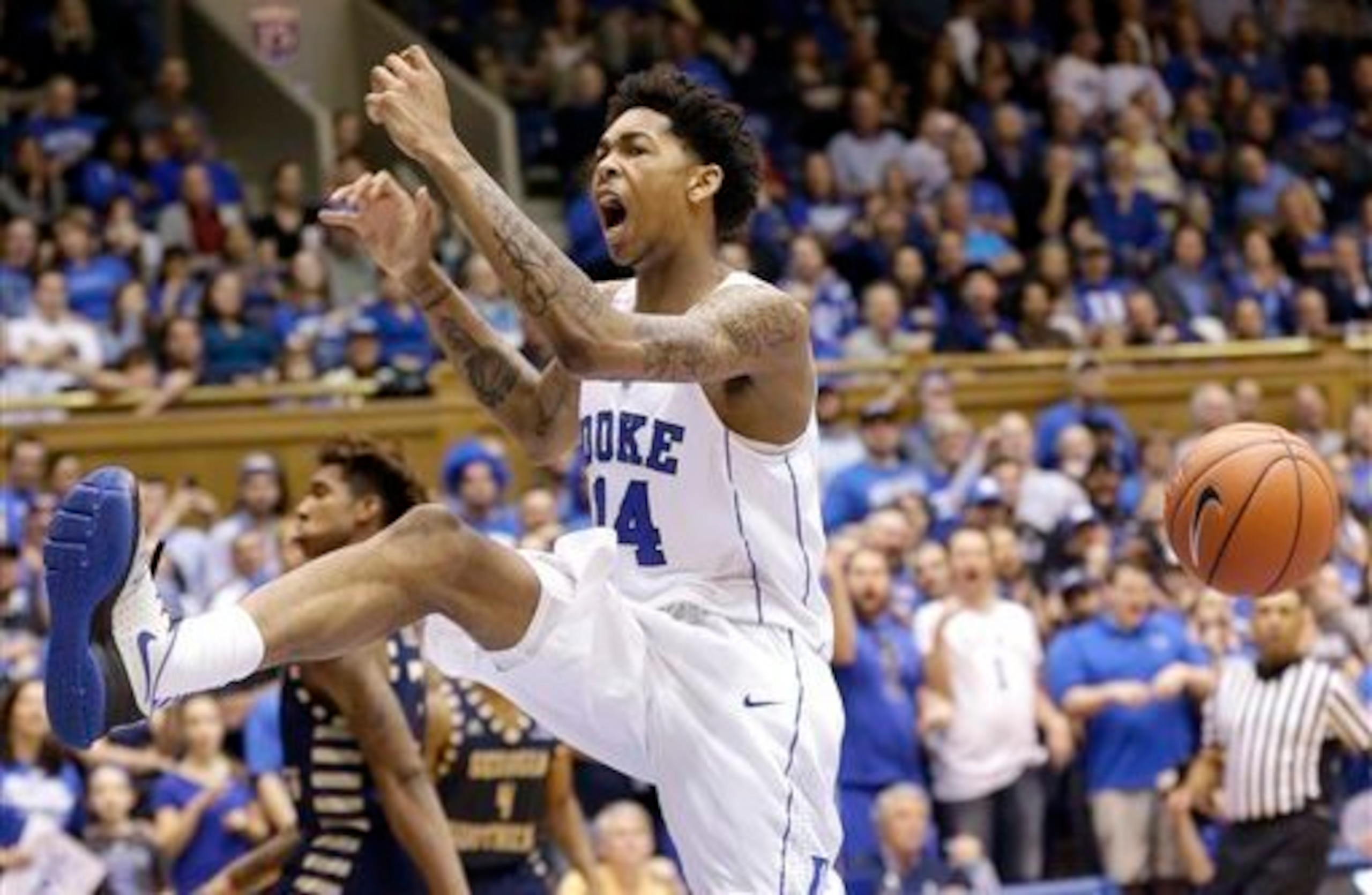
What We Learned: Freshmen can mature a lot in one month.
Early on in the season, things weren't looking so great for Duke's new guys.
Derryck Thornton really struggled for his first three games, and Brandon Ingram went through a stretch of three games in which he looked pretty disinterested in having to play this one-and-done season. (Those rough patches overlapped with each other and a poor outing from Grayson Allen for one disastrous game against Kentucky.)
However, the duo has been playing quite well lately, particularly Ingram. Since the start of December, Ingram has averaged 24.3 points, 9.3 rebounds, 2.0 blocks, 1.3 steals and 1.3 assists per game. Quite the improvement from the three-game stretch in which he averaged 5.7 points, 2.7 rebounds and 2.0 turnovers per game in the process of temporarily losing his starting job.
Will Duke's other two 5-star freshmen follow suit in month No. 2?
With Amile Jefferson out for at least a few weeks, Luke Kennard got his first start of the season Tuesday night against Georgia Southern—a game in which Chase Jeter set a new career high in minutes played.
The opportunity certainly exists for them to take the bull by the horns. And the short-handed Blue Devils would certainly prefer if at least one of them would immediately start living up to his recruited expectations.
6. Maryland Terrapins
20 of 25
What We Learned: Robert Carter Jr. is even more of a beast than we remembered.
When players transfer and sit out a year, it's easy to forget about them. Going 19 months without seeing a guy play is a long time, especially when some of us can't remember what we ate 19 hours ago.
But Robert Carter Jr. is just as much of a bruiser as we remember from his days with Georgia Tech—except he has been much more efficient with Maryland.
Carter shot 45.6 percent from the field in two years with the Yellow Jackets. He averaged 15.9 points and 11.2 rebounds per 40 minutes, along with the slightly more than occasional assist, block and steal.
But he's shooting 61.3 percent from the field thus far with the Terrapins—71.9 percent from inside the arc—has more than doubled his assist rate and has been significantly more valuable as a post defender.
According to Sports-Reference, Carter had a box plus/minus of 3.6 with Georgia Tech, but that number is 10.8 through 10 games with Maryland. His win shares per 40 minutes ratio has nearly doubled from 0.134 to 0.240.
Melo Trimble gets all the love (and rightly so), but this isn't a championship-caliber team without Carter's dominating in the post and leading the team in rebounds and blocks.
5. Iowa State Cyclones
21 of 25
What We Learned: Steve Prohm and Fred Hoiberg aren't all that different.
The differences between this year's Cyclones under Steve Prohm and the last few years of Fred Hoiberg's Cyclones are few and far between.
They still take more than 36 percent of their shots from beyond the arc and convert on better than 36 percent of them, still shoot better than 50 percent inside the arc, still rarely commit turnovers or fouls, still do a solid job on the defensive glass without much worrying about its offensive counterpart and still look the part of a team that could do some serious damage in the NCAA tournament.
Usually, a new coach will come in and immediately shake things up. But what Murray State played for four years under Prohm wasn't much different from what Iowa State had been doing for the past six years. The only major differences are the free-throw rate on both ends of the court and the fact that Prohm has a legitimate defensive stopper in the paint for the first time in his career. It's not a surprise that he hasn't tried to change much.
Plus, new coaches usually don't inherit rosters talented enough to win a national championship. It would have been pretty silly for him to tinker with a good thing.
4. Kentucky Wildcats
22 of 25
What We Learned: Kentucky doesn't know how to shoot.
Considering they can't do the most fundamental thing in basketball, the Wildcats are pretty doggone good.
In the paint, Kentucky is easily among the best in the nation. Skal Labissiere hasn't even remotely lived up to his potential yet, but he and Marcus Lee have been very good shot-blockers who are usually capable of finishing at the rim. Alex Poythress is also extremely effective when within range of a potential earth-shattering dunk, and all three guards have shown plenty capable of driving to the hole to get their buckets.
Outside the paint, though, the Wildcats are a bit of a train wreck. They're shooting 27.6 percent from three-point range, and the first few feet just inside the arc haven't been any prettier. Stuff the box and force this team to take jump shots, and it becomes extremely vulnerable.
Of course, this is what we said about Louisville three years ago when the Cardinals won the national championship, so it's not like you need a bunch of accurate gunners to win in this game. It helps, but so do great defense and rebounding, which the Wildcats have in spades. And if and when Tyler Ulis and Jamal Murray start shooting as well as we know they can, good luck finding a weakness on this team.
3. Oklahoma Sooners
23 of 25
What We Learned: Power forwards are overrated.
Oklahoma has four extremely good veterans on its roster. Buddy Hield, Isaiah Cousins, Jordan Woodard and Ryan Spangler are each shooting 50.0 percent or better from three-point range and are each averaging at least 12.4 points, 4.6 rebounds and 2.0 assists per game.
If you think there's a better quartet in the country right now, you're wrong.
And though we've spent much of the past few months wondering who Oklahoma's fifth starter/fifth-best player is, it really hasn't mattered. Those four guys have played so well that the Sooners don't even need a power forward to average 16 minutes per game in order to blow opposing teams out of the water.
We'll wait to see how they fare against the likes of Baylor, Kansas and West Virginia before dubbing the Sooners one of the favorites to reach the Final Four, but as long as their primary four players keep performing like this, there's very little anyone will be able to do to slow down Oklahoma.
2. Kansas Jayhawks
24 of 25
What We Learned: Third time's the charm for Wayne Selden.
It took a few years longer than expected—Wayne Selden was projected to be a 2014 lottery pick before ever playing a collegiate game—but he is finally playing better than we ever dreamed.
Selden entered his junior year a career 34.6 percent three-point shooter, but he has made at least 50 percent of his three-point attempts in eight out of nine games this season. In total, he's 30 of 50 (60.0 percent) from downtown and is averaging 16.6 points per game.
It's not just improved accuracy from long range, though. In every facet of the game, Selden is better than we've seen before.
Even though he's playing fewer minutes per game than he did each of the past two seasons, he's currently averaging more rebounds, assists, steals and blocks than either of those years. His win shares per 40 minutes ratio has almost tripled (0.249 vs. 0.084), as has his box plus/minus (12.0 vs 4.9).
Selden wasn't even remotely the best player at Kansas over the last two years, but he's certainly putting together a solid campaign for the Wooden Award in year No. 3.
1. Michigan State Spartans
25 of 25
What We Learned: Deyonta Davis really should have gotten five stars.
In the grand scheme of things, recruiting rankings mean very little. Sometimes 5-star guys flame out, and unrated guys occasionally go on to become franchise players. What you do in high school helps dictate which colleges will want you and fosters expectations of what you'll be able to do, but the stars don't matter once you step on the court to begin your collegiate career.
At the same time, recruiting rankings mean an awful lot. As far as 247Sports is concerned, Deyonta Davis will forever be a 4-star recruit. He was the highest rated 4-star recruit in this year's class. He was a McDonald's All-American. But 2015 will go down in the record books as another year that Tom Izzo didn't land a 5-star recruit. (2016 is already a very different story.)
However, it's pretty apparent the scouts whiffed on Davis.
Davis is shooting 62.0 percent from the field and is the only player in the country ranked in the top 15 in both offensive rebounding percentage and block percentage, where he ranks seventh and 11th, respectively.
Marvel over Denzel Valentine all you want—we'll certainly continue to do so, too—but you should also recognize that the Spartans have a real beast of a freshman in the paint.
Advanced stats courtesy of KenPom.com unless otherwise noted. Recruiting info courtesy of 247Sports.
Kerry Miller covers college basketball for Bleacher Report. You can follow him on Twitter @kerrancejames.


.jpg?w=2560 "Viral Rams Coach Vid 🖕")


