

Why Laremy Tunsil Is the 2016 NFL Draft's Only Elite OL Prospect
When you're discussing the 2016 draft class' offensive line prospects, the conversation starts in Oxford, Mississippi, but to understand why this college football season's star bookend ran away as the gem of pool in just a half season, we need to dig deeper.
The NFL has an offensive line problem. There's no way around that. If you watch any professional football game, you're going to come away thinking that defensive linemen are athletically dominant compared to their offensive counterparts, and this is absolutely true.
The issue is, college and high school football teams embrace this premise. In high school, if you're talented enough to play on the next level, you'll often play on both sides of the ball. During the recruiting process, schools are more than willing to let a player pick either side of the ball to play on, if he has the skills to hang at either position. This is when the economics of roster building comes into place.
TOP NEWS

New NFL Power Rankings 📊
The Robinsons POUND the Rock 🪨
Takeaways from Falcons' dominant MNF win
If you're a Power Five team looking at a 5-star prospect, you're more than willing to give him just about anything he wants to make sure he doesn't land with another school, let alone an in-state rival. So if you're Texas, and you're recruiting a big ugly to play on the offensive tackle, and Texas A&M offers him a spot to play defensive tackle, you have to let him know he's welcome as a defensive tackle in Austin, too.
Now, why do linemen tend to play on defense if they have the choice? First, coaches push them that way. The offensive line is more about the unit than the individual. You can have Joe Thomas playing blindside tackle for you, but if you have a liability at right tackle, your quarterback is still getting pressured every play. On defense, a sack can be a one-man show.
Second, there's more glory in playing on the defensive line. These athletes have been raised in a culture where they expect to see a 300-pound man dance after every sack. Offensive linemen are still looked at as taboo talking points who are uninteresting to fantasy football fans, so they're largely overlooked by the masses.
The third factor is simple: money. Defensive ends such as J.J. Watt and defensive tackles such as Ndamukong Suh sign $100 million contracts and become front-page news in their home cities as well as nationally. You'll be hard-pressed to find a casual fan who can name offensive linemen other than the Joe Thomases and Tyron Smiths of the NFL.
Often, some of the best offensive line prospects from the recruiting world never see a down at the position at the college level. The biggest example of this in recent memory is Arik Armstead. He was a California product, the brother of a then-USC Trojan, who was ranked by Scout.com as the top offensive tackle in the 2012 high school class and the No. 2 player in the nation overall.
There were hopes in Southern California that he'd be the next Matt Kalil or Tyron Smith, two top-10 bookends that the Trojans had drafted in 2012 and 2011, respectively. Instead, given the chance to play 5-technique defensive end for the Oregon Ducks, the flashy team up north, he spent his college years in Eugene.
Situations like this are why just about every team could use an upgrade at offensive tackle. Imagine if quarterbacks such as Aaron Rodgers, Cam Newton and Russell Wilson decided to play safety out of high school. The quarterback position would be in even worse shape than it is.
There are only so many 6'4"-plus, 300-plus-pound humans in the United States who are strong enough to pile-drive defensive tackles and mirror 230-pound blitzing linebackers. These dancing bears are a finite source, and it's why you see coaches swing at giant humans earlier in the draft.
"Plant Theory" drafting is an intelligent move on paper.
Unfortunately, fewer and fewer elite tackle prospects have come from college football through the years. Eric Fisher played for a mid-major and was essentially drafted first overall based off a week in Mobile, Alabama, during the Senior Bowl in 2013. Greg Robinson was a sophomore who never really had to drop into NFL-style pass protection while in Auburn's "gimmick" system and was taken second overall in 2014.
Few are ready to make an immediate impact on day one, but one player in the SEC, the country's toughest conference, looks like an Orlando Pace, Walter Jones, Jonathan Ogden or Tony Boselli of yesteryear: Laremy Tunsil.

Background
Like Armstead, Tunsil was a super recruit coming out of Lake City, Florida. He was the fourth overall prospect in the 2013 high school recruiting class, behind Robert Nkemdiche, Jaylon Smith and Vernon Hargreaves III, according to 247Sports' rankings. In Bleacher Report's Matt Miller's big board, he ranked Smith as the second overall prospect in the 2016 draft class, Nkemdiche fourth, Tunsil sixth and Hargreaves seventh. This is proof that if you streamline elite talents into the right positions, they're ready for the NFL in three or fewer years.
Tunsil breaks the mold at the position, to the benefit of whichever NFL franchise he signs a $20 million contract with in the spring. The only real red flag he's had during his college career is that the mold isn't the only thing he's broken. According to the NCAA, he received improper benefits before the 2015 season and was suspended for the first seven games of Ole Miss' football season. Rules are rules.
More than anything, it just limits the tape he was able to put out for NFL squads in what appears to be his final season in college football. Receiving improper benefits isn't going to be a factor at the next level.
Scouting report
You can tell a lot about an offensive lineman by just looking at his feet. There are different pass-protection assignments and different rhythms based on how many steps a quarterback is taking in the pocket and if play action is involved, but the basics are the basics.
There are two cardinal rules in pass protection: First, your inside foot, so right foot for a left tackle, must always be up. Your job as a bookend is to make a pass-rusher take the longest distance to the quarterback, which is around you. You can't ever let him have an easy lane on the inside.
Second, treat your behind like a camera, and your quarterback should never leave the frame. This gets you aligned correctly in a way that puts you at the right distance to force a pass-rusher to take an outside lane.
Mississippi ran a misdirection system that featured many screen passes, so it's not directly translatable to the NFL as a whole, but there are NFL blocking concepts intertwined in the offense. From a pure skill-set standpoint, one of the first things you notice about Tunsil is his size. He's listed at 6'5" and 305 pounds by the school's official site, and he looks the part.
He's strong, to the point where he can stonewall a defensive end without having to fully extend his arms, which essentially gives a defender a steering wheel. He will just snatch his hands inside like he's a defender himself and then drop a massive anchor.
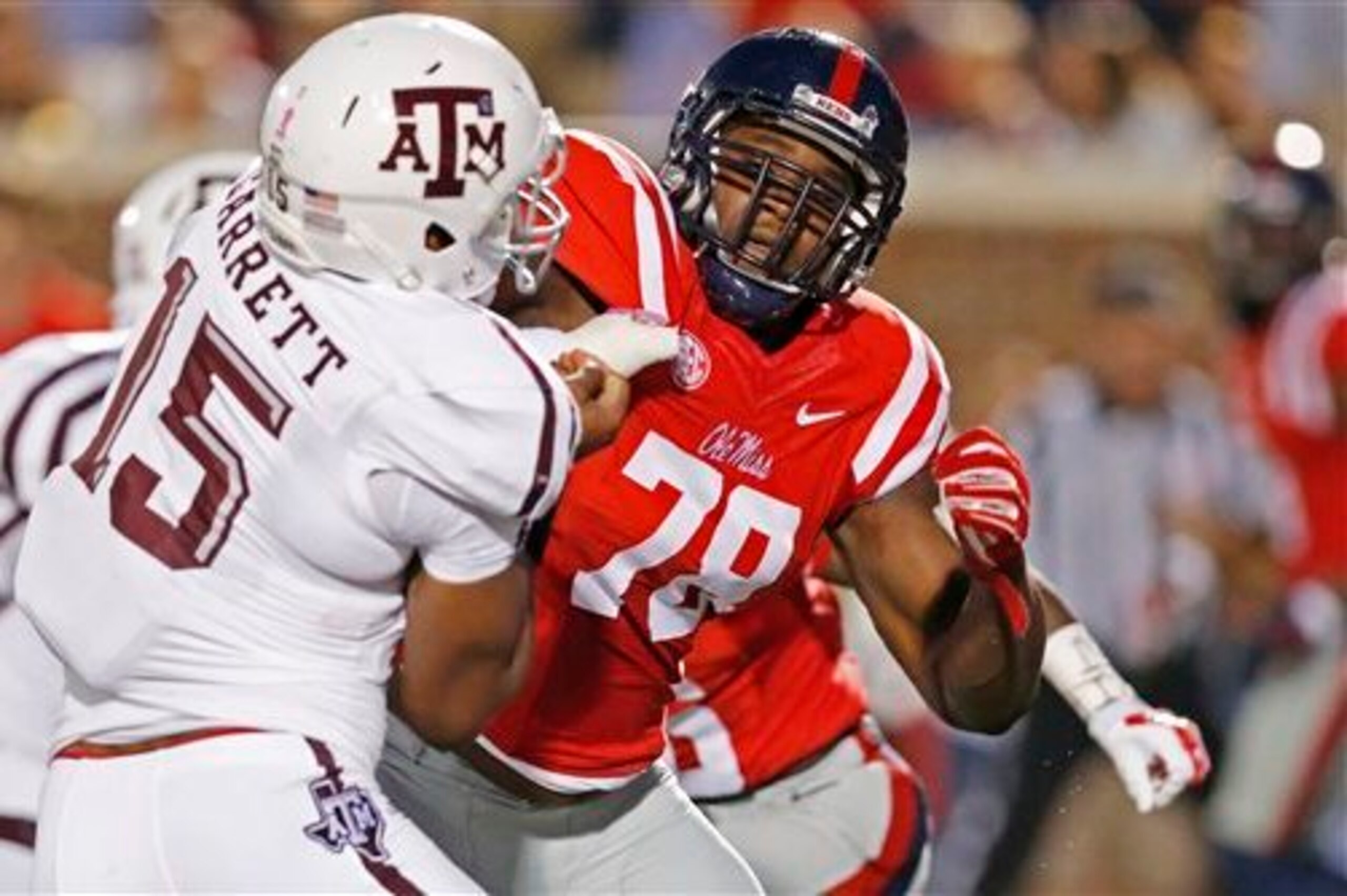
That's actually one of my favorite traits of Tunsil: how often he wins inside leverage with his hands. He was thrown to the wolves early in the season, facing Auburn's Carl Lawson and Texas A&M's Myles Garrett in his first two games back from suspension. For my money, those are two of the top three pass-rushers in the Power Five this season.
This play is a great example of what I'm talking about. Auburn's DaVonte Lambert, who has inside alignment, is his assignment. That means the left tackle has to slide over a half gap just to get in front of him so he doesn't win inside, and he has to beat his man to the mark.
You'll notice Tunsil makes contact at the line of scrimmage, while all the other Rebels offensive linemen are further in the backfield. The result? Tunsil shuts his man down for four seconds, not giving much ground at all, as his quarterback had time to show action, scan the left side of the field, scan the right side of the field and then get off a clean ball about 45 air yards from where he was standing.
A lot of Ole Miss' offense is based on quickly establishing your base rather than traditional three- or five-step kick slides that offensive tackles will see in the passing game at the next level, but when given the chance, Tunsil's feet have proved to be rapid. His stride length isn't great, but it's more of an experience issue than anything else. He's showing that he's quick to get his feet back into the ground, which is a huge plus, as whenever you make contact with your foot in the air, you're likely to find a cozy spot on the grass.
He's not perfect, but he's close. The only real slip-up he had, other than a couple of rusty false-start penalties, against the elite SEC pass-rushing duo was one play against Lawson.
He was caught bending his waist too much instead of standing tall, almost like he was sitting back into a chair. Because he was leaning into Lawson, the defender used Tunsil's own body against him, knocking down his outside arm and causing Tunsil to stare at his own shoes before frantically trying to make up for lost time.
Lawson won that round in their heavyweight bout, but as far as I'm concerned, Tunsil is the undefeated champion of college football. He can do everything from setting quickly and anchoring to nailing a linebacker downfield to sealing the most important block a bookend can make in the ground game—turning the shoulders of the containment defender on an outside zone play.
Garrett also brought his best against Tunsil, but the Ole Miss tackle just wasn't having any of it. Versus 98 percent of left tackles in college football, this play by Garrett is a sack. He got a great jump off the snap, was isolated one-on-one, sprinted into the right depth in the backfield and then tried to swipe and bend the corner. Tunsil is just so athletic, though, that he met the 262-pounder with speed, forced him to run the arch and then he put him into the dirt while his quarterback again got off a clean deep attempt.
Mississippi trusted him so much that it rarely helped its blindside tackle, even against the best that college football had to offer. That alone is a huge vote of confidence.

Summary
Tunsil is the best offensive lineman in the class. He's gone toe-to-toe with some of the biggest names in college football in his two-and-a-half years in Oxford, and he's finally ready for a franchise to call his name, potentially with the first overall pick. Looking at him from a high-floor and high-upside perspective, he's the best offensive tackle prospect since Joe Thomas and compares more to Hall of Famers drafted in the 1990s than the busts taken early in this past decade.
Tunsil can play left or right tackle for the majority of the teams in the league on day one. When you look at the other prospects in this class, it's hard to say they could. Ronnie Stanley of Notre Dame is a trendy name, but his skill set is almost exclusively based on finesse and footwork, as he was hung out for the world to see when Clemson's Shaq Lawson took it to him with power moves on national television earlier this season. People will claim he's the next Tyron Smith, but he's much closer to D.J. Humphries, who was taken 24th overall last draft by the Arizona Cardinals.
Taylor Decker of Ohio State and Jack Conklin of Michigan State are the other two offensive tackles whom people talk about in the first round. Decker is big, and he can likely hold his own at the next level, but since he's limited as an athlete, his best-case scenario is Andrew Whitworth, though he may end up having to play non-blind side with some tight end help, making him essentially the No. 2 tackle on whichever team he plays for.
Conklin's flaws are more extreme versions of Decker's. Conklin showed up to East Lansing as a walk-on, and it's not hard to guess why: He's not smooth or quick.
Unless a team such as Cleveland or Dallas ends up with the first overall pick, Tunsil should be the first name to come off the board in April. We're looking at a young Jonathan Ogden in the making, a prospect who can protect a Marcus Mariota for 10 seasons or Philip Rivers for the remainder of his career.
By the time the draft cycle fully kicks in and everyone is finished doing his homework, it's not going to be out of line to say "Laremy Tunsil has a chance to be this generation's best offensive lineman." What is going to be out of line, though, is the thought that he's just another Eric Fisher, Jake Long or Greg Robinson.

.jpg?w=2560 "Commanders Eagles Football")
.jpg?w=2560 "Grading WWE Raw 🔠")



.jpg?w=2560 "Viral Rams Coach Vid 🖕")