

Andrew Luck vs. Peyton Manning: Who Was Better Through Year 4?
The Indianapolis Colts' 27-24 win over the Denver Broncos on Sunday had huge significance for a number of reasons.
The Colts needed the win to turn their season around. Andrew Luck needed a strong game to turn his poor play around. The win knocked Denver from the ranks of the elite and put the Colts back in control of the AFC South.
But the game also brought the careers of Peyton Manning and Andrew Luck back into the limelight, particularly the comparison between the two. With Manning falling just short of setting the NFL's career records for passing yards and wins, not to mention throwing his final pass to a Colt for an interception, there was no lack of irony.
.jpg?w=2560 "Texans Jaguars Football")
.jpg?w=2560 "Jets Saints Football")
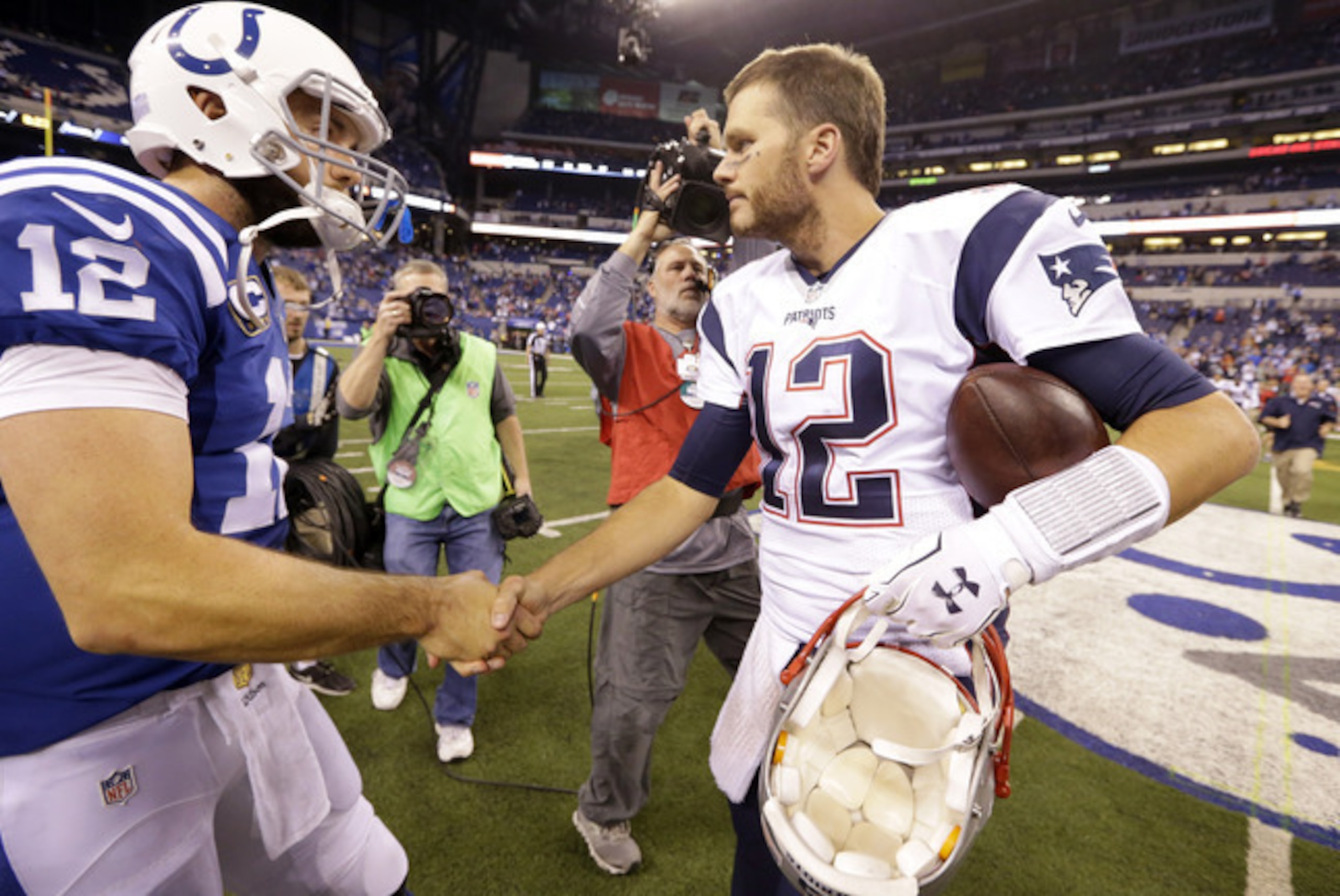
Luck and the Colts have gone 3-1 against Manning and the Broncos over the last four seasons, which led to people once again asking, is Luck better than Manning was?
The Stats Paint a Clear but Similar Picture
It's always interesting to see what the national media will throw around when it comes to Manning and Luck comparisons.
Bulk stats, particularly yards, touchdowns and interceptions are usually the default way to compare despite the fact bulk stats are an incredibly faulty way to compare any two quarterbacks, much less quarterbacks from two completely different eras.
You may not think of Manning and Luck as being from two different eras, but the 14 years that separates the starts to their respective careers has included a huge stylistic change in the way football is played in the NFL. Rule changes and a larger emphasis on offensive production (thanks, fantasy football) have completely changed the way bulk stats are compiled and viewed in today's NFL.
That's not to say bulk production doesn't matter, but it can't be the be-all and end-all or even one of the most important factors.
Consider this: In 2014, teams averaged 3,783 passing yards on 597 plays (6.34 yards per play). In 2000, teams averaged 3,302 passing yards gained on 566 plays (5.83 yards per play). Teams pass significantly more now and are significantly more efficient.
In 2014, there were 11 quarterbacks who threw for over 4,000 yards and 26 who threw 7.0 yards per attempt or more. In 2000, there were three quarterbacks who threw for over 4,000 yards and 13 who threw for 7.0 yards per attempt or more.
Still, the bulk stats are important, but we need to keep things in context, including where they fall amid their contemporaries. We also need to keep in mind that Luck's fourth year is not over just yet, so we'll go through Week 9 of each player's fourth year.
| Luck (2012) | 16 | 4,374 (7) | 23 (14) | 18 (3) |
| Manning (1998) | 16 | 3,739 (3) | 26 (5) | 28 (1) |
| Luck (2013) | 16 | 3,822 (13) | 23 (15) | 9 (23) |
| Manning (1999) | 16 | 4,135 (3) | 26 (3) | 15 (9) |
| Luck (2014) | 16 | 4,761 (3) | 40 (1) | 16 (6) |
| Manning (2000) | 16 | 4,413 (1) | 33 (1) | 15 (9) |
| Luck (2015) | 7 | 1,881 (20) | 15 (10) | 12 (2) |
| Manning (2001) | 8 | 2,077 (3) | 16 (4) | 11 (5) |
| Luck Total | 55 | 14,838 (7) | 101 (6) | 55 (5) |
| Manning Total | 56 | 14,364 (1) | 101 (1) | 69 (3) |
Luck has been pretty bulk friendly, so it shouldn't come as any surprise he generally fares well in these areas—interceptions aside. Luck and Manning's career arcs are kind of similar from this angle, with a decrease in interceptions in the second year followed by a peak year in the third season.
But Manning has long been the king of bulk stats, and his first few years in the league proved it. Manning was elite in terms of bulk from the moment his career started, taking no time racking up yards and touchdowns, especially in comparison to what most of the league was doing at the time.
While Manning gets the slight edge here, it's important to note several things.
First, looking at Manning's stats over the total four years in comparison to others at the time doesn't reflect the fact Manning had a bit of a boost since many of the elite quarterbacks of the generation prior to him, such as Dan Marino, Steve Young, Troy Aikman, John Elway and Warren Moon, were at the end of their careers. The other quarterbacks beginning their careers also didn't have nearly the quick start he did.
In fact, Manning and Brett Favre—who should not be overlooked in Manning's statistical dominance as Favre is one of the greatest stat compilers in the history of the league—were the only two quarterbacks to start every game over those four years. By comparison, there have been 11 quarterbacks to miss just one game or less from 2012 to the present. As such, Luck's competition in the bulk-stats category is much greater.
Still, from each individual year to each individual year, Manning's numbers stand out. Luck's third season is the only one that is in the ball park of Manning's when compared to their peers. But with the greater competition, it's at least somewhat close in bulk stats. Both quarterbacks were used very heavily.
Advanced Metrics Give Manning a Greater Edge
Unfortunately for Luck, he's never been the efficiency machine Manning was, even at an early age.
While most will remember Manning's efficiency peaking during his mid-2000s run, then later in his career with the Broncos, the future Hall of Famer was incredibly efficient even at a young age.
After Manning got past his trial-by-fire rookie season and dropped his interceptions to a manageable level, his efficiency numbers went through the roof.
Note: For these metrics, Manning's stats will go through his entire fourth year, while Luck's will just go through the present. For some of these metrics, historical week-by-week data is not available.
| Luck (2012) | -5.1% (19) | 107.6 (9) | 76.5 (25) | 7.0 (16) | 5.66 (20) |
| Manning (1998) | 7.7% (18) | N/A | 71.2 (23) | 6.5 (18) | 4.84 (21) |
| Luck (2013) | 4.6% (16) | 87.8 (8) | 87.0 (18) | 6.7 (27) | 6.06 (16) |
| Manning (1999) | 34.0% (2) | 109.6 (2) | 90.7 (4) | 7.8 (4) | 7.06 (2) |
| Luck (2014) | 9.2% (11) | 110.0 (8) | 96.5 (7) | 7.7 (7) | 7.28 (5) |
| Manning (2000) | 38.3% (1) | 133.0 (2) | 94.7 (6) | 7.7 (5) | 7.22 (6) |
| Luck (2015) | -12.5% (26) | 18.7 (27) | 74.9 (31) | 6.4 (30) | 5.04 (30) |
| Manning (2001) | 14.7% (7) | 30.8 (9) | 84.1 (9) | 7.6 (5) | 5.88 (6) |
Efficiency levels are much easier to compare directly across eras than bulk stats, but there is still a difference in the time periods, so we must remember to look the quarterbacks' respective rankings as well.
Either way, looking at it this way doesn't leave any doubt: Manning performed at a more efficient level by a remarkable margin.
While Manning and Luck had similar rookie years across the board, Manning began putting up top-five numbers in his second season in a way Luck never achieved.
Both quarterbacks peaked in their third season (as far as the four-year snapshot goes), but Manning's exemplary work on third down and in the red zone gives him a significant edge in DVOA (defense-adjusted value over average) and EPA (expected points added). Even during Luck's best season, he directed an offense that was explosive but not particularly efficient or consistent.
"In his third season, Peyton Manning had 1939 DYAR. Andrew Luck has 2107 cumulative DYAR through three seasons.
— John Morgan (@LesserNesser) January 19, 2015"
In each quarterback's fourth year, a regression occurred, but Manning's fall was nowhere near Luck's. Over the first half of this season, Luck has been putting up bottom-five quarterback numbers. Manning stayed in the top 10 despite his relatively poor performance.
The difference is especially true in DVOA, which is likely the best overall metric out there for judging a quarterback's efficiency statistically. Without even looking at the ranks, Manning's efficiency crushes Luck's. Even Manning's first season, with a 7.7 percent DVOA, was just slightly behind Luck's 9.2 percent last year. For context, 7.7 percent DVOA would have been 13th in 2014's rankings, per Football Outsiders.
If you're somebody who scoffs at advanced stats, it's worth doing some research into the methodology of the more critically acclaimed metrics used today. There is incredible value there to be understood if you take the time.
This is not something that should just be waved away with an attitude of "stats are for nerds." They are all painting the same picture.
Context, Support and Wins Does Not Make Up the Difference
All that being said, statistics are not the only way we measure quarterbacks, and they shouldn't be the only factor here.
Unfortunately, Manning's clear edge in the numbers give him too much of an advantage.
Some Luck supporters would look at the success he has had in the win column over the last few years in comparison with Manning. In that regard, we could certainly give him the edge in that rookie season, where the stats are very similar. While the Colts' 2012 roster was certainly better than the one Manning had to deal with in 1998, it had no business winning 11 games and going to the playoffs, which it did largely because of Luck's exceptional rookie play.
But Manning used that down rookie year to improve, and he managed 13 wins in 1999 and had 30 regular-season wins by the time Week 9 of his fourth season came around. Luck, meanwhile, has 35 regular-season wins under his belt despite an eight-win head start after his rookie season.
What about the playoffs, you ask?
That's again where the quality of the team matters much more than the quality of the quarterback. This is all a part of the perspective that wins are a team statistic, not a quarterback statistic, but some people place a great deal of value on quarterback wins. For the record, Manning and Luck have the same exact postseason passer rating for their first three seasons.
Let's take a look at how this perspective is flawed, especially in the limited sample of the playoffs, by examining Manning's wild-card loss to the Miami Dolphins in 2000.
In this game, Manning led the Colts on a field-goal drive with 5:00 remaining in the fourth quarter to put the Colts up 17-10. But the defense allowed a game-tying, 80-yard touchdown drive, and Manning got the ball back with less than 30 seconds remaining at his own 20-yard line. Against the No. 1 pass defense by DVOA in the league, the Colts opted to run the rest of the clock out and play for overtime.
Though the Dolphins received the ball first in overtime, the Colts' defense held and gave Manning a shot. He quickly moved from the Colts 18 into Miami territory, eventually getting to 4th-and-1 on the Miami 31. But Mike Vanderjagt missed the 49-yard field goal, not the first time he'd let down the Colts in the playoffs, and Manning never saw the ball again, as the Dolphins scored a walk-off touchdown on the ensuing drive.
That's not to say Manning was perfect in the game, but he gave the Colts plenty of chances to win, which is simply not communicated accurately by a simple win or loss designation.
Give Luck an edge in playoff performance if you're so inclined, but the difference is marginal.

The same is true for arguments that say Manning had more support from his team. People remember a young Marvin Harrison and Edgerrin James, but the Indianapolis rosters were a mess outside of those two players. Sure, Harrison racked up receiving yards and James gave Manning more ground support than Luck has ever had, but the Colts' second receivers in Manning's first four years were guys such as Jerome Pathon, Torrance Small and Terrence Wilkins.
Luck's overall receiving corps has been better, although Manning's support from the running backs has lapped Luck's by a mile. Edgerrin James and Marshall Faulk versus Donald Brown, Trent Richardson and an aging Frank Gore is no comparison. However, do not underestimate Manning's effect in the run game, as he was far more successful in getting the Colts in the right plays for different scenarios than Luck has been thus far.
Offensive lines are a more of a wash than one might think given the Colts' rushing success in Manning's early years. Faulk and James made those lines look better than they were, as they really were an odd combination of mismatched parts. The good offensive lines that are usually associated with the Colts, featuring Tarik Glenn, Ryan Lilja, Jeff Saturday, Jake Scott and Ryan Diem, wouldn't come until the mid-2000s.
The defenses are roughly similar as well, although Luck gets the slight edge here. The 1998-2001 Colts had a couple of standout inside linebackers, but that was really it, and the stats showed as much.
| Luck- Defensive DVOA | 31 | 16 | 13 | 15 |
| Manning- Defensive DVOA | 29 | 26 | 23 | 29 |
| Luck- Points Allowed | 21 | 9 | 19 | 20 |
| Manning- Points Allowed | 29 | 17 | 15 | 31 |
| Luck- Yards Allowed | 26 | 20 | 11 | 28 |
| Manning- Yards Allowed | 29 | 19 | 22 | 28 |
Overall, Manning gets the edge in support, mostly because of James and Faulk, but it's much less than some would try to argue. Both quarterbacks took over franchises in turmoil, coming off horrific seasons with a very small base of talent to work with. In the fourth season of their careers, both quarterbacks saw significant front-office turmoil result in coaching changes.
Considering Manning didn't get to play in a horrific AFC South division, it kind of all washes out.
The problem with the support argument for Luck is it's an argument of hypotheticals. Even if Manning had vastly better teammates and coaching, which can be disputed, the fact is he still performed and produced at a higher level. There are plenty of reasons that could have factored into that production, but it still happened; the statistics bear that out.
Maybe Luck would have performed at a similar level had he been put in that situation. Maybe he wouldn't have.
There's no way to know. All we know for sure is how they performed in their given contexts, and those numbers lean toward Manning in a big way. If the two had performed at similar levels, it would make sense to weigh the context more heavily as a sort of tiebreaker.
But they didn't.
Manning's highs were higher and his lows weren't nearly as low. He was an elite quarterback by Year 2, and even in his fourth-year regression, he kept performing at a high level. We've been anticipating Luck's ascension to the elite level, but aside from a brief glimpse of it in 2014, we're still waiting.
After last season, the race was very close. Luck's regression this year has allowed Manning to take a commanding lead once again, and it will take historic seasons for Luck to close the gap. After all, what Manning did from 2002 to 2010 is unprecedented.
That's not a knock on Luck. Manning is one of the greatest quarterbacks of all time, and doing 85 percent of what he did for the Colts would make for a fantastic career. At 26, Luck also has plenty of time to cement his own legacy.
Aaron Rodgers had been starting for just one season and went 6-10 in his fourth year in the league. Tom Brady was a game manager on a great team, putting up middling stats at best. Drew Brees went to his first Pro Bowl after Year 4, but the San Diego Chargers were already grooming Philip Rivers to eventually replace him.
None of those quarterbacks looked like Hall of Fame locks after four years in the league.
Luck has accomplished more individually than any of them had.
He's just not quite Peyton Manning. Not yet. Maybe he never will be.
Don't let that diminish the greatness he does possess.
.jpg?w=2560 "Texans Jaguars Football")
.jpg?w=2560)
.jpg?w=2560 "Ref Slips on Wet Turf in London 🎥")
.jpg?w=2560 "McCarthy Injured During Game")