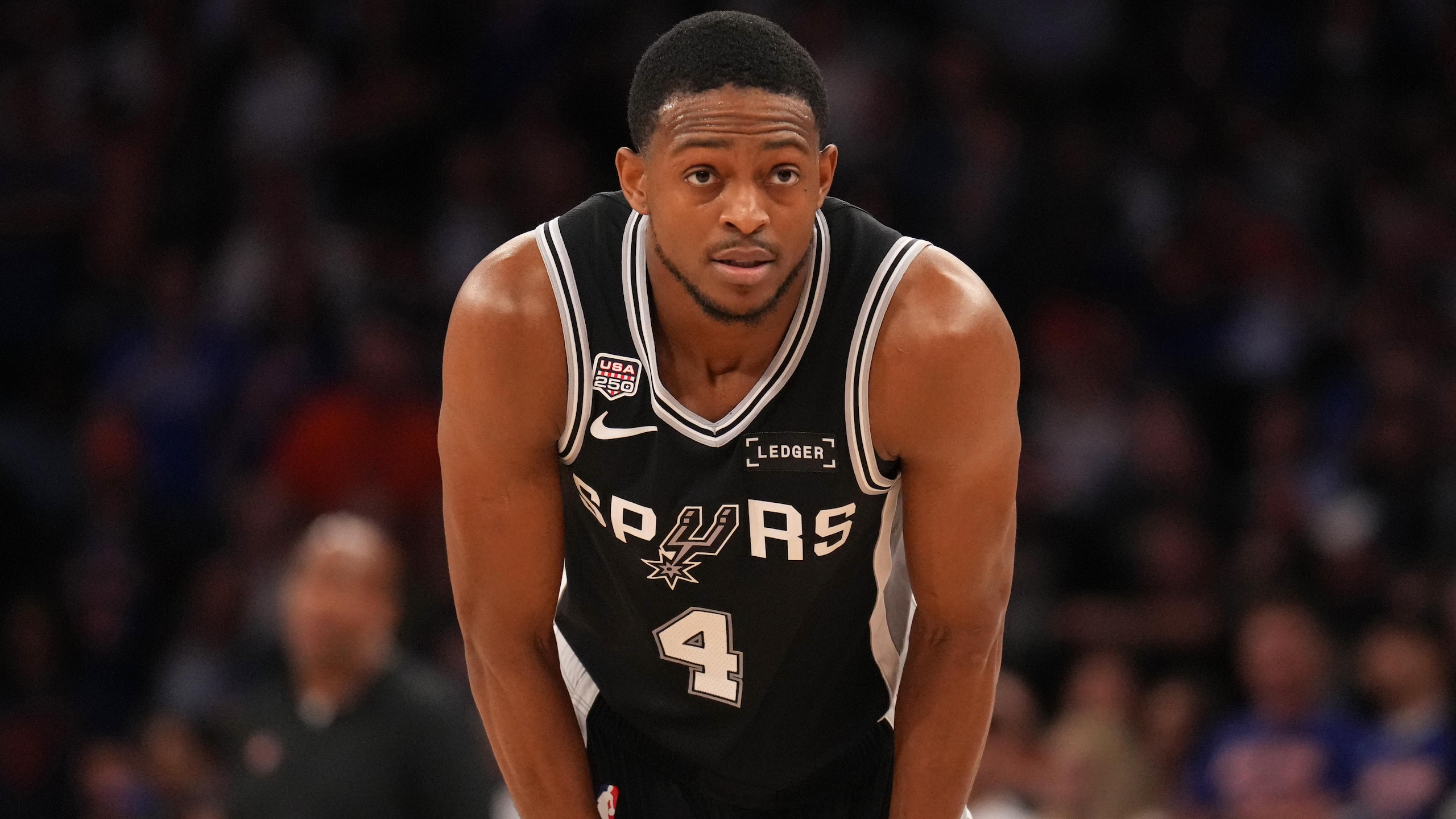

De'Aaron Fox Is Officially the NBA Finals' Biggest X-Factor
De'Aaron Fox didn't join the San Antonio Spurs to save them, but that's exactly what they need him to do now.
That's a big ask from a player who steered himself toward San Antonio with an intent to support resident megastar Victor Wembanyama. Usually, saviors aren't secondary.
It's a bit much to say Fox planned to ride Wemby's coattails. Charitably, the veteran guard saw an opportunity to align himself with a potential great and took it. He seemed to relish the idea of serving as a second option on a good team after so many years of being the first on a bad one. Who could blame him?
And yet, here's Fox, suddenly occupying a niche that feels singularly pivotal—not because he's been anything close to San Antonio's best weapon against the New York Knicks in these Finals, but because he's the role player whose performance is the most unreliable and the most desperately needed.
The shot Fox hit with 12.2 seconds left in Game 3, a foul-line jumper in isolation against OG Anunoby, secured a win, salvaged a series and sustained hope for a Spurs team that very nearly fell into a historically insurmountable 3-0 deficit.
He was 3-of-13 on the night before drilling the game's biggest bucket, which is a pretty good encapsulation of how much his struggles have hurt the Spurs and how critically necessary his contributions are.
After Fox's game-icing shot, you could practically feel everyone associated with San Antonio think, "THERE he is!" And they didn't mean it like people used to when talking about Fox, a player who was once regarded as perhaps the fastest athlete in the league, the kind of human blur who seemed to teleport from midcourt to the rim.
They meant it as an acknowledgment of who Fox hasn't been throughout most of the postseason, of who the Spurs so badly need him to be.
Forget the fact that Anunoby is basically a heavily caffeinated 6'8" octopus made out of cast iron, the type of defender no one in his right mind ever attacks in straight-up fashion. Even against weaker opponents, no one on the Spurs' roster has the combination of quickness, ball-handling and experience to generate that sort of must-have scoring chance.
This isn't to take anything away from Stephon Castle or Dylan Harper, both of whom have outplayed Fox in this postseason and both of whom already sit higher on the Spurs' long-term chart of organizational importance. Those two have already nuked expectations—to the point that asking either one of them to do more than he's already done would feel absurd.
Oh, really, you think the 20-year-old who has already set the franchise postseason scoring record for rookies should take on an even bigger role?
And how about that 21-year-old who's on pace to be the youngest player in history to average at least 19.0 points, 5.0 assists and 5.0 rebounds in the playoffs (minimum 10 games) while guarding every opponent's best player? He needs to step up?
It would be a joke to demand more of Wemby, who continues to be San Antonio's biggest star on both ends.
Fox, meanwhile, is the highest-paid player on San Antonio's roster, a two-time All-Star and the only guy in the regular rotation with even a modicum of postseason experience. He's averaging 15.9 points on a 42.8/29.4/75.0 shooting split while virtually never getting to the basket.
The 20 points Fox scored in Game 2 were the exception to the rule. He managed just seven in Game 1 and a dozen in Game 3. He's scored in single digits three times in his past six postseason appearances.
Fox was second on the Spurs in total points during the year, and he averaged at least 23.0 points per game in each of the five seasons prior to this one. So far, he hasn't led San Antonio in scoring a single time in these playoffs.
If it's fair for the Spurs to ask more of anyone on the roster, it's clearly him.
This is the part where we have to cite the high ankle sprain Fox suffered earlier in the playoffs as an excuse. Much of his inability to get to the cup, beat his man and threaten defenses as a pull-up shooter from deep may owe to that injury.
But he's out there, he's consistently logging minute totals in the high 30s and he's clearly still important in his limited state. Remember those two games he missed against the Thunder in the West Finals, when an overburdened Castle coughed up the rock a whopping 20 total times?
Some might argue reducing Fox's role is actually smarter than waiting for him to put together a solid game. What happened to Castle against OKC is the best argument against that strategy, even if we all want to see more of Harper in an on-ball role.
Fox must continue to start and close, but he also has to be more than a player who takes care of the ball and makes the occasional big shot. San Antonio needs him to spark its transition attack, turn the corner hard in the pick-and-roll and bend the defense in ways that clear room for Wemby to receive the ball deep in the paint.
Wembanyama caught four lobs for dunks in Game 3, arguably the highest-efficiency shot San Antonio or any other team can generate. Fox assisted on three of them.
For the Spurs to do more than leave this series with a single win, Fox needs to produce more of those setups, generate more paint touches, hit more in-between bailout jumpers and, well...provide more of everything an actual star second option is supposed to.
If he can do that, these Finals are there for the taking.
Stats courtesy of NBA.com, Basketball Reference and Cleaning the Glass. Salary info via Spotrac.
Grant Hughes covers the NBA for Bleacher Report. Follow him on Bluesky and subscribe to the Hardwood Knocks podcast, where he appears with Bleacher Report's Dan Favale.

.jpg?w=2560 "Cam Ward Says He's Not A Loser")
.jpg?w=2560 "Chargers Fall to 0-5 🤢")

.jpg?w=2560 "Grading MHJ Trade 📝")