
NBA Backups Who Will Be Better Than Their Starting Counterparts Next Season
What happens when certain NBA backups are on course to be better than the players they're backing up next season?
This slideshow.
Members of NBA second units are typically considered inferior to those whom they spell. The best players deserve the biggest roles, and the biggest roles normally exist within the starting lineup. Ergo, the best players start.
But it doesn't always work out that way.
Sometimes, that's by design. Other times, it's by accident or because a developing player morphs into a force that transcends the tenured veteran for which he provides support.
In a select few cases, it's merely because Team X is mistakenly banking on the resurrection of a fallen superstar or player who, to put it plainly, just isn't good enough.
Last season's performance along with age, health, career trajectories and fun or unflattering statistical factoids will all go in to determining which of the Association's alternates end up better than the first-stringers they play behind. The selection process will always rest more on the backup's value than the starter he's undermining.
Opening-night depth charts and starting fives aren't yet common knowledge for every team, so educated guesstimates are necessary. By identifying subs who will thrive, we're simultaneously making predictions for who will and who won't start. That's just the nature of the biz during the dog days of summer.
So keep an open mind and realize that our mini-depth charts are not binding. They could change. The reserve set to outplay his starting counterpart could, in the end, become the starter himself.
After all, these players, while they project as backups, have the tools to make that happen.
Darren Collison, Sacramento Kings
1 of 5
Backup to: Rajon Rondo
Darren Collison was one of just four players to average at least 16 points, 5.5 assists and 1.5 steals while shooting 37 percent or better from deep last season.
His company: Stephen Curry, James Harden and Chris Paul.
His reward: being relegated to second fiddle on the Sacramento Kings' point guard totem pole behind the redemption-seeking Rondo.
It's true that Rondo has four All-Star selections to his name and that Collison, despite seeing ample time as a starter elsewhere, has never piloted a top-flight offense. Collison also missed 37 games due to injury in 2014-15 and is working his way back from a surgery on a core muscle.
Still, it's equally true that, at this point, Rondo is the inferior player.
Not only was Collison's true shooting percentage nearly 13 points higher than Rondo's last season, but he racked up more than twice as many win shares while appearing in 23 fewer games. And while the Kings were no offensive juggernaut, they were at least statistically better with Collison on the floor.
Rondo hasn't been an offensive plus since the 2011-12 campaign.
Why, then, would the Kings bring in Rondo on a one-year deal, pinning Collison to the second unit by default? As Aaron Bruski of The Koz and Bru Show wrote on Twitter, this is kind of their thing: "Collison quickly going through three stages of being a Sacto point guard. 1) What a nice surprise. 2) Clearly we need an upgrade. 3) Here's the new guy."
Collison figures to be a trade candidate next season if he becomes unhappy with the current arrangement. Head coach George Karl can mitigate the damage by playing Collison and Rondo together, but if the former starts to obviously outshine the latter, the Kings will have an issue on their hands.
In the meantime, hopefully Isaiah Thomas thought to send Collison a gift basket or "Karma's a Jerk" bumper sticker.
Jerian Grant, New York Knicks
2 of 5
Backup to: Jose Calderon
Trotting out rookie Jerian Grant with the rest of the starters is a tantalizing proposition for the New York Knicks. But the 33-year-old Calderon still projects as the first-string floor general. He has more experience, and the Knicks, for all their big-picture moves, are still trying to compete now.
They don't own the rights to next year's first-round pick, and Carmelo Anthony, now 31, isn't getting any younger. They have every incentive to gun for one of the Eastern Conference's final two playoff spots.
Calderon is also a better fit for the triangle offense. Grant is at his best when dominating the ball and attacking the rim, while Calderon can function almost strictly as a triangle-friendly spot-up shooter. He put in 38.1 percent of his catch-and-shoot threes last season and 45.9 percent in 2013-14.
But the Knicks, as they showed during the NBA's Las Vegas Summer League, aren't married to the triangle anymore. Chris Herring expanded upon this for the Wall Street Journal:
"But as [Phil] Jackson and [Derek] Fisher head into Year Two at the helm, there seems to be a concerted effort—not only in message, but scheme as well—to de-emphasize Jackson's offensive system of choice.
The Knicks haven't scrapped the triangle, which is still their base offense, even here in summer-league games. But from last year to now, there's been a considerable difference concerning how and when the players rely on the system to score.
"
The Summer Knicks ran a healthy number of pick-and-rolls, and everyone, from Langston Galloway and Cleanthony Early to Kristaps Porzingis and Grant, was given the freedom work off the dribble.
And that means Grant will have an opportunity to shine even as a member of the second unit. He shot under 40 percent from the field in Vegas, but at 6'4", he can see over rival defenders and makes nice passes off screens.
As the Knicks continue to make the triangle a systematic guideline rather than an X's-and-O's bible, Grant should see more playing time. He's already a defensive upgrade over the slow-to-react-if-he-reacts-at-all Calderon, and his incisive drives are luxuries New York hasn't enjoyed at the point guard position in years.
That he can play shooting guard as well is equally huge. The league values multiposition talents above all else, and with Calderon on his last legs, coming off a season in which he battled Achilles pain, it's only a matter of time before the Knicks value Grant more than any other guard they employ.
Meyers Leonard, Portland Trail Blazers
3 of 5
Backup to: Ed Davis/Mason Plumlee/Noah Vonleh
Meyers Leonard, Mr. 50/40/90 himself, poses an interesting predicament.
With the Portland Trail Blazers now in full-on rebuild mode, he should be a lock to make the starting lineup. But the team has assembled itself an unevenly built frontcourt.
One of Davis or Plumlee needs to start. It doesn't make sense to bring two bigs who struggle to score outside three feet of the basket off the bench. That's a spacing nightmare waiting to happen, and the Blazers are already taking a chance by presumably slotting the erratic-shooting Al-Farouq Aminu at small forward.
Davis is the clear choice over Plumlee, if only because Portland is paying him $20 million over the next three seasons. Davis also fared better as a rim protector than Plumlee last season, and the Blazers need someone to police the paint after losing Robin Lopez to the Knicks.
Leonard could man the 4 next to Davis, but he stands at 7'1" and is actually Portland's strongest rim protector in the wake of Lopez's departure. Opponents shot just 42.3 at the iron when being defended by him last season, the fourth-best mark among all players who contested at least 3.5 such attempts per game.
Vonleh, at 6'10", is a better fit for the starting power forward spot—provided Davis is the starting 5. He shot 5-of-10 from beyond the arc in Vegas, so he can provide the spacing Portland is otherwise short on while Leonard helps mask Plumlee's rim-protecting deficiencies within the second unit.
Indeed, Leonard is the best big on the Blazers roster, and it's not even remotely close. Though his limited sample sizes make it difficult to call him a star in waiting, he's as futuristic as futuristic big men come.
Over the last five years, only two qualified players have averaged at least 19 points, 15 rebounds and two made three-pointers per 100 possessions in the same season: Leonard and Kevin Love. That's it. Leonard may not be the second coming of Love, but his ceiling is, at bare minimum, that of a starter.
"That's my goal, and I'm certainly going to work my tail off to try to do so," Leonard said of starting, per the Portland Tribune's Stephen Alexander. "The expectation is there."
It's just that next season, with the Blazers constructed the way they are, the expectation should be that Leonard will play the part of a starter trapped in a reserve's role.

Isaiah Thomas, Boston Celtics
4 of 5
Backup to: Marcus Smart
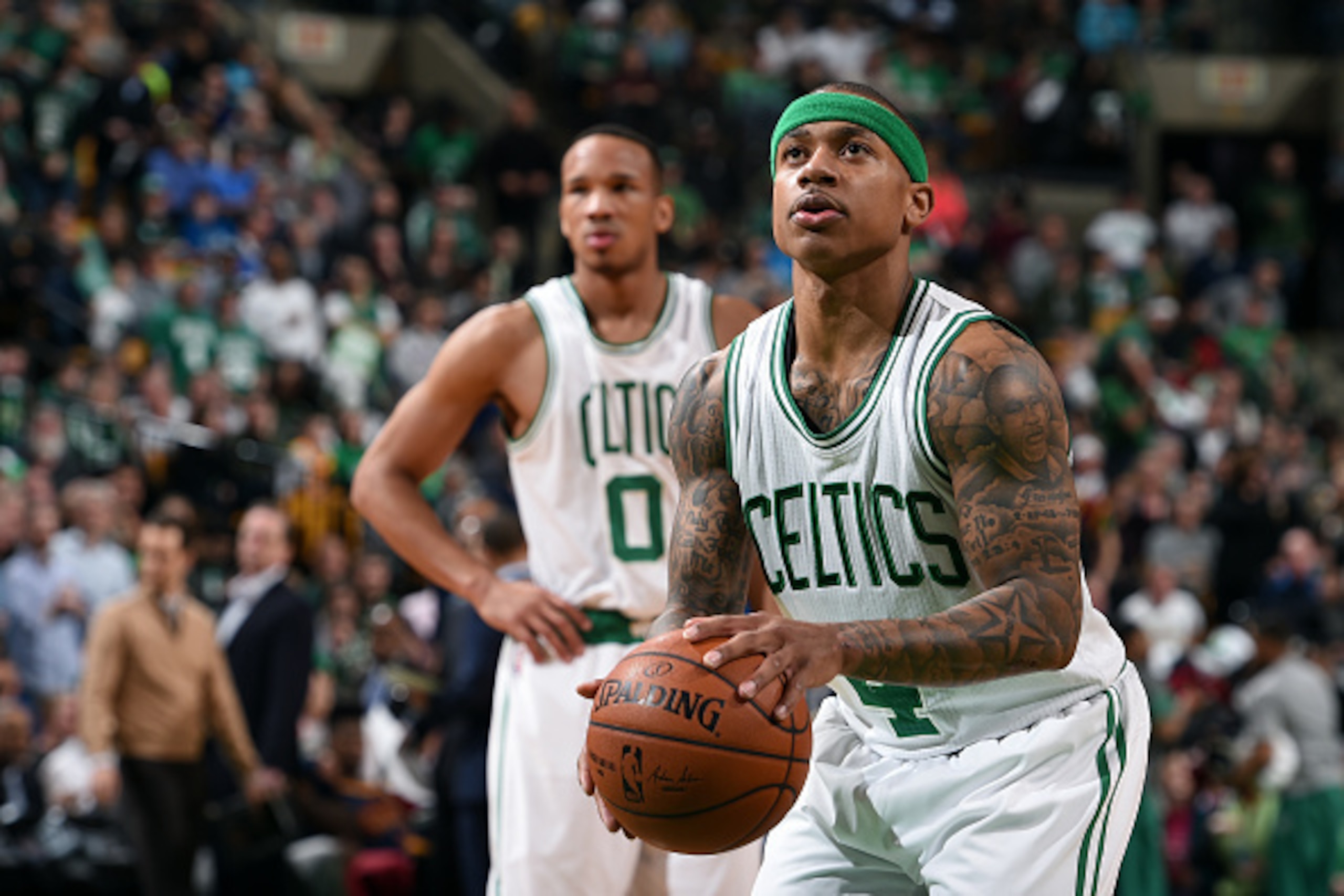
Marcus Smart needn't take offense to this, just as Isaiah Thomas needn't be offended that he's arguably the Boston Celtics' best player but will still be coming off the bench next season.
This is purely a logistics thing.
The Celtics have too many guards on the roster, Smart is a top-six pick and projected cornerstone, and Avery Bradley is the better option at shooting guard because, even at 6'2", he's five inches taller than Thomas and a much more effective defender.
That doesn't make Thomas any less important than Smart, who, like Bradley, is a better defender. As of now, in fact, Thomas is by far the more polished player.
Boston outscored opponents by 7.3 points per 100 possessions in the 545 minutes Thomas was on the floor last season. Such a small sample size comes with the requisite caveats, but a net rating of 7.3 would have ranked second in the entire league. And that matters.
Thomas is just a stat-sheet-stuffing machine in general. Although his per-100-possession numbers exploded upon being traded to the Celtics, he's always been a per-metric enthusiast's dream.
Since entering the NBA in 2011, Thomas is averaging 28 points and 8.4 assists per 100 possessions. Seven other players have maintained those benchmarks while matching or exceeding Thomas' minutes totals during that time.
When thrown together, these seven form a list that reads like a who's who of NBA dignitaries: Stephen Curry, James Harden, Kyrie Irving, LeBron James, Damian Lillard, Tony Parker and Russell Westbrook.
Keeping that company doesn't make Thomas a superstar. The Celtics are still in the market for one of those. Smart may even be that superstar himself when all's told.
For now, though, he has just 71 playoff and regular-season tilts under his belt along with two dislocated fingers from which he must heal. He is still very much in the development phase of his career, while the diminutive Thomas is someone who can realistically lead a playoff-bound Celtics squad in points, assists and, most importantly, win shares.
T.J. Warren, Phoenix Suns
5 of 5
Backup to: P.J. Tucker/Markieff Morris
Someone ought to warn Tucker. Sending a carrier pigeon to Markieff Morris and Mirza Teletovic with an explicit note detailing the threat to their playing time is probably a good idea, too.
T.J. Warren is coming for their minutes. And fast.
The 21-year-old Warren lit up Vegas yet again this year, earning All-NBA Summer League First Team honors with averages of 18.7 points, 3.6 rebounds, 1.1 steals and 1.1 blocks per game. If not for Kyle Anderson going all LeBron James, Warren might have even snagged the summer league's MVP award.
Not that he needs it. His performance in Vegas was more than convincing enough to give the Phoenix Suns something to think about. He needs more minutes, and they need to find him those minutes.
By now, it's not a question of "Should they?" This is officially a matter of "How will they?"
Sending Reggie Bullock, Danny Granger and Marcus Morris to the Detroit Pistons opens up at least one additional spot in the rotation. But the Suns still have both minutes and moral dilemmas on their hand.
First off, it's not entirely clear where Warren should play. He's listed as a small forward, but 6'8" wings are today's power forwards.
Nor does it help that, despite an ability to play off the ball, Warren's three-point stroke is broken. He shot 26.7 percent from deep during his final season at North Carolina State, and he was just 5-of-21 (23.8 percent) from behind the arc during his rookie campaign.
Phoenix also employed Giannis Antetokounmpo levels of three-point aversions during the summer league. Warren hoisted just four shots from long range, all of which he missed.
Carving out a concrete role for Warren will entail the Suns running him at the 4 to some extent. Head coach Jeff Hornacek told Bryan Gibberman of ArizonaSports.com he hasn't spoken with Morris since the Suns traded his brother, Marcus, and Phoenix remains at the forefront of the NBA's undersized lineup movement.
Minutes for Warren, then, could just materialize out of trades or certain lineup combinations. Wherever he plays, it's just unlikely he starts.
The Suns have an obligation to balance rebuilding with attempted winning after signing Tyson Chandler to a four-year deal and investing $70 million in Brandon Knight. More likely than not, Warren will spend most, if not all, of his time spelling Tucker or Morris (or both) as a super sub.
Just don't be surprised if, by season's end, he's outperforming those for whom he subs.
Stats courtesy of Basketball-Reference.com and NBA.com unless otherwise cited.
Dan Favale covers the NBA for Bleacher Report. Follow him on Twitter, @danfavale.

.jpg?w=2560 "Cam Ward Says He's Not A Loser")
.jpg?w=2560 "🚨 Texans Trade for MHJ")
.jpg?w=2560 "Grading MHJ Trade 📝")
.jpg?w=2560 "Chargers Fall to 0-5 🤢")

.jpg?w=2560 "MHJ Bought Own Jugs Machine")