Which Top NBA Stars Will Take a Step Back in 2015-16?
Improvement and decline are not always linear things. Young players don't just get better and better by the same amount every year until they reach a certain age and then get worse and worse by the same amount every year. That's not how things work.
Sometimes a young, improving player takes a step back for reasons beyond his control. Sometimes an older player simply falls off a cliff. But whenever something like that takes place, there are usually signs pointing to it ahead of time that we only notice when taking a look back with the benefit of hindsight. For some of these guys, those signs come in the form of new teammates or a new environment. For others, it's age and/or injury.
TOP NEWS
KAT's Contract News Quote 😬

1 Player Every Team Should Trade 🔀
Most Fascinating Players This Season 😲
We're still a few months away from the start of the 2015-16 NBA season, so it's a good time to take a look at some statistical trends that point toward a few high-profile players (one at each position, to be exact) taking a step back in the coming season. We'll start in the Pacific Northwest, with an up-and-coming point guard.
PG: Damian Lillard
This one is the most obvious call of the bunch but also the one people are most likely to disagree with at season's end because they'll look at what are likely to be massive scoring numbers and wonder how exactly Lillard could have taken a "step back."
The protective shell Lillard has played under for the first three years of his career has been ripped off. All four players who started alongside him for the last two seasons are now playing elsewhere. LaMarcus Aldridge decamped to the San Antonio Spurs, Robin Lopez left for the New York Knicks, Wesley Matthews now joined the Dallas Mavericks, and Nicolas Batum was traded to the Charlotte Hornets.
If we're being honest, Lillard already took a slight step back last year. His three-point shooting dropped by five points, his turnover percentage went up by 1.1 percent, and he didn't get to the free-throw line quite as much. Some of that was because of injuries to Aldridge, Lopez and Matthews, as well as Batum's seemingly season-long slump. That doesn't bode well for Lillard next season, especially when you consider what his numbers looked like with those players on and off the floor.
Over the last two years, Lillard's played 453 minutes with the trio of Aldridge, Lopez and Matthews all not on the floor (we're not including Batum here because the Blazers picked up some players who can approximate his skill set on both ends). In those 453 minutes, the numbers, as laid out by NBAwowy.com, aren't pretty:
Lillard's usage shot up without the other starters on the court, while his individual efficiency took a big hit and the team as a whole suffered even worse. Without any of those aforementioned teammates next season, Lillard will likely bear the burden of that huge offensive responsibility.
C.J. McCollum, Meyers Leonard, Mason Plumlee, Al-Farouq Aminu, Noah Vonleh—these guys are all nice players. But they're not nearly capable of carrying the type of offensive and defensive load Aldridge, Lopez, Matthews and Batum did.
So Lillard's usage rate seems likely to hover around that 30 percent mark he posted without those players on the floor over the last two seasons, which means we probably will not see him score quite as efficiently as he did over his first few years in the league. He'll put up big numbers, sure, but he won't be as effective in doing so.
And given all of that offensive responsibility, it's unlikely Lillard has a bounce-back campaign on the defensive end of the court, where he regressed last season as well. And without Lopez patrolling the paint and Matthews and Batum on the wings, Lillard's poor D may be even more noticeable, which could cast a shadow over whatever offensive gains he makes as a result of using more possessions.
SG: Joe Johnson

Similar to Lillard, Johnson seems likely to be affected by the loss of one of his teammates—in this case, Deron Williams.
Over the last two seasons, Johnson has fared much better with Williams on the court, and so have the Nets. In the 3,234 minutes the two played together, the Nets outscored opponents by 207 points, or about 3.1 points per game. In the 2,132 minutes Johnson played without Williams, Brooklyn was outscored by 270 points, the equivalent of a 6.1 point-per-game loss.
The Nets will replace Williams at point guard with Jarrett Jack and Shane Larkin, not exactly the most confidence-inspiring duo. If the Nets let Larkin play more spread pick-and-roll than the Knicks did last season, he should fare better. But Jack seems likely to see more of the point guard minutes anyway, and he and Johnson have not been the best combination.
Check out this shooting breakdown:
That's Joe Johnson's three-point percentage broken down into three buckets: overall, passes from that specific point guard, which you can toggle using the buttons up top, and other. As you can see, Johnson shot 38.4 percent from deep on passes from Williams, an excellent mark, while he shot a scant 31.6 percent on passes from Jack, which is terrible.
Jack has always been more of a combo guard who looks for his own shot than a guy who does a lot of creating for others. So it seems likely that unless Larkin makes a big leap in his third season, Johnson will have to do a lot of his own shot creation next season. That is also not a welcome development.
Per data compiled by Nylon Calculus' Seth Partnow, Johnson had an effective field-goal percentage (eFG%, which simply accounts for the additional point yielded by a three-point shot) of just 45.5 percent on self-created attempts last season. When the shot was created for him by someone else, that number shot all the way up to 53.6 percent. By way of reference, a 45.5 eFG% is essentially the equivalent of Jordan Crawford's career average, while 53.6 percent is more in line with Nick Collison, Hubert Davis or Mario Elie.
Johnson simply appears to be moving into a stage of his career where he needs someone else to do the heavy lifting for him, and with Williams gone, there's one less candidate to do it. Considering he'll also be 34 years old for all of next season, it's not hard to see the drop-off coming.
SF: DeMarre Carroll

Carroll was essentially in the perfect situation for the last two seasons in Atlanta. He was a fifth option on offense, shooting only the most wide-open of threes and sneaking in behind defenders with well-timed cuts. Mike Budenholzer's offense put him in the best possible position to succeed, as did the attention siphoned away by Al Horford, Paul Millsap, Kyle Korver and Jeff Teague.
Carroll's no longer a Hawk. While the Raptors certainly have some talented players, there's nobody there who is quite Horford or Millsap's caliber in the frontcourt and no Korver-esque shooter to draw even more defenders away on the perimeter.
Instead, he's surrounded by players like Jonas Valanciunas, an improving post-up option but a player with limited range; DeMar DeRozan, a high-usage, low-efficiency scorer who needs the ball in his hands to be a true threat; and Terrence Ross, who hasn't developed nearly as much as the Raptors have expected. At his best, Kyle Lowry is a better version of Teague at nearly everything point guards are asked to do, but he also saw a huge drop-off last year after his breakout 2013-14 season.
Playing in a new system, with teammates who aren't quite as well-suited to augment Carroll's skill set as his old ones, will probably lead to a decline in efficiency, if not necessarily counting stats. As Bleacher Report's Michael Pina wrote last week, Carroll may have to get used to doing some things in Toronto he didn't do all that often—or all that well—in Atlanta:
"Here’s a stat: Carroll appeared in 70 games last year, and in 18 of them, he never attempted a shot after dribbling more than two times. That’s incredible. It’s also with good reason.
Carroll’s effective field-goal percentage was 62.3 when he caught the ball and immediately shot. When one dribble preceded the shot, his accuracy dropped to 56.6 percent. Two dribbles: 52.4 percent. Any more, and things fell off a cliff.
"
He's now on a team that ran isolations more than all but three other squads last season (as opposed to the "sharing is caring" Hawks), Carroll may have to create more of his own looks. According to the numbers Pina cited, that's not something he had much success with in Atlanta.
It's a tricky balance here, because Carroll should still be plenty good. He just won't be quite the "star in his role" type of guy he was for the Hawks.
PF: Zach Randolph
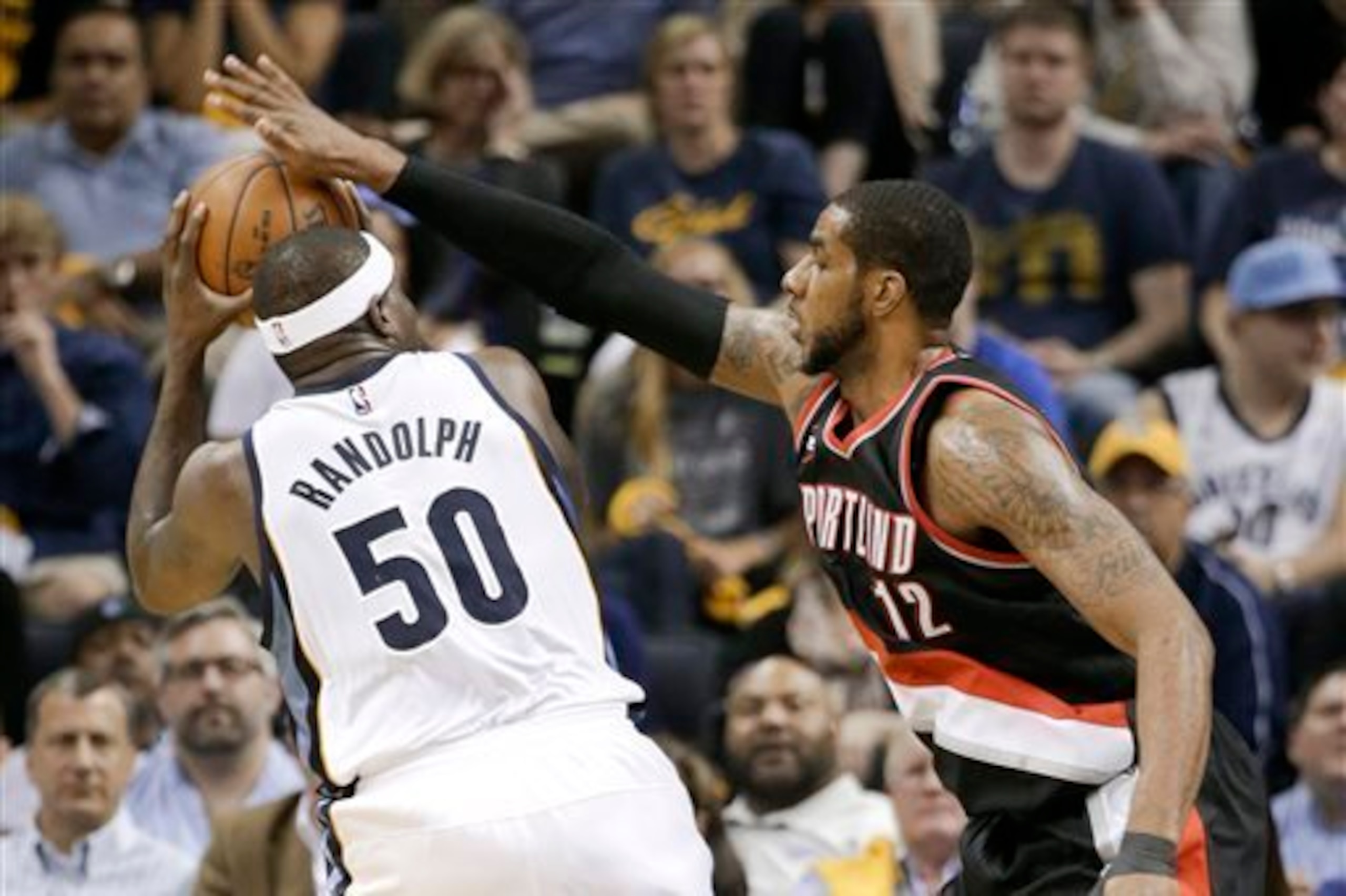
In Randolph's situation, we should expect a trend from last season to continue in 2015-16.
Last year, Randolph's usage rate dropped 1.8 percent overall and 1.5 percent in the minutes he shared the floor with Mike Conley and Marc Gasol, per NBAwowy.com. Given Randolph's advancing age (he just turned 34), Gasol's new contract and steadily improving play as well as Conley's performance when given more responsibility last season, it makes sense to continue shifting some of the offensive burden away from Z-Bo and toward the Grizzlies' two younger stars.
Because Randolph draws so much of his value from his scoring prowess, any additional drop in usage takes away from his effectiveness at a disproportionate rate to that of other bigs. He's not a huge outside shooting threat who draws defenders away from the paint. He's also not a top-notch defender, so taking the ball out of his hands puts a big dent in his value.
Randolph can make up for that dent by continuing to hit the glass, but the last few seasons show another somewhat discouraging trend: He's not quite the offensive rebounding force he used to be.
Randolph's individual offensive-rebounding percentage, as well as Memphis' offensive-rebounding percentage with Randolph on the floor, has been in decline for a few years now (see chart above). If he gets fewer possessions and doesn't grab quite as many offensive boards as he used to, Randolph's on-court value takes a steep hit because he doesn't help the Grizz quite as much in other areas a power forward might normally be asked to.
Combine that with a likely decline in minutes due to the presence of a backup big man who fits better with Gasol than his predecessor (Brandan Wright makes more sense in a Gasol-led frontcourt than Kosta Koufos did) as well as an additional small-ball option (Matt Barnes), and Z-Bo taking a step back becomes a fairly clear conclusion.
C: Joakim Noah
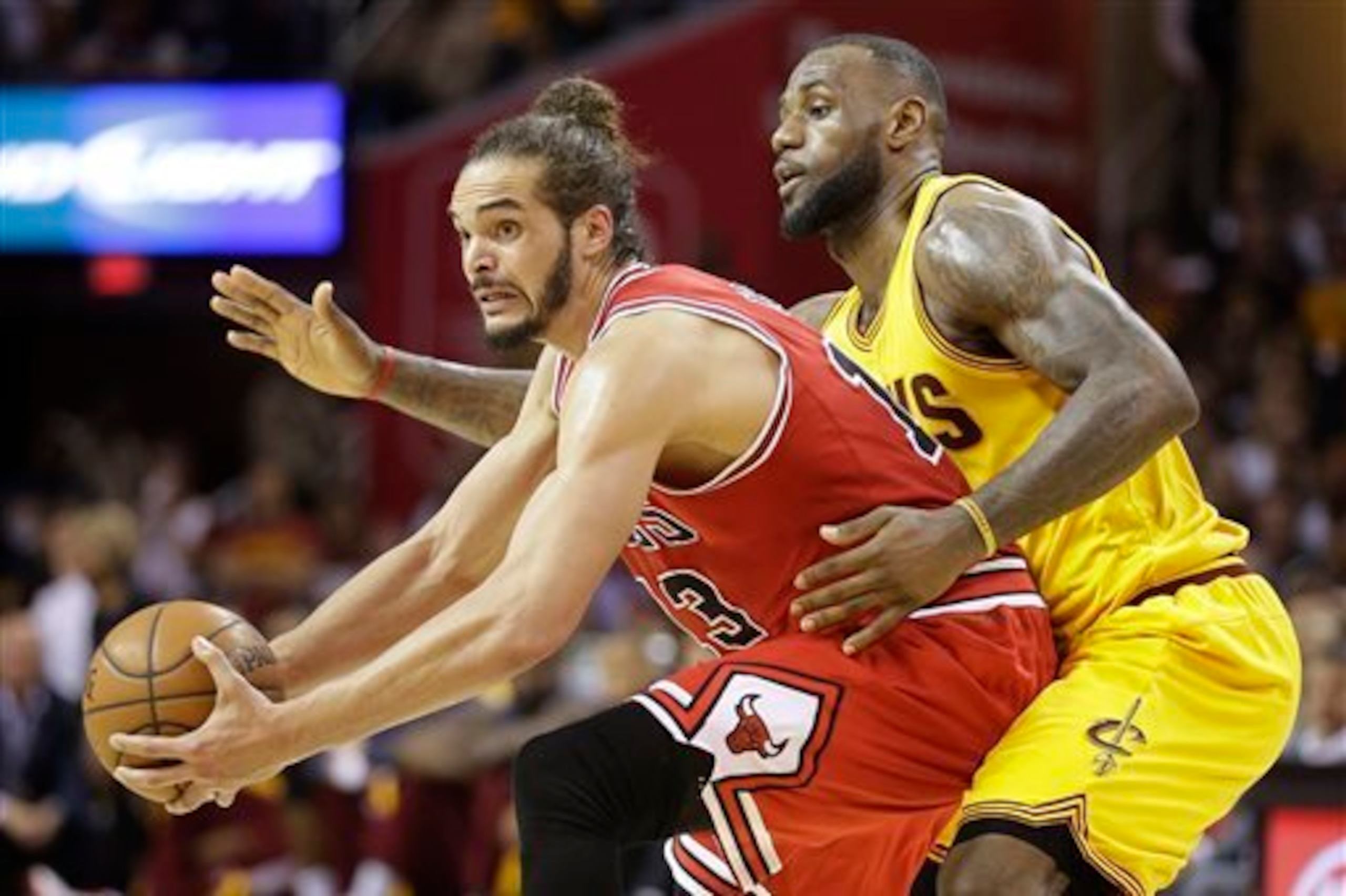
Here is a case of a player who's already been in decline, but not that many people have noticed it yet. Even though Joakim Noah was a fringe MVP candidate just two years ago, his best days have truly been behind him for a while. He's now on the wrong side of 30, his body has a ton of wear and tear, and the Bulls are likely to continue shunting off some of his offensive responsibility to Derrick Rose, Jimmy Butler, Pau Gasol and Nikola Mirotic.
Noah's shooting numbers (field-goal percentage and True Shooting) have declined in each of the last four seasons, and he has become an especially poor finisher around the basket (FG% inside three feet). He's never been a great mid-range shooter, and he doesn't have range beyond that.
He's still one of the smartest passers among all NBA bigs, but the Milwaukee Bucks stifled the Bulls offense for a few games in last year's playoffs by simply switching every Noah pick-and-roll and daring him to attack a guard or wing with a dribble or post-up.
He wasn't completely healthy during that series, but it would not be a surprise at all to see other teams do the same thing until Noah proves he can beat them that way. That's a far preferable option to letting Pau Gasol get good position in the block or having Rose or Butler slice through the heart of the defense. And it's not like Noah has proved he can stay healthy over the course of his career. He's missed fewer than 15 games just twice in eight years.
Conclusion
These five players (probably) aren't going to suddenly crumble and become below-average contributors for their teams. However, due to the circumstances surrounding them—whether it be player movement, age or health—they likely won't perform up to the lofty expectations in 2015-16.
All statistics courtesy of NBA.com/stats unless otherwise noted.

.jpg?w=2560 "Cam Ward Says He's Not A Loser")
.jpg?w=2560 "🚨 Texans Trade for MHJ")
.jpg?w=2560 "Grading MHJ Trade 📝")
.jpg?w=2560 "Chargers Fall to 0-5 🤢")
.jpg?w=2560 "MHJ Bought Own Jugs Machine")