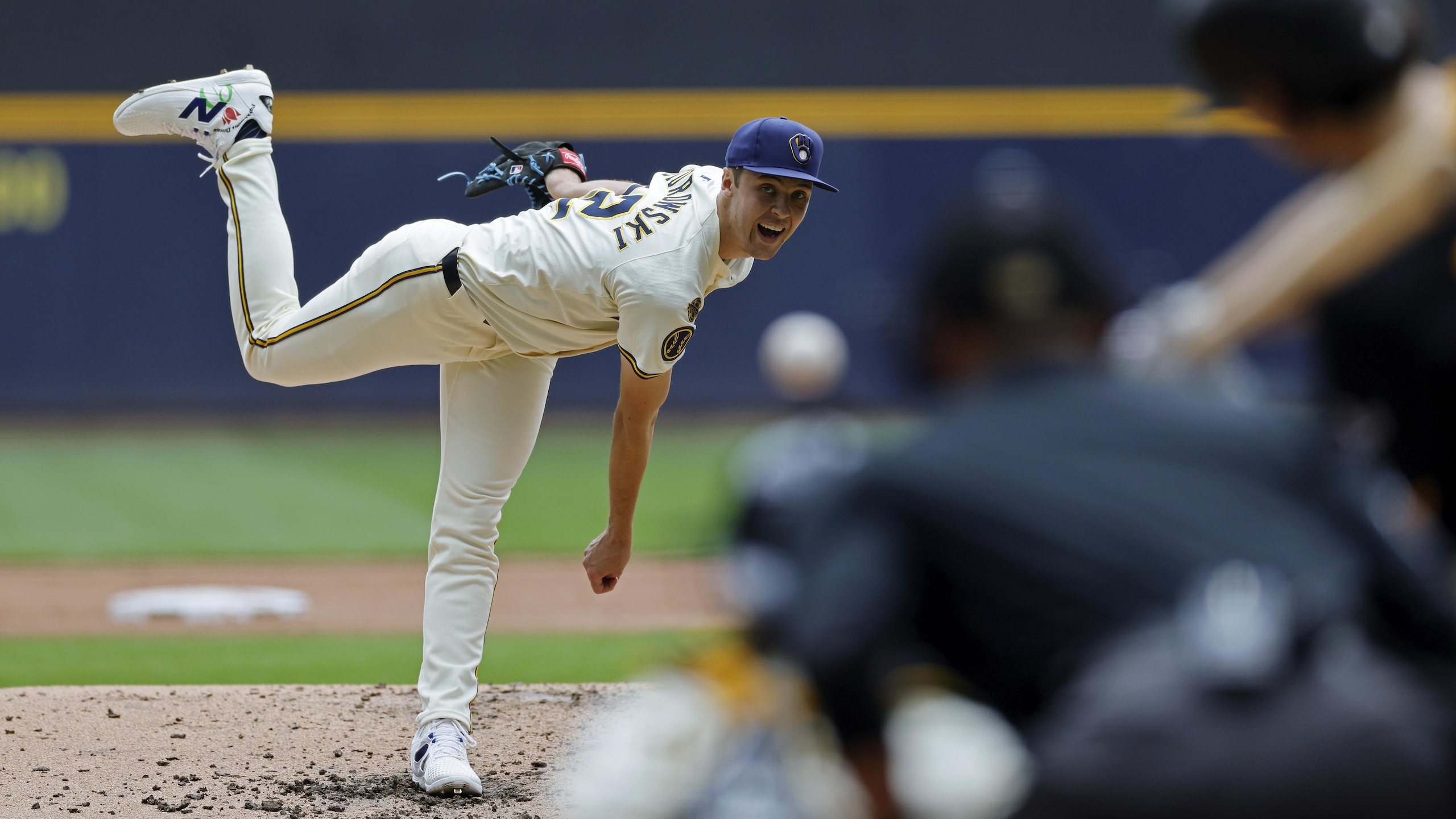


There are those of us who remember when triple-digit heat was a special treat, and typically only served by a certain profile of pitcher.
It used to be that the only hope of seeing "100 mph" flashed on a scoreboard was to stick around for the late innings. Even then, you had to hope a team was no longer riding its starter. And even then, you had to hope said team had a flamethrower in its bullpen.
Though there were plenty of those, relatively few could dial a fastball up to the century mark. It was pretty much just closers such as Billy Wagner, Troy Percival and Billy Koch, and even they maxed out at 100 and 101.
TOP NEWS

Brewers Complete Comeback In Game 2

World Series Game 2 Takeaways 🍿

Next MLB Players to Sign $200M Contracts 💰
What you basically never saw back then was a starting pitcher throw 100 mph. You'll just have to trust my memory on this one, but I will point out this out: In 2002, not one starter who threw at least 100 innings averaged over 95 mph on the fastball.
All of the above is a blatant "old man yells at cloud" rant, but the point is to add context to where we are in 2025, wherein the profile of pitchers who throw 100 mph has changed.
They are everywhere and, increasingly, they are young and just as liable to be starting games as finishing them.
What Jacob Misiorowski and Paul Skenes Can Tell Us
Consider Wednesday's matinee between the Milwaukee Brewers and Pittsburgh Pirates. The matchup was between Jacob Misiorowski and Paul Skenes, both of whom are 23, and the gas was flowing.
Skenes threw his fastest pitch of the year in the first inning on a 3-2 pitch to Sal Frelick, missing wide but hitting 100.2 mph on the gun. Misiorowski, meanwhile, hit 100 mph on 19 of his 74 pitches, maxing out at 102.4 mph.
It was in 2008 that MLB's pitch-tracking era began in earnest, and data from that year shows only six starting pitchers dialed up at least one fastball over 100 mph. The leader was Ubaldo Jiménez, who did so 20 times—exactly as many as Skenes and Misiorowski did in one day of work.
What they did is fairly typical of what things are like here in 2025. There are 18 different starting pitchers who have thrown at least one 100 mph fastball, and 14 of them have thrown multiple.
We are still only halfway through the 2025 season, so those ranks and numbers are sure to grow. Chase Burns will surely do his part, as he touched 100 mph twice and sat 98-99 in his Cincinnati Reds debut on Tuesday.
And now for an observation: The 100 mph maestros among this year's starting pitchers are almost exclusively young guys.
For Young Starters, Throwing Hard Is the New Normal
Only two 30-something starters have hit 100 mph this year: Jacob deGrom (37) and Shohei Ohtani, who turns 31 on July 5.
Even though each has had two major elbow surgeries, deGrom and Ohtani are anomalies of nature. They won't be able to hit 100 mph forever, but it's also hard to bet against it.
The 20-somethings on that list, on the other hand, aren't so much anomalies of nature as standard specimens. Throwing hard is just what young starting pitchers do now, to a point where 95 mph has pretty much become a barrier for entry.
From the data that goes back to 2002, we know the average fastball for all starters has increased from 88.6 mph to 93.9 mph over the last 24 seasons. It's a solid 5.98 percent increase.
Yet it is primarily young pitchers who are driving the bus, and specifically those 26 and under. Their average fastball has shot up by 6.39 percent since 2002, starting from 89.2 mph and rising to 94.9 mph in 2025.
Of the 23 qualified starters averaging over 95 mph on the fastball in 2025, only five are over 30, and 13 are 26 and younger. A good chunk of MLB's best up-and-coming starters are among that list of 13, including potential first-time All-Stars like Spencer Schwellenbach, Hunter Brown, Bryan Woo and Yoshinobu Yamamoto.
Mind you, that list notably does not include Misiorowski and the 22-year-old Burns, who don't have the innings to qualify yet.
Also likely to make their MLB debuts in 2025 are Bubba Chandler for the Pirates and Andrew Painter for the Philadelphia Phillies. They are rated by MLB Pipeline as the two best right-handed prospects in the sport, with each getting an elite 70 grade for his fastball.
As to MLB Pipeline's favored left-handed prospects, each of the top six gets at least a 60 grade for his fastball. The best is Chicago White Sox farmhand Noah Schultz, who has three inches even on the 6'7", 197-pound Misiorowski, and there's a short distance between his high as a pro (99 mph) and the coveted century mark.
Let Them Eat Heat
There is, of course, the awkward dance that comes with beholding the velocity that modern young starters are capable of: It's easy to be awed by it, yet hard not to worry about it after catching wind of so many cautionary tales.
Just two years ago, Strider used a 97.2 mph average fastball to strike out 281 batters in only 186.2 innings for the Atlanta Braves. But following his second major elbow operation in five years, he's now sitting at 95.5 mph and working through a 4.07 ERA. He is 26.
There's also Jackson Jobe, who was hitting 100 mph for the Detroit Tigers last October before he entered this year as arguably the best pitching prospect in the league. He made 10 starts before needing Tommy John surgery. He is 22.
These guys are not outliers. As an example, Tommy John surgery has gone from being reserved for big leaguers to increasingly being performed on high school, college and minor league pitchers. That's from Jon Roegele's Tommy John database, which also shows the median age for pitchers having the operation has hovered in the low-to-mid 20s since the mid-1990s, when the typical patient was in his late 20s.
It's not merely difficult to separate this from all the velocity in MLB today. Frankly, it's impossible.
As ESPN's Jesse Rogers reported in December, a study on pitching injuries commissioned by MLB found velocity to be the No. 1 contributing factor to injuries. Yet that risk comes with obvious reward, and professional pitchers have broadly deemed the reward to be worth it.
Strider is a perfect example, as he signed a six-year, $75 million contract at the end of his first full year in the majors in 2022. Another is deGrom, as the sheer promise of his stuff—i.e., the stuff that won him two Cy Young Awards—helped net him a record $37 million in average salary when he signed with the Texas Rangers mere months after Strider got his deal.
The message is being heard at youth levels, where there is now a culture of young pitchers seeking to throw harder, sooner. J.J. Cooper of Baseball America reported on this last winter, citing a 2023 study that found adolescents who pursue advanced training methods are at greater risk of injury because they "lack the physical maturity" to sustain the impact of such methods.
Hypothetical ways to solve this problem include scouting blackouts that could disincentivize youth pitchers from throwing as a means to impress powerful audiences. And if MLB were to ever partner with youth leagues, it could make like the NCAA and implement rules that periodically put distance between players and teams, so as to force pitchers into downtime and, accordingly, rest.
And yet, these things wouldn't change the incentive structure that really matters.
Throwing hard and maximizing stuff have become professional obligations in the MLB ranks, and those who do so successfully are that much more likely to get paid. As long as such rewards are out there, aspiring pitchers aren't going to stop chasing stuff no matter what the official protocols are. There are plenty of private coaches out there, after all, and even a viral social media video can draw major league attention.
Ultimately, it's hard to imagine the velocity genie ever going back in the bottle. This is simply a time when the letters "mph" matter even more than the letters "ERA," leaving us little choice but to keep doing our awkward dance of awe and concern.
If the path of least resistance is to let ignorance be bliss and keeping smiling every time "100 mph" flashes on the screen, then so be it.
Maybe it isn't the treat it used to be, but it's still a treat.
Stats courtesy of Baseball Reference, FanGraphs and Baseball Savant.




.jpg?w=2560 "Jonathan Taylor Landing Spots 📍")




