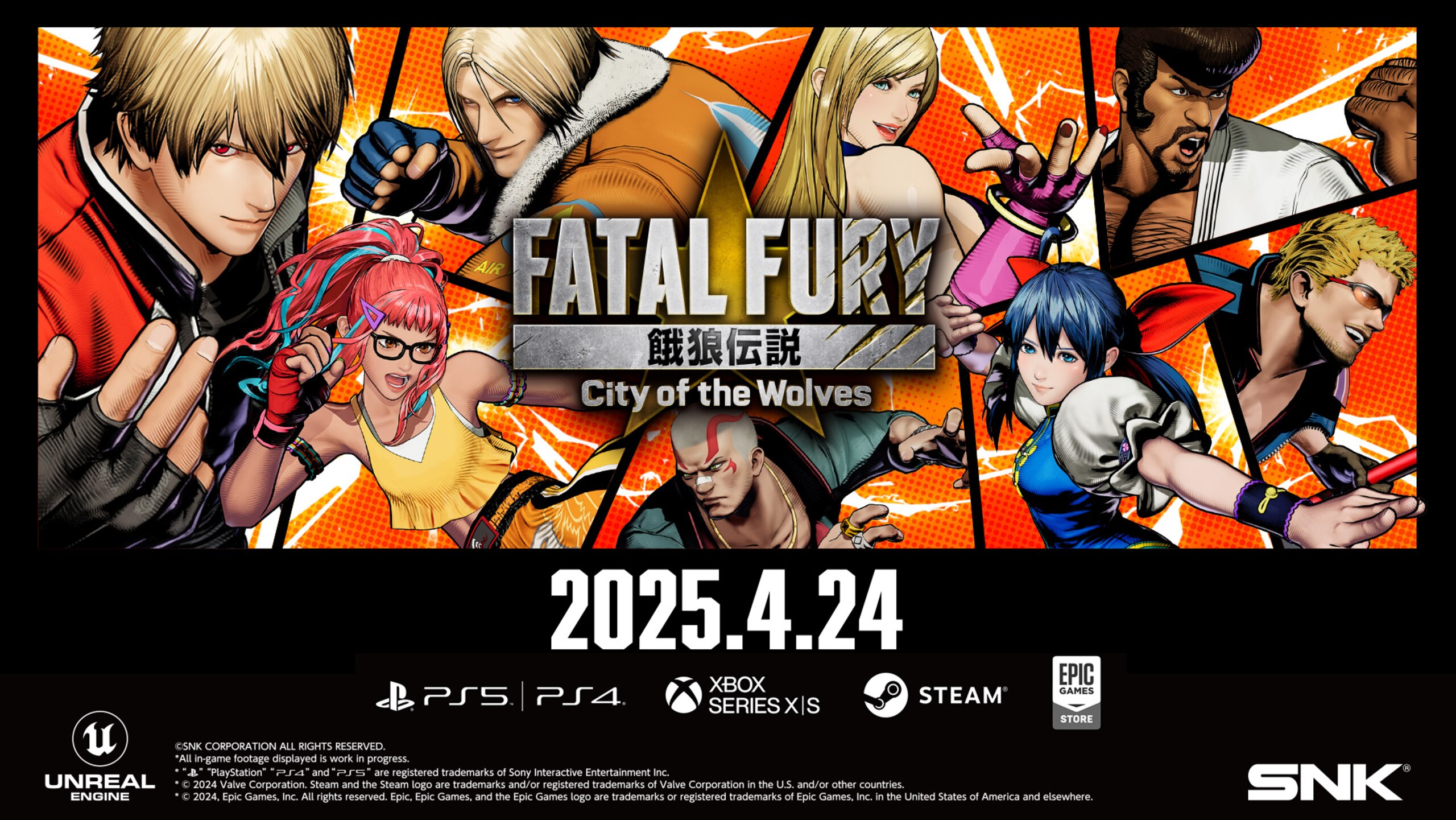

Fatal Fury City of Wolves Review, Gameplay Impressions, Videos and Top Features
Fatal Fury: City of the Wolves from developer KOF Studio and SNK is a long-awaited return for a beloved fighting series.
A 2.5D fighter with must-have modern trappings, City of Wolves is the first Fatal Fury entry in 26 years, dating back to 1999’s Garou: Mark of the Wolves.
This sequel arrives during an arguably golden era for fighting games thanks to the evolution of modern tech, including networking developments that make for seamless online play and features like cross-platform play to keep playerbases healthy.
TOP NEWS
.jpg?w=2560 "Packers 49ers Football")
AD Trolls Bears WR on IG 😂
.jpg?w=2560 "Seahawks Cardinals Football")
Buzz: MHJ Hired Agents for Trade
.jpg?w=2560 "Steelers Browns Football")
Report: Steelers WR to Miss 'Weeks'
But City of Wolves isn’t happy to just loop in the expected features. It goes overboard with a host of gameplay upgrades for the series and a jaw-dropping art style, too, positioning it as one of the biggest fighting game releases of the last few years.
Graphics and Gameplay
City of Wolves is visually one of the most impressive games of the last year or more thanks to its distinctive cel-shading approach. It’s an eye-popper in screenshots and shockingly fluid in motion, complete with all sorts of detailed shadow work, expansive color palette and battle effects to complement the action.
It helps that each stage background offers depth and detail not often seen in fighters, whether it’s old-school-cool looking NPCs reacting to the action or big buildings off in the distance to create immersion.
Impactful audio design pushes the whole package over the top. The soundtrack itself is nostalgic goodness, but the special moments get accentuated with great sound effects and the general combat sounds punchy and violent.
The entire cast (from series staples to professional footballer Cristiano Ronaldo and planned Street Fighter additions such as Chun-Li) looks great in motion, too, with the overall UI around the screen providing the important information.
Gameplay-wise, characters feel distinctive, as they should. Some are better at zoning, while others have dash-cancels that can string into fun combos and even others are more grapple-based.
When it comes to familiar systems for the series, Gear makes a return. Spending one of the two meters performs an Ignition Gear attack, while spending both unleashes a Redline Gear attack.
"Selective Potential Gear" (S.P.G.) system (formerly the T.O.P. system) lets players select a position on the health gauge to deem when it’s active during a fight. That, in turn, influences how other systems in combat work in real-time. Selecting the start, middle or end of the health bar is a huge part of the strategy that goes into each match.
“Just Defense” returns and enables guard cancels, but gets expanded upon with “Hyper Defense,” a similar system that can interrupt a multi-hit combo from the opponent. Time these right, and the aforementioned Gear attacks can be unleashed faster than normal.
That S.P.G. system loops back to the Gear attacks—with S.P.G. active, spending both bars unlocks a Hidden Gear attack for big bonuses.
The expansion of mid-fight strategy doesn’t stop there, either. A “Rev” system opens up new abilities to players when active, including special moves that create spacing, attack chains or defensive abilities. But these are tied to a meter that, when full, prohibits the player from using Rev at all.
However, players can speed up the cooldown of the overheated Rev meter through actions—advacing toward a foe, landing an attack or successfully defending.
The result is a complex layer of strategy. It feels like players always have more than one option at their fingertips for a given scenario, which is a really impressive feat for a fighting game.
To top it all off, in the name of balance and skill gaps, there’s also a punish feature. If a player misses an attack, they become vulnerable and when hit in this state, they suffer a knockback, opening up more combos for the opponent. Oh, and don’t forget the ability to fake-activate special moves.
While all of this sounds intimidating, the result is a balanced-feeling fighter that keeps control in the hands of players at all times.
Episodes of South Town and More
City of the Wolves features the standard arcade mode where players will battle through fights in an expected manner.
Arguably more notable, though, is a single-player romp called Episodes of South Town.
There, players will find an RPG-style experience in which they travel around specific points on a map to take on challenges. The rewards for doing so go beyond cosmetics, too, with things like extra skills unlockable through the experience points gained.
Online offerings run the expected gamut of ranked, casual and private lobby matches. The latter can host up to 12 players and feature various ongoing matches at a time, complete with spectator modes.
The control players have in these lobbies, including setting rules such as Best of 3 or Winner Stays On, will enable pretty simple tournament setups.
There’s also a clone mode, where players can fight copies of themselves via AI, or copies of other players online.
City of Wolves leans into accessibility to a broad playerbase, too. There are two control styles, with the arcade selection being a more traditional format. The smart style is a simplified version, to the point players can execute combos with a single button press.
The game also boasts lots of fun extras, too, like character customization via earned colors and outfits. There’s also unlockable music from throughout series history available to play.
As expected, City of Wolves runs well and comes with the must-have suite of tech backing the modern fighting experience, which includes rollback netcode.
Conclusion
It’s not often a series stays away this long and returns in such a fantastic manner—yet here comes Fatal Fury with City of the Wolves.
City of the Wolves makes some surprisingly good improvements atop its classical fighting format. There are few scenarios in the game that feel out of a player’s hands because of the sheer number of options at their fingertips.
The result is a game with huge skill ceilings that is still fun to pick up and play for more casual audiences.
While the post-launch support sounds great, what City of Wolves offers right out of the gates makes it one of the best fighters of the last decade with guaranteed staying power, influencing the rest of the genre as it thrives.
.jpg?w=2560 "Lions Cardinals Football")



.jpg?w=2560 "Cam Ward Says He's Not A Loser")