Michigan Football: 10 Best Players in Wolverines History
It’s taken more than 134 years for the Michigan Wolverines to develop one of college football’s most celebrated and respected programs. With 915 victories, 42 Big Ten titles and 11 national championships, Michigan is recognized as nothing short of NCAA royalty.
And for decades, its winged helmet and maize and blue jerseys have helped define Saturdays in a way unrivaled by most teams in the land. There have been dozens of books written about the rich heritage and proud tradition of Michigan football, yet there is always room for more. Fans and alumni just can’t get enough background when it comes to learning about “Mad Magicians” and “Harmon of Michigan.”
With that being said, it’d be nearly impossible to limit a Wolverines' top-10 slideshow to just 10 people or players for that matter. However, by covering the early days of Fielding H. Yost and Fritz Crisler, all the way to the present-day Jim Harbaugh era, this slideshow will highlight 10 (plus a few) of the greatest men who laid the foundation in Ann Arbor.
“Have you ever been to the Louvre?” asked legendary Wolverines broadcaster Jim Brandstatter, who played for the iconic Bo Schembechler from 1969 to 1972 and has called the team’s games for various outlets since the late 1970s. “If you ever get there, you walk around there and there are these paintings, and there’s a masterpiece at every turn, OK?
You walk around the corner of the hallway, and you’re like, ‘Oh, there’s a Van Gogh. Oh, there’s a Monet.’ You get sensory overload. You know, when you’re playing with these guys, you see them every day in practice, and you see them doing remarkable things. You’re used to it.”
Back then, players such as Dan Dierdorf and Reggie McKenzie were “just your buddies." Today, they’re heroes who not only helped shape a program, but they also helped influence Brandstatter's career. Because of them, he knows exactly how to identify special talent.
Michael Keller agrees "100 percent" with Brandstatter. Because of time spent playing for Schembechler and with guys such as "Brandy" and others, Keller developed a deeper knowledge of the game that helped him excel as a player and executive. He spent five decades holding various titles in the NFL, NFL Europe, XFL and USFL.
"The types of guys that we had playing on either side of us; that’s what made me a better scout," said Keller, a defensive lineman who started a program-record 33 games during his career (1968-1971). "I knew what it took to be successful and to be great, and I applied my experiences with my teammates to find players for the teams I was going to be scouting for and building.
“I’ve built four or five championship teams because of my experiences at Michigan and being exposed to great players at Michigan. I can't say enough about what I learned from my teammates."
Harmon of Michigan
1 of 9
Statistically speaking, Tom Harmon is behind most Michigan quarterbacks in just about everything. With 2, 134 rushing yards and 1,399 passing yards, Harmon’s three-year career, on paper, looks like one season from Denard Robinson.
So no, stats-wise, Harmon’s numbers aren’t “top 10” among Michigan quarterbacks.
However, he tops them all in terms of contributions to the university and to the game. Prior to becoming a World War II hero, an actor and all-around prime example of what to emulate, Harmon captured America with his kid-next-door charm and incredible athleticism.
“One of the things I appreciate is the history and tradition of Michigan football,” Brandstatter said. “So I go back to, if you’re going top 10, you’ve got to include Tom Harmon. He’s before my time, and everyone’s time—he played in the ‘30s and ‘40s.
I mean, this guy was the iconic player in the country. He was George Rogers, he was Reggie Bush, Matt Leinart—[Harmon] was the great college player. He was Marcus Mariota and Jameis Winston of his day. No-body did not know about Tom Harmon—and he was ‘Harmon of Michigan’—they made a movie [about him]!”
It’s true. After winning the Heisman in 1940, he was the subject of a Hollywood film. In fact, the movie poster, a rare collectible owned by Michigan historian Ken Magee, can be found on display at the Towsley Family Museum in Schembechler Hall.
According to Sports-Reference.com, Harmon rushed for 15 touchdowns and threw for six during his Heisman-winning campaign in 1940. He completed just 43.3 percent of pass attempts in his career, which just wouldn’t cut it today, but again, the game was much different during Harmon’s time and statistics weren't valued as highly as they are today.
Wins mattered, and Harmon, who was selected No. 1 overall in the 1940 NFL draft by the Chicago Bears, led the Wolverines to a pair of six-win seasons and one seven-win season. Today, those would be comparable to double-digit win totals.
"Harmon was that guy, and he became bigger than life, and in turn, Michigan became bigger than life," said Brandstatter, who has called games involving dozens of Heisman candidates.
An 'Unforgettable Character,' Ron Kramer
2 of 9At one time or another, even if just for a snap or two, Ron Kramer played just about every position on the field while at Michigan. However, he was best known for his prowess at tight end, which led him to a fruitful NFL career with the Green Bay Packers and Detroit Lions.
But Kramer was much more than the No. 4 overall pick of the 1957 NFL draft (Packers). Playing football was just part of the NFL All-Pro's legend and one of most colorful and beloved Wolverines in history.
“This is a guy, not just nationally as a football star, but also as a track guy and a basketball guy,” said Brandstatter of Kramer, who was a chiseled 6’3” and 234 pounds during his athletic career. “When you go back and look at his numbers and his records, I’m sorry—they’re off the charts.
He led the Big Ten basketball in scoring and he was the best football player in the Big Ten. I mean, he dropped spring practice, and after he was done, he’d walk over to Ferry Field and the track meet, and he’d win the discus and the shot-put and high jump, and basically win for Michigan at the track meet after doing three events.
And that was after spring ball.”
At one time, Kramer also held the scoring record for Michigan basketball, a mark of 1,261 points that stood until 1961—which wasn't a bad feat for a football player who was trying to stay conditioned during the winter months.
Players at Michigan admired Kramer. They wanted to be like him.
“From a national perspective, he kept Michigan at the forefront,” said Brandstatter. “Not just regionally, but from coast to coast. He was on the Ed Sullivan Show and on the cover of Sports Illustrated.”
Later in life, Kramer made sure that he gave back to the program that he loved. Up until his death in 2010, Kramer was a regular at Michigan practices.
“Unforgettable character, just unforgettable,” said Brandstatter. “He went on to win Super Bowls in Green Bay and play for [Vince] Lombardi. But the beauty of Ron Kramer was that he always stayed around Michigan, despite his great success outside of Michigan. He stayed in Michigan and made his home here. He stayed very close to the football program.”
Kramer also ventured in broadcasting, another one of his passions, as a way to keep tabs on the Wolverines. He also fed them snacks after a hard day’s work.
“He’d bring bushels of apples every Thursday or something to practice,” said Brandstatter. “And after a while, he was known as ‘The Apple Guy.’ And the reason he did it was because there was an old guy who did it when he was there. He wanted to carry that on. Ron is one of Michigan’s greats, one of the anointed greats. Clearly, you’ve got to include Kramer in that [top 10] mix.”
Forefathers Fielding H. Yost and Fritz Crisler
3 of 9
Bo Schembechler is a folk hero for good reason, but there are two coaches within Michigan football history that simply can’t be equaled: Fritz Crisler and Fielding H. Yost.
Schembechler holds the No. 1 spot with a winning percentage of .850, but Yost and Crisler are right behind him. With a mark of .778, Yost (1901-23, 25-26) is No. 3 on the list. Just a fraction behind is Crisler, No. 4, who won .777 percent of his games (1938-47) as head coach of the Wolverines.
Crisler’s national champion “Mad Magicians” and contributions to the rules of the game put him in rare air, says Brandstatter. Platoon football and standardized width of goal posts revolutionized the game. But one change really made an impression.
“The helmet, the winged helmet; that was part of Fritz’s idea,” said Brandstatter. “He needed his receivers to be identified by quarterbacks going down the field and with that winged helmet, they were easier to pick out.
Back then, those guys all wore leather helmets and stuff, they were all kind of brown and gray, stuff like that. So sometimes it was difficult. So he put the winged helmet on and changed the color scheme and they were easier to identify. And here we are, that helmet has become iconic.”
Although he didn’t physically build Michigan Stadium, “The Big House” was certainly part of Yost’s vision, which was initially completed in 1902; however, according to Brandstatter, Yost had “left room for more concrete footers” as a way to allow for expansion.
More than 100 years later, Michigan Stadium officially seats 109,901—and the one is an extra spot for Crisler.


Early Days Honorable Mentions
4 of 9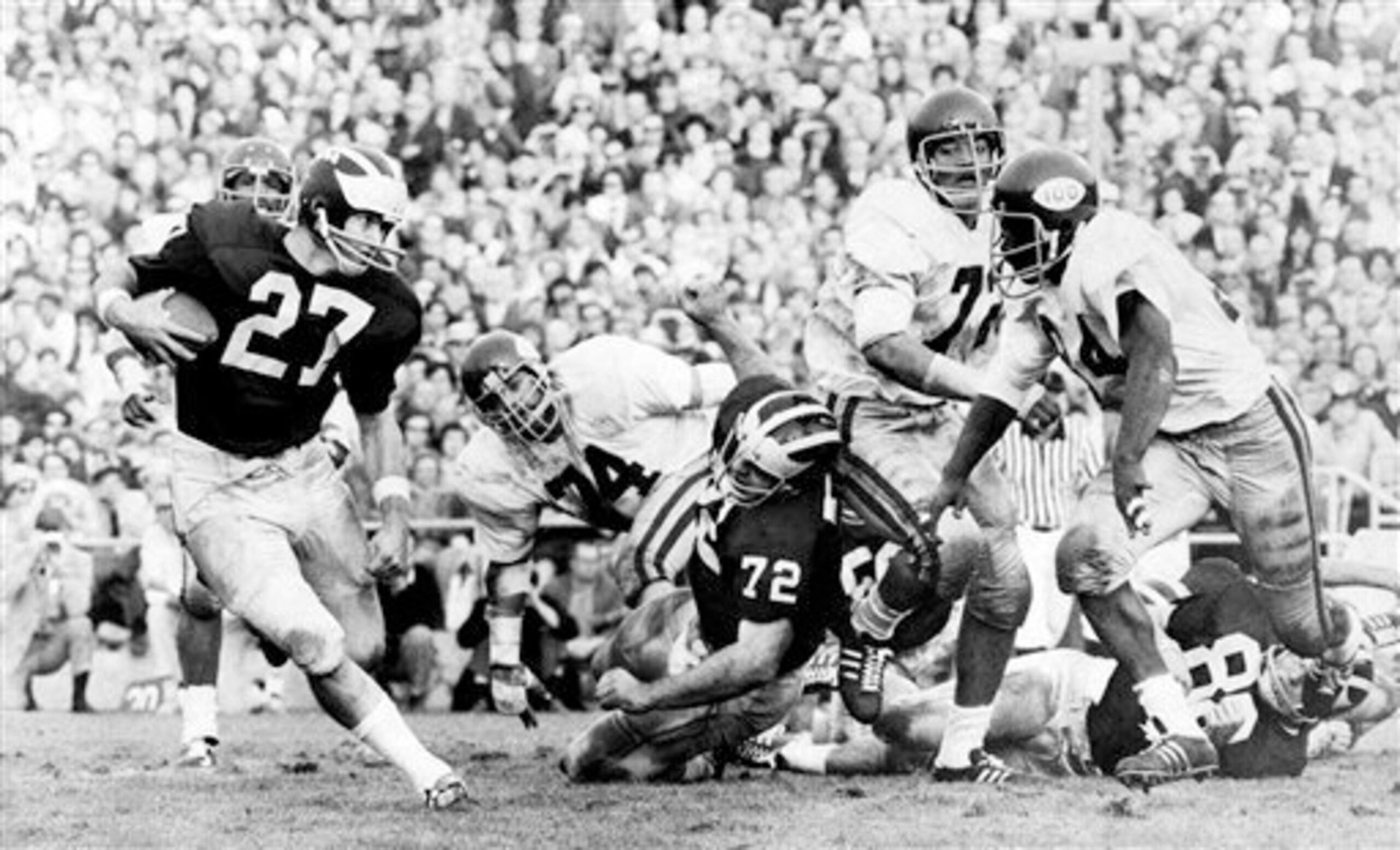
Paul Seymour isn't necessarily a household name, but he holds the distinction of being one of the best all-around athletes to play during the early phases of the Bo Schembechler era.
"Paul Seymour started out as a wide receiver, he was in my class that came in—and he was All-Everything in the Detroit area," said Keller, who was amazed at Seymour's ability to play everything well. "He came in as a wide receiver and ate himself into a tight end and then ate himself into an offensive tackle. But he was an All-American at each one of those levels and then went onto play in the National Football League.
“It says a lot to how much innate physical talent he had. He was an offensive tackle who could catch a pass when he played for the Bills. I think Paul Seymour doesn’t get all the credit he deserves because he was kind of overshadowed at Michigan by all these other guys.”
Regarded as one of Michigan's finest offensive lineman Dan Dierdorf, an All-American in 1970, certainly deserves credit for helping the team establish a dominating rushing attack.
"He's one of the smartest, most instinctful players I've ever played with," said Keller. Brandstatter agreed, calling his partner in the booth "one of the best guys to ever play at Michigan."
Due to his "toughness," Reggie McKenzie earned the respect of teammates, especially in 1970 when he was in the trenches with Deirdorf, clearing the way for Billy Taylor, who led Michigan with 911 rushing yards and 10 touchdowns.
Thom Darden doesn't show up on the Bentley Library's historical list, but his bio, plus Keller, says he had 11 career interceptions, which would put him in the top five. Darden was arguably the most athletic defensive back Keller had ever seen at the collegiate level.
Tom Curtis holds the record for most interceptions (22), yet doesn't get talked about very often, either. Part of that is due to time, but the other is because the Wolverines continuously stock their shelves with excellent defensive backs.
Without Louis Elbel, Michigan wouldn't have "The Victors," which is one of the most recognizable fight songs in all of sport. In 1898, then a music student at Michigan, Elbel wrote the song while watching the Wolverines beat bitter rival Minnesota. Back in those days, Michigan versus Minnesota was the hottest ticket in town. Even bigger than Michigan versus Ohio State, according to Wolverines historian Ken Magee.
Getting Modern
5 of 9Now that the past has been covered, it's time to shift gears into the more modern era, which encompasses everyone from the mid-1970s to today.
Before naming the rest of the field, this slideshow will touch on a few of the modern-day greats who just missed "all-time" status.
As Michigan's career leader in rushing yards, former running back Mike Hart deserves consideration as a program great. From 2004 to 2007, the 5'9', 202-pound pinball darted his way through Big Ten defenses en route to accumulating 5,040 net yards and 41 touchdowns.
Anthony Thomas (1997-2000) and Chris Perry (2000-2003) also to come to mind when thinking of great Michigan ball-carriers. And so does Tyrone Wheatley, who rushed for 4,178 yards and 45 touchdowns from 1991 to 1994. Today, he coaches Michigan's running backs.
Butch Woolfolk was always on the brink of a big play and "only needed to miss one or two guys" before breaking a long run, said Keller. From 1978 to 1981, Woolfolk rushed for 3,850 yards and 29 touchdowns; he's No. 6 on the career rushing list.
A member of the 1997 national co-championship team, "Big Jon" Jansen holds ground as one of the best O-liners in program history. The two-time captain earned All-American status in 1998.
Play Catch with Anthony Carter and Braylon Edwards
6 of 9Fans love to debate the topic of best receiver at Michigan. Some would say Braylon Edwards (2001-2004), who leads all Michigan wideouts with 252 cartches fo 3,541 yards and 39 touchdowns.
But then there's Anthony Carter, who finished his career with 3,076 yards and 37 touchdowns. But he did all of that with 161 receptions, evidenced by his average of 19.1 yards per catch. Edwards averaged 14.1 per grab.
"Anthony Carter is one of the truly, truly great ones," said Brandstatter, who isn't sure if Michigan will ever find another quite like the guy who rampaged Big Ten secondaries from 1979 to 1982. He was also the first obvious superstars during Brandstatter's beginning as the voice of the Wolverines on WWJ 950.
Heisman in the House: Desmond Howard and Charles Woodson
7 of 9Harmon won the first Heisman for Michigan, but Desmond Howard and Charles Woodson did it in front of millions of eyeballs on national TV during the 1990s.
As a punt returner and wide receiver, Desmond Howard capitalized an opening caused by an injury to Derrick Alexander, then the No. 1 receiver, during his Heisman run in 1991. He finished his career with 32 touchdown catches, highlighted by a streak of 19 consecutive games with a touchdown. Today, he's one of the most recognizable personalities on sports television and makes frequent trips to support his alma mater in Ann Arbor.
Charles Woodson recently visited Michigan's campus, making him another star who loves to come home. Woodson won the Heisman in 1997 and remains the only primary defender to do so during the 80-year history of the award. He started his second game as a true freshman and never looked back, amassing 34 appearances before skipping his senior year and turning pro in 1998 (No. 4 overall, Oakland Raiders).
Woodson had 18 picks at Michigan, good for No. 2 behind Tom Curtis, who had 22 from 1967 to 1969.
Howard's and Woodson's Heisman moments versus Ohio State will live forever in Michigan lore.
The Left Tackle of Left Tackles?
8 of 9At 6'7" and 315 pounds, Jake Long epitomizes the prototypical left tackle. He's incredibly strong, agile, smart and "just knows how to play the game at a high level," said Brandstatter, who says that Long is "easily" one of the best collegiate lineman he's ever seen.
In 2008, Long, a former two-time All-American and team co-captain, was selected No. 1 overall in the NFL Draft by the Miami Dolphins. Now with the St. Louis Rams, the Lapeer native remains constant on Sundays and has started 96 games during his All-Pro career. When healthy, he's recognized as one of the better blind-siders in the game.
There's Only One 'Shoelace'
9 of 9He scored a touchdown on his first play. Blew a tire, too.
From that point forward, Denard Robinson cemented himself as the guy who'd carry the Wolverines. And from 2009 to 2012, he did exactly that, accumulating 10,745 total yards of offense plus an outstanding 42 passing touchdowns and 49 rushing touchdowns (No. 3 at UM).
During the dark days of former coaches Rich Rodriguez and Brady Hoke, Robinson kept Michigan football relevant. Despite more losing seasons than ever, the Wolverines were must-see TV, if even just for a drive or two, because of Robinson, who accomplished feats such as the longest run at Notre Dame Stadium (87) and crazy combinations of 250-yard rushing/250-yard passing games.
With 4,495 yards, Shoelace is the NCAA's all-time leading rusher at quarterback and No. 2 overall at Michigan behind Mike Hart.
"You'll never see another kid like Denard," said Brandstatter. "Never."
Follow Bleacher Report's Michigan Wolverines football writer Adam Biggers on Twitter @AdamBiggers81
Unless otherwise noted, all quotes and references were obtained firsthand by the writer via press conference, press release or other media availability.


.jpg?w=2560 "Terrell Owens Being Sued for Defamation")
.jpg?w=2560 "CJGJ Shares Cryptic Post 🤔")
.jpg?w=2560 "Buyers or Sellers for NFL's Most Surprising Teams 🏈")