It only took several years of hand-wringing and very vocal complaining about the pace of play, but college basketball is finally getting a reduced shot clock.
In mid-May, the NCAA men's basketball rules committee proposed a change to shorten the shot clock from 35 seconds to 30 seconds, and on June 8 the proposal was officially approved. Beginning this November, college basketball games will feature a 30-second shot clock.
Now that we have our cake, do we get to eat it, too?
.jpg?w=2560 "Seahawks Chiefs Football")


Several intelligent and informed people certainly seem to think scoring in college basketball will increase significantly with the presumed increase in the pace of play.
The Twitter handle for "The Greek Sportsbook" had this to say shortly after the new rules were approved:
Because that comes from an account dedicated to action taking place at sports books, it's our assumption that is an expected eight-point increase for the over/under lines. However, those lines aim to serve as the average guess/calculation of the entire gambling population, so that would suggest the majority of people are expecting a significant increase in scoring.
According to StatSheet.com, the average men's basketball game featured 134.46 total points last season. An eight-point increase would then equate to a 5.9 percent increase in scoring.
That would be nice, but it's nothing compared to what Christopher D. Long projects:
According to an interview with Long conducted by the Friar Forecast in 2008, he is/was the senior quantitative analyst for the San Diego Padres. He got the job after finishing graduate school, where he studied mathematics, statistics and biostatistics.
Generally speaking, when it comes to numbers and projections, the dude knows his stuff.
Still, a 9.9 percent increase seems pretty insane, right? That would put us at 147.78 points per game. StatSheet's data goes back to the 1996-97 season, and 142.28 points per game was the highest average for a season during that 19-year span.
Could a five-second decrease in the shot clock really give us 5.5 more points per game than we have seen in the past two decades?
Long's name is not a well-known one in the college basketball world. But we know Ken Pomeroy. And he also believes that, based on 2015 postseason play, we could be headed for a major increase in scoring this year.
In a piece that he wrote for Deadspin in early April on the amended rules in the NIT, CBI and CIT, Pomeroy penned:
"Adjusting for the matchups and expected points in each game, scoring in the smaller tournaments has been about 5.6 PPG more than the NCAA tournament. This is 2.4 PPG higher than the typical difference in these events. That's not something that will transform the game, but if you assume that boost applies to the entire 2015-16 season, it would take the sport to scoring levels not seen since 2003. (That statement excludes last season, when scoring increased dramatically, partly because a bunch of fouls were called.)
"
These are just a few examples of the many statisticians assuming that scoring will increase immediately. Good luck finding anyone suggesting that scoring will continue to decrease in 2015-16.
Chances are, though, you didn't need a statistician to confirm that more possessions will lead to more points anymore than you need a dietitian to explain why more midnight snacks means more pounds on the scale.
The real question is how much of an increase in scoring will there be and at what aesthetic cost?
While we're overjoyed that the committee was willing to admit that the pace of play had become so snail-like that something had to be done, we're skeptical about the immediate effect it will actually have on the game—particularly when taken in conjunction with the other rule changes beginning this season.
The recent past and common sense would suggest that a bunch of rule changes over the course of one summer will initially be detrimental to the aesthetics of the game. But in the long run, the decreased shot clock, in addition to other amendments we'll address momentarily, will lead to a substantial uptick in points per game.
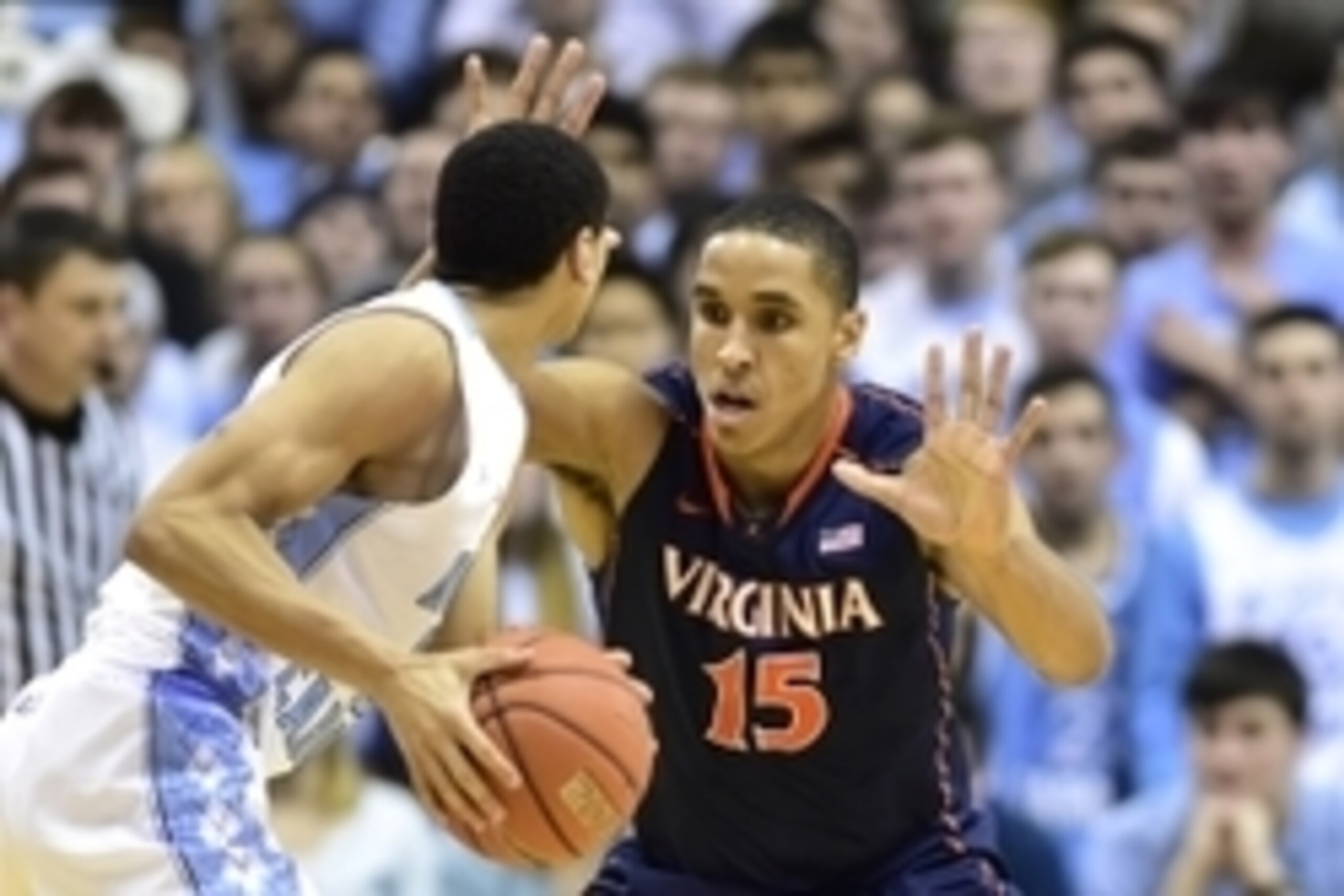
Immediately, scoring will increase. So that's good news.
Part of that will be due to the decreased shot clock. According to KenPom.com, the average possession length last season was 18.4 seconds. Decreasing the shot clock by 14.3 percent isn't going to increase possessions by 14.3 percent, but it's not unreasonable to expect an increase of two possessions per team per game based solely on the new 30-second limit to shoot. Assuming the same rate of points per possession, that alone would increase scoring by about 4.1 points per game.
One other cause for the expected scoring increase is the expanded restricted-area arc.
Widening the three-foot arc to a four-foot arc should decrease the number of offensive fouls called. We'll have to wait until November to see how drastic of a decrease it will be, but it stands to reason that there shouldn't possibly be as many charges drawn in the lane. Not only will that decrease the number of possessions ending without a shot attempt or fast-break opportunity, but it will increase the number of minutes that aggressive scorers are able to play without fear of foul trouble.
Perhaps the biggest impact, however, will come as a result of the stricter enforcement of defensive rules.
Two years ago, the NCAA attempted to implement new defensive rules that primarily served to eliminate hand checking. Touch a guy on the perimeter and it was a foul. Place a hand on a guy trying to back you into the post and it was a foul. After about a month of play, I took a look at scoring on a national level to see if the rules were having the desired effect.

The abridged version of those findings is that points per game, possessions per game and points per possession were each considerably higher than they had been in more than a decade, but largely because fouls per game and free-throw attempts per game were also at record highs.
We knew going into that season that we were headed for some uncomfortable, whistle-filled growing pains while players and coaches adapted to the new emphasis on freedom of movement, but college basketball was supposed to be a substantially more watchable product in the long run.
Unfortunately, the officials unofficially abandoned the new rules in the middle of the year and we spent the latter half of the season back in the world of stagnated offenses and physical defenses with no clue what constituted a block or charge.
Had they actually stuck with the emphasis on freedom of movement, the state of college basketball very likely would have improved considerably. Fouls would have eventually dissipated as players learned how to defend with their feet, and we wouldn't have needed to decrease the shot clock to increase scoring.
But now we have both shorter shot clocks and new rules that make it more difficult to defend. It should be easier to get open looks, there will initially be more fouls called than usual and slower-paced teams won't be allowed to be quite as lethargic on offense as they used to be.
If scoring doesn't increase by at least eight percent, it could only be because national shooting percentages decrease by two or three percent—which is a pretty unreasonable expectation, given the aforementioned easier looks at the hoop.
So, yes, scoring will increase. It should increase substantially. Long's 9.9 percent increase sounded overly optimistic at first, but it's absolutely feasible. The 30-second shot clock isn't entirely responsible for that, but it should certainly help.
All in all, it's a big step in the right direction. It's highly unlikely we'll start confusing college basketball scores with NBA scores, but at least we theoretically won't have any more college basketball scores that resemble college football scores.
Kerry Miller covers college basketball for Bleacher Report. You can follow him on Twitter @kerrancejames.