The Stars Are Aligning for American Pharoah to Break the Triple Crown Drought
After American Pharoah bounced out of a half-mile workout May 26 at Churchill Downs, trainer Bob Baffert said something that should drive a sense of doomed resignation into the hearts of everyone trying to upend his colt’s quest Saturday to win the Triple Crown.
“He’s come back [from the Preakness] extremely well,” Baffert told the gathered media. “He only had those two races [the Rebel and the Arkansas Derby as Triple Crown preps], and they were light races up at Oaklawn. The Derby was a hard race, and I think it really got him fit.”
When the race that often sends exhausted horses reeling to the sidelines for months is the one that gets Baffert’s horse fit, be afraid. Be very, very afraid.
.jpg?w=2560 "Seahawks Chiefs Football")


American Pharaoah will be the 13th horse to go to the post in the Belmont Stakes with a chance to win the Triple Crown since Affirmed last did it in 1978, and few have appeared to have as much going for them.
Acknowledging potentially sabotaging distance limitations in his pedigree—along with the fact that every horse that has swept the Triple Crown raced at least once at Belmont Park prior to the Belmont Stakes, which American Pharoah hasn’t—this horse looks most like the one who will join the 11 immortals who swept the American Classics.
Three potent advantages are in American Pharoah’s corner: fitness, speed and, this year, a relatively short field size for the Belmont.
Fitness
American Pharoah’s edge in terms of fitness actually began when he was scratched from the Breeders’ Cup Juvenile with a minor injury and still named two-year-old champion.
The runners from that race either subsequently failed to get on the Triple Crown trail because of injury or made little impact. Winner Texas Red got hurt after one spring outing, runner-up Carpe Diem finished 10th in the Kentucky Derby and was withdrawn from consideration for the Belmont Stakes, and third-place finisher Upstart finished last in the Kentucky Derby.
American Pharoah concluded his two-year-old season going gate to wire in winning the Grade 1 Frontrunner Stakes on Sept. 27. That gave him three fast, foundation-building races as a sophomore before he returned to the track as a three-year-old on March 14 in the Rebel Stakes at Oaklawn. In that race, he led, unchallenged, the entire way around, chased by Belmont competitor Madefromlucky.
In his next start, the 1 ⅛-mile Arkansas Derby, American Pharoah had an even easier time of it, rating comfortably behind hopeless long shot Bridget’s Big Luvy before dancing away to an eight-length victory.
Then came the Kentucky Derby and a different American Pharoah than ever seen before. Six furlongs into the race, jockey Victor Espinoza could be seen vigorously urging American Pharoah to keep up with leaders Dortmund and Firing Line.
“And American Pharoah has come under a ride!” race caller Larry Collmus cried on the NBC broadcast as they spun off the far turn moments before Espinoza went to the whip with his right hand—approximately 28 times in the stretch—and pulled away to victory.
“I don’t want to say it was his worst race, but it wasn’t an ‘A’ race for him because you could tell he was struggling all the way around there,” Baffert said, looking back three days before the Preakness. “When he turned for home for Victor and he had to get after him, usually he doesn’t have to touch him.”
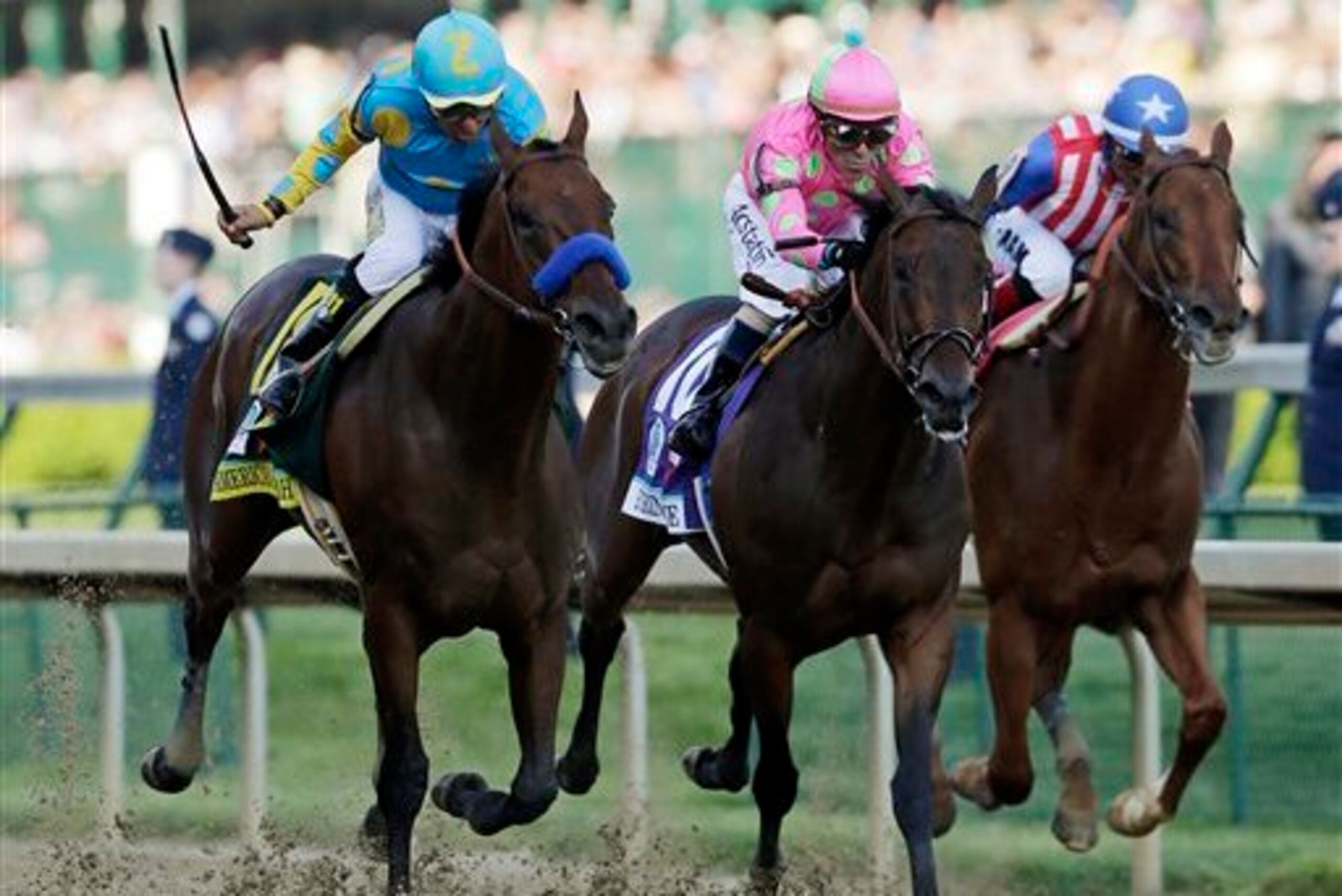
For Baffert to win the Kentucky Derby with a horse running a "B" race should be demoralizing for the competition. Fitness is the hallmark of his training style. Six different Baffert three-year-olds, including American Pharoah, have taken Triple Crown races, and only one—Lookin At Lucky—failed to take two in a row.
“I train for the Classics,” said Baffert, who three times has gone into the Belmont with a Triple Crown on the line—with Silver Charm (1997), Real Quiet (1998) and War Emblem (2002). “I don’t try for one. I’ve put a good foundation in them, a good bottom.”
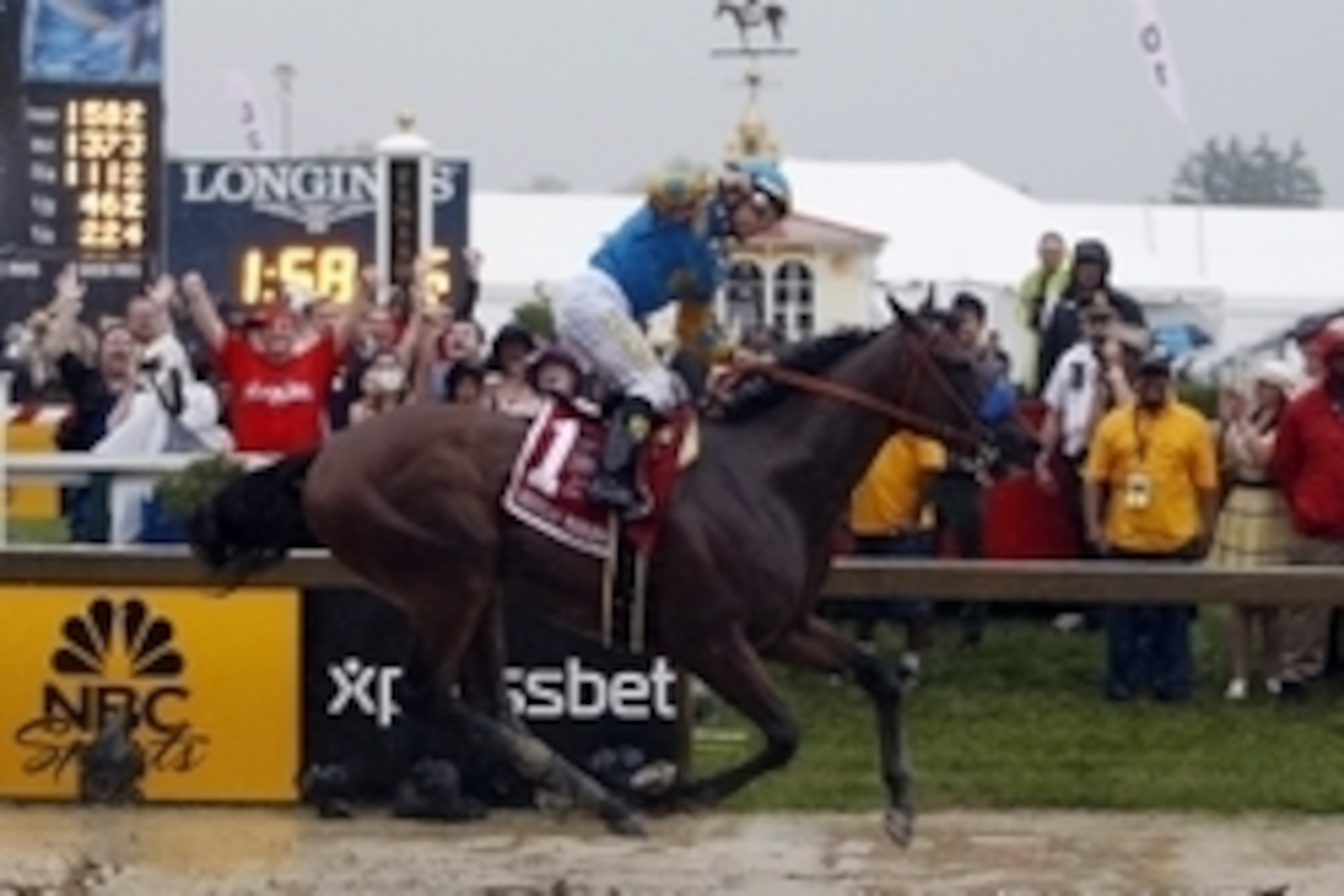
Two weeks after winning the Derby, Espinoza only flashed the whip as American Pharoah dominated in the Preakness. He tore through an opening quarter-mile in 22.90 seconds, took a breather with a third quarter in 24.93 seconds and, with the opposition futilely paddling behind him through the slop, practically cantered home.
Some might point to the dramatically slowing quarterly times (26.32 seconds in the fourth quarter) and say American Pharoah was exhausted at the end of the Preakness, but he ran unchallenged through the lane, and who knows how much the deluge just before the race affected the track?
In his first appearance ever on the Belmont course Wednesday morning, American Pharoah couldn’t have looked healthier or more eager to do something other than jog.
Pedigree analysts can point to legitimate knocks against him. Progressive Handicapping’s authoritative “Sire Ratings 2015-2016” show that while American Pharoah’s sire, Pioneerof The Nile, has produced offspring capable of winning at 1 ⅛ miles and longer, broodmare sire Yankee Gentleman, with nine crops on the ground, has firmly established distance limitations up to a mile.
The Belmont Stakes adds another quarter-mile to the farthest distance American Pharoah has ever run, yet he gives all indications he has maintained his fitness and is ready to deliver a knockout performance.
Established form supersedes statistical probability when picking a winner. That’s why people call this horse a freak.
Speed

Trainer Dale Romans will try to beat American Pharoah with 20-1 long shot Keen Ice. After a half-mile work on Tuesday, Romans pointed out why it will be so tough.
“This is a race that even though people think it’s for a deep closer, it’s not; you need to be in the race,” he said. “Woody Stephens [who trained five consecutive Belmont Stakes winners, from 1982-86] said years ago that it’s a speed horse race going a mile-and-a-half...”
American Pharoah has terrific speed, yet it’s not one-dimensional. In a long race such as the Belmont, horses must be able to effectively cruise for a long time and not try to kick home too early. American Pharoah has won making the pace (in the Del Mar Futurity, Frontrunner Stakes, Rebel and Preakness) and tracking leaders (the Arkansas Derby and Kentucky Derby). His lone loss came in his debut. In all of the winning races, not once did he ever appear to face stressful pressure from an opponent. He gallops with economy and ease and has a long, fluid stride.
Horses have come from well back to win the Belmont—Jazil was 10 ½ lengths behind after a half-mile before winning in 2006; Editor’s Note was 11 lengths back after a half-mile in 1996—but most winners race within five lengths of the lead or on it. American Pharoah should have little problem racing close up, whether on the pace or just off it, and time and again, he has proved himself to be the fastest three-year-old in the country.
Field Size
The 11 Triple Crown winners, beginning with Sir Barton in 1919, faced an average of 4.36 opponents in the Belmont Stakes. Sir Barton needed to beat just two other runners, and Gallant Fox needed to best just three in 1930.
Only Citation in 1948 and Seattle Slew in 1977 beat as many as seven opponents in the final leg to sweep the series. Since Affirmed beat four runners, including his nemesis, Alydar, in 1978, the field size for the Belmont has ballooned as more trainers skip the Preakness to await the Kentucky Derby winner with a fresh horse or show up with a new runner, hoping to get into the limelight.
In the past 14 years, the Belmont Stakes has averaged 11.07 runners and hasn’t had a single-digit field since nine ran in 2008. With just eight horses entered this year, American Pharoah, who beat a combined 24 runners in the first two legs of the series, has the advantage shared by all the other Triple Crown winners—few opponents.
If he is as good as he looks, the 90,000 fans expected for the Belmont Stakes are in for a treat and will bear witness to a fine piece of racing history.
John Scheinman covered racing for eight years at the Washington Post, co-founded and edited Kentucky Confidential and contributes to the Blood-Horse. He is is also the winner of the the 2014 Media Eclipse Award for Writing in the Feature/Commentary category. He lives in Baltimore. Unless otherwise noted, all quotes were obtained firsthand.