

Re-Grading Indianapolis Colts' Past 5 Drafts
The 2015 NFL draft is less than a week away, and anticipation is ever-growing.
One of the best ways to prepare for the future is to look at the past and attempt to learn from your mistakes. The Indianapolis Colts have made their share of mistakes in the last few drafts, but they've also had some rousing successes.
The team has been in a variety of draft positions of late, whether it was having the first overall pick in 2012, having just five picks (and no first-rounder) in 2014 or having a plethora of late picks.
The different experiences the Colts have been through is an intriguing case study, and it could provide valuable insight as to how the team got to where it is today.
So, with that, let's take a look back at Indianapolis' last five drafts, giving each a grade and figuring out how it contributed to the current version of the Colts.
2010: Jerry Hughes Revenge Party
1 of 5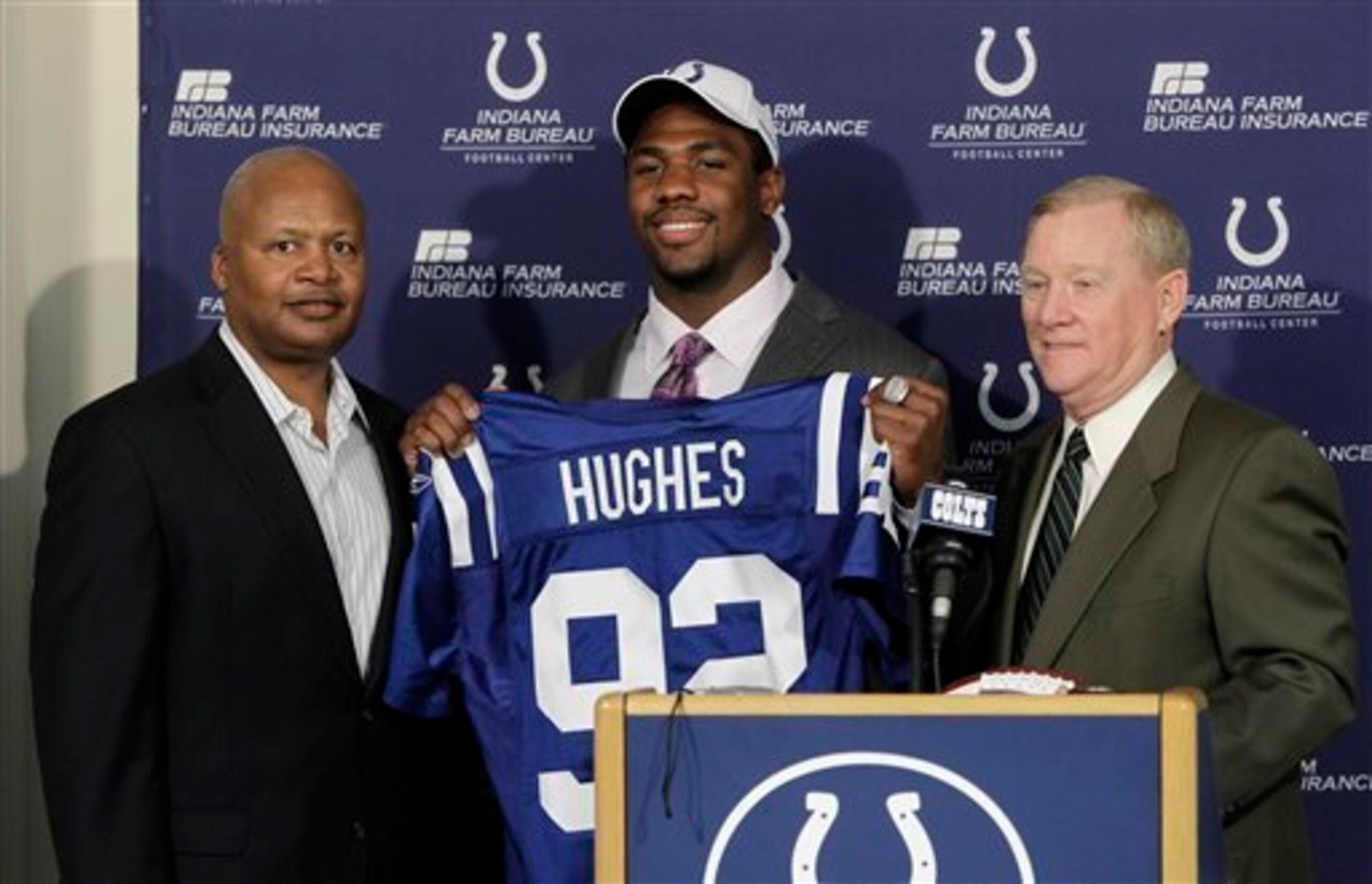
No. of Picks: 8
Left On the Team: 0
Left In the League: 4
Best Player: DE Jerry Hughes (25 career sacks)
Best Bang for Your Buck: LB Kavell Conner (seventh-rounder, three years as a starter/rotational linebacker)
Worst Pick: DB Kevin Thomas (third-rounder, nine games played, two games started)
Really, this draft is all about Jerry Hughes. Had Hughes worked out, the Colts would have been fine with this draft, which netted two fringe starting linebackers (Pat Angerer and Kavell Conner), a depth guard (Jacques McClendon) and a rotational defensive lineman (Ricardo Mathews). Those names don't seem like much now, but Angerer was very good in his final healthy season, while Conner and Mathews were excellent values in the seventh round.
The problem is that Hughes never panned out in Indianapolis, accumulating just five sacks and seven starts in three seasons. However, once Hughes went to Buffalo, he exploded onto the scene, finishing with 10 sacks in each of the last two seasons.
So what was the issue? I've contended that the Colts never used Hughes properly or gave him enough of a chance, given his sporadic snaps and few full-time opportunities.
Hughes was stuck behind Dwight Freeney and Robert Mathis in Indianapolis and was miscast as a 4-3 defensive end for two years. When playing in the Colts' 3-4 front in 2012, Hughes had a higher rate of pressure than either Mathis or Freeney, according to Pro Football Focus.
It's a reminder that developing a prospect is as much a part of drafting as scouting and college player evaluation. A player has to go to the right team and be put in the right role in order to succeed. That didn't happen with Hughes, and it hurt what could have been a decent draft haul for Indianapolis.
Grade: C-
2011: The Left Tackle Draft
2 of 5
No. of Picks: 5
Left On the Team: 1
Left On the League: 2
Best Player: OL Anthony Castonzo (four-year starter, above-average left tackle)
Best Bang for Your Buck: OL Anthony Castonzo (only productive player)
Worst Pick: DB Chris Rucker (Never panned out as a NFL-level cornerback)
The Colts' biggest need going into the 2011 draft was an offensive tackle, as the Colts had finally allowed Charlie Johnson to leave in free agency. It was the draft's worst-kept secret that the Colts would draft an offensive tackle, and Castonzo was the clear best fit for Indianapolis.
It was a match made in heaven with Castonzo's relatively clean technique and pass-protecting skills. When he was available at No. 22, it was a no-brainer.
While Castonzo hasn't been to a Pro Bowl, he's developed more each season and has been the steadying force on the offensive line for the last three seasons. He's panned out as one of the top two or three left tackles in a tackle-heavy class, and the Colts would probably do the exact same thing in a 2011 redraft.
The rest of the draft is littered with injury busts: Ben Ijalana is still in the league, but he's never regained his form after tearing his ACL twice. Drake Nevis looked like a very promising penetrating defensive tackle as a rookie, but back issues ended his year prematurely and he was never the same.
Still, getting a long-term left tackle is a pretty good value for a draft with only five picks. On the other hand, the 2011 draft was chock-full of talent, and the Colts managed to draft one of the more unlucky groups.
Grade: C+
2012: A New Era
3 of 5
No. of Picks: 10
Left On the Team: 6
Left In the League: 7
Best Player: QB Andrew Luck (duh)
Best Bang for Your Buck: WR T.Y. Hilton (third-rounder, Pro Bowl in third season)
Worst Pick: OL Justin Anderson (never played a down)
When your worst pick is a seventh-rounder who never played due to injury and your best pick is an elite quarterback, you know you have a good draft.
The 2012 draft was the gold standard for drafts. Could some picks could have had more value? Sure. But realistically, the Colts got great value from six or seven of their picks, all of them high.
Andrew Luck was a slam dunk, but even if you take him out of the equation, the draft was a rousing success for the Colts.
Coby Fleener and Dwayne Allen turned into a very well-paired tight end combination, and despite the knocks on either (Fleener for his general disappointment and Allen for his injuries), they were good value at their respective draft slots. T.Y. Hilton was the steal of the draft, and he and Alshon Jeffery are the two (head and shoulders) best receivers in the class.
The further depth has value too. Josh Chapman as a rotational nose tackle and fringe starter is great value in the fifth round, and LaVon Brazill was productive before being cut following a substance abuse suspension.
If you could script a draft, this is about how it would go.
Grade: A+
.jpg?w=2560 "Chiefs Giants Football")
.jpg?w=2560 "Colts Football")
.jpg?w=2560 "Titans Colts Football")
2013: Hope Springs Eternal
4 of 5
No. of Picks: 7
Left On the Team: 4
Left In the League: 7
Best Player: DE Bjoern Werner (close call over Hugh Thornton)
Best Bang for Your Buck: OL Hugh Thornton (third-rounder, starting right guard)
Worst Pick: DB John Boyett (never played a single snap before getting cut)
The 2013 draft is in the ultimate pivot spot.
On one hand, you have those who have watched Werner try and try over the last two years, continually getting key opportunities while failing to produce—especially in 2014 as Robert Mathis sat at home. Then you have the other side, which says that three years is still not enough time to accurately assess a draft class.
They might be right, as waiting for at least four years and beyond is preferable to forcing an evaluation after just three years. However, the NFL has a short career life, and there is no time for standing around. If a player hasn't shown anything after two years, what is the likelihood that a drastic change will come in the third year?
Sure, potential growth is possible, but if we're grading based on the available data, it doesn't look good for the 2013 draft class.
Grade: C-
2014: Hope Actually Makes Sense
5 of 5
No. of Picks: 5
Left On the Team: 4
Left In the League: 5
Best Player: OL Jack Mewhort (14-game starter)
Best Bang for Your Buck: DE Jonathan Newsome (fifth-rounder, 6.5 sacks as a rookie)
Worst Pick: OL Ulrick John (no career disruption thus far)
While the 2013 NFL draft was disappointing almost exactly as expected, the 2014 class has been surprisingly good. Both Jack Mewhort and Donte Moncrief have been productive, while Jonathan Newsome was a steal in the fifth round.
There is still a lot of time left for these prospects to develop into starting-caliber players who can contribute in key areas, but for now, our expectations of this draft class are largely wrapped around long-term projections. This group still does well as a long-term projection despite also being productive as rookies.
Grade: B+
.jpg?w=2560)
.jpg?w=2560 "Cardinals Giants Football")






