Cody Fajardo Ready to Follow Colin Kaepernick's Path into NFL
There are two quarterbacks in NCAA history who rushed for over 3,000 yards in their collegiate careers, while also passing for at least 9,000.
You’re quite familiar with the guy who did it first. And you should get to know Cody Fajardo.
Colin Kaepernick only narrowly missed being a first-round pick in 2011 and was selected by the San Francisco 49ers at 36th overall. He’s played in three NFC Championship Games and one Super Bowl, and holds the NFL’s all-time single-game rushing record for quarterbacks (181 yards).
TOP NEWS
.jpg?w=2560 "Chiefs Giants Football")
Mahomes Told Teammate to Leave Meeting
.jpg?w=2560 "Titans Colts Football")
5 Teams Eyeing Jonathan Taylor
.jpg?w=2560 "Eagles Jaguars Football")
NFL investigating Eagles
Kaepernick was alone on that rare 3,000/9,000 pedestal when he played his final game for the Nevada Wolf Pack in 2010. Fast forward four seasons and he’s now sharing it with another product of a pistol offense.
The same pistol offense. Fajardo first replaced Kaepernick, and then joined him, giving Nevada ownership over a record rooted in athleticism.
Now Fajardo is looking to carve his own NFL future. He’s not Kaepernick, and he’ll tell you that. Draft projections will, too, with Fajardo often pegged as a late third-day pick.
But he's preparing to step into a league that no longer views the pistol formation as strictly a college-based gimmick, largely because of Kaepernick's influence. The Denver Broncos whip out the pistol periodically, even with a creaky 39-year-old Peyton Manning under center. And Green Bay Packers head coach Mike McCarthy told the Milwaukee Journal-Sentinel he may use it more often.
Between the pistol’s evolution and increased read-option use in general, it’s a brave new world for athletically gifted quarterbacks looking to find an NFL role.
“Before Kaepernick, 100-percent shotgun was hurting quarterback prospects,” Fajardo told Bleacher Report during a phone conversation. “Once he was very successful a lot of teams noticed, and thought ‘alright, we can get a guy from Nevada who can transition into a good NFL quarterback.’”
“I think his success over the years has really helped the pistol offense, and helped me.”
Sometime between April 30 and May 2 we’ll know exactly how much Kaepernick’s trailblazing has helped Fajardo. For now, he’s going about the business of being his own quarterback, which means embracing change while remaining true to what brought him success.
It’s a delicate balance, one five-step drop at a time.
A familiar adjustment
Running is both a natural ability and instinct for Fajardo, who compiled 3,482 rushing yards and 44 touchdowns on the ground at Nevada.
“That’s how I’ve been my whole career,” Fajardo said. “Even going back to Pop Warner days when I was little, and just sort of took off with the ball.”
A younger, tinier Fajardo presumably ate his vegetables and consumed other essential nutrients, because he’s now grown into the 6’1”, 223-pound scrambling quarterback who attended the Manning Passing Academy three times. In high school he weaved and chucked his way to a California state championship in 2009. That same season he was also named California’s High School Player of the Year.
He took his act to Nevada, and like Kaepernick, he was an ideal fit for a pistol system. The pistol leans heavily on a quarterback’s ability to make quality post-snap reads and capitalize on running room. It also demands accuracy on quick-hitting routes. Fajardo particularly excelled on outside throws to the boundary, leading to his 9,659 passing yards.
At the 2015 NFL Scouting Combine, Fajardo finished tied for the fourth-fastest 40-yard-dash time among quarterbacks (4.63). He was also second in the 20-yard shuttle (4.10 seconds), and third in the three-cone drill (6.95 seconds).
Those metrics tell us information we already know: Fajardo is blessed with rumbling speed. He may not quite match his predecessor at Nevada (Kaepernick ran the 40-yard dash in 4.53 seconds during his combine appearance), but that doesn’t matter when he sees a corner available to be rounded.
Like this one during a 2012 game against the California Golden Bears:
The concept there is simple and a staple of the pistol, but the result is a fine example of what Fajardo can bring to an offense as a runner. It also shows why, even if he’s at the bottom of a depth chart initially, there may still be opportunities to contribute in Wildcat packages.
Fajardo took the snap and pivoted on his left foot, extending the ball toward the running back. He then read the movement of linebacker Chris McCain, who had taken about three steps in toward the middle. The space he vacated doesn’t look like much.
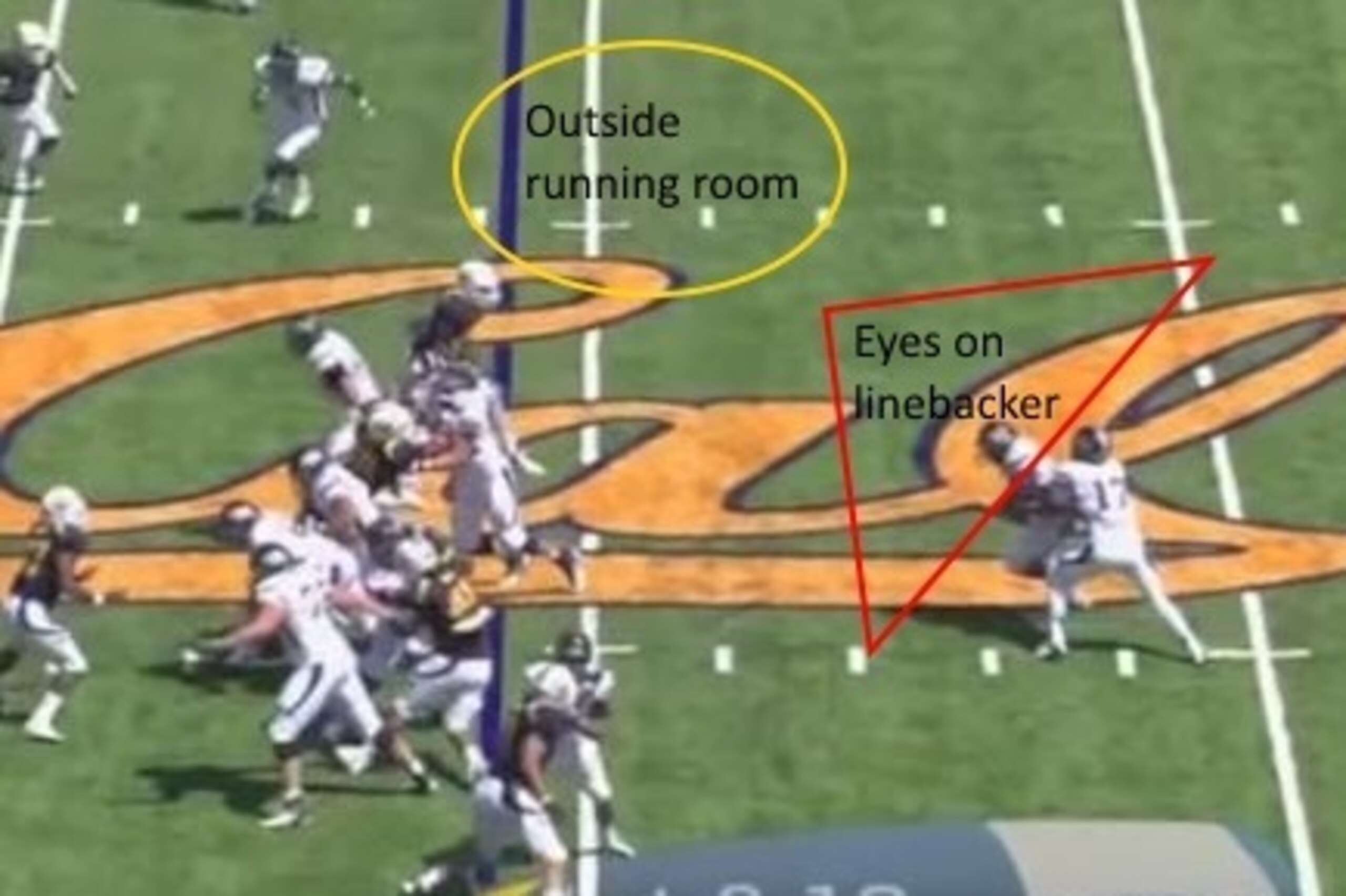
But for Fajardo it was more than enough.
With the decision made to keep the ball, Fajardo’s next task was to eliminate McCain’s angle and beat him in a sprint to the corner.
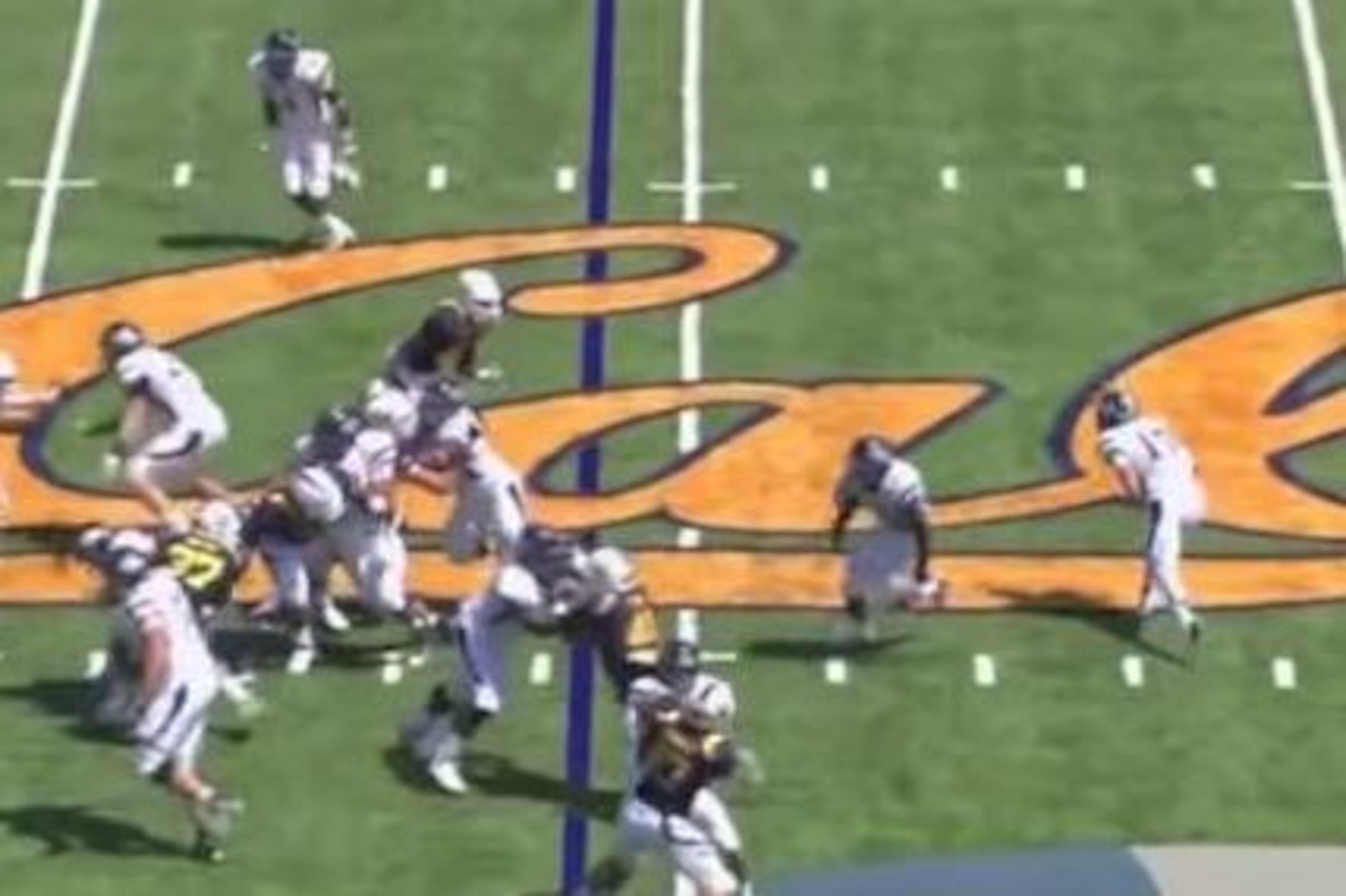
He did that easily, but was still greeted by a swath of blue-shirted bodies 10 yards downfield.
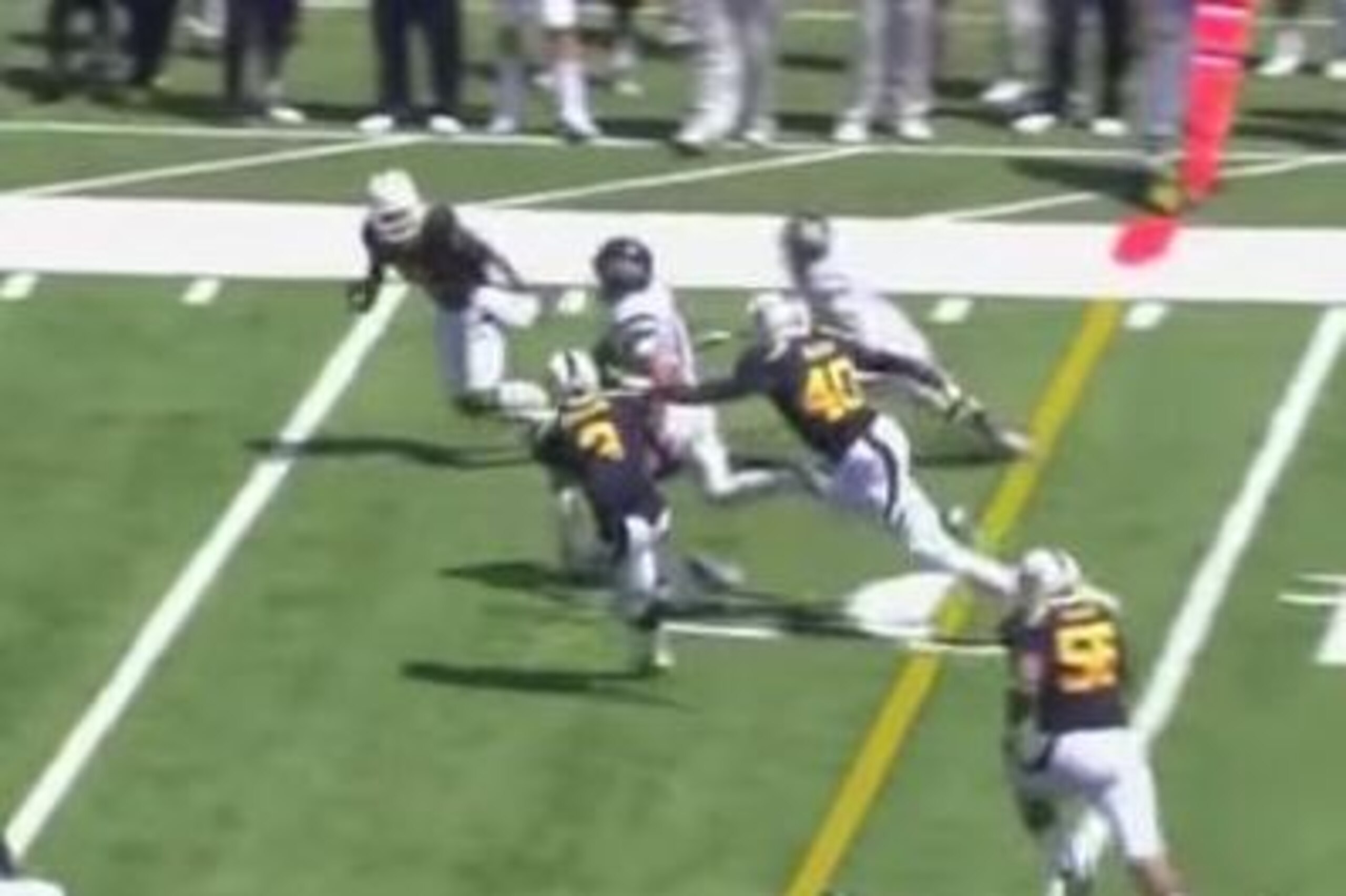
It didn’t matter, as only McCain’s hand grazed Fajardo on the play while he ran for a 49-yard touchdown.
That’s the Fajardo whose body and mind were perfectly crafted for a pistol offense. He had 13 games with 100-plus rushing yards over his four years as a starter at Nevada, averaging 5.5 yards per carry.
The quest ahead? Plucking him from comfort, and creating functionality within a pro-style system.
That road is well worn by college quarterbacks oozing with athletic gifts, including Kaepernick, who rose to prominence quickly and has since regressed. The examples of failures are infamous (Tim Tebow) and forthcoming (Johnny Manziel).
Fajardo needs to harness his talents and plug them into a more conventional NFL offense while still staying versatile. His first steps have been encouraging.
So encouraging noted draft godfather Gil Brandt of NFL Network opined Fajardo lifted himself more firmly into draftable territory with his performance at Nevada’s pro day. If he was a late-round pick and teetering, at worst Fajardo could be on level ground now.
“Fajardo was accurate with his passes and had good velocity on the ball,” wrote Brandt after watching a scripted series of throws, all from under center. They were designed to showcase the 23-year-old’s ease with the footwork necessary for five- and seven-step drops.
After not taking a single snap under center at Nevada, intricate dropback mechanics have been Fajardo’s focus in training, and it showed.
He actually didn’t need to learn how to be a dropback passer. Just re-learn it, with the necessary polish and muscle memory added.
“He looks natural, and it looks like he’s been doing it for 10 years,” said Steve Calhoun, Fajardo’s quarterback coach who also spoke to Bleacher Report.
Fajardo looks like he’s been dropping back from under center for a decade because, well, he has been doing it for nearly a decade.
Calhoun has worked with Fajardo for nine years and said he always stresses footwork fundamentals with his quarterback students. Now there’s been notable progress after focusing specifically on life under center since last summer.
“Right after the first time now he’s like ‘OK, I got this’,” said Calhoun. “It never takes a whole hour of a workout to get him adjusted, because we’ve worked on dropbacks since his freshman year of high school.”
The most difficult preparation has been mental, not physical. Fajardo struggled during the East-West Shrine Game while being thrust into something completely foreign: a West Coast offense run by Jim Zorn. The verbiage alone sounds exhausting.
Fajardo looked to the sideline at Nevada, and the play calls through signals were much simpler. That’s the case with many quarterback prospects emerging from the college game. Too often we focus on the physical or mechanical tweaks necessary for the NFL jump, when clearing mental hurdles is very much part of the process, too.
“I think I had a few plays that were 15-to-16 words long,” Fajardo said of his Shrine Game experience. “Processing the whole play and then regurgitating it back out to the huddle was the toughest thing for me to do.”
“It’s been one of the weaknesses I’ve had, but I’ve really tried to master it.”
Fajardo completed only two his his six pass attempts in that game for five yards and an interception, which fueled concerns about a critical flaw.
Accounting for accuracy
At least 67 percent of Fajardo's pass attempts landed safely throughout each of his first three years at Nevada. Then he took this tumble between his junior and senior seasons…
| 2013 | 353 | 67.9 | 7.5 | 3 | 140.8 |
| 2014 | 405 | 59.0 | 6.2 | 11 | 120.1 |
The dip in accuracy can partly be attributed to a tweak in passing-game strategy, with Fajardo asked to take more low-percentage shots downfield.
He said there was a shift from working the field horizontally through screens, to vertically on deeper looks. Fajardo also admitted in his senior season he may have become overconfident and pushed a little too much, trying to fit balls where they didn’t belong.
“It was a little bit of overconfidence,” he said. “That can get you into trouble at times. Especially when you’re playing into your fourth year, and you think you can do it all. You kind of have to humble yourself a little.”
Fajardo surely isn’t alone while fighting that battle as a college career winds down and the NFL’s bright lights loom. But whatever the cause, recent accuracy concerns have done more than prompt questions about his passing ability.
Briefly, there was chatter about a position switch. Speculation reached its peak at the combine, when DraftInsider’s Tony Pauline passed along rumors that had circulated since the Senior Bowl.
"He’s a sensational athlete but his passing, specifically his accuracy, leaves a lot to be desired. Though there’s been no official word to date it’ll be interesting to see if Fajardo is put through receiver drills at the end of the quarterback practice session.
"
Those drills didn't happen, and no team asked Fajardo about a potential switch at the combine. Instead he received positive feedback about his showing as a quarterback.
Right now playing quarterback is his focus and goal. But if his NFL opportunities at quarterback fizzle and Fajardo’s natural athletic gifts still open a door somewhere, he’d listen.
“I’m a quarterback at heart,” he said. “I love the quarterback position and everything it entails, and I want to be a quarterback. But if my quarterback career in the NFL doesn’t work out and another team says ‘hey, we want to try you at another position’ then sure.”
Of course, where he finishes as a quarterback rests with how he starts.
The journey ahead
Guessing Fajardo’s destination in a draft widely viewed as a muddled mess at the quarterback position beyond the top two (Jameis Winston and Marcus Mariota) is about as easy as trying to decipher anything Iggy Azalea is saying.
But here’s one good guess/hint/possibility.
Although he’s already made strides, Fajardo is aware of the transition still lying ahead. He’s confident after his pro day showing and thinks he can turn into “whatever quarterback a team needs.” He’s also keenly aware of what he doesn’t need to learn and a selling point already very much in his favor.
“It’s really hard to be a pocket passer and turn into a running quarterback,” he said. “But it’s an easier transition for an athletic running quarterback to become a pocket passer under center.”
That’s the luxury provided by the tools Fajardo can bring to an offense. Athleticism can't be learned.
Kaepernick's scouting reports prior to the draft in 2011 read a lot like the evaluations of Nevada’s most recent former quarterback. Like, say, the one from Bleacher Report’s Matt Miller, who noted Fajardo “struggles too much as a passer to succeed.”
Compare that to NFL.com's Kaepernick observations four years ago: "He'll need to become accustomed to making pro-style progressions and must improve overall accuracy.”
That sentence can still describe Kaepernick as a passer. But overall he’s a sort of pistol pioneer, leaning on an ability to run, escape and create. When Fajardo gets his chance he’ll follow the same path, doing it in a league where what was once a nearly foreign college offense is more common.
“Had I come out a few years earlier I would have had no chance,” Fajardo said. “But now as the league has transitioned to have more running quarterbacks I have a much better shot of making my dreams a reality.”
Right now that’s all he’s asking for: A shot.
.jpg?w=2560 "Colts Football")
.jpg?w=2560)