B/R MMA Retrospective: Examining the Career of 'GSP,' Georges St-Pierre
With so much talk of which fighter will be the next pay-per-view superstar of MMA and who is really the greatest of all time, people can forget even great fighters of the recent past—unless their name is Georges St-Pierre.
It’s been over 16 months since St-Pierre retired and left his championship in the cage.
Since that time, the sport that he served so well has been taxed to fill the void he left behind after his controversial victory over Johny Hendricks at UFC 167. As always, we are left wondering if he will ever come back because even GSP doesn't seem to know.
But it was clear that he needing something else and thus he stepped away, now a man of means, to embark on the next stage in his life.
Since then, the UFC has tried its best to forget or ignore the fact that the greatest welterweight in MMA history is no longer active. Pay-per-view sales have gone down significantly, and the next hope for a Canadian MMA champion—Rory MacDonald—seems like a long shot given how competitive the welterweight division is.
And that is when we appreciate just how great GSP was; the welterweight division was just as competitive when he was king, yet he was so damn consistent that he turned away even great fighters like Carlos Condit, time after time.
When GSP took the title from Matt Serra in their rematch in 2008, very few thought the Canadian king would ever control the throne like his predecessor, Matt Hughes. To think he would surpass one of the greatest fighters in MMA history in the welterweight division seemed like a pipe dream.
Very rarely does the fighter who ends the reign of a great champion become an even greater champion; it’s like lightning striking the same person twice in the same location.
Yet that was exactly what St-Pierre did, albeit after an initial stumble at UFC 69.
Like Hughes, GSP is a former two-time welterweight champion. Yet when looking at title reigns, St-Pierre stands alone as the only champion in UFC welterweight history to defend his title nine consecutive times, nearly doubling the record of Hughes.
Of course, he was also elevated by the company he kept during his time as the UFC welterweight king. He was mentioned frequently—often in the same breath as Anderson Silva—whenever talk began about the best pound-for-pound fighter in the sport, and those debates were as heated then as they are now.
That kind of consideration speaks volumes for a fighter; detractors are not given credence in such conversations because the body of a fighter's work is really the only thing that matters, especially to his peers. Fans of the sport may be quick to dismiss many of St-Pierre’s opponents for this reason or that, but his peers have never been of the same mind, which is important to note.
Fighters appreciate great accomplishments just as much as they covet them, and the fact that they regard St-Pierre with such respect is a clear sign that his accomplishments in the sport are significant.
If that is not enough, we need only look at the current title picture of the division to appreciate the consistency he was able to impose.
Hendricks, the man whom many St-Pierre detractors crowed so loudly about, lost the title almost as soon as he had won it. His successor, Robbie Lawler, is scheduled for first defense against MacDonald.
Will Lawler succeed? That is a serious question given the tools and styles of both fighters. But if either man was facing St-Pierre, his chances of victory would be greatly diminished and our excitement subdued due to the dominant nature of GSP's style in the later stage of his career.
And that is where we find the rub in our appreciation for such a man. No fighter is perfect, just as no title reign is breathtaking at all turns. The tale of St-Pierre has always seemed to be an epic saga of not one man, but two: Rush and GSP.
The former was a machine who ran over the opposition, crushing them underfoot in order to gain the crown. The latter was a machine of a different sort, intent of maximizing advantage and minimizing risk in order to keep what the former had earned.
Obviously, both were opposite sides of the same coin, but in retrospect, fans will no doubt be divided as to which side they miss most. Diehard fans will applaud both sides, and rightly so; however, just as a man is not the sum of his lesser parts, a champion is not the sum of his record alone—how a fighter wins is still an important consideration in the combative sports, and it always will be.
But while bickering will continue about the worth of Rush versus GSP, another fact seems to be lost.
St-Pierre brought true gravitas to the sport, his title and the division. He was an honest man in a sport that ridicules such honesty when it admits fear, yet St-Pierre was utterly fearless when confronting his own fears in the most public of ways.
He had no need of promotional bravado; he was able to draw large audiences without the inflammatory oratory style of men such as Conor McGregor or his predecessor, Chael Sonnen. He did this because he, like all of us, was vulnerable to defeat; it pained him greatly to lose, and in that pain we found a man we could identify with. After all, who among us could say that being crushed by an opponent wouldn’t affect us or how we saw ourselves in the eyes of the public?
If anything, examining the career of St-Pierre shows us that even the strongest must still remain human—and that the fears of the common man (or woman) exist on all levels and at all times yet are still subject to great desire and will yield to great courage and discipline.
No, he wasn’t perfect, but he was perfectly human and remains, to this day, an inspiration for many who want to accomplish great things in a sport that doesn’t seem designed to reward the better angels of the human spirit.
This is the career retrospective of St-Pierre, the greatest welterweight champion in the history of the sport.
2002
1 of 13For some fighters who achieve greatness, their beginning is a clear precursor of big things to come, such as when BJ Penn entered into the sport after gaining such recognition in the realm of Brazilian jiu-jitsu. For Georges St-Pierre, the start of his epic career was subtle yet still impressive.
St-Pierre has never been a man who found his identity in the cage, allowing his success to empower a falseness of self-worth. For him, each bout was a new test that deserved all the attention and effort he could muster, especially given just how painful defeat can be.
When he began his career in 2002, he was facing the undefeated Ivan Menjivar, who was 4-0 with three victories by stoppage. It was a big fight for St-Pierre, and looking back at how honest he has been about how the specter of fear motivates him, that he took a fight against an opponent who looked superior on paper shows that he was just as honest in the beginning as he was in the end.
St-Pierre beat Menjivar via TKO from punches with just one second remaining in the first round. He enjoyed a size advantage in the bout and used it as best he could to overcome the experience of his opponent.
Next up was a bout against Justin Bruckmann, who was 4-1 coming into the bout with both a victory and a defeat against St-Pierre's training partner, David “The Crow” Loiseau, in 2000. Once again, St-Pierre stepped in against a more experienced opponent and won via armbar at 3:53 of Round 1, claiming the UCC Welterweight Championship in the process.
For his final fight of the year, he faced off against Travis Galbraith, winning his third fight in a row via TKO stoppage from elbow strikes at 2:03 of the first frame. He was now a professional fighter with a perfect record of 3-0 with all wins via stoppage.
The whole of the MMA world may not have been watching St-Pierre carve the first footholds of his run toward greatness, but it was still good work against good opposition.
It was a humble beginning for a humble man in a hard sport.
2003
2 of 13In 2003, St-Pierre would only fight twice, but he continued to impose his will on experienced opposition in methodical fashion, growing into a style of fighting that would serve him well against the best of the best for years to come.
His first bout of the year was against Thomas Denny, who was 10-9 as a professional. St-Pierre found Denny to be a tougher opponent than his record would indicate, but he finally won via TKO (doctor stoppage due to a cut) at 4:45 in Round 2.
From there, he faced Pete Spratt, a UFC veteran with a record of 12-6. Spratt was a large step up in competition since he had defeated Robbie Lawler at UFC 42.
St-Pierre bested Spratt via rear-naked choke at 3:40 of the first round. He ran his record up to a perfect 5-0, with all victories coming by finish and four of those finishes in Round 1.
His victory over Spratt turned out to be the biggest of his career to date; not only did he defeat a proven fighter with UFC experience, but he also gained the notice of the UFC, which would call on him in 2004, pulling him from the smaller stages of Canada and into the big time.
2004
3 of 13
On January 31, 2004, at UFC 46, Georges St-Pierre stepped into the Octagon for the first time opposite Karo Parisyan, who was 10-2 and had just made his Octagon debut at UFC 44.
On paper, Parisyan looked to be the favorite, given his love of fighting, intensity and confidence. However, the two defeats on his record came at the hands of Sean Sherk, a power wrestler with good conditioning and positional awareness.
St-Pierre used many of the same tools but in his own way, staving off submission attempts in order to pound out a unanimous-decision victory over Parisyan to earn his first victory in the UFC.
At UFC 48, the Canadian ran all over Jay Hieron, letting his punches fly and doing damage quickly. He blasted Hieron off his feet and swarmed him with more blows, earning his sixth victory via stoppage and his second victory in the UFC.
With such momentum, now it may not seem like a surprise that the UFC chose him to face Matt Hughes for the vacant welterweight title, but back then, it still seemed like it was just too soon for St-Pierre, at least to some fans. Hughes was a legend in the sport and looked to be better than St-Pierre in nearly every facet of the sport, save perhaps striking.
Then there was the issue of experience. St-Pierre was still new to MMA, whereas Hughes had amassed an excellent record of 36-4, with 28 wins via stoppage. When looking at such a vast gap in experience, it looked like the UFC was throwing St-Pierre to the wolves, although it was clear the promotion's options were limited, especially when we look back at the sport some 11 years later.
For his part, St-Pierre was as nervous as expected. In the UFC’s Fightography series, St-Pierre discussed his feelings going into his first bout with Hughes:
"I didn’t want to fight Hughes at UFC 50. I was like ‘Matt Hughes? Oh sh*t! I am not ready!’ To me, Matt Hughes was this giant, the greatest of all time, he was so huge in my mind I could not imagine defeating him. But I felt like I had no choice but to take the title fight. Who turns down a title fight? They may never offer me another shot in my career if I say I don’t want to fight for the belt. So I was forced to take a fight I felt for sure I could not win.
"
St-Pierre took the fight nonetheless, and at UFC 50, he was fighting for the UFC welterweight title against the greatest champion the 170-pound division had ever seen. Nervous or not, St-Pierre took it to Hughes, even at one point landing a spinning back kick that struck Hughes square in the chest, knocking him back into the fence.
As fate would have it, St-Pierre saw his dreams of championship glory dashed due to the experience and submission acumen of the former champion. As the fight hit the floor late in the round, Hughes transitioned from a kimura to a step-over armbar, forcing St-Pierre to tap out with just one second remaining in the opening frame.
St-Pierre suffered the first loss of his career (bringing his career record to 7-1) but gained a newfound sense of confidence that would serve him well in 2005 and beyond.
2005
4 of 13
After losing his shot at the welterweight title, St-Pierre jumped back into competition, but this time at TKO 19: Rage, in Montreal on January 29. His opponent for the night was Dave Strasser, who came into the fight with a record of 21-6-4. St-Pierre defeated Strasser via submission, tapping him out with a kimura in less than two minutes of Round 1.
While it was a step down in the promotional sense, it was still a good showing that saw him primed for his return to the Octagon against Jason “Mayhem” Miller at UFC 52. Not only was it his first fight back in the UFC since his first loss, but it was also a large event that would see the coaches of the first season of The Ultimate Fighter—Randy Couture and Chuck Liddell—fight for the light heavyweight title in a rematch of their first meeting at UFC 43.
The UFC was soaring in popularity; UFC 52 broke the live-gate records for the company, and it also showed a large jump in pay-per-view sales. St-Pierre’s fight with Miller would be the first bout of the main card, and after his fight with Hughes, many eyes were on him, watching to see if he could live up to the promise he had showed thus far.
St-Pierre showed everyone that not only had he bounced back from his first loss but he was better than before. He dominated and bloodied Miller en route to a unanimous-decision victory that never really saw him challenged, no matter how much hype Joe Rogan was affording Miller and his submission skills.
Later in the evening, Hughes defended his belt in a rematch with the No. 1 contender in the division, Frank Trigg, once again securing the victory via rear-naked choke late in the first round. It was an exciting fight that saw Trigg hurt Hughes and make a good accounting of himself, but with the defeat, he would need an opponent.
St-Pierre was called for the job.
And so, at UFC 54, the last two men to be defeated by Hughes faced each other. Aside from his bout with Hughes, Trigg was the best man St-Pierre had ever faced, and a loss for either man would be a troublesome indicator for the future.
St-Pierre fought Trigg passionately, treating him like an amateur. He got Trigg to the ground early and kept him there, pounding on him and controlling the transitions from the top. Eventually, he secured the rear-naked choke and the victory.
It was a shocking display of confidence and authority from a man who had looked so tentative and unsure of himself at UFC 50. This version of St-Pierre was like a hungry machine—a machine that ran all over Trigg, reducing him to tears and leaving him in awe of his conqueror.
Then, for his last fight of the year, St-Pierre faced another wrestling standout, Sean Sherk, at UFC 56 on November 19. Once again, he was pitted against a powerful and experienced wrestler; Sherk had been the only man to take Hughes the distance in his pre-Penn reign (from UFC 34 up to UFC 45).
St-Pierre came out, explosive and hungry, and again made a great fighter look woefully out of his depth. St-Pierre was the larger man and used those advantages brutally, pounding Sherk into a bloody submission at 2:53 of Round 2.
Then, during the post-fight interview, St-Pierre got down on his knees and begged for a shot at the title.
He had fought and won four times in 2005, with three stoppages. The man who had lost to Hughes looked like a pale skin shed by this new monster from Canada, who ended the year with a record of 11-1.
2006
5 of 13In March, St-Pierre had one last obstacle thrown in his path to another shot at the title: BJ Penn.
Penn was coming back to the UFC and the welterweight division, and since he was the last man to defeat Hughes, the promotion deemed it appropriate to have St-Pierre and Penn battle it out for the next title shot.
Many of today’s fans dismiss Penn outright, calling him overrated, lucky and so on. But theirs is a point of view well-removed from the spirit of the day that is being judged. In 2006, the return of Penn was a big deal because he was viewed by many as the uncrowned king at 170 pounds; they felt that Hughes was merely holding the title for him and would give it up just as easily the second time around.
Penn was one of those rare fighters—he was gifted physically and possessed true desire undimmed by any self-doubt. He was hungry and a natural at fighting wherever the bout landed.
In nearly every way that mattered, Penn was the biggest threat St-Pierre had ever faced; he was the man who had routed St-Pierre’s only conqueror, and now he was stepping right into St-Pierre’s path, roaring and hungry to get the belt back.
If it looked risky for St-Pierre on paper, it looked catastrophic for the Canadian in real life, as Penn blasted him with both fists throughout Round 1, leaving him badly bloodied and dazed at the sound of the bell. What began as an errant eye poke early in the round saw Penn administer a beating that reacquainted St-Pierre with the sensation of fear (as admitted by St-Pierre in the first episode of the Primetime series)—only this time he rose above it.
St-Pierre regrouped and out-grappled Penn for the next two rounds, taking him down with surprising consistency, keeping him on his back and grinding his way to a split decision. It was the toughest victory of his career, but with Penn removed, he was now in line for another shot at the title and, with that, a chance to confront the only man to beat him.
Just as it seemed that St-Pierre had earned some serious momentum, he suffered a groin injury in his training and was forced to watch as Penn took his place against Hughes at UFC 63. After Hughes pulled off a come-from-behind victory over Penn, St-Pierre entered and told Hughes he was not impressed with his performance.
Thus launched a thousand jokes and imitations that still endure to this day, but back then, Hughes was not laughing and told St-Pierre what he thought. Both men went on to mend their fences over the comments, but no doubt that added an extra edge to their rematch, which finally took place at UFC 65 on November 18.
It had been 757 days since Hughes had handed St-Pierre his first loss; since that time, the Canadian contender had evolved into a vastly different creature; this time, he looked ravenous as he stared down Hughes before the fight.
The bout was all St-Pierre from start to finish. He was now the younger, sharper fighter, and he also looked like he more powerful man in the ring, which was shocking. Perhaps that was an illusion made believable by the superior athleticism of a younger man coupled with the timing and desire of a hungry contender; either way, St-Pierre was simply ahead of Hughes from the moment the bout started.
In Round 2, St-Pierre caught Hughes looking for a low kick and brought his shin up high, catching Hughes in the head and flooring him. From there, he swarmed the champion with hard blows on the ground until the fight was finally called.
St-Pierre had avenged the lone loss on his record and in doing so he became the new UFC welterweight champion of the world, bringing his professional record to 13-1, with 10 victories by way of stoppage.
2007
6 of 13After dethroning the greatest welterweight in MMA history, the next challenge St-Pierre faced was eclipsing his championship record. That was no small feat when you consider that, at the time, Hughes was tied with Tito Ortiz for the most consecutive title defenses (five) and had earned a second reign, no matter how brief. In total, Hughes had seven defenses of the crown over two runs—something no one had ever done.
St-Pierre set about making his first title defense against the winner of Season 4 of The Ultimate Fighter, Matt Serra. Far too many people were dismissive of Serra’s chances in the bout, thinking he didn’t deserve the gift of a title shot.
After UFC 69, we all learned just how wrong we were in thinking that St-Pierre was getting soft touches.
What was expected to be an easy night for St-Pierre turned into a nightmare early in the first round and ended up as one of the greatest upsets in MMA history. Serra caught St-Pierre with a punch slightly behind the ear, knocking his equilibrium off the table. From there, Serra blasted St-Pierre from pillar to post with accurate power punches that were delivered with poise and patience, no matter how frantic the moment seemed.
It was shocking to watch, and it must have been brutal for diehard fans of the Canadian champion. At one point, even Randy Couture, who was the color commentator for the night, exclaimed “Good Lord!”
Where other fighters in Serra’s position would have been swinging wild, looking for the final KO shot, he was dipping and rising along with St-Pierre as he stumbled and staggered from blow to blow. Finally, Serra stepped in at the perfect moment and blew St-Pierre off his feet. From there, Serra loomed above him and let his fists fly, eventually causing St-Pierre to turn to the side and tap.
Suddenly, Rush was no longer the UFC welterweight champion. He was now just another fighter who had been unable to defend the title. One couldn’t help but think there was some extra sting in that, given Hughes had always said a champion wasn’t really a champion until he defended his title.
That salient point was no doubt terribly clear to St-Pierre since Hughes was ringside, clapping at the results of the bout. Obviously, this was due to the fact that Hughes would be facing the winner of the bout, and a victory over Serra no doubt seemed much more probable for Hughes than a victory over St-Pierre.
Yet everything outside of the ring only added extra gravity to what had happened inside of it. St-Pierre had just been utterly destroyed inside of a single round by a man thought by many to be nothing more than an over-inflated lightweight who bulked up to cash in on the popularity of a spot on The Ultimate Fighter.
For men such as St-Pierre, the personal loss is not enough; they seem to also carry upon their shoulders the full weight of every single person they feel they disappointed. Perhaps that is why the loss to Serra seemed to resonate throughout the rest of his professional career...or perhaps after that night he became the most honest realist in the world of MMA.
The world loves it when a likable man (or woman) wins. But when that fighter is beaten—especially in MMA, where those who live vicariously through the fighters find their own pride assailed when the fighters they support suffer hard defeats—those same people quickly abandon ship in order to get the distance required to feel unaffected by the loss in question.
St-Pierre lost hard on April 7, and no one has any right to criticize or judge how another man handles loss, let alone how he overcomes it. In the end, all we as fans have is the right to judge their performances, hopefully with an appreciation for the courage it takes to give oneself up for such a harsh and public reckoning.
Who knows how many detractors of St-Pierre were still smirking when St-Pierre stepped in to face Josh Koscheck at UFC 74. The term “mentally weak” was associated with St-Pierre anytime his name was brought up in more than a few corners of the MMA community, and with that came those who were anxious to see him fall.
Instead, what they got was the return of St-Pierre, the methodical machine; he won a unanimous decision (30-27 on two judges cards), outwrestling the TUF alumnus at nearly every turn. The fight didn’t produce a fantastic finish, but it was a dominant victory that put St-Pierre back in the win column.
Finally, in his last fight of the year, St-Pierre was offered a shot at the interim welterweight title as Serra sat on the sidelines, recovering from an injury. The opponent was Matt Hughes, the opposing coach for Serra on Season 6 of The Ultimate Fighter.
Thus, at UFC 79, the two former welterweight champions met for the third and final time. St-Pierre dominated Hughes in a rout; the fight wasn’t even close. Hughes looked flat and slow, and St-Pierre looked simply perfect, returning to the form that had seen him embarrass Trigg at UFC 54 in 2005.
St-Pierre finally locked up an armbar on Hughes, forcing the verbal submission at 4:54 of Round 2 to become the interim champion. St-Pierre was gracious after the fight but made it known that Serra was really the only champion of the division.
St-Pierre finished the year with a record of 15-2 and was closing in on a rematch with the man who had beaten him down.
2008
7 of 13
By the time St-Pierre was set to rematch Serra, his status as a known name in the sport had grown to staggering proportions. While Serra was still the undisputed welterweight king, when the press began to arrive and the Octagon was being constructed inside the Bell Center in Montreal, it was St-Pierre who was commanding the attention of fans, detractors and the media.
Perhaps the manner in which Serra had defeated St-Pierre the first time—the sheer violence of it—had so many people watching. When a man gets beaten down with such authority, questions swarm until he can conquer the conqueror; until then, it always seems like he can never be the best.
For his part, St-Pierre looked poised and ready; it was the way we expected him to look before UFC 69, and seeing that degree of confidence and purpose was inspiring. If a fighter is going to be a great champion, he (or she) cannot accept any challenges to supremacy, and St-Pierre looked like he was prepared to erase all doubt as to who was the best welterweight in the world.
Serra, who had shocked the world, came to Canada to defend his belt, fully aware that he was persona non grata, yet he was bold and utterly professional. His grievance—that St-Pierre had tried to diminish Serra’s victory at UFC 69 by making excuses—had merit. He came to Montreal to prove that the first victory wasn’t a fluke—that he deserved the respect due all champions—and he was willing to go deep into enemy territory to get it.
On April 19, 2008, in front of a packed crowd some 21,000 strong, interim champion and reigning champion collided.
Serra got the respect he wanted, albeit in an indirect way; St-Pierre seemed to want to avoid any prolonged striking exchanges with the man who had thrashed him before, so he scored an easy takedown early in Round 1. But after that, it was all St-Pierre, who scored takedowns easily, avoided any heavy strikes when both men were standing and battered the champion on the floor without mercy.
When St-Pierre began slamming brutally hard knees into the midsection of Serra, who was turtled up on the ground, the referee rightfully stopped the fight. St-Pierre was once again the new UFC welterweight champion, via TKO at 4:45 of Round 2.
Now, he just had to defend his title; if he could pass that hurdle, he could rightfully be considered a champion, alongside such men as Matt Hughes, Randy Couture, Tito Ortiz, Frank Shamrock and countless others.
Many people have tried to make light of the accomplishments of St-Pierre in the effort of dismissing the claims of many that he is the GOAT (Greatest of All Time). If there is one area that such an argument falters, it is found in the level of competition St-Pierre faced.
For his first title defense at UFC 87, he was slated to defend the belt against Jon Fitch.
While Fitch may not be a name of note in 2015, back in 2008, he owned a record of 18-2 and was clearly the biggest threat to St-Pierre’s title at the time. Fitch had proved capable of smothering nearly everyone he faced, grinding their best weapons into the floor and leaving them looking like they were stuck in the mud. He was a gritty wrestler with good conditioning who knew how to win, as evidenced by his 16-fight win streak.
And on August 9, 2008, St-Pierre beat the holy hell out of him.
It’s hard to really put into words the authority of St-Pierre’s victory at UFC 87. He was clearly sharp and ready, but there was more to it than that.
He managed to blend together the realms of striking and grappling with such fluidity that he was able to catch Fitch going in the wrong direction nearly all night long. The champion was clearly calling the tune, and Fitch was reduced to a man waiting for a chance to be given to him—a role he would play all night long.
When Fitch lingered too long in one position on his feet, he was punished severely, blasted with brutal strikes that saw him bloodied and bruised. When Fitch dug his heels in to get into a standing slugfest, St-Pierre took him down like a boy tipping over a broom.
Fitch never gave up, but once the final horn sounded, he looked like he’d been run over by a truck. As a result, fight fans were wondering who, if anyone, could pose a threat to the now-established king of I-170.
The answer to that question would be found in 2009, in the person of BJ Penn.
2009
8 of 13
As ever, all fighters must face their detractors; no fighter in history has been willingly embraced by all.
After his first successful title defense, Georges St-Pierre had to ready himself against the assault of a new foe and detractor: BJ Penn.
Given the nature of their previous encounter and the weapons Penn so eagerly brought to the fray, St-Pierre was now, early in his tenure as champion, a marked man.
Penn was terribly confrontational, going so far as to say he wanted to kill the Canadian. Penn was one of St-Pierre’s pound-for-pound luminaries; he was an excellent submission specialist with proven punching power and a clear desire to do harm not as policy but as prejudice—at least as far as the name “Georges St-Pierre” was concerned.
Penn wanted to crush St-Pierre and become the only fighter in UFC history to hold two titles at the same time. Given that he had dethroned Matt Hughes with ease prior to St-Pierre losing to him at UFC 50 and had bloodied and battered St-Pierre in their first fight, many fans of the Canadian champion were anxious and worried on his behalf.
After all of the promotional events had passed, including the Primetime series that had been created for the event, St-Pierre and Penn met at UFC 94 on January 31, 2009. Their fight drew in over a million pay-per-view buys and a packed house at the MGM Grand Garden Arena in Las Vegas.
This was honestly the first time two pound-for-pound rivals had met in UFC history, and Zuffa went about the business of promoting such a historic moment with all it could muster.
Many expected the aggression and violent attitude of Penn to put St-Pierre in a tentative state; if anything, it turned out that such aggressions brought out the confrontational attitude in St-Pierre. The welterweight champion wasted no time in imposing his size advantage on Penn, pushing him against the cage and limiting his space in order to wear him down.
Then, in Rounds 2, 3 and 4, St-Pierre grew more confident by the minute, engaging Penn in the stand-up with stiff jabs and meaningful leg kicks. The most significant aspects of the fight took place on the floor; St-Pierre took Penn down often, and from there he had tremendous success with his ground-and-pound and top position, passing the legendary guard of Penn often times at will.
In the end, St-Pierre was simply too much for Penn—too much power, too much size, too much intelligent aggression. He gave Penn a thorough beating, eventually causing the Hawaiian’s corner to throw in the towel after Round 4.
St-Pierre now had not only his second title defense but also revenge against a rightfully respected rival who also happened to be one of the best pound-for-pound fighters in the sport. The victory had seen his name grow even greater, and moreover, it would help him secure a slot on what would turn out to be the biggest pay-per-view success the promotion would ever stage: UFC 100.
As the UFC continued to stage events, like UFC’s 97, 98 and 99, everyone was counting down to No. 100; how could they not? The last time I had felt such anticipation for a UFC event was when Frank Shamrock was scheduled to defend his then-middleweight title against Tito Ortiz at UFC 22.
We all knew it was going to be an epic event in every conceivable way, and when it was announced that St-Pierre would defend his title against Thiago Alves in the co-main event (alongside Brock Lesnar defending the heavyweight title against Frank Mir), it all fell into place.
The event was fantastic. UFC Hall of Famer Mark Coleman fought and bested Stephen Bonnar. Dan Henderson fought Michael Bisping (his rival coach of Season 9’s The Ultimate Fighter) and won the bout with one of the most brutal and memorable knockouts ever, and that was before St-Pierre faced Alves and Lesnar faced Mir.
All told, UFC 100 pulled in approximately 1.75 million pay-per-views, a record for the UFC that still stands today and is unlikely to be eclipsed anytime soon—Ronda Rousey and Conor McGregor be damned.
By the time St-Pierre was being introduced, UFC 100 hard already been a huge success. But when the fight started, and we saw just how big Alves looked, it seemed like St-Pierre might get bitten by the snake no one saw curling around his feet.
Then, St-Pierre did what he does and turned the Brazilian striking machine into a fish flopping on the sand of the beach. The champion used his stiff jab, highly underrated footwork and leg kicks to maneuver Alves out of offensive positions. He took his opponent down and imposed his will and strong top control to win a unanimous decision and with it his third consecutive title defense on the biggest stage ever.
At the close of 2009, St-Pierre owned a record of 19-2 and was within striking distance of besting Matt Hughes as the greatest welterweight champion in UFC history.
2010
9 of 13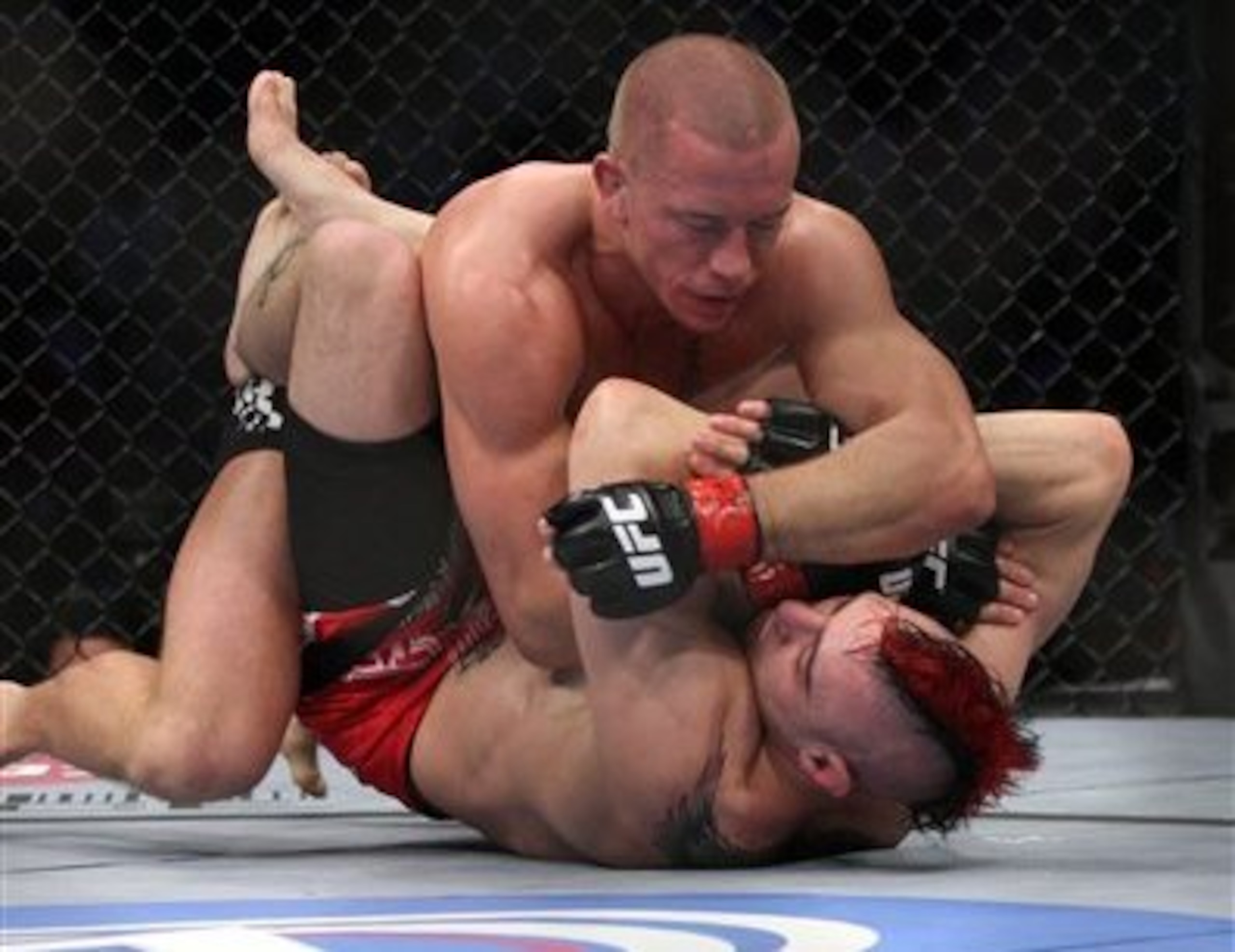
For his fourth title defense, St-Pierre met Dan Hardy in a fight that was really only possible due to the later being given fights against opponents with less-than-established takedown and wrestling credentials.
The one thing that Hardy did seem to have was fluid knockout power in his fists. Aside from that, he didn’t pose enough of a threat from a “complete” mixed martial arts standpoint in order to be that big of a worry.
Hardy had amassed a record of 23-6, going undefeated in the UFC with a record of 4-0, but none of his UFC opposition had been comprised of anyone with a solid wrestling base. He had defeated some tough customers—including Marcus Davis and Mike Swick—but none of them were as dangerous or held such a positional advantage as St-Pierre.
Still, Hardy knew how to sell himself; he managed to convince more than a few of St-Pierre’s detractors that he knew how to put fist-to-face and that when he did, St-Pierre would fall. He even drew from the well that was found in Matt Serra’s gym, which added some fuel to the anticipations of those who wanted to see the champion get knocked out cold once again.
With the stage set for UFC 111 in Newark, New Jersey, on March 27, 2010, St-Pierre stepped in to defend his crown in front of a crowd 17,000 strong and a pay-per-view audience of 770,000.
Hardy proved a game fighter, but he was up against GSP, a clinical machine with the perfect defense that was based upon the sound strategy that says “He who dictates where the fight is fought wins the fight.” Theory unfolded to fact, and St-Pierre earned his fourth straight title defense and, more impressively, had not lost a convincing round in his title reign.
While the victory over Hardy had not seen blood spilled or true pain suffered on either end, it did see an unquestionably dominant style employed, and against this style, resistance seemed futile; that is what made UFC 111 so impressive.
With Hardy out of the way, the table was cleared for St-Pierre’s next defense against the man many thought should have taken Hardy’s place at UFC 111: Josh Koscheck.
Koscheck had been introduced to MMA fans on a large scale thanks to Season 1 of The Ultimate Fighter, where we got to see him grow from a strict wrestler to a true mixed martial artist who threw punches with full conviction. With every victory, he got better and better.
On The Ultimate Fighter, Koscheck had been seen as the anti-bully to Chris Leben, but that coloring had gone outside the lines. By 2010, Kos was a “bad guy” who didn’t think it wise enough to spend the energy necessary to fight public opinion when going with the flow was so much easier, not to mention lucrative.
None of this is to say that Koscheck didn’t know how to push buttons or sell himself as a villain because he did; however, in the real world of combative sport, it is important to note that images are as tradable as fight shorts. They rarely fit more than once in a fighter's life, unless he is really up to wearing them for the long haul.
Simply put, Koscheck was happy to play the role of villain because at the time, the sport needed that and he could use it for his own ends, even if he had to endure slights to his person that should have gone no deeper than his persona.
It was in that spirit that he put on his black hat and stepped into The Ultimate Fighter gym as a coach for Season 12 opposite St-Pierre, with the big payoff taking place at UFC 124 on December 11. For better or worse, Koscheck had battled and babbled his way through the ranks, fought and defeated some excellent fighters and was now the third fighter from the first season of TUF to earn a title shot. He was going to stay with the same song that had got him there in the first place.
As for the competition of Season 12 of The Ultimate Fighter, well, St-Pierre enjoyed a dominant showing. None of this is to say he is an overall better coach, but during the filming of the show, his fighters got the better of those of Kos, eventually leading to two fighters from St-Pierre’s team facing each other for the lightweight plaque.
St-Pierre and Josh Koscheck squared off at UFC 124 in St-Pierre’s backyard of Montreal. The event pulled in over 23,000 people and sold approximately 800,000 pay-per-view buys.
It was expected that this fight would be much closer than their first meeting at UFC 74 in 2007, given that Koscheck was now much more confident as a fighter and had grown into his punching power.
As it turned out, as much as Koscheck had improved, so had St-Pierre, and once again, fans saw the champion defend his title in a methodical, restrained pace that saw him minimize danger while retaining his belt. St-Pierre put his newly improved jab on full display, breaking Koscheck’s orbital bone in Round 1 and swelling his eye badly.
From there, St-Pierre maintained control of the bout, earning a unanimous decision and retaining his title to tie the record set by Matt Hughes for consecutive title defenses at five.
St-Pierre finished the year with a record of 21-2, with three straight decision victories.
2011
10 of 13
After a successful 2010, St-Pierre would next face former Strikeforce champion, Jake Shields, at UFC 129.
Shields was a capable fighter with exceptional submission skills and a great deal of grit. At Strikeforce: Nashville in 2010, he had defeated Dan Henderson in a bout that almost saw the former blown out of the water in the first round.
Henderson hammered Shields repeatedly during the first frame, but then Shields had regrouped and came on strong in Rounds 2 through 5, winning the fight via unanimous decision and retaining his Strikeforce middleweight title.
While no one thought Shields would pose any kind of danger to St-Pierre standing, there were questions as to how the champion would deal with Shields on the floor. Perhaps it was those questions, coupled with the fact that Shields was riding a 15-fight winning streak—with victories over Robbie Lawler, Dan Henderson and Carlos Condit—that saw him receive the shot at St-Pierre’s title.
Either way, Shields had his shot in front of the largest crowd ever gathered to watch an MMA event in North America. UFC 129 was held in the Rogers Centre in Toronto, and over 55,000 fans came out to watch St-Pierre attempt to make welterweight history.
The pay-per-view numbers were exceptional as well, with a buyrate around 800,000.
The fight was fairly uneventful. St-Pierre used his jab, overhand right and leg kicks to score points, as Shields tried to find a way to lure or take the champion to the ground. Shields always seemed like he was behind, and the gap between the striking skills of both men was clearly in St-Pierre’s favor.
Hardly any time was spent on the ground, and St-Pierre jabbed and kicked his way to a unanimous-decision victory, becoming the first welterweight champion in UFC history to defend the title six consecutive times.
Although eventually scheduled to face Carlos Condit (as a replacement for Nick Diaz, who no-showed the promotional press conference) at UFC 137, St-Pierre suffered a knee injury and would not fight again in 2011.
St-Pierre closed out the year with a record of 22-2, finally eclipsing Hughes in at least one respect.
2012
11 of 13After rehabilitating his injuries and watching Carlos Condit defeat Nick Diaz to become the interim welterweight champion, St-Pierre made his return in 2012 at UFC 154 on November 17.
His recovery had been a long and rocky road, but he was finally back, and waiting for him was a serious test in Condit. While St-Pierre had the advantage in grappling and power, Condit looked to be the better striker, not to mention finisher. The interim champion also had the advantage in that he had remained free of major injury and had been more active, whereas St-Pierre had been on the sidelines for over 18 months.
While past bouts had seen St-Pierre dominate in fairly one-sided fashion, in Condit, the champion had an opponent who knew he had to fight in any position he was put in, good or bad. Condit was gritty and knew the opportunity at hand was rare. He fought with energy due the moment.
St-Pierre was in fine form, working behind an ever-improving jab and snatching takedowns with excellent timing and drive. The champion got the takedown early in Round 1, controlled the ground and went to work on pounding away, opening a cut along Condit’s brow that bled free as both fighters went to their corner.
After St-Pierre took Round 2 much the same way he had the opening frame, Condit came roaring back in the third, looking low but kicking high, landing his shin to the head of St-Pierre and knocking him down. Condit swarmed, trying to close the show, but St-Pierre regained his wits, defended himself, remained calm and managed to back up to his feet, but now he was bleeding as well. He finished the round strong, but it was clear that Condit had come to fight. For a moment there, it looked very bad for the champion.
St-Pierre got right back on track in Rounds 4 and 5, working for takedowns and defending against submissions in order to do damage with his ground-and-pound. He took the unanimous decision and extended his winning streak to 23-2 with seven consecutive title defenses.
2013
12 of 13
While 2011 and 2012 had only seen St-Pierre fight twice, in 2013 he looked to be more active. This may have had something to do with a certain Nick Diaz, who was goading St-Pierre mercilessly, claiming the champion was afraid to fight him.
GSP was normally a calm, collected professional, but Diaz clearly got under his skin, showing that once again, fighters are as human as the rest of us. St-Pierre finally got the chance to face his Stockton demon at UFC 158, although the fight failed to deliver upon the promise of vengeance that St-Pierre had given voice to once the bout had been signed.
With so much angst, it seemed that Diaz had succeeded in goading the champion into recklessness—at least before the fight began. As soon as the bell rang, St-Pierre put all his anger and wounded pride in his back pocket and went about defeating Diaz in methodical fashion. Jabs, leg kicks and takedowns, followed by a strong top control and somewhat passionless ground-and-pound, saw St-Pierre defeat the outmatched Diaz 50-45 on all the scorecards.
Once again, St-Pierre was taken to the whipping post by his detractors for failing to fight with the passion of his earlier days, content to win yet another decision rather than going for a finish.
But as always, there was a flip side to this hastily spent coin; fighting has always been a tale of two combatants, and if one is unable to stop the other, then why should the winner fight recklessly? Fans of St-Pierre were quick to point out that his kind of fighting was dominant and spoke to his clear authority over the division.
It was no secret what the champion was going to do come fight night, and if his opponents couldn’t stop him, why should the responsibility of pleasing everyone go to the man who was risking his legacy and health?
Of course, the debate had no true answer and probably never will.
When it was announced that St-Pierre’s next opponent would be knockout slugger Johny Hendricks, people raised their eyebrows higher than they had in a long time.
Hendricks wasn’t just a power puncher; he was also a good wrestler with a low center of gravity who was hungry for the belt. Of all of GSP's past opponents, it looked like Bigg Rigg would have the greatest chance of success, given that he wasn’t giving up much to the champion in terms of wrestling.
And what looked close on paper proved to be closer on fight night when both men collided at UFC 167 on November 16.
Hendricks proved to be just as capable of scoring takedowns as the champion in the first frame, as both men tried to find the favorable range for their strikes. This, in truth, would be the tale of the entire fight, as many of the rounds were very close.
Hendricks looked to be landing the harder shots, and St-Pierre’s face was clearly busted up after the final buzzer. But stats showed that St-Pierre scored three out of six takedown attempts, while Hendricks scored two out of four.
In strikes, St-Pierre landed 101 significant strikes, whereas Hendricks landed 85. But in total strikes, it was Hendricks with the advantage, 142 to 125.
In the end, the judges awarded St-Pierre the victory via split decision; after the cards were read, St-Pierre announced to Joe Rogan that he was going to take some time away from the sport to clear his head and decide what to do next.
He finished the year with an excellent record of 25-2, with nine consecutive defenses of his title.
The Present
13 of 13
After the fight, many fans were conflicted on a great many topics. Some were busy debating that Hendricks had been robbed, while others debated if St-Pierre should ever come back.
The latter crowd felt that the champion had done enough in his career to allow him to retire with no regrets, and to that end they seem to have been right. St-Pierre has not fought since, and although speculation has always been split down the middle as to if he will ever return, it seems unlikely.
Champions the caliber of St-Pierre are rare. Even though he seemed to become a more careful, calculated fighter in the final stretch of his career, he was dominant and managed to master a deep division.
While many of his detractors constantly poke fun at his “safe” style, we need not look far to see that, in many ways, St-Pierre was simply responding to the needs of the moment. Johny Hendricks did the same thing in his last bout with Matt Brown, and who could blame him? With so much to risk in a sport where your position in the largest promotion in the world is never a certainty, getting the win is far more important than many fans are willing to admit.
But those fans should not be faulted for their opinion, either. No one who chooses the combative sports is under any illusions as to what the fans want, and to fault said fans for being honest is a backward attempt at sleight of hand.
Sometimes, it amazes me that a man with the personality of St-Pierre chose such a violent and unforgiving sport as MMA. It is even more amazing that he managed to become such a star given that he admitted fear and doubt so freely, never hiding that which could (and would) be used against him by future opponents.
The success of St-Pierre as a pay-per-view star may be surprising, but the success of St-Pierre the fighter is not. He was disciplined, gifted, dedicated and well-trained, using his fear of defeat to motivate him in training until he had grown into a masterful fighter.
In the end, his record speaks for itself with authority. He avenged his losses against Hughes and Serra, defeated BJ Penn twice (when the latter was in his prime) and defeated Matt Hughes twice. During his title reign, he defeated many other excellent fighters, at times making them look like amateurs.
If anything, the career of St-Pierre is proof that inflammatory oratory is the most important thing in the world of combative sport; dedication, daring and desire can succeed where all else fails. He is proof that nice guys don’t always finish last, and further, that transparency doesn’t indicate a lack of substance.
Georges St-Pierre was real from the beginning until the end, and in a sport like MMA, nothing is more remarkable. That is why we will likely never forget him.

.jpg?w=2560 "Jazz Chisholm Landing Spots📍")
.jpg?w=2560 "Lions DC Defends Play Calls 🫥")