

Depth of Running Back Draft Class Could Sway Teams Away from Gordon, Gurley
The two-year drought on running backs as first-round draft picks is expected to end this year, as Wisconsin’s Melvin Gordon and Georgia’s Todd Gurley are both considered rare talents at the position. A deep class of talented runners behind them, however, could leave NFL teams to question whether Gordon and Gurley are really worth investments in the top 32 picks.
Gordon, who led the Football Bowl Subdivision with 2,587 yards and 29 touchdowns this past season, should be among the stars of the speed, agility and explosiveness drills at the NFL Scouting Combine on Saturday. Gurley, when healthy, possesses a rare combination of size, speed, power, agility and pass-catching ability.
TOP NEWS

New NFL Power Rankings 📊
The Robinsons POUND the Rock 🪨
Takeaways from Falcons' dominant MNF win
There are legitimate individual concerns that could stop teams from drafting them in the first round: Gurley is still recovering from a torn ACL, while some question whether Gordon will be able to run between the tackles successfully.
That’s not what this article is about.
Despite the concerns surrounding them, Gordon and Gurley are among the most talented overall prospects in this year’s draft. No team should be faulted for taking one of them in Round 1, as the teams who end up with them just might land two of the best rookie running backs in the NFL.
But there are also many other potential starting running backs in this year’s draft class. At a position that has become severely devalued in recent years, there might be better value in drafting another running back on Day 2 or 3 than there is in using a premium pick on Gordon or Gurley.
The Rest of This Year’s Running Back Crop
Any team that decides not to use its first-round pick on Gurley or Gordon but still wants to find a playmaking running back in this year’s draft should consider each of the following players.
Duke Johnson, Miami (Fla.)
The best combination threat in this year’s running back class, Johnson was productive as both a runner and receiver at Miami.
An explosive back who accelerates quickly and can make defenders miss in space, Johnson also runs great routes out of the backfield and consistently catches the ball in his hands.
At 5’9” and 207 pounds, Johnson is not going to run through many NFL defenders, but he shows the toughness to bounce off contact and shed arm tackles. He is a threat to make a big play once he hits a crease and shifts into top gear.
Ameer Abdullah, Nebraska
Virtually identical in size to Duke Johnson at 5’9” and 205 pounds, Abdullah brings a similar game to the table as a projected second- or third-round pick. His speed will be tested on Saturday, but his film shows how dynamic he can be in making defenders miss in the open field.
Like Johnson, Abdullah won’t truck through defenders but is a hard-charging runner who can bounce off contact and shake off arm tackles. He catches the ball consistently as a receiver out of the backfield.
Abdullah could stand out in the interview room. He was the winner of the 2014 Senior CLASS Award, which is awarded for “notable achievements in four areas of excellence—classroom, community, character and competition.”
Tevin Coleman, Indiana
One of the breakout stars of the 2014 college football season, Coleman is another back who is a threat to turn any play into a big play. While he is not the most dynamic or powerful runner out of the backfield, he is a home-run hitter with breakaway speed in the open field.
Exhibiting great vision to find running lanes, Coleman makes clean cuts in space and can rip through arm tackles. The 5’11”, 206-pound back possesses enough strength to hold up between the tackles and is also a capable pass-catcher.
David Cobb, Minnesota
Thickly built at 5’11” and 229 pounds, Cobb is the best power runner outside of Gurley in this year’s draft class. While he lacks an explosive burst out of the backfield, Cobb consistently finishes forward through contact and is tough to bring down once he gets a head of steam going.
Cobb will not stand out for his speed and agility in Saturday’s combine drills, but his vision and balance enable him to extend downfield runs. He won't be much of a big-play threat, but he is tailor-made to be a between-the-tackles innings-eater in a one-cut running scheme.
Jay Ajayi, Boise State

Jay Ajayi is quietly one of the most well-rounded running backs in this year’s draft class. He does not stand out for explosiveness or power, but he is a tough runner who exhibits great vision, accelerates through contact and has quick feet.
A good receiver out of the backfield who holds his own in pass protection, Ajayi could be a three-down back yet can probably be had in the third or fourth round. At 6’0” and 221 pounds, Ajayi has nice size and can be a weapon both between the tackles and in space.
T.J. Yeldon, Alabama
T.J. Yeldon’s career at Alabama never quite reached the heights it appeared it would after a breakout freshman campaign, in part because he was repeatedly plagued by fumbling issues. Still, he has as much upside as just about any runner in the draft class as a 6’1”, 226-pound back who can cut on a dime in the open field.
Yeldon’s game is atypical for his size, as he is dynamic in space but does not exhibit much power. He does not have a tremendously explosive burst, but he is dangerous once he gets up to speed and is a solid pass-catcher out of the backfield. He is likely to be drafted above many running backs who had better collegiate production.
David Johnson, Northern Iowa
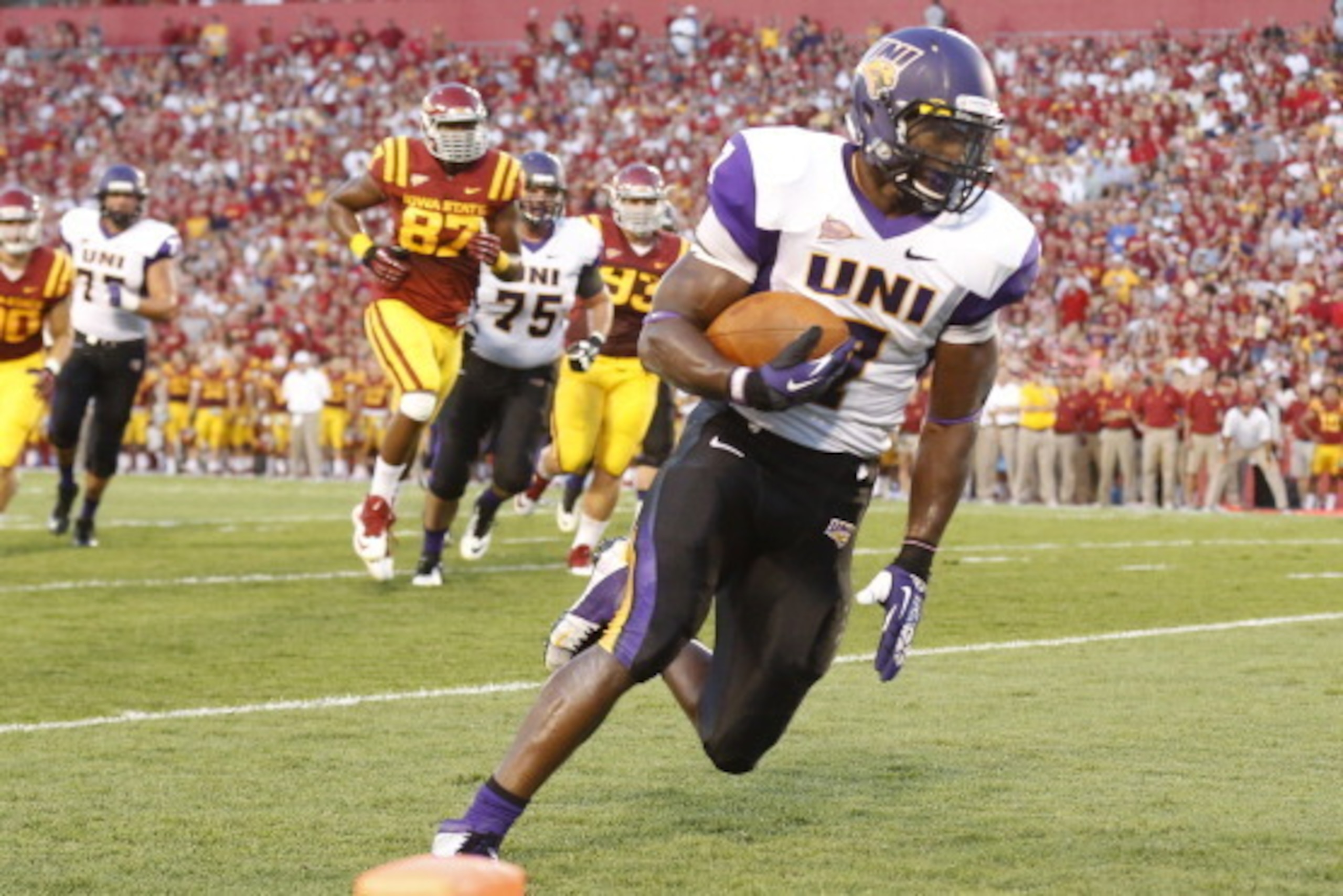
Probably the best receiver from the running back position in this year’s draft class, Johnson might actually project better as an H-back than he does as a tailback. A 6’1”, 224-pound player who runs good downfield routes, Johnson should be an immediate weapon for an NFL passing offense.
There is nothing special about Johnson as a runner, and he probably won’t stand out in athletic testing at the combine. Nonetheless, his size gives him potential as an inside runner, while his versatility to play multiple offensive positions, and even return kickoffs if needed, should make him a valuable addition to an NFL roster as a late Day 2 or early Day 3 pick.
Jeremy Langford, Michigan State
Langford’s physical traits do not stand out, but his production over the past two seasons, in which he has rushed for 2,944 yards and 40 touchdowns, certainly does. A durable tailback who can carry the load, he is a tough, bouncy runner with adequate size (6’0”, 208 lbs) and deceptive athleticism.
Likely to project as a fourth-round pick, Langford does not have great power or explosiveness, but he exhibits good vision in following blocks and has efficient moves in the open field. Also a solid pass protector, he does not project as a star but should be a productive part of a running back committee.
Other Running Backs to Consider
South Carolina’s Mike Davis has battled injuries and did not have great collegiate production, but he is a well-built back who flashed starter potential when running at his best.
Mississippi State’s Josh Robinson is a stout, pinball back who has drawn comparisons to Maurice Jones-Drew.
USC’s Javorius “Buck” Allen lacks top-end explosiveness but is a strong runner with good receiving ability out of the backfield.
Auburn’s Cameron Artis-Payne lacks standout traits but was the SEC’s leading rusher in 2014.
The Dilemma: Should Teams Draft a Top Running Back or Take Advantage of Depth?
It might not be completely accurate to use the past two drafts as evidence that teams do not want to use first-round picks on running backs. While 2013 second-round picks Le’Veon Bell and Eddie Lacy and 2014 second-round pick Jeremy Hill have all already emerged as stars, none of them were viewed in the same light as Gordon and Gurley when they were prospects coming out of college.
In 2013 and 2014, there simply were not any running back prospects worth drafting in Round 1, or so it was believed. Where Gordon and Gurley end up this year will be a true litmus test of how much the perceived value of running backs really has fallen.
Precedent—including that of Bell, Lacy and Hill—would suggest that selecting a running back in Round 1 is not worth the investment. Of the 13 running backs who ran for 1,000 or more yards this past season, only one, Marshawn Lynch, was a first-round pick. He was acquired by the Seattle Seahawks in 2010, from the Buffalo Bills for the price of just two Day 3 draft picks.
If Gordon and Gurley become superstars, the teams who draft them will be happy they did so. Even still, the value of selecting them in Round 1 might not be worth it if a productive starting running back could still be had in Round 2, 3 or 4.
Teams who could consider drafting Gordon or Gurley with their first-round pick include the Miami Dolphins (who have the No. 14 overall pick), San Diego Chargers (No. 17), Detroit Lions (No. 23), Arizona Cardinals (No. 24), Baltimore Ravens (No. 26), Dallas Cowboys (No. 27), Indianapolis Colts (No. 29), Seattle Seahawks (No. 31) and New England Patriots (No. 32).
All of those teams either lack feature running backs or are at risk of losing them in free agency this offseason. The potential opportunity to draft either Gordon or Gurley, especially for those selecting in late Round 1, could be a strong temptation.
To draft smart, however, each of those teams must consider whether their first-round picks would be better spent upgrading at another position. While they could still land a potential starting running back in a later round, that might not be the case at other valued positions in the modern NFL.
Ultimately, there will come a point in the draft where the talent of Gordon or Gurley outweighs the higher value of drafting a player at another position. It’s likely that will be in the first round for at least one of them. But it also should not come as a shock if teams choose to let Gordon and Gurley slide out of Round 1, knowing there is no shortage of quality running back options available in later rounds.
All measurables are from official weigh-ins at the NFL Scouting Combine and can be found at NFL.com.
Dan Hope is an NFL/NFL Draft Featured Columnist for Bleacher Report.

.jpg?w=2560 "Commanders Eagles Football")
.jpg?w=2560 "Grading WWE Raw 🔠")


.jpg?w=2560 "Viral Rams Coach Vid 🖕")
