

UCLA's Brett Hundley May Shine at NFL Combine, but QB Still Not 1st-Round Worthy
NFL teams searching for a franchise-caliber quarterback picked the wrong year to try to address the need.
Once Oregon's Marcus Mariota and Florida State's Jameis Winston are selected early in April's NFL draft, options are very limited in one of the weakest quarterback classes in recent memory.
The lone quarterback standing among the next tier of prospects with the potential to develop into a starter is UCLA's Brett Hundley. But concerns surround the former Bruin's ability to process and play in an NFL system.

.jpg?w=2560 "Rams Eagles Football")

Scouts were unable to watch Hundley perform in a practice environment under NFL coaches when he declined his invitation to the Senior Bowl due to a lingering injury.
NFL Network's Ian Rapoport reported Tuesday that Hundley will complete a full workout at the NFL combine in Indianapolis:
Whether or not Hundley would complete a workout at the combine shouldn't have been in question.
First, he isn't considered an elite prospect. Plus, it's a situation where Hundley should be able to shine due to natural athleticism and raw physical tools.
However, NFL scouts and executives won't be fooled by a workout without pads in a sterile environment.
NFL Network draft analyst Mike Mayock, via NFL.com's Bryan Fischer, summed up Hundley's combine experience before the quarterback even landed in Indianapolis:
At first glance, Hundley appears to be everything a team would want at the position.
The UCLA signal-caller stands 6'3" and weighs 226 pounds. His size will allow him to stand tall in the pocket and absorb the type of punishment he'll experience against professional defenses.
Hundley is also very athletic, and the UCLA coaching staff took advantage of his natural abilities. The team utilized the zone read effectively, while the quarterback amassed 1,747 rushing yards and 30 touchdowns on the ground during his three seasons as a starter.
Plus, the UCLA quarterback's overall arm strength isn't in question.
In fact, a quick look at Hundley's career passing statistics shows a lot of promise. The three-year starter completed 67.6 percent of his passes. His 69.1 completion percentage as a redshirt junior ranked fourth-best among quarterbacks at the FBS level. Hundley threw for at least 3,071 yards each season, and he owned a career 75-to-29 touchdown-to-interception ratio.
Everything on the surface checks out to a satisfactory level.
Upon closer inspection, though, concerns within Hundley's game start to materialize and scare teams away from the quarterback as a potential first- or even second-round talent.
The biggest concern stems from a perceived lack of development as a passer.
| Season | Attempts | Comp. % | Passing Yards | YPA | Touchdowns | Interceptions |
| 2014 | 392 | 69.1 | 3,155 | 8.0 | 22 | 5 |
| 2013 | 369 | 67.2 | 3,071 | 8.3 | 24 | 9 |
| 2012 | 479 | 66.6 | 3,745 | 7.8 | 29 | 11 |
While there were slight improvements in some areas, UCLA's coaching staff relied more on Hundley as a passer as a redshirt freshman than it did during his final year on campus.
The increasing completion percentage with a decreasing interception total is certainly a positive, but the concerns extend beyond statistics.
With each passing year, the quarterback position becomes more cerebral. Due to the the complexities of NFL offenses and defensive schemes, a quarterback must exhibit three traits: an ability to process information rapidly, quick eyes to work his way through progressions and reliable decision-making.
Hundley struggles in two of these areas, and it becomes evident very quickly.
Mayock, via ProFootballTalk.com, explained why Hundley and even Baylor's Bryce Petty aren't valued as highly now as they were before the season started and where their struggles originate:
"When you watch them within the framework of their offense, they’ve got a long way to go to become pocket quarterbacks. They don’t throw with anticipation. If the first look isn’t there, both of them are hesitant and indecisive which leads to stacks and other problems. You want to say you’re going to need at least a redshirt year as a second or third round draft pick, but what they need is live snaps, not seven-on-seven snaps in practice.
"
This leads back to a lack of progress in processing information quickly. Thus, the quarterbacks' eyes are slow progressing through their reads, and they don't see throws developing in front of them.
A quarterback who is slow to react often needs to see his receivers come open before he uncorks a pass. The league's best quarterbacks are capable of throwing their receivers open by seeing it before it happens and leading their targets to the intended spot before the defense adjusts.
In the NFL, passing windows shrink at an alarming rate. A wide receiver that may have been running wide open at the collegiate level won't be open for long in the professional ranks due to the awareness and athleticism of NFL-caliber defensive backs.
It's vitally important for quarterback prospects to show gradual improvement with anticipatory throws in order to expect increased growth at the next level.
A quarterback who "doesn't see it" in college will take tremendous time and development to do so for an NFL team, if he ever does.
Hundley believes these particular concerns about his game are overblown.
In an interview with NJ.com's Eliot Shorr-Parks, the UCLA signal-caller painted a very different picture of his abilities as a pocket passer:
"I can sit back in the pocket and make throws. The one thing that sets (me apart from other pocket passers) is being able to take off and run. Create plays. It's a huge part of my game.
The feel of the pocket is a question a lot of people have. But another is that when someone hasn't met you or spoken to you or talked to you, you would never know until you get to personally meet them. So I think that is the biggest question—what is he like off of the field? How am I going to be impressed? What's his vibe?
"
Each and every instance Hundley was asked about his ability to win from the pocket, he didn't actually provide specific examples to counter claims that he struggled within the framework of the offense. He simply stated he is a passer first who can run the football if needed.
"When you have the ability to run you get labeled as a runner, instead of 'OK, he is a quarterback, but he can run.' And when you put that label on a quarterback, people see that and immediately think of (former Eagles quarterback) Michael Vick or (Cleveland Browns quarterback) Johnny Manziel. But (Green Bay Packers quarterback) Aaron Rodgers is a passer—but he can run as well. (Indianapolis Colts quarterback) Andrew Luck has some speed to him, but can pass. I think that is the label you want as a quarterback.
"
Some of the blame doesn't fall on Hundley or the team's coaching staff. The UCLA quarterback played behind one of the worst offensive lines in college football, as FootballOutsiders.com's Matt Waldman noted:
During his time a starter, Hundley was sacked a whopping 128 times.
Undue pressure on a quarterback creates bad habits. In Hundley's case, it was easy to see that the junior quarterback wasn't confident keeping his eyes downfield and started to peek at oncoming pressure.
In UCLA's season opener against the Virginia Cavaliers, defensive coordinator Jon Tenuta made life miserable for Hundley. The Cavaliers sacked the quarterback five times and applied consistent pressure.
As a result, the UCLA quarterback's eyes began to drop any time there was pressure.
In the below screenshot, it's clear Hundley wasn't looking downfield.

At least two receivers were open and looking back at their quarterback. Instead of standing tall in the pocket and delivering the football, Hundley stared down the blitzing linebacker and tried to evade pressure. The result? The quarterback was sacked.
It isn't simply pressure from a good defense that can get to Hundley. The quarterback will pull the ball down far too quickly instead of surveying his options in the passing game.
Below is another example of Hundley already making up his mind to run with the ball instead of waiting on routes to develop by stepping within the pocket to create space.
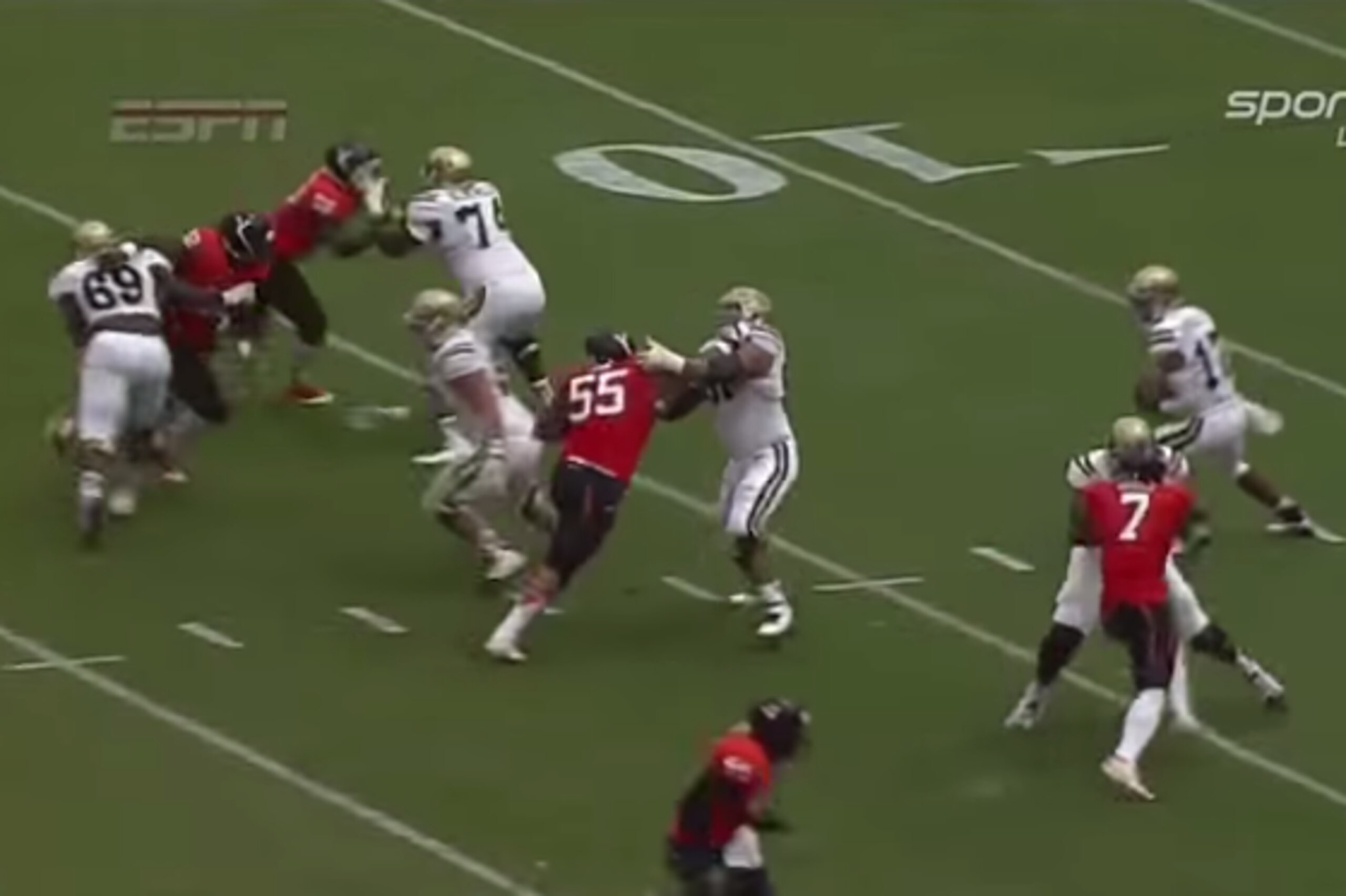
Despite some room to still operate, Hundley decided to run the football at the point shown in the above picture.
It's a major concern from teams as they evaluate this particular prospect.
When Hundley is given time and allowed to survey the field, he makes good decisions. CBSSports.com's Dane Brugler noted how close his production was to a highly touted Pac-12 Conference counterpart:
NFL quarterbacks, however, rarely operate in perfect conditions. It's up to those quarterbacks to remain calm under pressure and make the right decisions.
Hundley remains an intriguing prospect because coaches will see his raw ability, but an inability to process everything properly within an offense could be his downfall as a professional.
The UCLA quarterback is a gifted athlete with all the natural tools to impress at the combine. Hundley won't be in position to improve his draft stock, though. Where he's eventually drafted will be determined by a team's evaluation of his development as a passer and his projected long-term upside.
Brent Sobleski covers the NFL draft for Bleacher Report. Follow him on Twitter.
.jpg?w=2560 "Texans-Mixon Released Football")
.jpg?w=2560 "Falcons Saints Football")
.jpg?w=2560 "Grading WWE Raw 🔠")


.jpg?w=2560 "2 NFL Officials Suspended")
