
NBA Draft 2015 Prospects: Star Comparisons for Top 10 Players
Though no two players are the same, each one fits into the mold of another player who came before him.
And now two weeks into the season, we've gotten a good enough look at our projected 2015 NBA draft field to make some comparisons.
I ranked our top 10 NBA prospects based on their NBA draft stock and gave each a professional player comparison. For some of the prospects, two comparisons were given to either highlight a blend of similarities or a worst- and best-case outlook.
10. Willie Cauley-Stein, Kentucky, 7'0", C, Junior
1 of 10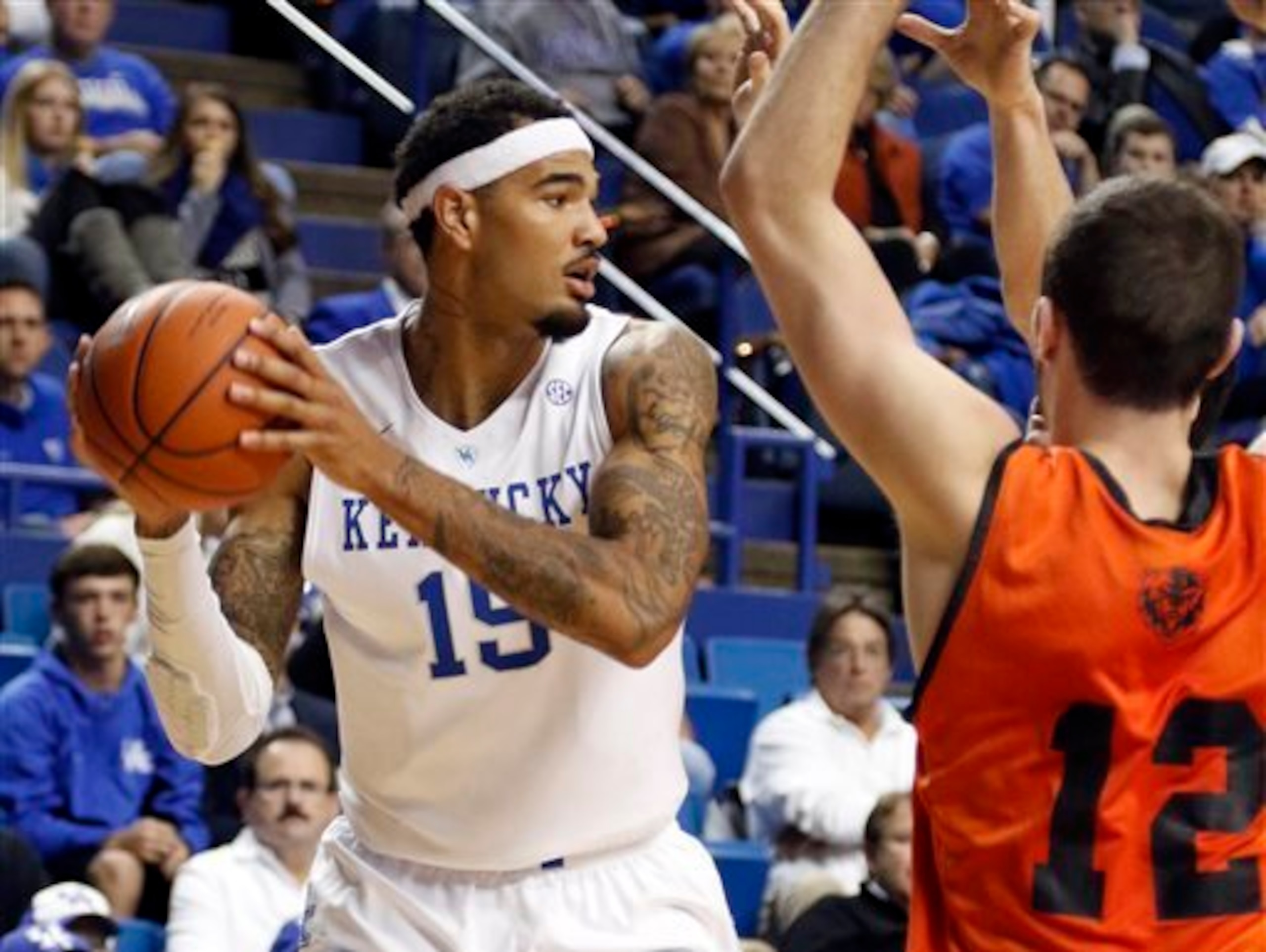
NBA Comparison: Tyson Chandler, Dallas Mavericks
In terms of what they each bring to the table, there isn't much of a difference at all between Willie Cauley-Stein and Tyson Chandler.
At the offensive end, it's all about easy buckets for Cauley-Stein, who like Chandler, does most of his work off pick-and-rolls, catch-and-finishes or putbacks off misses.
While both players lack ball skills, they play to their strengths—size, mobility and athleticism. And as a result, both guys shoot extremely high percentages from the floor.
But it's at the defensive end where Chandler has made his money, and that's where Cauley-Stein will make his NBA living as well. He changes shots just by being in games. And he'll block a few too—Cauley-Stein swatted 2.9 shots last season, and he's averaging 1.7 a game early on this year.
A limited offensive skill set ultimately hurts Cauley-Stein's upside, but there's still plenty of value tied to guys who can protect the rim and finish everything around it.
9. D'Angelo Russell, Ohio State, 6'5", PG/SG, Freshman
2 of 10
NBA Comparison Blend: Monta Ellis, Dallas Mavericks
While they don't have the same look, size or speed, you can categorize both D'Angelo Russell and Monta Ellis as scoring combo guard playmakers. That pretty much covers their offensive identities.
Russell is a scorer at heart who also handles the ball and sees the floor. Through four games, he's averaging 19 points and 5.5 assists.
He's tremendously skilled, with the ability to create and make shots from all over the floor. Russell has a nifty handle with an extensive shot-making repertoire, from pull-ups and step-backs to floaters, runners and acrobatic finishes in the lane.
Off the ball, he moves and shoots well, having already hit 12 of his first 23 three-point attempts. Russell has a pretty lefty stroke with a quick release and deep range.
Like Ellis, Russell's scoring attack is ahead of his floor game in terms of facilitating, but he's tough to contain off the dribble, where he keeps his head up and finds finishers and shooters.
Yahoo Sports' Adrian Wojnarowski mentioned he heard scouts "gushing" over Russell's passing ability.
At 6'5", he's bigger than Ellis yet less athletic, though it's his balanced playmaking ability that fuels the comparison. Russell is one heck of an offensive player, and while combo guards aren't always viewed in a positive light, you can't argue with his blend of size, skill and versatility.
8. Cliff Alexander, Kansas, 6'9", PF, Freshman
3 of 10
NBA Comparison: Derrick Favors, Utah Jazz
Power, athleticism, energy—that's Cliff Alexander's game at this stage in his young career. And that's what it was for Derrick Favors coming out of Georgia Tech.
Alexander lacks polish and refined offensive skills, but as we've seen from Favors, that's something he can add over the years.
In the meantime, Alexander's above-the-rim presence and non-stop motor translate to rebounds, blocks and easy buckets.
He's only playing 16.5 minutes a game through four contests, but he's sporting a strong 19.5 percent rebounding percentage, an average of one block and he's shooting 57.1 percent.
Still, Alexander has plenty of work to do on his raw offensive game, but he's got all the tools one needs deliver major interior activity. He's got Derrick Favors-like potential to hit with the right adjustments and improvements.

7. Stanley Johnson, Arizona, 6'7", SG/SF, Freshman
4 of 10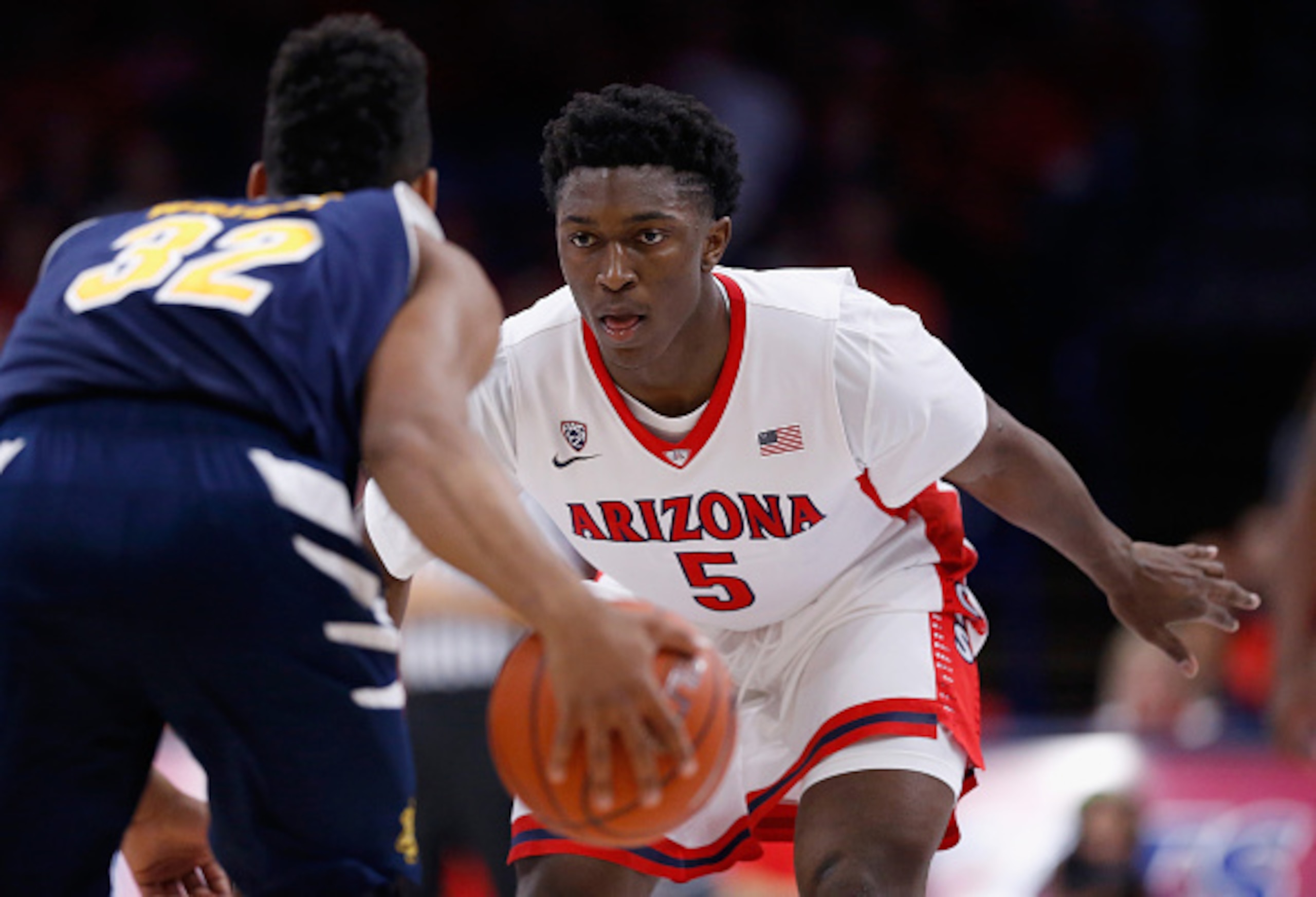
NBA Comparison: Ron Artest, China/Kawhi Leonard, San Antonio Spurs
Listed at 6'7", 245 pounds, Stanley Johnson is as strong and physical as any freshman wing you'll come across. Cue up the Ron Artest and Kawhi Leonard comparisons.
Like Artest and Leonard, Johnson is one of those in-your-grill type of defenders—a guy who can really pester opposing ball-handlers with strength, length and intensity.
He's also a go-getter under the boards. Johnson is active on the glass, where he's averaging 6.2 rebounds in 27.8 minutes. It's not often he lets a loose ball in his area wind up in someone else's hands.
Offensively, Johnson is more of a complementary scorer than one you'd feature. Artest and Leonard have never really established themselves as go-to options either. But like Artest and Leonard, contact doesn't bother Johnson, who plays right through it, whether he's fighting for a bucket down low or plowing through traffic on the way to the rim.
On the perimeter, Johnson isn't a guy you can just leave open—he's hit five three-pointers through his first six games this season. Still, improving his perimeter shot-creating and shot-making ability should be a priority moving forward.
Johnson is averaging 13.5 points a game through six while already building his defensive credibility. He'll be in the conversation for top two-way wing in the field by the time draft night rolls around.
6. Myles Turner, Texas, 6'11", PF/C, Freshman
5 of 10
NBA Comparison: LaMarcus Aldridge, Portland Trail Blazers
Fresh off an eye-opening 25-point outing on 11-of-12 shooting against St. Francis, Myles Turner is starting to resemble a previous Texas stud turned NBA star.
There's a lot of LaMarcus Aldridge in Turner's game, given his size and inside-out skill set.
Of Turner's 11 made buckets against St. Francis, six of them came on jumpers outside the paint. And they weren't just of the catch-and-shoot variety. Like Aldridge, Turner has the ability to separate for jumpers one-on-one, whether he's turning over the shoulder or jab-stepping before rising to fire.
Turner also offers versatility as a ball-screener, as he can pick-and-roll or pop, depending on what the defense gives him.
Defensively, he actually projects as more of a natural rim protector than Aldridge. So far on the year, he's blocked 13 shots through five games.
You can ignore the fact that he's coming off Texas' bench early on. It's no reflection on Turner's outlook as an NBA prospect.
“It’s a perfect situation for me,” Turner told Bleacher Report's Jason King. “I can learn under a core group of experienced players and then hopefully move into a bigger role.”
Big men who can shoot and defend are always in demand, and Turner appears to specialize in both. He's probably the biggest riser on our board early on.
5. Kristaps Porzingis, Spain, 7'0", PF, 1995
6 of 10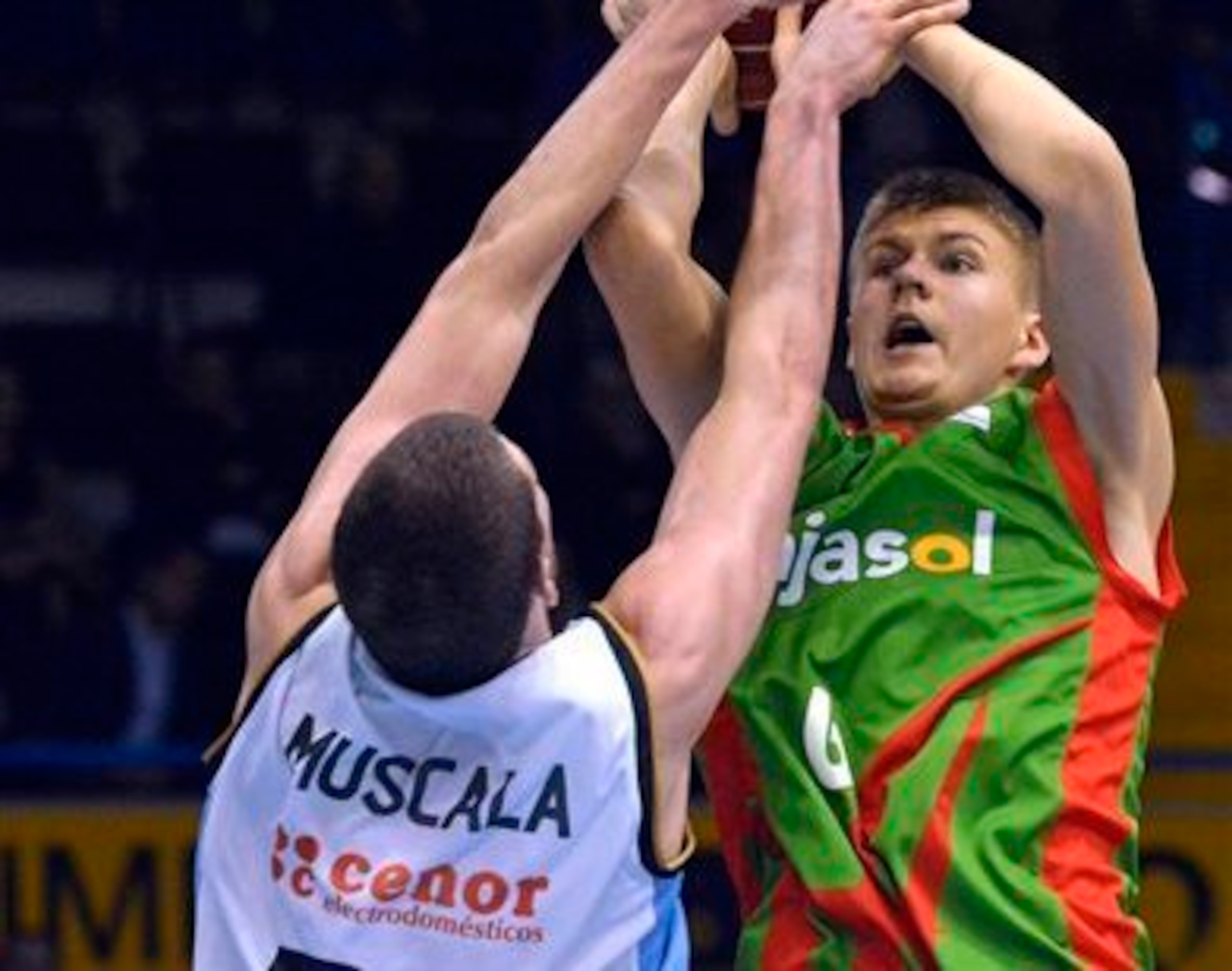
NBA Comparison: Danilo Gallinari, Denver Nuggets/Dirk Nowitzki, Dallas Mavericks
You just don't typically see 7-footers with Kristaps Porzingis' perimeter ball skills. Though Gallinari is more of a small forward and not quite as tall, his face-up offensive approach is similar to Porzingis'.
Given his physical tools and style of play, you'd have to say his ceiling comparison is Dirk Nowitzki—a best-case scenario outcome dependent on how Porzingis' skinny body fills out and one-on-one game develops.
Other than being able to finish plays high above the rim, Porzingis' offensive appeal revolves around his ability to stretch the floor as a shooter, attack closeouts and score off the dribble.
He's currently hitting 42.1 percent of his three-point attempts for Sevilla. And in doses, we've seen some impressive shot creativity in the mid-range.
Defensively, Porzingis projects somewhat differently, as his mobility and hops have translated to rim protection overseas, where he's averaging roughly 2.5 blocks per 40 minutes.
At this stage, he doesn't quite finish strong enough in traffic, which probably has something to do with his skinny 220-pound frame. And he tends to play smaller than he is, whether it's under the boards or as a drifter on offense. But the upside tied to his physical tools and skill set is enormous.
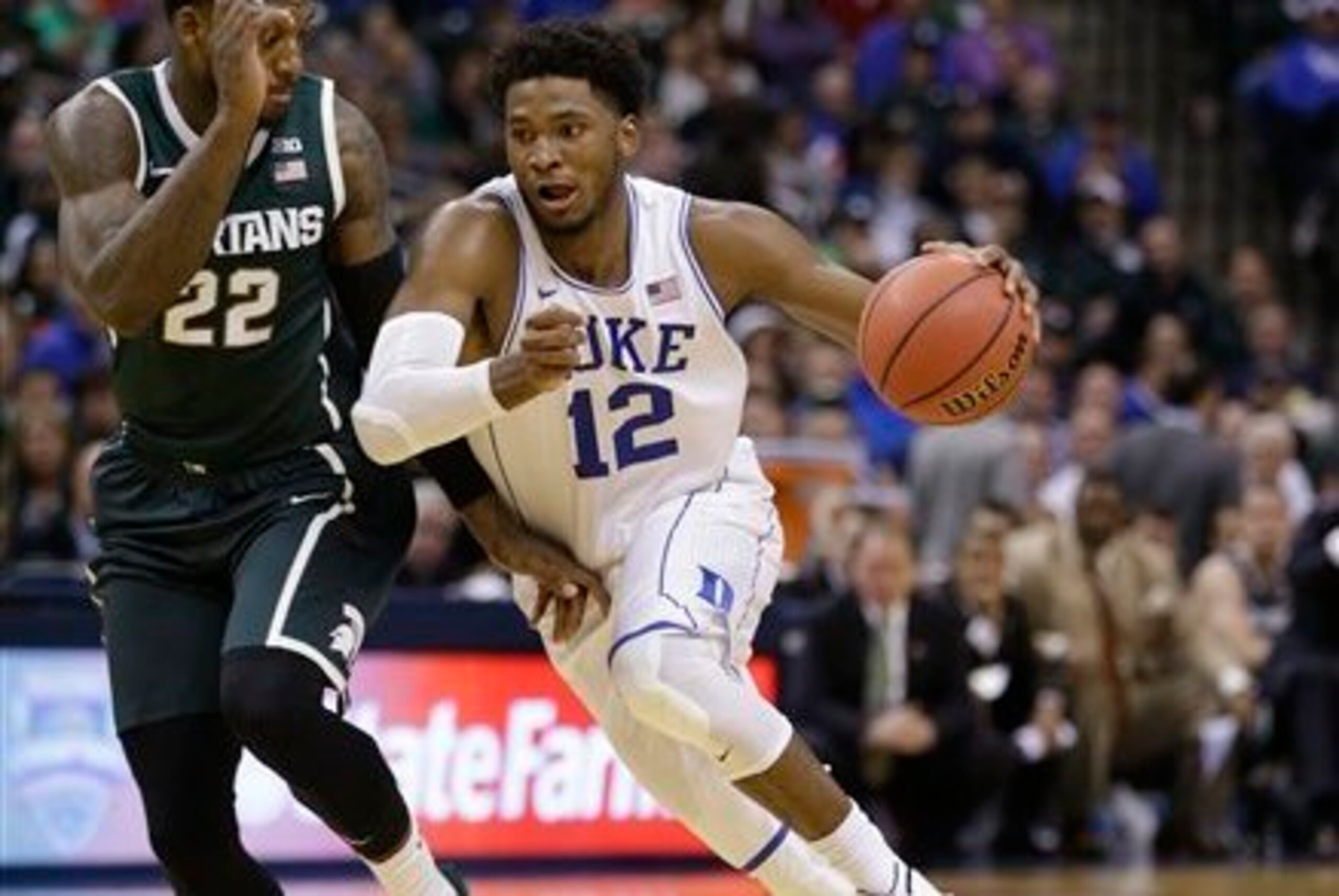
4. Justise Winslow, Duke, 6'6", SF, Freshman
7 of 10
NBA Comparison: Michael Kidd-Gilchrist, Charlotte Hornets/Victor Oladipo, Orlando Magic
At first glance of Justise Winslow, you see a lot of Michael Kidd-Gilchrist—spectacular athleticism, NBA wing size, a relentless motor, loads of lockdown defense potential.
But once you look a little closer, you might also notice a little Victor Oladipo, who offers the same intangibles as Kidd-Gilchrist, only better ball skills and less size.
At 6'6", 225 pounds, Winslow aces the eye test. And while he's currently at his best making plays off the ball—catching-and-slashing, tip-ins, deflections, fast breaks (like Kidd-Gilchrist)—he also has a decent handle, which allows him to elude defenders off the dribble, as well as a decent-looking jumper, which has connected on 8 of 21 attempts (38.1 percent) from downtown so far on the year.
Just as Kidd-Gilchrist and Oladipo were considered "safe" prior to their respective drafts, Winslow will enter his with the same exact label.
Worst comes to worst, someone is getting a fireball of energy and defense. But the two-way upside here is big if he can continue improving his handle and shooting touch.
3. Emmanuel Mudiay, China, 6'5", PG, 1996
8 of 10
NBA Comparison: Jrue Holiday, New Orleans Pelicans
Like Jrue Holiday, Emmanuel Mudiay's game revolves around size for the point guard position, blurry quickness and a high offensive skill level.
And they're similar athletically—about a notch below John Wall and one above Brandon Knight.
If you had to label Mudiay, you'd probably call him a scoring point guard. He's at his best attacking the rim, whether it's in the open floor or half court, where he can change direction on the dime, weave through traffic or explode through the tiniest gap.
On the downside, Mudiay hasn't exactly been automatic in traffic as a finisher, and neither is Holiday, who's shot below 55 percent within five feet in each season he's played.
Still, Mudiay's athleticism allows him to score and finish acrobatically from difficult angles in the paint. And though his jumper is a work in progress, he's looked capable in the mid-range and threatening from downtown, where he's made nine three-pointers through nine games so far in China.
In terms of his ability to run an offense, Mudiay is more than trustworthy. Though he can take over a game as a scorer (averaging 18.8 points a game in China), there's no questioning his priorities or vision—he's a true point guard who likes to get his teammates involved, whether it's with the pick-and-roll or off a drive-and-dish.
Mudiay's shot selection and shooting consistency could use work, but you can't really ask for a better blend of raw talent and guard skills.
2. Karl-Anthony Towns, Kentucky, 7'0", PF/C, Freshman
9 of 10
NBA Comparison: DeMarcus Cousins, Sacramento Kings/Rasheed Wallace, Retired
Karl-Anthony Towns has shown it all early on, even in limited time playing 18.3 minutes per game. He's got an exceptionally high skill level, and much like DeMarcus Cousins, Towns is a guy you can feed in the post and watch go to work. Spin moves, jump hooks, running hooks, drop steps—Towns has soft touch and nimble feet, along with some above-the-rim bounce we haven't seen from Jahlil Okafor at Duke.
But Towns is more than just an interior scorer—like Rasheed Wallace, he's got the ability to spread the floor as a shooter and facilitate from the post, where he's an excellent passer out of double-teams.
He's also a handful under the boards—Towns is sporting a monster 22.25 percent rebounding percentage and brings in roughly the same amount of rebounds as Okafor (7.7 to Okafor's 7.8) playing nine less minutes per game.
Defensively, Towns has plenty to learn, but based on his 21 blocks in 110 total minutes—good for a ridiculous 21.21 percent block percentage—his athleticism and massive wingspan can still be problematic for opposing offenses.
There just really aren't many troubling questions to ask regarding Towns' outlook and game. And given his inside-out versatility, NBA center size and above-average athleticism, there also isn't a prospect in the conversation who has a higher two-way ceiling.
1. Jahlil Okafor, Duke, 6'11", C, Freshman
10 of 10
NBA Comparison: Al Jefferson, Charlotte Hornets
Jahlil Okafor has mostly toyed with Duke's nonconference opponents early on, averaging 17.2 points and 7.8 boards on 64.9 percent shooting through six games.
And like Charlotte Hornets big man Al Jefferson, he does most of his damage below the rim, where he combines overwhelming strength with sharp footwork and soft hands.
For the most part, both are interior-oriented scorers who rarely shoot with two hands on the ball. Most of their offense comes off quick moves and touch from foul line to baseline.
Both have established themselves as go-to options you can feed in the post—guys capable of creating their own high-percentage shot in the half court against a set defense.
On the downside, neither are dominant defenders or shot-blockers, nor are they considered stretch big men that catch and shoot with range.
Still, between his outstanding physical tools, skill level and basketball IQ, Okafor has the ability to control a game from the paint. As a No. 1 overall candidate, he's looking like the safest option in the field early on.
.jpg?w=2560 "Every Trade's Best Trade Asset 🔁")
.jpg?w=2560 "Insiders: Cowboys Overpaid for Porter")
.jpg?w=2560 "MHJ's Potential Trade Value 📉")