Cold Weather Proving to Be Big Obstacle for Vikings' Teddy Bridgewater
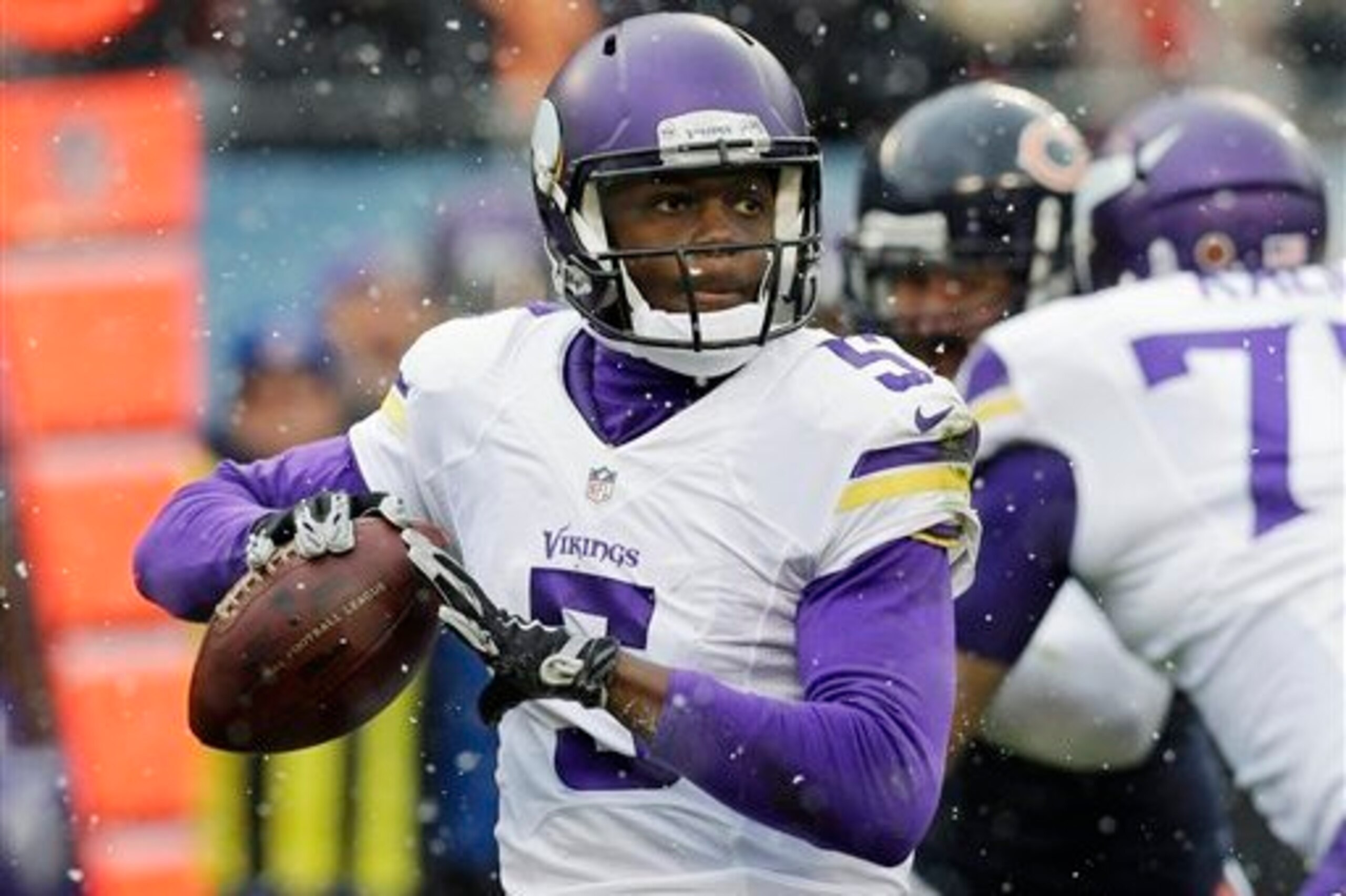
The Minnesota Vikings’ thumping at the hands of the Chicago Bears on Sunday added a big concern related to rookie quarterback Teddy Bridgewater, an obstacle that will have a significant bearing on things to come. Bridgewater might not be cut out for high-end quarterback play in the cold weather.
This realization has been lingering under the surface ever since the Vikings selected him back in May’s draft, plugging him into the bitter-cold locale of the team’s temporary home for 2014 and 2015.
Bridgewater took the first step toward making this worry an undeniable truth with a poor showing in Chicago. He completed 18 of his 28 passes for a respectable percentage, but his yardage was extremely deflated by the repeated underneath passes.
TOP NEWS
.jpg?w=2560 "Chargers Mack")
Every Trade's Best Trade Asset 🔁
.jpg?w=2560 "Green Bay Steelers Football")
Insiders: Cowboys Overpaid for Porter
.jpg?w=2560 "Seahawks Cardinals Football")
MHJ's Potential Trade Value 📉
With early snow flurries, Bridgewater deferred to safe passes underneath for a majority of the first half. Bleacher Report's Zach Kruse provides the harrowing details:
"#Vikings are now 4 drives and almost 20 plays into this game. Still no targets for a WR.
— Zach Kruse (@zachkruse2) November 16, 2014"
Playing four drives without targeting a wide receiver, much less completing a throw down the field to one, is stunning.
Bridgewater may have been acutely aware of the question marks about his ability to play in such weather. He has little experience doing so. That may have led to the passive approach, not daring to test the elements with throws through the frigid air.
Receivers may also have been struggling to get open. Some combination of those two theories is likely. But as Andrew Krammer of 1500 ESPN points out, Bridgewater was slow to the draw on more than one play where a receiver ran open down the field:
"Greg Jennings comes free down the middle of the field for second time today and Bridgewater throws elsewhere.
— Andrew Krammer (@Andrew_Krammer) November 16, 2014"
The entire showing was riddled with hesitancy to throw down the field. That reflected poorly on Bridgewater’s confidence in the conditions. His game-ending interception on a deep throw put a cap on a disappointing performance.
Bridgewater will get many more chances to prove his merits in the cold weather, but this first showing will move the magnifying glass just a little closer.
A few questions will be pondered now after seeing Bridgewater’s first exposure to the cold in an NFL setting. First, will the deflated statistics be a theme in the frigid temperatures, and to what degree will that happen? Second, what does that say about the future for Bridgewater?
To quantify the effect cold weather has on him, I compared Bridgewater’s collegiate statistics by game-time temperature to those of three other college quarterbacks who faced or are facing cold-weather games in current Oregon QB Marcus Mariota, former Wisconsin and North Carolina State QB Russell Wilson and former West Virginia QB Geno Smith.
Temps of 50 degrees or below qualifies as cold. Anything higher than that, including indoor games, qualifies as warm. Three of Mariota's 20 college games qualify as cold. Six of 20 qualified for Bridgewater and seven of 21 qualified for both Smith and Wilson. Only games against power-conference teams were considered.
The outcomes don’t quell the concerns for Bridgewater.
| Cold | Warm | Diff. | |
| Bridgewater | 63.9% | 73.0% | -9.1% |
| Mariota | 60.2% | 65.2% | -5.0% |
| Smith | 65.1% | 69.6% | -4.5% |
| Wilson | 64.2% | 69.3% | -5.1% |
The relevance is not necessarily in the completion percentages in the cold. All quarterbacks are tasked with different throws in different offenses, which complicates comparisons of raw completion-percentage data.
What is concerning is the difference between the percentages by temperature. Bridgewater was clearly the most affected of these four collegiate quarterbacks.
His issues in the cold are minimized somewhat in terms of yardage measures.
| Cold | Warm | Diff. | |
| Bridgewater | 8.54 | 9.53 | -1.0 |
| Mariota | 8.95 | 9.70 | -0.8 |
| Smith | 7.41 | 8.63 | -1.2 |
| Wilson | 8.39 | 8.13 | 0.3 |
The numbers as a whole match what casual observation surely led scouts to believe about Bridgewater’s fit in cold-weather cities. With smaller hands, ones that do meet baseline levels, however, a lean frame and an average arm in terms of outright distance and velocity, Bridgewater doesn’t match the description of a quarterback who thrives in all elements.
Also consider the fact that he grew into his own as a QB in the warm weather of Florida at Northwestern High School in Miami, as Rivals.com confirms. That in and of itself doesn’t mean Bridgewater won’t cut it in the cold, but the information is relevant.
The issue of Bridgewater’s struggles in the cold will be amplified in the remainder of this season. Week 15 in Detroit and Week 16 in Miami are the only warm games left on the schedule this season, and the cold has only begun to set in for the others.
The Vikings return to TCF Bank Stadium in 2015, the team’s final season outdoors before the move into the new stadium. That means a big chunk of Bridgewater’s development in the first two years of his career will happen in cold settings. That complicates any idea that the Vikings only need to wait it out. The team needs immediate results, and Bridgewater needs early development.
A few schematic adjustments can be made to try and tailor the offense to what the rookie can do. Throws to the middle of the field, especially in the short to intermediate regions, decrease the length of the throw. That doesn't mean every throw is a checkdown underneath, but Bridgewater can be successful attacking defenses between the hashes. He did a little bit of that to the Bears late in Sunday's game.
Having success on the ground is obviously a great plan too, decreasing the reliance on Bridgewater to bail the offense out in 3rd-and-long situations. That might be easier said than done.
Finally, Bridgewater must acclimate to the conditions from a mental perspective. The team will expect him to play with more confidence moving forward than he did in Chicago. These are new settings for him as a quarterback, so the team can only ask for growth moving forward.
The Vikings should also be exhausting all possible methods to grow the rookie’s frame, building him into a stronger quarterback with a stronger arm. This is not entirely possible for every QB on the planet. Some prominent ones have increased arm strength after entering the NFL in the past, though, Drew Brees being the best example.
Either way, Minnesota will need more from its rookie quarterback as the season continues. The offensive game plan may not be scaled back at all if the Chicago game is any indication. It’s up to Bridgewater to adjust to the conditions while staying aggressive down the field.
How Bridgewater adjusts to this new obstacle will say a lot about where his career as the Vikings quarterback is headed.
Statistics accumulated via ESPN.com. Temperature data accumulated via Weather Underground.
.jpg?w=2560 "Giants Football")