NBA Starting Fives Showing Unity This Season
There is something to be said for continuity. That’s apparent when viewing the best starting rotations early in the NBA season. When you look at the ball movement, defensive rotations and chemistry of the starting rotations who remained intact, the teams with the most unity have few, if any changes.
To evaluate this I used the plus/minus numbers of the best starting rotations, meaning the number of points a lineup has outscored its opponents per 48 minutes. The numbers were obtained from NBA.com/Stats.
To qualify a lineup had to have 100 minutes playing together and be the actual starting lineup.
There are some notable teams who don’t qualify because of these qualifications. These include surprisingly good lineups from the Boston Celtics and Minnesota Timberwolves, and not surprisingly, the Chicago Bulls and San Antonio Spurs.
These are certainly teams to watch, but they don’t qualify for the list because of the small sample size.
Here are the five most effective starting fives, listed in order of plus-minus per 48 minutes.
Unless otherwise noted, the numbers here were obtained form NBA.com/Stats or Basketball-Reference.com. They are current through November 16.
5. New Orleans Pelicans, Plus-11.6
1 of 5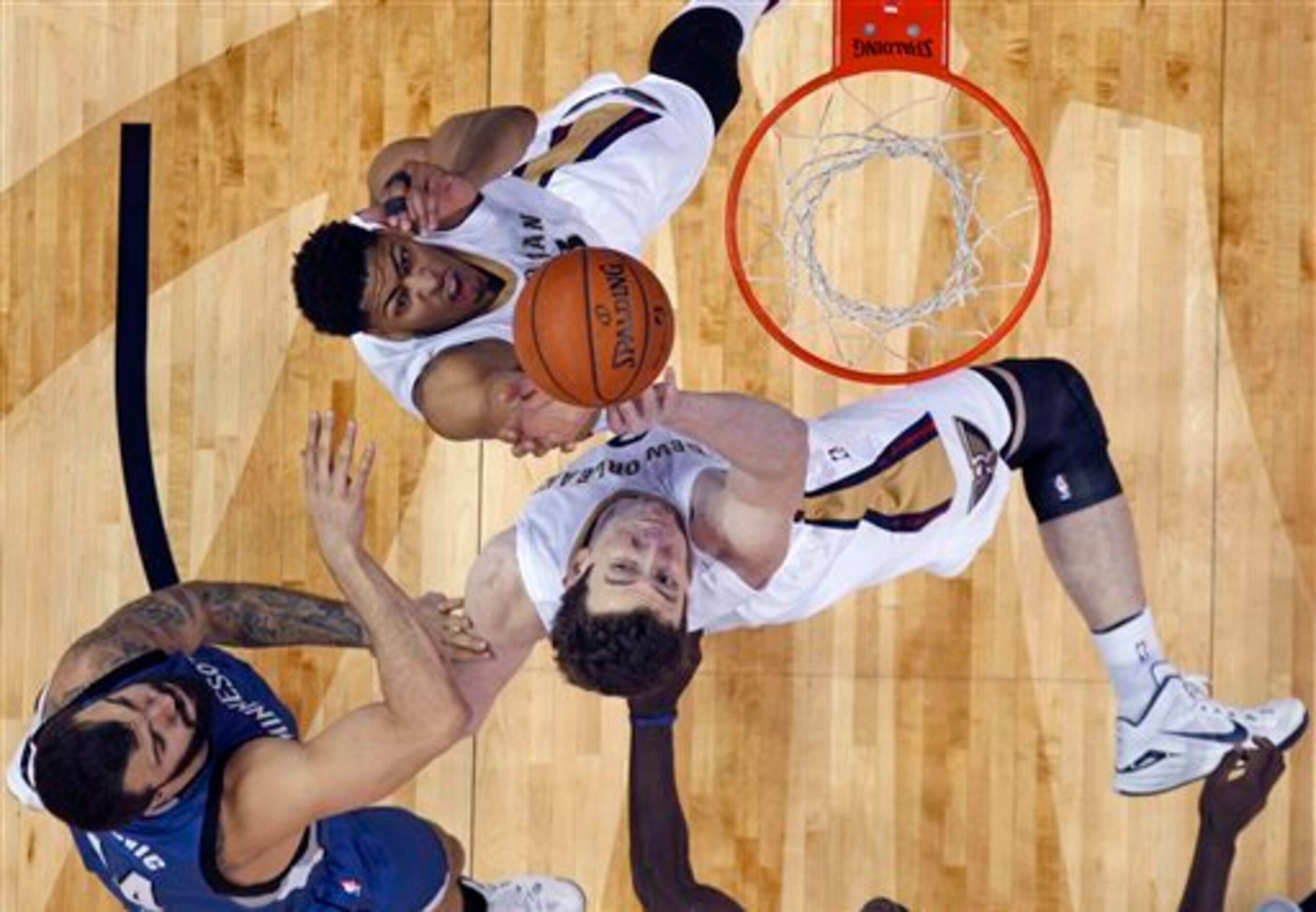
Lineup: Jrue Holiday, Eric Gordon, Tyreke Evans, Anthony Davis, Omer Asik
Last year, the New Orleans Pelicans were one piece away in their starting five. All they needed was a center. This offseason, they got that piece when the traded for the defensive specialist, Omer Asik. He is the perfect complement to the Unibrow, Anthony Davis.
At HoopsStats.com they track production by “In-the-Paint,” which is the combination of the power forward and center (as opposed to being actually in or out of the paint). The Pelicans tandem is plus-25.5 in efficiency difference, placing them 7.7 points better than the second-place Dallas Mavericks.
Davis is having a monster season. Defensively, the duo is borderline unfair. Add to that Davis posting MVPish numbers: 24.5 points, 11.8 boards and 4.1 blocks. Throw in Tyreke Evans and Jrue Holiday combining for 32.6 points and 14 assists per game.
Eric Gordon, though, is struggling. The lineup is succeeding more in spite of him than because of him.
He does have talent, though. His career-low coming into the season was 15.4 points per game. This year, he’s scoring just 8.1 on 32.9 percent shooting. The Pelicans are a surprising 5-3. If Gordon can get things going with the other four starters, this team could not only make the playoffs, it could make waves there.
4. Toronto Raptors, Plus-16.4
2 of 5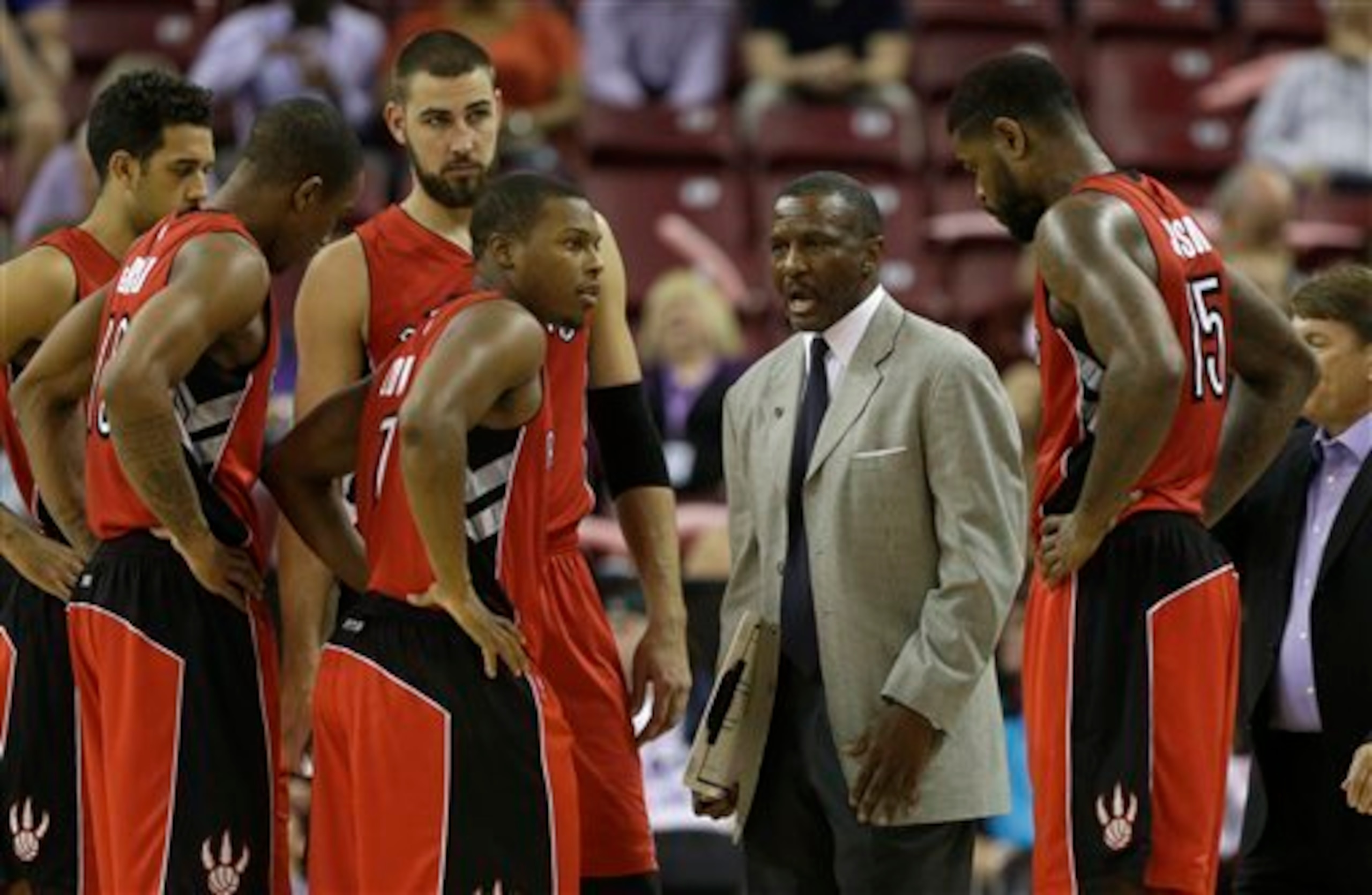
Lineup: Kyle Lowry, DeMar DeRozan, Terrance Ross, Amir Johnson, Jonas Valanciunas
If the New Orleans Pelicans are winning with their frontcourt, the Toronto Raptors are winning with their backcourt.
Kyle Lowry is averaging 18.3 points, 5.8 assists and 4.8 rebounds. DeMar DeRozan has 21.2 points, 2.5 assists and 4.2 rebounds.
No one else on the team is averaging more than 11 points.
The frontcourt, though, is nothing special. Valanciunas leads the team in rebounds with 8.0 per game. Amir Johnson brings nice defense and energy. Terrence Ross is a tremendous athlete who has developed three-point range. But none of these guys are stars.
What makes this group click is they work together to find the best shot. Much of that has to do with the backcourt creating opportunities and then making the right decisions about when to shoot and when to pass.
Credit also has to go to the coaching of Dwayne Casey, who should be in the early conversation for Coach of the Year.
The starters are 52.0 percent from the field and 43.2 percent from three. As a result, the team is fifth in offensive rating. The Raptors starting five operates as a unit; correspondingly, it's greater than the sum of its parts.
3. Sacramento Kings, Plus-19.5
3 of 5
Lineup: Darren Collison, Ben McLemore, Rudy Gay, Jason Thompson, DeMarcus Cousins
The Sacramento Kings are the surprise team of the season, and much of that has to do with the play of Rudy Gay and DeMarcus Cousins. That may be even more remarkable than the success of the team.
Cousins had earned a reputation as a talented player but one whose emotions and complaining got in the way of his own stardom. Gay was stigmatized as a volume scorer who could score, but only because he passed like an old man in a Studebaker (in other words, rarely and with great misgivings). His scoring numbers were good but cheesy.
Somehow, when the Kings traded for Gay, Whiney and Cheesy were paired together like fine wine and cheese, though. And they’re really working. Gay is averaging 22.5 points, 6.8 rebounds and 3.5 assists. Cousins is notching 22.4, 11.1 and 1.6 respectively.
As any connoisseur will tell you, the key to a good pairing of wine and cheese is balance. Offseason acquisition Darren Collison has provided that. As a traditional, facilitate-first point guard, he’s been able to work an offense where both stars are able to find success.
In the 228 minutes those three have played together, the Kings have outscored their opponents by 97 points.
They can get better too. As Aykis16 points out for SactownRoyalty.com, Ben McLemore’s defense has improved and now his offense is coming around.
"In almost every area, Ben is holding guys to less than their normal FG%, and is forcing all opponents into just 40.3% from the field. Compare that to last year's numbers, where he was allowing a very poor 48.9% from the field
Eventually though, a guy has to start making his open shots. It all seemed to come together over these last four games on the road for Ben, starting last Friday in Phoenix. With DeMarcus Cousins fouled out of the game, it was McLemore who hit some tough clutch shots for the Kings in both overtime periods, and it was McLemore who stymied Eric Bledsoe. These last four games, McLemore averaged 16.3 points on 54.8% from the field and 50% from three on 6 attempts a game.
"
With Jason Thompson providing rebounding and creating offense out of scraps, if the Kings’ shooting guard can develop into a solid two-way player, they could be shocking challenger for a playoff spot in the West.

2. Dallas Mavericks, Plus-23.6
4 of 5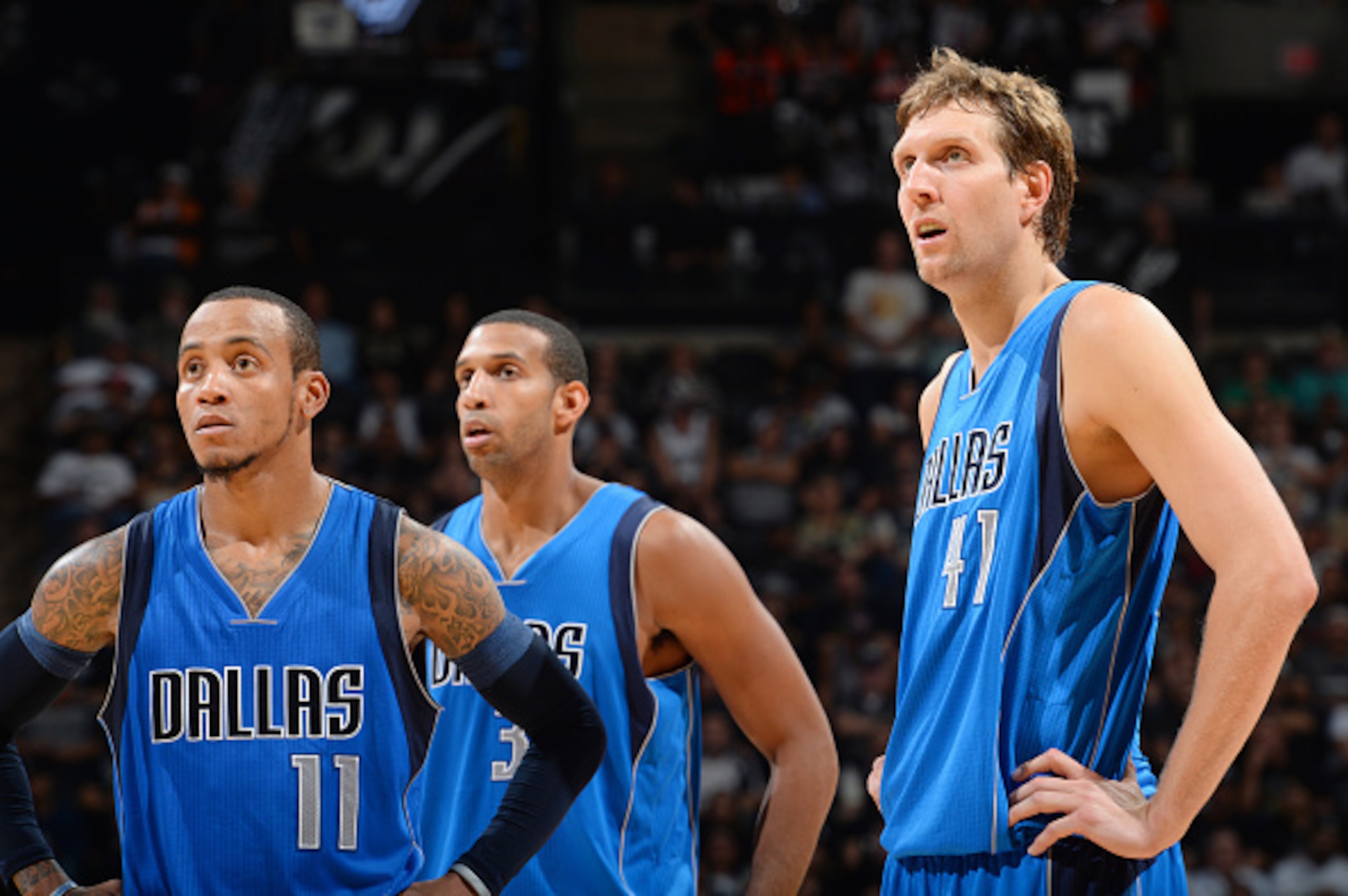
Lineup: Jameer Nelson, Monta Ellis, Chandler Parsons, Dirk Nowitzki, Tyson Chandler
After winning the championship in 2011, the Dallas Mavericks dissolved much of the core of their team. Since then, they’ve been rebuilding, and now they’ve become the contender that no one is talking about.
Their starting five is elite, and they’ve been destroying everyone. Since falling behind to the Kings (Nov. 11) three games ago in the first quarter, they’ve outscored their opponents by 93 points in 11 quarters.
The secret to the Mavericks’ success is the adage “You’re only as strong as you’re weakest link.” Their starting five has no weakness. Each part has its job and does it well.
Jameer Nelson facilitates. Dirk Nowitzki sinks jumpers with the purest, most beautiful shot in the history of life. Monta Ellis and Chandler Parsons make for a pair of wings who can both drive and shoot. Tyson Chandler is second the league in field-goal percentage (trailing only teammate Brandon Wright) in large part because he gobbles up offensive rebounds and puts them back on the few shots his teammates miss.
As a result the Mavericks are second in the league in both effective field-goal percentage and true-shooting percentage. The only team ahead of them in both is also the only team ahead of them in the starting-five rankings.
1. Golden State Warriors, Plus-27.3
5 of 5
Lineup: Stephen Curry, Klay Thompson, Harrison Barnes, Draymond Green, Andrew Bogut
The Golden State Warriors are looking like a team who could legitimately dethrone the San Antonio Spurs, and a big part of the reason for that is their starting five. This is even scarier when you consider the fact that their true starting power forward, David Lee, has just played seven minutes this season.
The key here is the Splash Brothers: Stephen Curry and Klay Thompson. The pair is the league’s most dynamic duo thus far in the season. The two are plus-138 in the 250 minutes they’ve been on the court together.
But that’s just the surface. The best six tandems are composed of Warriors. Thompson and Draymond Green are second, Thompson and Andrew Bogut are third. Curry and Green are fourth, Curry and Bogut are fifth. Thompson and Harrison Barnes are sixth. The whole group just clicks.
The point of this exercise is to demonstrate that the success doesn’t rely on any one player. They feature five of the six best four-man lineups and seven of the nine best. The best group absent Barnes is first in the league. Without Green, it’s second. Sans Thompson, it's fourth. The best non-Bogut foursome is fifth. And even without Curry, it's ninth.
Even with all that production from his teammates, Curry is off to an MVP start. There are two extremely prestigious clubs he could join. The first is the 2,000 point, 600 assist club. Its members feature Tiny Archibald, John Havlicek, LeBron James, Oscar Robertson, Michael Jordan and Derrick Rose.
The other is the 50/40/90 club, consisting of payers who hit those percentages on field-goal, three-point and free-throw attempts, respectively. That club consists of Larry Bird, Kevin Durant, Reggie Miller, Steve Nash, Dirk Nowitzki and Mark Price.
Curry is averaging 24.8 and 7.7 assists, which puts him on place to join the former club. He’s shooting 49.1 percent from the field, 39.7 percent from three and 95.7 percent from the stripe. The latter club is well within reach.
Curry would not only be the first player to be in both clubs, he could even do it in the same season. With the weapons he has around him, why not?
.jpg?w=2560 "Every Trade's Best Trade Asset 🔁")
.jpg?w=2560 "Insiders: Cowboys Overpaid for Porter")
.jpg?w=2560 "MHJ's Potential Trade Value 📉")