Mike Evans Flashing Pro Bowl Potential with Special Rookie Season
Tampa Bay Buccaneers wide receiver Mike Evans became a Top 10 draft pick after a very impressive stretch of football with Johnny Manziel at Texas A&M.
Over two seasons, he caught 151 passes for 2,499 yards and 17 touchdowns. Evans showed the requisite size, speed and fluidity to dominate college defensive backs, with the ball skills to make NFL scouts take notice of him.
While Evans never displayed amazing speed on the field in college—he did run a 4.53 at the combine—he was fast enough and quick enough to suggest he wouldn't have separation issues in the NFL. Early in his rookie season, Evans was somewhat sluggish.
.jpg?w=2560 "Chargers Mack")
.jpg?w=2560 "Green Bay Steelers Football")
.jpg?w=2560 "Giants Football")
Through his first five games, Evans tallied just 258 yards and two touchdowns on 21 receptions.
His underwhelming production could partially be blamed on poor quarterback play, but for the most part, Evans seemed hesitant and unsure on the field. His straight-line speed wasn't where it was expected to be, and his lack of quickness through his routes was preventing him from running with the ball after the catch.
It's not easy for rookie wide receivers to adapt to the NFL.
In college, most NFL receivers were able to dominate their opponents on a weekly basis by simply relying on their greater levels of athleticism. In the NFL, the technical aspects of the position become vitally important. Technicalities make playing the wide-receiver position the second-most difficult position to transition to from college, behind quarterback, of course.
Over the last four games, Evans has compiled an incredible 536 yards and five touchdowns on 25 receptions.
Evans' production peaked against Washington in Week 11, as he and quarterback Josh McCown combined for 209 yards and two touchdowns on seven receptions. Evans had two receptions of over 50 yards, with one of those, a 56-yarder, going for a touchdown.
The ease with which Evans' production has come in recent weeks is partially due to the quality of the opposition that he has faced, but primarily a result of his own comfort level on the field.
When the Buccaneers drafted Evans, they obviously envisioned him becoming an Alshon Jeffery type of complement to Vincent Jackson, acting as the Buccaneers' version of Brandon Marshall. Jeffery and Evans share some traits—they are both big receivers with speed—but there are clear distinctions.
The primary difference between the two is body shape. Jeffery is primarily a linear athlete because of his lanky frame. He dominates defensive backs in very specific ways, whereas Evans has more versatility in his game even at this early stage of his career.
For his huge touchdown reception at the start of the fourth quarter against Washington, his fluidity was evident.

On 2nd-and-16, Evans is lined up as the innermost receiver in the trio to the right of the formation. Predictably in this situation, the defense is backing off the line of scrimmage to try to prevent any deep passes.
This means that Evans initially has a free release.

After getting off the line, Evans is immediately met by a linebacker dropping back into coverage from the inside. This linebacker will likely have surprised Evans, and he does hesitate when the defender meets him in space.

However, Evans doesn't let the movement in front of him disrupt his route. He doesn't stop his feet or sharply change direction. He instead angles slightly inside to move past the defender, who is moving toward the outside.
By doing this, Evans is able to sustain his speed and keep the timing of his route.
Once past the first defender, Evans is matched up with a linebacker running down the middle of the field. The linebacker is either responsible for the deep middle third or he was in man coverage against Evans from the start.
Based on the rest of the movement in this play, he isn't in man coverage.
Either way, Evans is able to easily run past the linebacker to create huge space behind the defense. McCown has a relatively basic task, as he only needs to lay the ball out for his receiver to run underneath it. Evans gets somewhat lucky on this play, since the ball bounces off his facemask when it arrives, but he manages to coral it before running into the end zone.
As far as 56-yard touchdowns go, this one was fairly effortless.
Although it was only a minor movement at the beginning of his route, Evans' fluidity and balance at the start of this play were crucial. By slipping past the initial linebacker unimpeded, Evans prevented the linebacker over the middle of the field from positioning himself to stay on top of his route or redirect him.
Evans is officially listed at 6'5" by the NFL. For most NFL receivers, and humans in general, being 6'5" is a blessing and a curse.
The blessing is obvious more often than not.
Bigger receivers are used more in the red zone because their size allows them to make basketball-style post-up receptions against smaller defensive backs. While it isn't as simple as suggesting that all bigger receivers have greater catch radii, their length affords them opportunities that shorter receivers don't get.
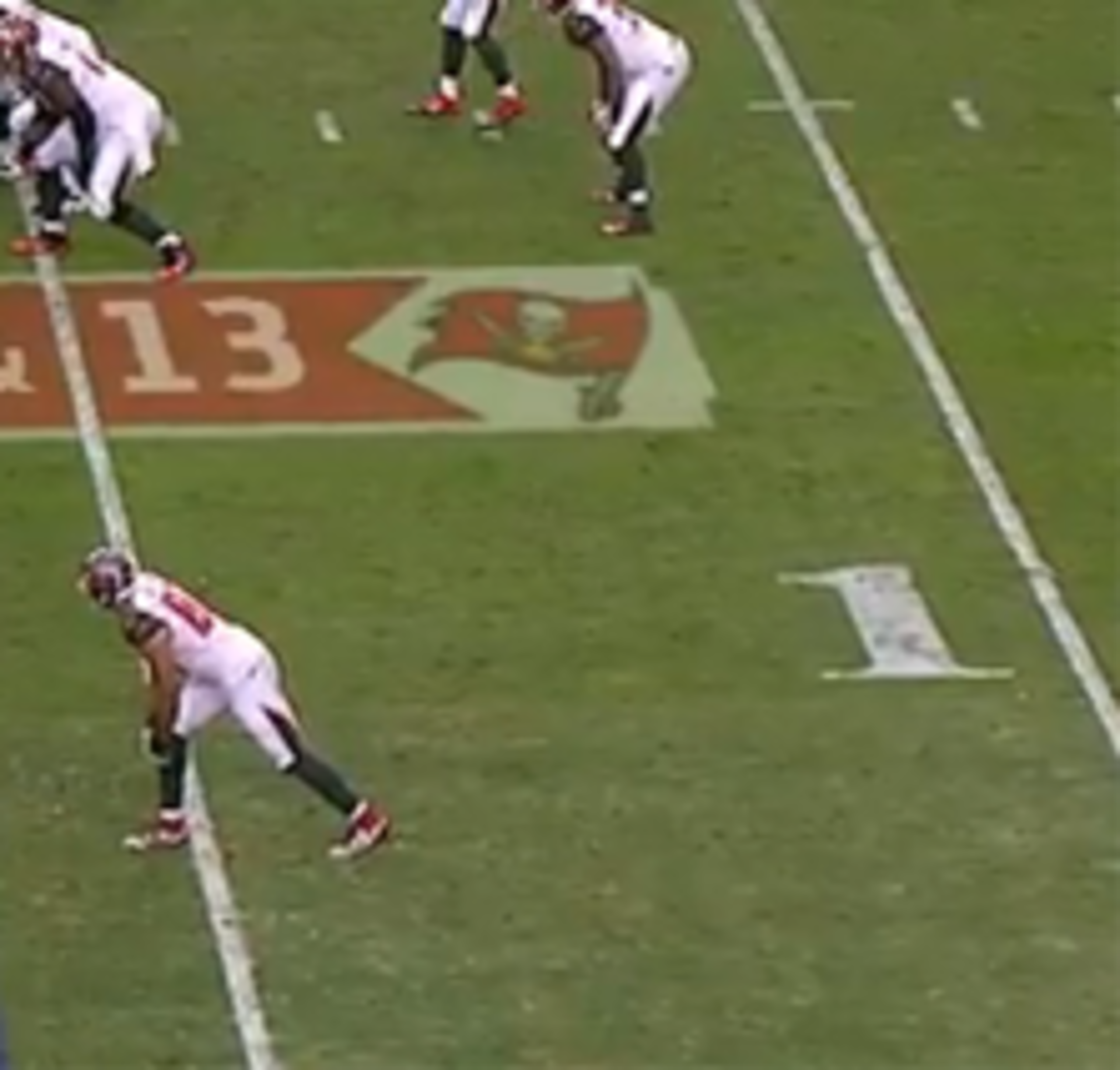
On this 3rd-and-13 play near the end of the third quarter, Evans is lined up at the top of the screen. Fellow rookie Bashaud Breeland is attempting to press him at the line of scrimmage, but Evans is lined up a yard off the line, giving him space to maneuver at the snap.
Evans initially works against Breeland's outside shoulder before turning inward to run down the seam.

He gets inside position on the cornerback without creating any separation. Breeland is in position to cover Evans, but the receiver's size keeps him at a distance. Evans doesn't high-point the football by extending his arms, but he does leave his feet to bring it into his chest.
Ideally, Evans would have caught this ball away from his body, but his strength and size allowed him to be effective either way.
On the other hand, the curse of being a taller receiver is that you have a heavier load to carry around the field when running routes and attempting to create separation. Being that big typically means carrying more weight and having a wider frame, especially around the waist.
Like Dez Bryant and A.J. Green, Evans' size doesn't appear to hamper his movement. He has the fluidity and foot frequency that most players his size lack. He doesn't have excess bulk in his midsection, and that allows him to sit into his routes and turn with relative ease.
That's not to say that he is or ever will be as good as Green or Bryant, but his potential is considerable because of that shared trait.
Evans is the kind of receiver who can beat you in a variety of ways. He doesn't possess a certain particularly dominant skill. He doesn't have Sammy Watkins' explosiveness or Odell Beckham Jr.'s refined technical ability. Instead, he must rely more on winning at the catch point against better cover corners and beating bigger defensive backs with his fluidity.
Watkins and Beckham, as well as a number of other receivers from this class, are setting a very high standard for rookie receivers right now. It's hard to argue that Evans has eclipsed them based on his body of work thus far, but he's definitely not lagging too far behind.
Evans has shown enough in recent weeks to suggest that he will develop into a high-quality receiver at some point.
As with most players, and especially most receivers, it will be difficult for him to maintain consistency over the first year or two of his career. That is something that we are already seeing and will likely be amplified by the Buccaneers quarterback situation moving forward.
With Vincent Jackson providing a veteran influence, though, there's no reason to think that Evans can't become a Pro Bowl-caliber player sooner rather than later.
.jpg?w=2560 "Seahawks Cardinals Football")
.jpg?w=2560 "Commanders Cowboys Football")