Seattle Mariners: M's Offense Must Improve for Team to Progress
The Seattle Mariners are coming off of a highly successful 2014 MLB season. They not only posted their best win total in seven years, but they also added several players— via promotion, trades and free agency— who will be integral parts of the Mariners’ nucleus for years to come.
Included in the wave of new additions were Austin Jackson, Roenis Elias, Dominic Leone, James Jones, Fernando Rodney, Chris Taylor, James Paxton and Robinson Cano.
These improvements helped the Mariners reach said win total (87), but they also helped the team make a 16-game improvement on the 71-95 squad of 2013. That’s a tremendous turnaround in one year.
TOP NEWS
Tokyo Giants Hire Matsui 👔

Next MLB Players to Sign $200M Contracts 💰
.jpg?w=2560)
World Series Predictions 🔮
If the M’s can make anything close to that kind of progress in 2015, the team will be in superb shape going forward. If not, the team could be in for a sense of déjà vu. If the team wants to seriously improve, it should upgrade its offense.
Seattle made similar strides in the win column in both 2007 and 2009, improving by 10 and 24 games, respectively. However, both teams would follow up promising seasons by crashing back down to earth with identical 61-101 seasons in both 2008 and 2010.
There are a few differences between those two Mariner teams and the team at present. Both the ’07 team and the ’09 team were riddled with older players and unsatisfactory starting pitching, traits that don’t befit a team that should be rebuilding.
The current incarnation of the team has youth at every position and a borderline-elite rotation that is still relatively young. Regardless, Seattle must be smart with its offseason work in preparation for 2015—offseason work that should include drastically upgrading a paltry offense.
Despite finishing only a game behind Oakland for the final playoff spot, the Mariners offense needs some serious work. The team finished below league average in almost every offensive category, with the most telling stats being a .300 team OBP—good for third worst in the league and a team OPS of .676—sixth worst in the league.
Major League Baseball’s league average OPS for an individual player was .695 in 2014.
Seattle’s top OPS performer was all-world second baseman Robinson Cano, with an .836 clip. In addition to Cano, the only other Mariners with an OPS above league average (regardless of plate appearances/games played) were Logan Morrison, Kyle Seager and Michael Saunders.
Having only four players with an above average OPS is pathetic, especially considering two of the four (LoMo and Saunders) didn’t reach 100 games played.
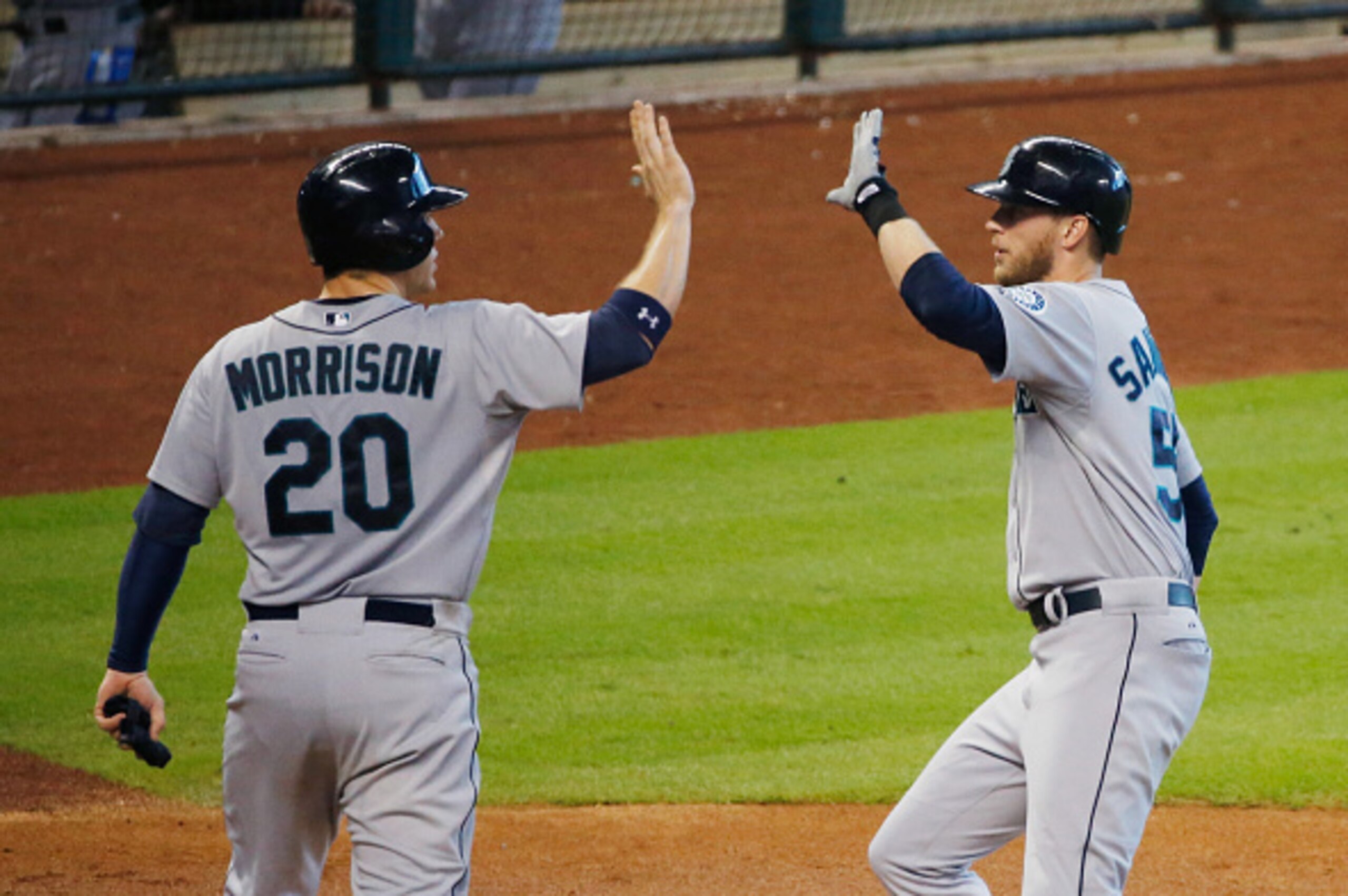
The M’s had four players with an OPS over league average. Perennial offensive powerhouse Detroit finished second in the league in team OPS and had eight players above league average in individual OPS. World Series champions San Francisco finished just below league average in terms of team OPS, but every one of their regular starters posted an OPS better than league average.
It may sound harsh to berate the M’s for underperforming, but the team is a legitimate playoff contender at present. They may not be a threat to capture, or even reach, a World Series, but they stand a good chance to make the postseason.
The team has to expect more and get more out of its offense. Seattle’s pitching is phenomenal, and it almost single-handedly propelled the team into October, despite a subpar group of hitters. For the team to take the next step and get to “World Series contender” status, it must improve the offense.
The Giants are a comparable team to the M’s in terms of across-the-board pitching depth. However, where the teams differ is on the other side of the ball. San Francisco has its elite hitter (Buster Posey) and complementary sluggers (Pablo Sandoval and Hunter Pence), but they don’t have any easy outs.
Seattle’s lineup is following a similar blueprint with one elite hitter (Cano) and two complementary sluggers (Kyle Seager and potentially Kendrys Morales).
So, what positions should the Mariners look to upgrade?
Catcher seems to be out of the question with Mike Zunino entrenched at the position, and Austin Jackson receives similar entrenchment status in center field. On paper, shortstop would seem to be in safe hands with Chris Taylor, while Brad Miller will get an occasional start here and there.
Despite all that, the Mariners’ issue is still at the traditional power positions—the outfield corners and first base. Saunders and Morrison, the M’s current starters in right field and at first, can’t seem to stay healthy. In addition, Morrison’s power numbers leave a little to be desired, considering his position and potential.
Left field, on the other hand, has been a position of change for the M’s recently. The team settled on playing Dustin Ackley full-time in the outfield during 2014 but were rewarded with statistically average-at-best offensive results.
Jack Zduriencik should leave no stone unturned while looking for outfield upgrades—upgrades he can afford. Mariners president Kevin Mather has told ESPN Seattle that the club will increase payroll for next season, meaning Zduriencik can go after high-end bats in free agency.
Michael Cuddyer, Yasmany Tomas and Nick Markakis (should he reach the open market) all fit the mold of the “impact-hitting outfielder” that the M’s need.

All three players would likely cost Seattle north of $10 million annually, with a deal for Tomas likely to be somewhere in the range of—or surpass—fellow Cuban Rusney Castillo’s seven-year, $72.5 million contract with the Red Sox.
It’s a mountain of cash to spend, but the Mariners need an impact bat, or at the very least an offensively above-average outfielder. They may have to overpay slightly to get one in free agency, but this is the reality for a contending team with a glaring weakness that is hindering its ability to win a World Series.
Long have Seattle’s pitchers outperformed and outshined the Mariners’ hitters. That pitching alone got the M’s ever so close to the playoffs last season. Imagine the success the team will find when it fields a potent offense to go along with the already outstanding pitchers.
The Mariners must actively search out offensive replacements in order to progress into the playoffs and stay competitive next year, while not letting the past history of regression become reality.
All stats courtesy of http://www.baseball-reference.com/ unless otherwise noted.
.png?w=2560)