Cordarrelle Patterson Struggling in Misplaced Role in Vikings Offense
An impressive outing against Tampa Bay only temporarily masked what became increasingly evident in Cordarrelle Patterson’s play from Sunday’s game against the Washington Redskins. The sophomore receiver is struggling mightily with his role in the new Minnesota Vikings offense.
Expectations were raised a level after a rookie campaign in which Patterson was one of the league’s most electric players. He truly could score from anywhere on the field, and there were games he did.
Then in the 2014 opener, he ripped the St. Louis Rams for 128 offensive yards, most of which came on explosive gains as a runner. Patterson hasn’t tipped the century mark since. In four of the last five weeks, his receiving yards never topped 15.
.jpg?w=2560 "Chargers Mack")
.jpg?w=2560 "Green Bay Steelers Football")
.jpg?w=2560 "Giants Football")
How did one of the league’s most explosive players become such an afterthought on the stat sheet?
The Vikings coaching staff is trying to grow him into a primary receiver, the type that runs a full route tree and can beat a variety of coverages. That means Norv Turner and the offensive staff have stopped catering to his playmaking ability with manufactured touches such as end-arounds or receiver screens. Instead, they want him to develop as a route-runner.
Strategically, the goal of reducing the reliance on manufactured plays for Patterson makes sense. Though his backfield touches periodically lead to big gains, they aren’t sustainable sources for yardage. When a drive begins, Turner cannot mentally chalk up a few first downs and a chunk of yardage to end-arounds or receiver screens.
In football parlance, these are coined “constraint plays” because of the way they are meant to be used. An offense has its core plays that beat a variety of defenses and constraint plays that can beat specific defensive looks that offensive coordinators identify during the game.
In “The Essential Smart Football,” Chris B. Brown sums up how constraint plays should work, using a bubble screen as an example.
"Designing an offense is all about structure. Constraint plays, like the bubble, work when the defense gives you the play by how it is lined up; same for play-action passes over the top.
When I say these are defensive cheats, I mean they aren’t the base, whiteboard defenses you expect because defenses – both players and coaches – adjust to take away what you do well. But you want to go to your core stuff, so you build your offense off of that, and each constraint play forces the defense back in line, right where you want them.
"
The problem for Patterson is that constraint plays are his main avenue to big gains, but Turner and the Vikings have been careful not to overdo it, calling plays based on what defenses have been giving them and relying on core principles instead.
As a result, Patterson’s usage has changed. According to Pro Football Focus' Fantasy Gold (subscription required), Patterson’s average depth of target has increased from a team-low 8.5 yards in 2013 to a team-low 11.4 in 2014. That speaks to how the downfield elements of the Turner-led offense have asked more from Patterson as a true route-runner.
Struggling may be a generous way to describe Patterson’s play. By multiple statistical measures, Minnesota is getting less out of him as a receiver than others of a decent sample size, of which the Vikings have only two.
| Comp. % | TD | INT | Rating | |
| Jennings | 62.5 | 2 | 1 | 92.8 |
| Wright | 66.7 | 0 | 1 | 80.6 |
| Patterson | 54.2 | 1 | 4 | 46.2 |
Both Greg Jennings and Jarius Wright stand above Patterson in yards per target, mostly as a result of better completion percentages when targeted. Those two measures stick to the receiver as more indicative of his quality of play, but Patterson has also been targeted on four interceptions, which further highlights the poor results of passes in his direction.
Expected points added, an advanced statistic that speaks more closely to the value of every single play, also points to Patterson’s struggles.
| EPA | |
| Ford | .52 |
| Jennings | .36 |
| Wright | .25 |
| Patterson | .17 |
*Interceptions removed from calculations due to the measure's high sensitivity to turnovers, which may or may not be the receiver's fault.
Of receivers with more than 20 targets, Patterson has added the least value in terms of expected points per target, even after interceptions have been removed, of which Patterson has the most.
Logically, the next question worth asking is whether or not the Vikings are using him correctly in order to maximize offensive output. Over a short period of time, consider the 2014 season only, Patterson would be more productive as an underneath receiver and constraint-play specialist. But in the long run, asking more from Patterson and sacrificing some short-run returns makes sense.
Go back to the theory of constraint plays. A receiver like the 2013 version of Patterson can be valuable in capitalizing on defensive misalignments and taking advantage of cheating defenders. A receiver who can free himself up on any number of routes, make catches in traffic and attack defenses down the field provides more value on a down-to-down basis, though.
A more developed Patterson in terms of all aspects of receiver play would bring both to the table, an incredible proposition if it ever becomes a reality. Some growing pains will be endured in order to get there.
Unfortunately, the growing pains are having a rough impact on the Vikings offense.
The disconnect between Teddy Bridgewater and Patterson came to a head on Sunday, producing some awful stats when the rookie targeted Patterson, per Andy Behrens:
"Bridgewater 1-for-7 targeting Patterson in first half, 16-for-21 to everyone else.
— Andy Behrens (@andybehrens) November 2, 2014"
Then in the second half, Patterson didn’t receive a single target.
When he was targeted down the field, he failed to give the rookie quarterback everything he had to make receptions. On a coverage bust in the first quarter, Patterson seemed to give up on a borderline-catchable pass that he thought was overthrown.
Later, Patterson stopped on a go route that almost led to an interception.

Cornerback David Amerson was in off coverage, making this a difficult task unless Patterson accelerates well in his release and can outrun Amerson.
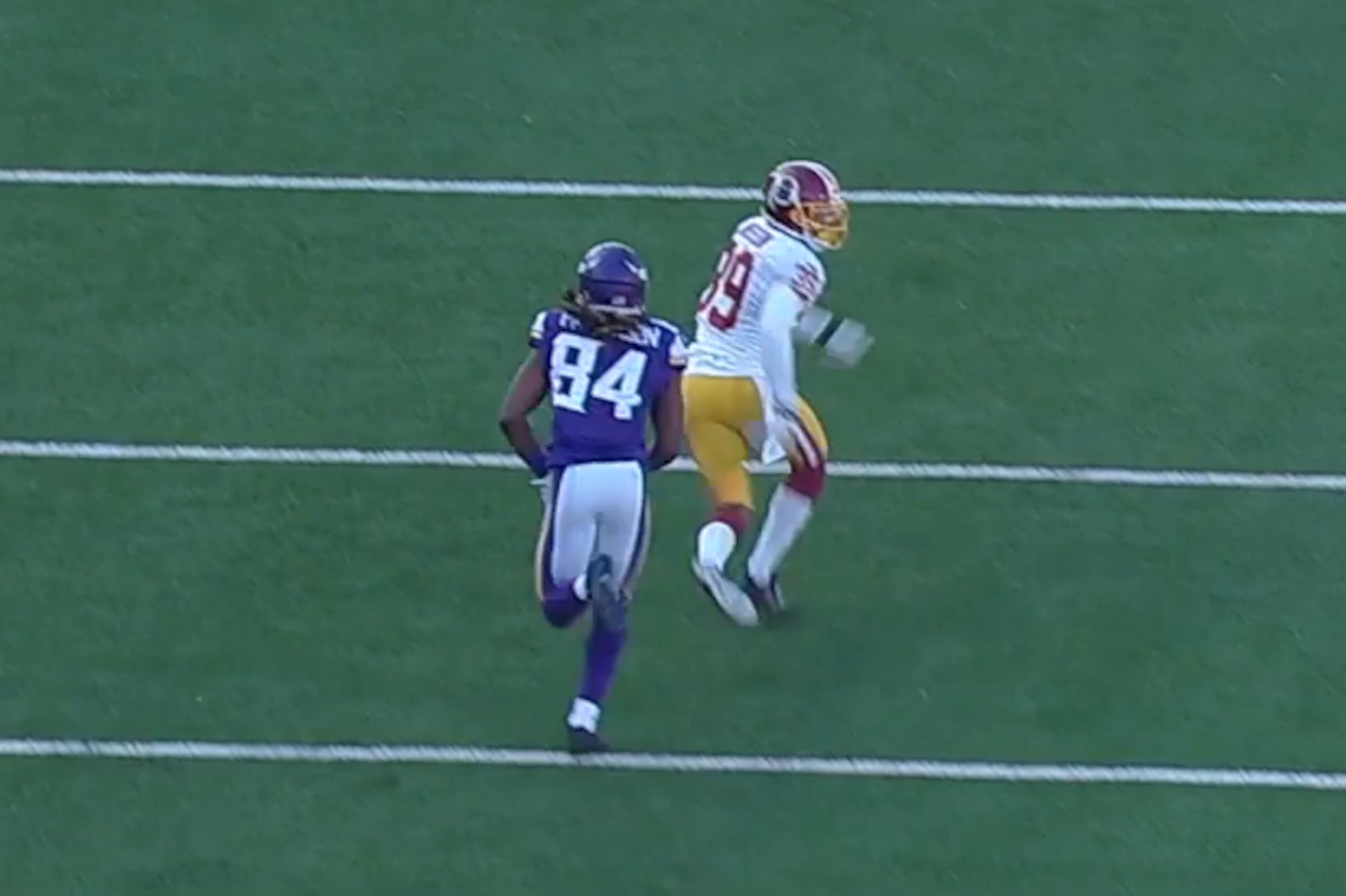
After Patterson releases, Amerson is quick to flip his hips and run with the receiver.
No safety help is given, though. As taught, Bridgewater takes a stab with the deep ball when he has single coverage and his receiver has won to the outside of the cornerback. But as the quarterback releases, Patterson ad libs to the inside, bailing on the route because he failed to run past Amerson.
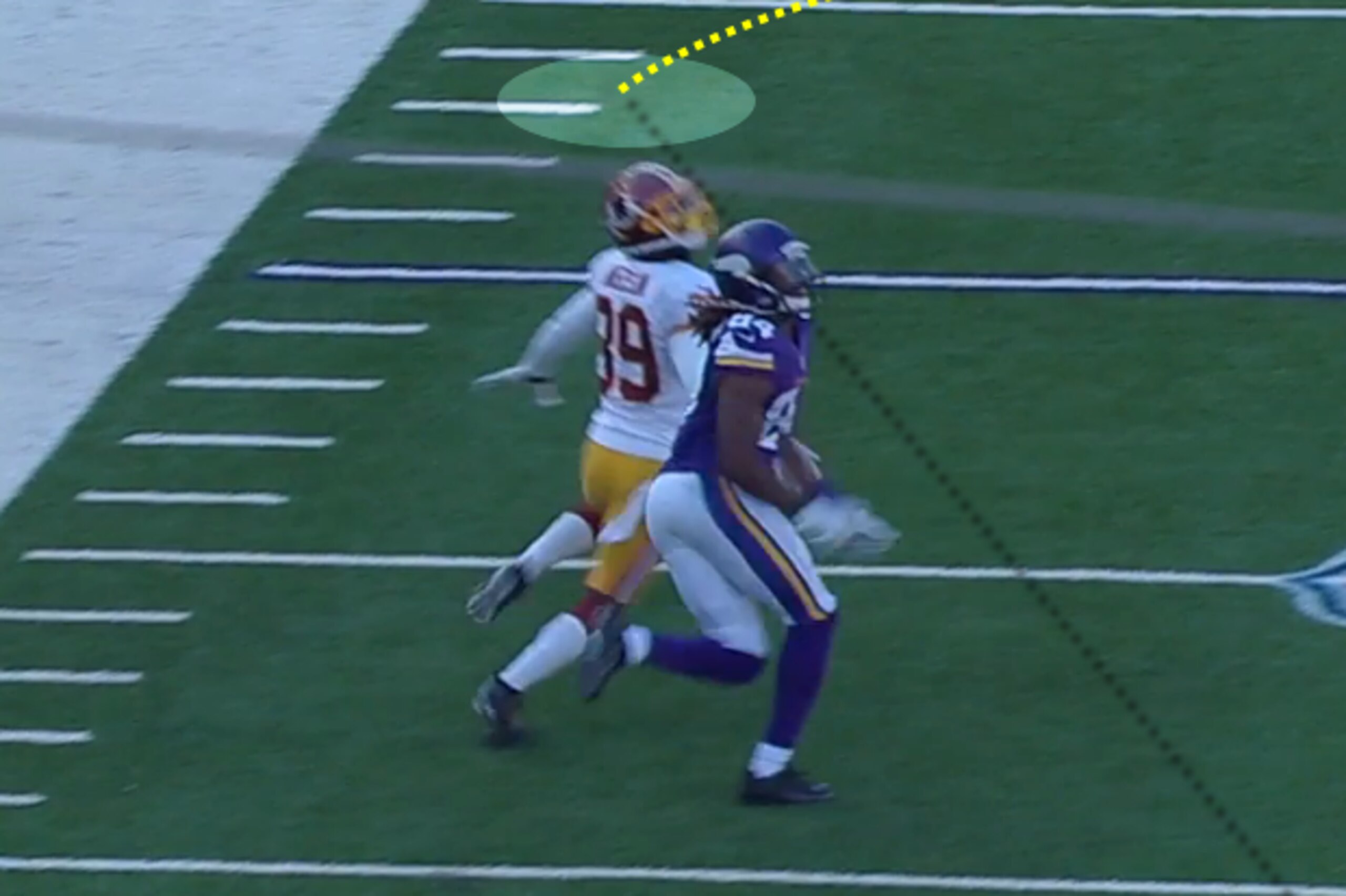
That left the cornerback in perfect position to play the ball. Instead of fighting his way past the coverage and being in the right position to at least make a play for the pass, Patterson quit on his route and hung his quarterback out to dry.
Greater commitment to routes is needed from Patterson. He must be more aggressive and more assertive in the way he deals with coverage, utilizing the size, speed and strength advantage he almost always holds against cornerbacks.
Sometimes Patterson can be not only uncommitted but also outright lazy. This play from the Buffalo game stands out.
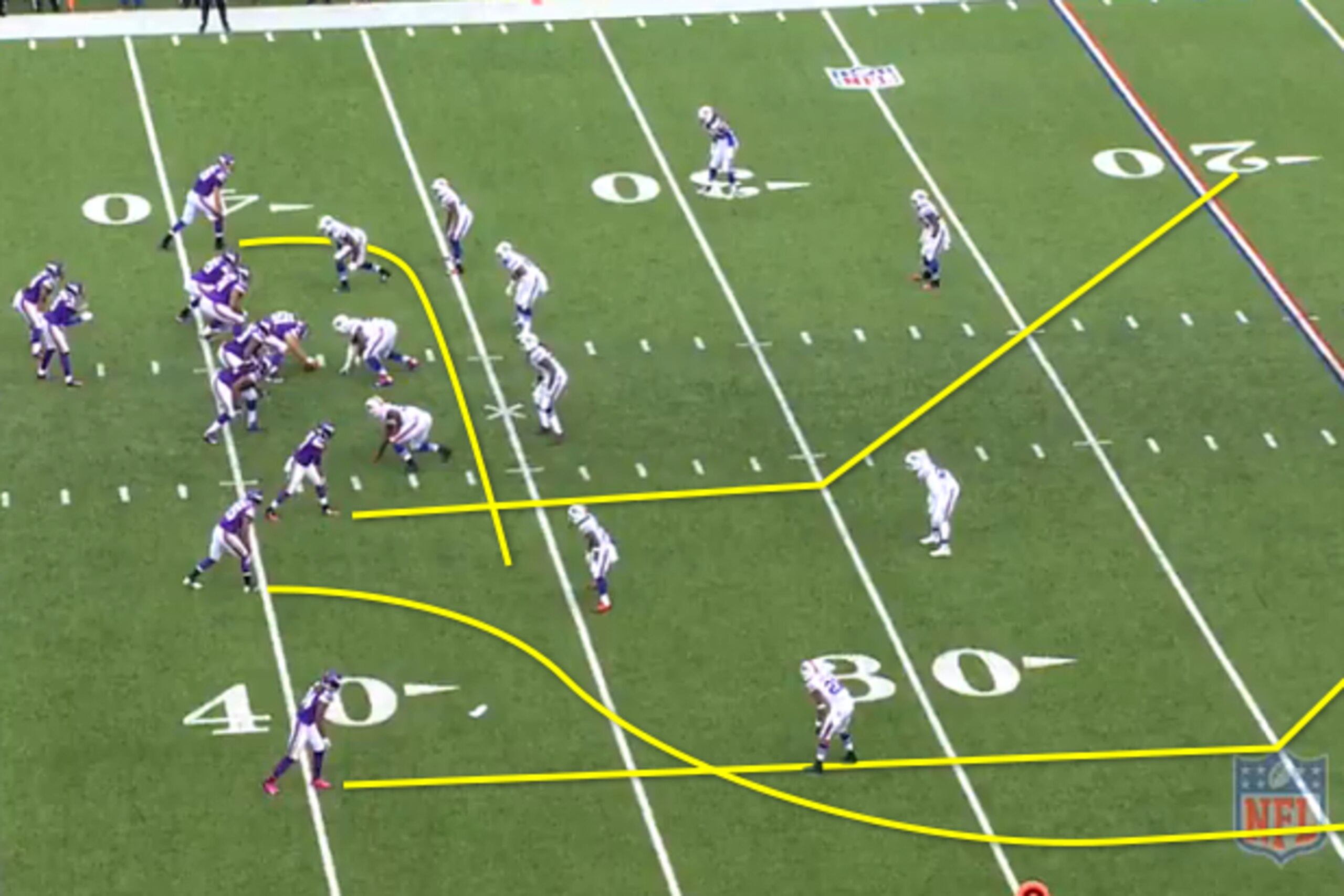
Patterson is the nearest receiver, running the patented post-wheel route combination with Jennings following behind. With the location of the two deep safeties, Patterson is looking at no-man’s land as a route-runner.

But when no receiver comes open, the mobile Bridgewater breaks the pocket. An experienced, savvy wide receiver who never quits on a route is able to break back to his quarterback and make himself available for a big third-down conversion.
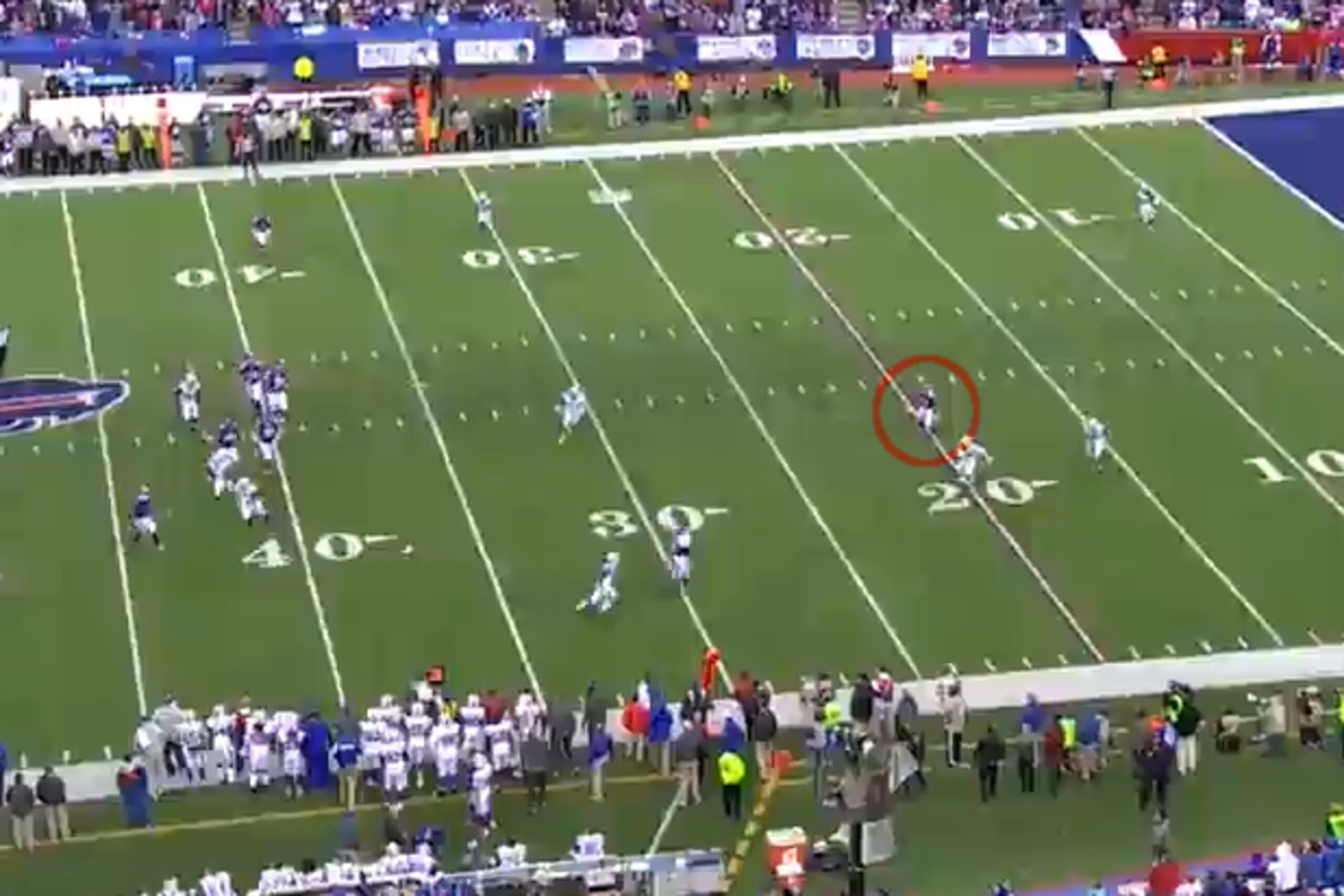
Instead, Patterson quits. He literally takes a half-step from the second screenshot to the third. He should have been charged admission as Bridgewater was forced to throw on the run, his pass ricocheting into the arms of a cornerback for an interception.
These are the frustrating plays that are unacceptable, no matter how new these downfield routes are to him. For the 2014 offense to hold its head above water, receivers need to take extra measures to aid a rookie quarterback who’s often swarmed by rushers. Patterson is not doing that at all.
Maybe this is all part of the transformation process that turns Patterson into a reliable receiver who wins in numerous ways. That’s what the Vikings hope, and Mike Zimmer indicated that the team’s sink-or-swim plan for Patterson won’t change, via Chris Tomasson of the Pioneer Press:
"Zimmer on Cordarrelle Patterson: "We'd love for him to be involved'' but there's no concerted effort and Patterson must also help.
— Chris Tomasson (@christomasson) November 3, 2014"
Patterson needs to help himself. Turner and the Vikings aren’t about to bend their offense to him, for better or worse.
In order for the slumping sophomore to raise his level of play, he must increase his commitment to running sharp, decisive routes, and he must take accountability for what the coaches are asking him to do, which is to become an all-around receiver.
Statistics via ESPN.com unless noted otherwise.
.jpg?w=2560 "Seahawks Cardinals Football")
.jpg?w=2560 "Commanders Cowboys Football")