Germany vs. Ireland: A Switch to the 4-1-4-1 Almost Wins It for Joachim Low
Germany were held to a 1-1 draw by the Republic of Ireland on Tuesday, with John O'Shea netting an equaliser for the Irish in the dying moments of the match.
The hosts were frustrated throughout but finally got a break via Toni Kroos in the 70th minute, but they couldn't hold on for a much-needed three points.
Let's take a tactical look at the match.
TOP NEWS
Live World Football Moments 🍿

Final Men's Ballon d'Or Rankings 📊
.jpg?w=2560 "NFL Paris Football")
NFL House in Paris Closes for Protests
Formations and XIs

Germany began in a 4-2-3-1, bringing Mattias Ginter and Julian Draxler in for an injured pair post-Poland. Toni Kroos, Thomas Muller and Mats Hummels were the staple players in each line.
Republic of Ireland, too, started in a nominal 4-2-3-1 on paper, but they soon fell into a more defensive set as the game turned in the hosts' favour.
ROI's Low Block
Chiefly, the Republic of Ireland made themselves exceptionally hard to break down. The first prerogative was to escape the Ruhr, if possible, with a clean sheet.
They set out in a flat back four, with two holders just ahead of the defensive line and the wingers tucked right in to help with Germany's overloading full-backs. Jonathan Walters matched Erik Durm stride for stride, while James McClean did a similar job on Antonio Rudiger on the left.
The result was this:

Finding space on the flanks, over the top or in between the lines proved exceptionally difficult for Germany, who were swamped out in every area. In sacrificing legs for an attack, Martin O'Neill was able to prevent wide overloads, clamp down in space in midfield and play deep enough to avoid vertical attacks.
Dwindling Options
It left the Germans a little short on ideas. Missing many of the players they won the FIFA World Cup 2014 with, it was perhaps understandable that there would be a) a comedown and b) a struggle without key players.
In the end, the hosts identified just three ways to attack this ROI side: Set pieces were always an option, given Kroos' wonderful deliveries; allowing the Irish to press with four, then springing a quicker ball into the space behind and after springing the space, allow ROI to rush deep to the ball, only to tee up Kroos on the edge of the area for a shot.
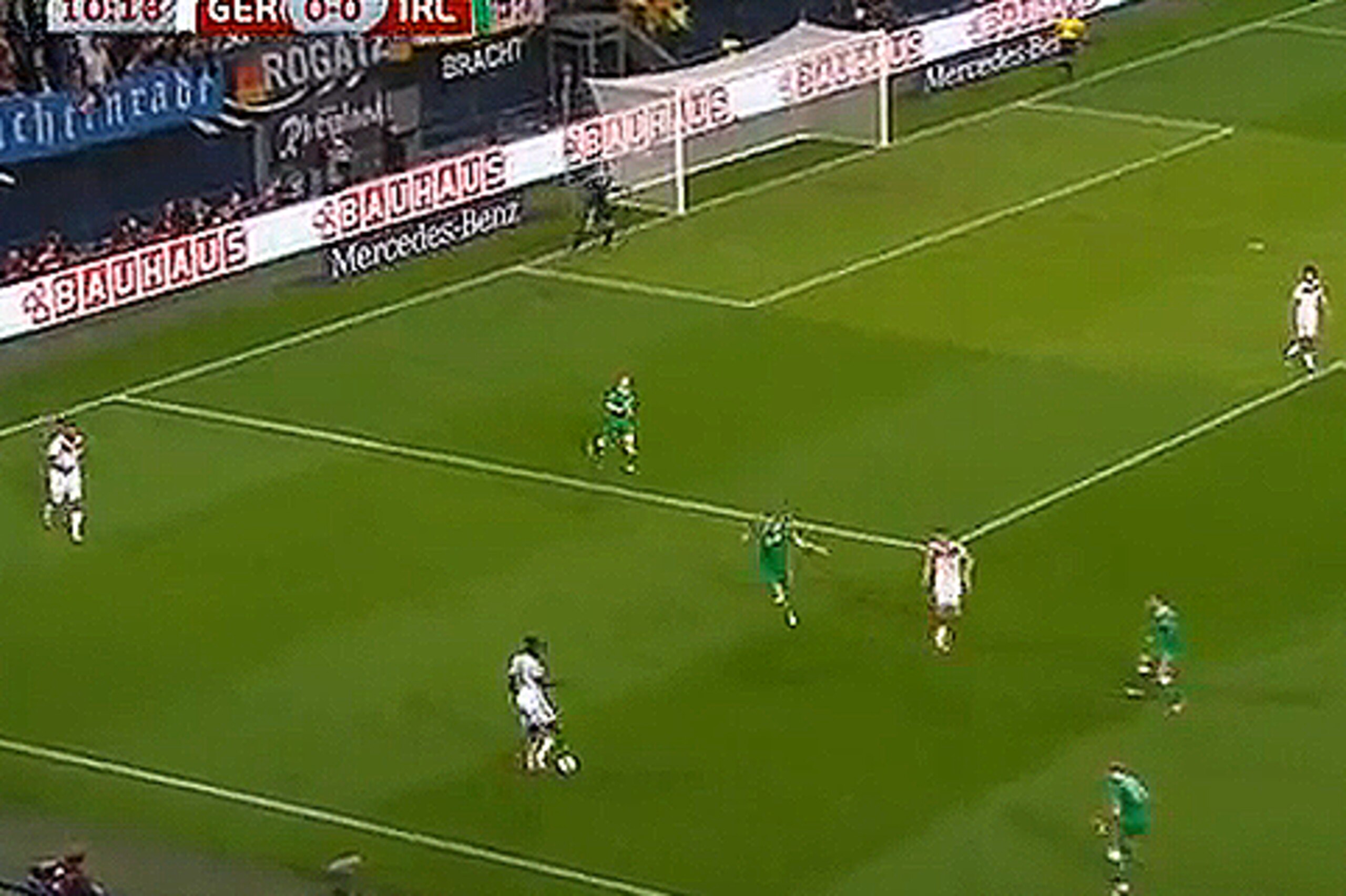
Muller tried to run the channels but was often crowded out by sheer numbers, and Mario Gotze didn't anticipate his movement very well when dropping in to receive the ball. Pull-backs to Kroos appeared the most obvious breakthrough method, but Ireland got to half-time at 0-0.
Switch to 4-1-4-1
Lukas Podolski replaced Mattias Ginter at half-time, moving Germany into a 4-1-4-1 formation. It left Kroos holding in midfield on his own, Draxler moving infield to left-central-midfield and Podolski found a home on the left flank.
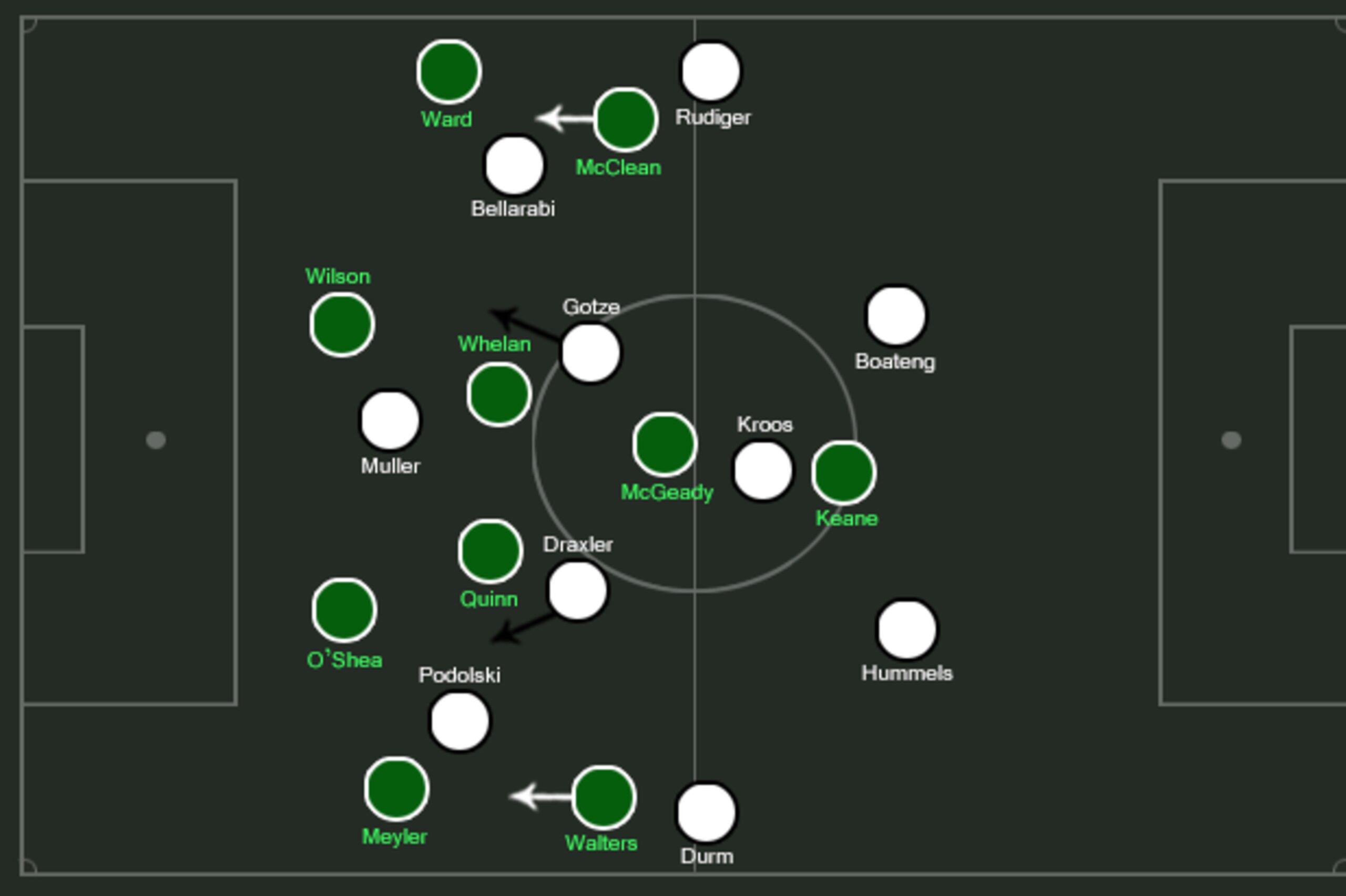
The switch allowed Germany another player on the edge of box as they sought an intricate piece of skill to burrow through the Irish wall, but it also enhanced the chances of the Irish targeting Kroos and countering through the middle.

Strategic or not from Joachim Low, lightening the midfield and allowing Die Mannschaft to be slightly overrun in central zones worked in their favour; it encouraged O'Neill's men forward, and made space for their own counter-attacks.
The breakthrough goal came directly from a Germany counter—the type you simply wouldn't see in the first half—and finished with Kroos slinging it from distance onto the inside of the post and in.
In the 4-2-3-1, Ginter sat off and ensured no Irish counters were possible. Low realised at half-time that Ginter was (systematically) holding the team back, but to what extent he overran Kroos to create space, we can't be sure.
Quickfire Conclusions
- A goal down, O'Neill threw centre-back John O'Shea forward on his 100th cap and he scored the equaliser—a momentous achievement for him.
- Karim Bellarabi was much quieter than against Poland, struggling in tight spaces.
- A single point from two games against Poland and ROI is not good enough for Low; he'll be wishing his stalwarts back to health soon.
- The spirit in this Irish side is something else. O'Neill doesn't play tactical football well, but he creates a sense of togetherness like no other.
- Unlike against Poland, where Germany just missed a torrent of chances, they carved out very few clear-cut ones here.
Thanks to those who read my work and voted for me, I made the finalists list of the 2014 Footballing Blogging Awards. If you have a spare moment and the inclination to vote, I ask you to do so again in the final round.
You can vote by simply clicking here: http://bit.ly/1yyx7Om

.jpg?w=2560 "Seahawks Chiefs Football")