Miami Dolphins' Secondary Play Must Step Up Immediately
Entering Miami’s Week 6 matchup with the Green Bay Packers, the Dolphins secondary was rarely tested. The most talented wide receiver it faced was Buffalo Bills’ rookie Sammy Watkins, who torched Miami’s soft Cover 1 scheme for eight catches and 117 yards. Against the Packers, however, Miami’s secondary was faced with a complex scheme that is made more dangerous by the Packers’ deep and talented receivers.
After seeing how the Packers’ big wide receiver group bullied Dolphins’ cornerbacks, Brent Grimes and Cortland Finnegan, there is reason for concern that this trend will continue. The list of big, physical wide receivers Miami will face (barring injuries) in the next five games is extensive, including Brandon Marshall, Alshon Jeffery, Keenan Allen, Calvin Johnson, Watkins and Demaryius Thomas.
TOP NEWS
.jpg?w=2560 "NFL Paris Football")
NFL House in Paris Closes for Protests
.jpg?w=2560 "Seahawks Chiefs Football")
Trevon Diggs Cut by Seahawks
.jpg?w=2560)
B/R's Expert Week 7 NFL Picks 🔮
With the return of Reshad Jones to the secondary, Miami has the talent to deal with such explosive athletes. Grimes and Finnegan, measuring in at 5’10” and 5’9”, respectively, have major height and weight disadvantages against such receivers. Those limitations cannot be fixed, but there were other parts of their performances against the Packers that can be fixed through various measures.
We’re going to look at their play in Week 6 with a microscope, along with cornerback Jimmy Wilson and safeties Jones and Louis Delmas.
Miami did so much right for most of the game, and ultimately, it held an explosive offense led by the best quarterback in the NFL to just 20 points until the 59th minute. But the mistakes made by the secondary cannot be overlooked when difficult matchups are approaching and unavoidable.
The most disappointing performance came from veteran Cortland Finnegan. Finnegan has been solid until this week, so it’s important to keep his one bad game in perspective.
His signing in the offseason was not a popular move, as his recent seasons in St. Louis were not filled with quality play. But he’s been rejuvenated in Miami, holding off Jamar Taylor for the starting job. (Taylor, by the way, has been very good when he’s on the field).
Covering Davante Adams exclusively, Finnegan couldn’t overcome the athletic mismatch that Adams presents. Adams had a monstrous game, logging 70 yards on five catches, with a ridiculous 45 yards after catch (YAC), per Pro Football Focus.
Miami played Cover 1 defense 70 percent of its snaps in pass coverage, according to self-charting, and that left Finnegan on an island against Adams. That puts Finnegan squarely in the spotlight on plays such as the one below.
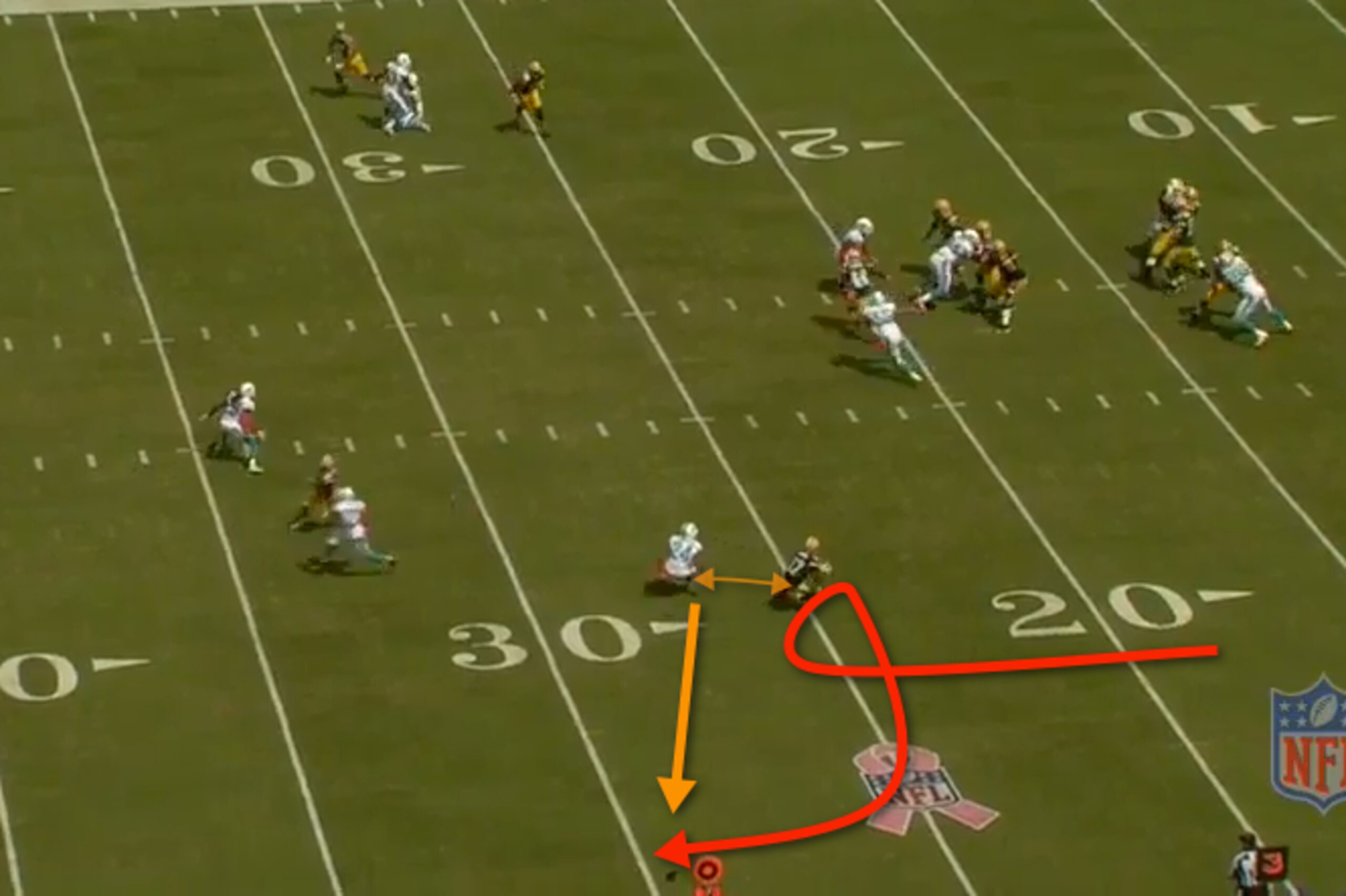
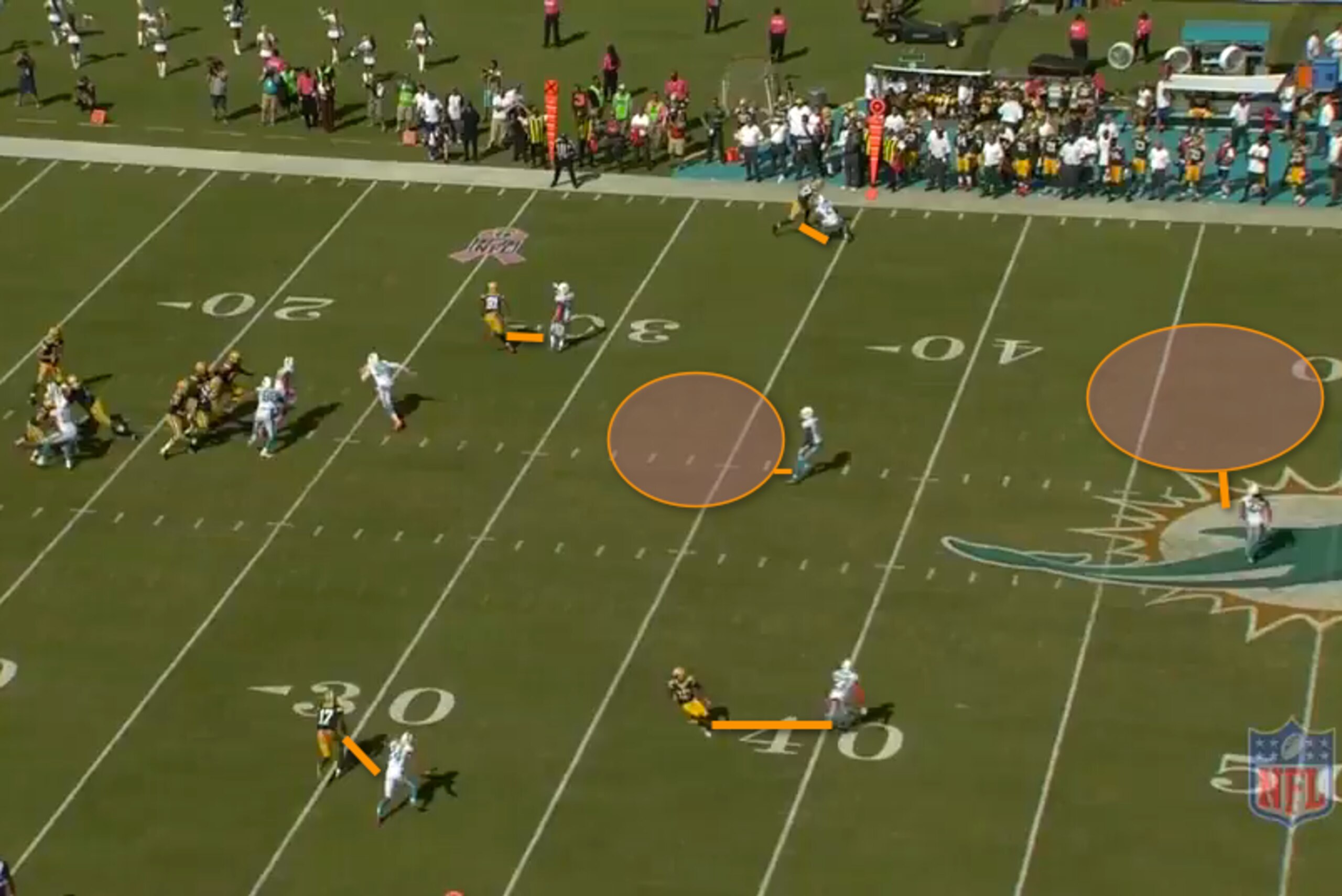
In the first quarter, Finnegan was caught too far off Adams’ break outside. Finnegan is quicker and was unable to catch up to Adams in time to prevent his first-down reception. At Finnegan’s size, he must show better footwork and be on top of the receiver to limit yards after a catch (YAC). In the NFL, two yards of separation is close to being wide-open and is not acceptable on a third-down play.
Later in the game, Finnegan was again on an island without safety help over the top, playing in Cover 1 again. As Adams planted and waited for the ball to arrive from Rodgers, we can see Finnegan five yards away from Adams, allowing Adams to gather his balance upon catching the ball, and shedding a weak tackle attempt. The broken tackle led to 15 extra yards.
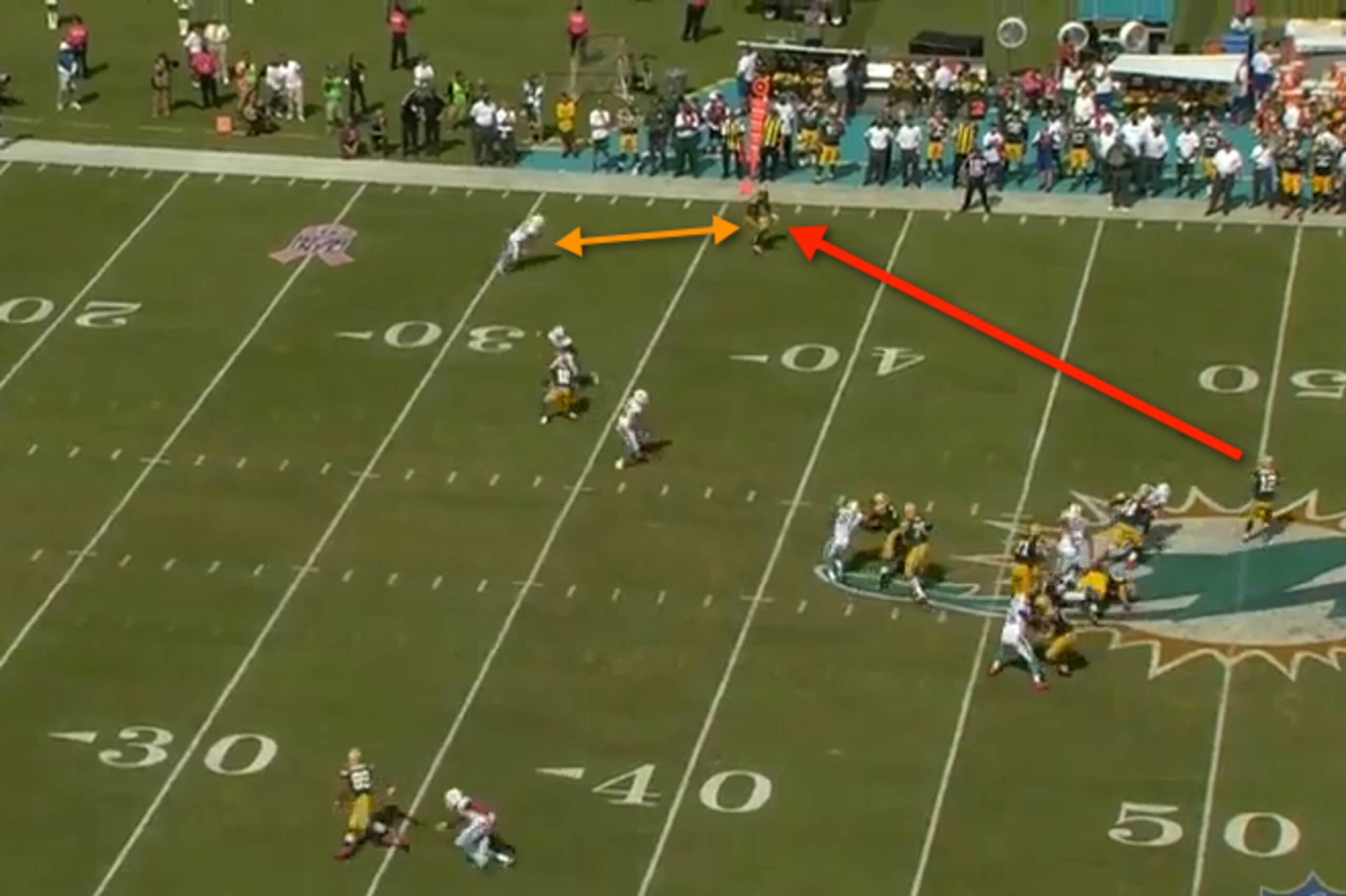
Finnegan has to be able to sink his hips and explode back to the receiver and keep his feet underneath his body to be more efficient with his movements. Allowing Adams to make the catch is by design of the defense, but so is limiting the number of yards after the catch. Miami wants to prevent chunk yards by playing off-man Cover 1, but if Finnegan cannot tackle effectively, there is no purpose to the scheme.
Slot cornerback Jimmy Wilson had been playing free safety with Jones out, and his play was mostly unnoticed, which is a good thing for secondary members. He didn’t blow coverages, but he also failed to really make an impact. At cornerback, Wilson has been very effective throughout his career. He’s physical but quick enough to smother most slot corners.
Against the Packers, Wilson was picked on because of his matchup against Randall Cobb. Rodgers and Cobb have incredible chemistry, and Cobb’s pure athleticism and speed is elite among NFL players. He’s hard to cover with his physical traits, and then the Packers do a great job of getting him open with rub routes.
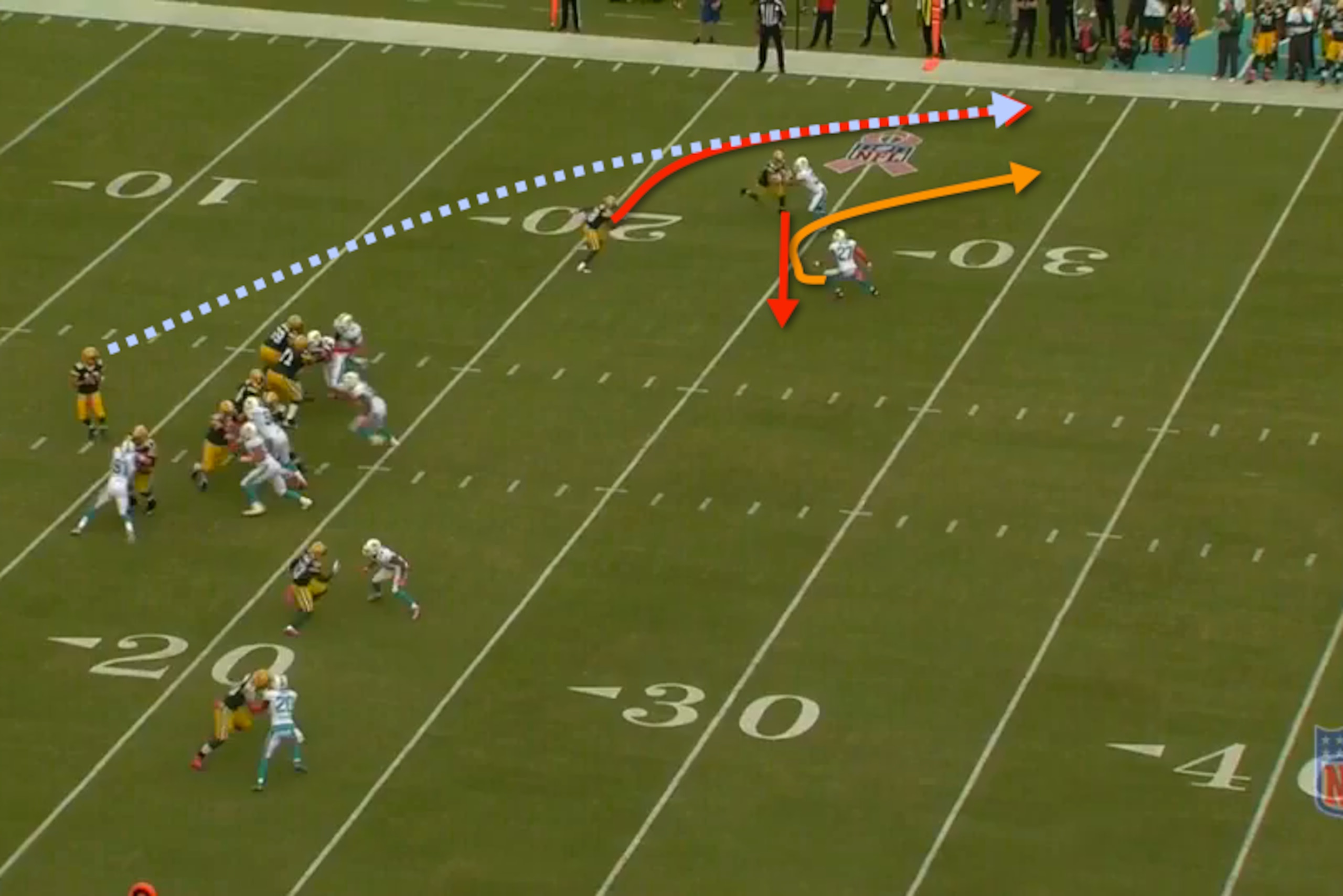
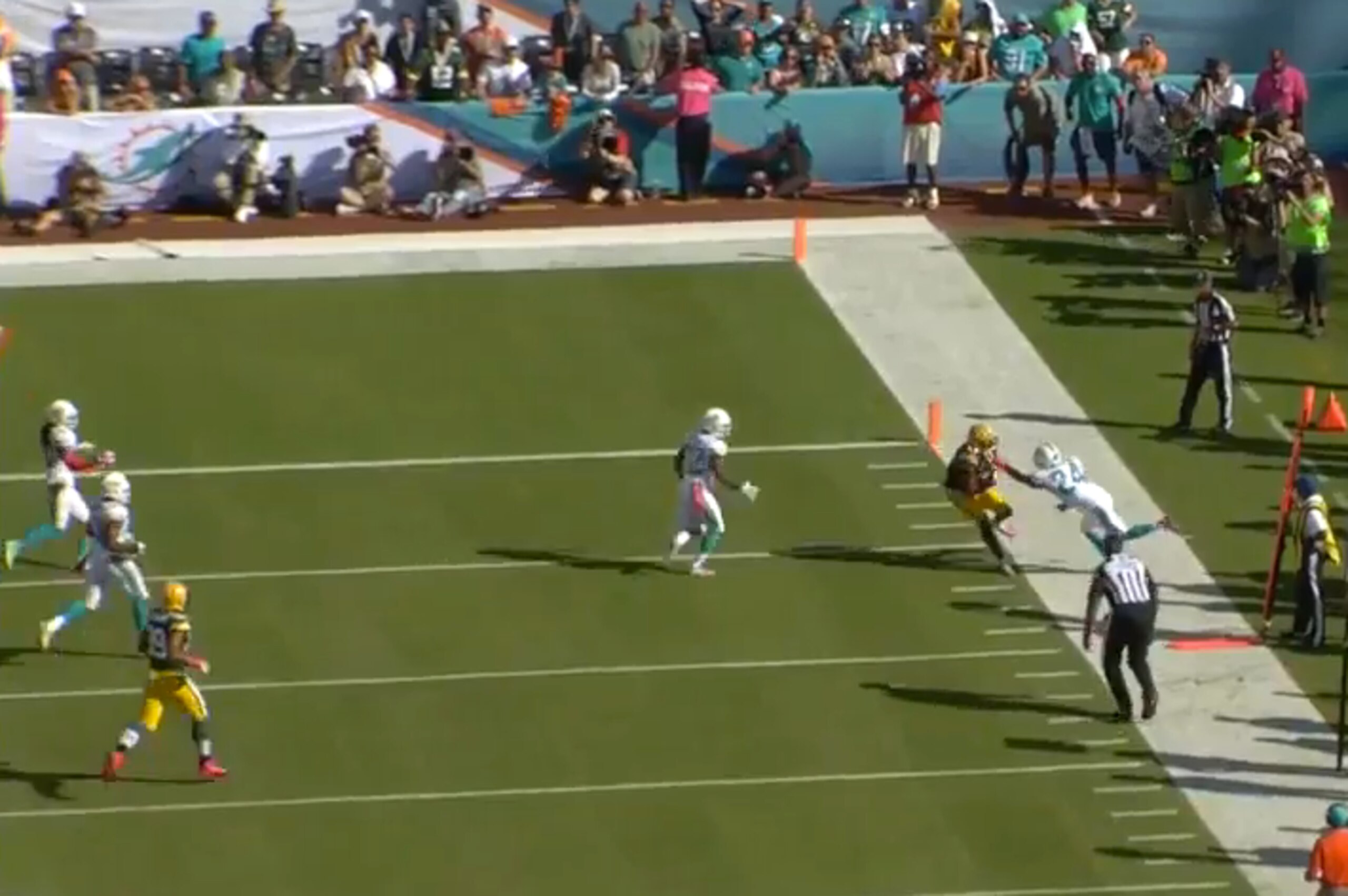
On the play above, Green Bay runs Jordy Nelson on a quick slant to open up the sideline for Cobb. With Wilson so far off the line of scrimmage, he is in danger of being hit by his teammate, Brent Grimes. Wilson shows indecision; at first approaching the line of scrimmage before realizing his angle was poor.
Rodgers realizes the leverage Cobb has at this moment and lobs a pass for Cobb. There are few easier 14-yard gains you’ll find in the NFL.
Dolphins’ star cornerback Brent Grimes hasn’t been the dominant player he was in 2013, allowing 64.9 percent of all targets and a 91.5 quarterback rating this year, compared to 60.2 completion percent and a 66.5 quarterback rating against, per PFF.
Seeing exactly why Grimes has struggled isn’t easy, because his decline has been subtle. His footwork has not been quite as good as it was last year. He’s not breaking back toward the ball as quickly, and he’s a step slower in getting to the ball. This has led to more receptions.
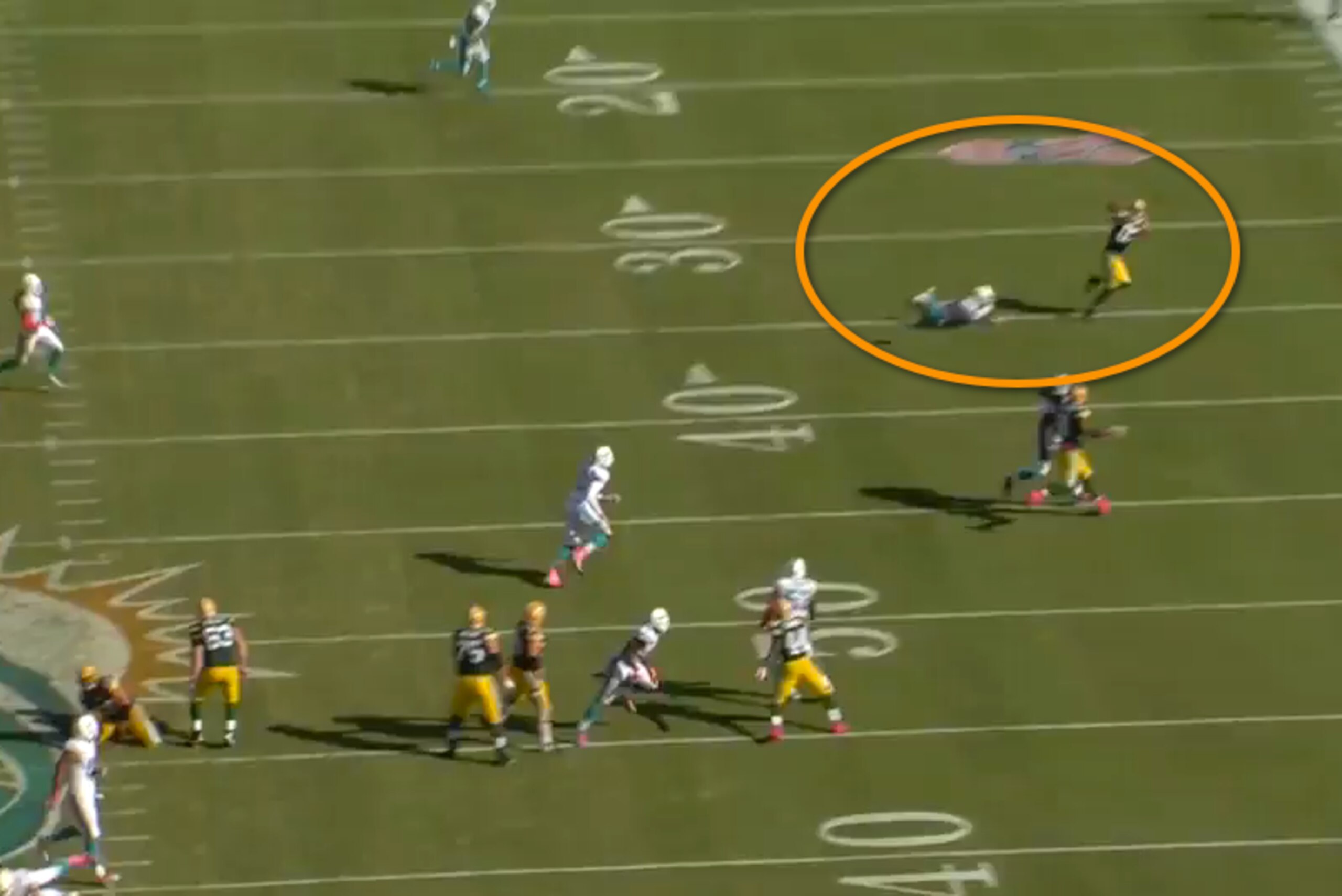
Grimes is still a very good, upper-tier cornerback in the Dolphins scheme. He played Nelson, a possible top-five receiver, well, with the exception of one crucial fourth down. On the final Packers drive, Grimes was with Nelson step-for-step until he tripped and fell, allowing Nelson to convert the first down and set up the game-winning touchdown pass.
Uncharacteristically, Grimes had another instance of poor footwork on a prior drive, when Rodgers extended the play by avoiding a sack. Nelson ran upfield, and Grimes stumbled in pursuit. This led to another significant gain for the Packers offense.

Against elite talents, these simple mistakes cannot continue to happen. Miami’s cornerbacks are great system fits in allowing the fundamentals to get in the way of execution.
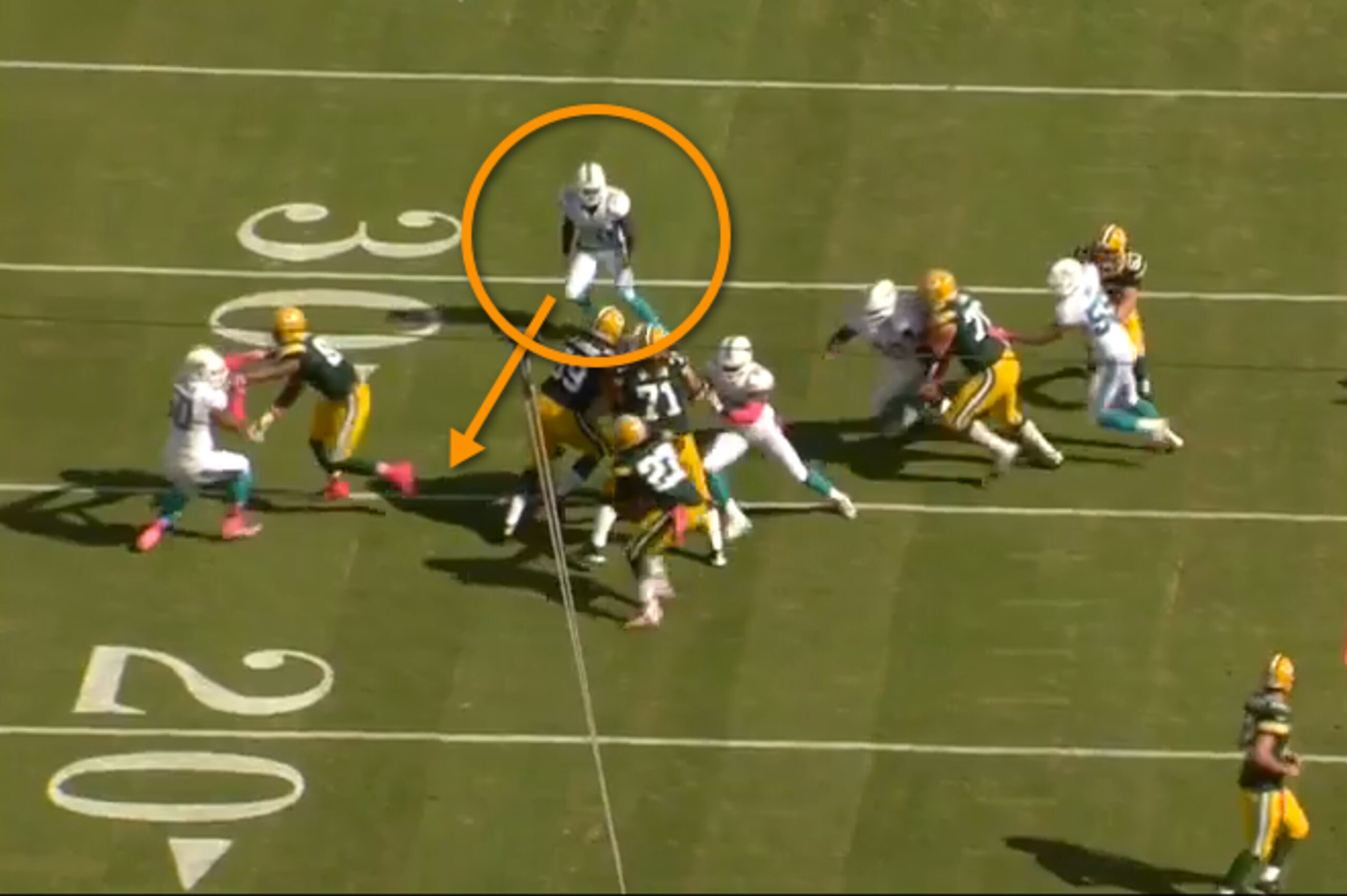
Jones had an impressive return game, showing great ferocity and leadership on field throughout the game. His ability to roam in Cover 1 is invaluable to Miami’s defense. He is so smooth as he approaches the line of scrimmage post-snap, and he is a great tackler on bigger ball-carriers. On multiple occasions, he met either Eddy Lacy or Aaron Rodgers for a hard collision. His wrap-up tackling was sorely needed for this unit.
The only negative on Jones’ performance came on the first drive of the game. On a play-action fake, Rodgers quickly spotted Jones biting on the play action.
Jones was supposed to provide Grimes with inside support on Nelson, but Jones’ positioning was compromised when he approached the line of scrimmage. Jones’ aggressiveness was used against him, and that’s an easy pitch-and-catch for Rodgers and Nelson.
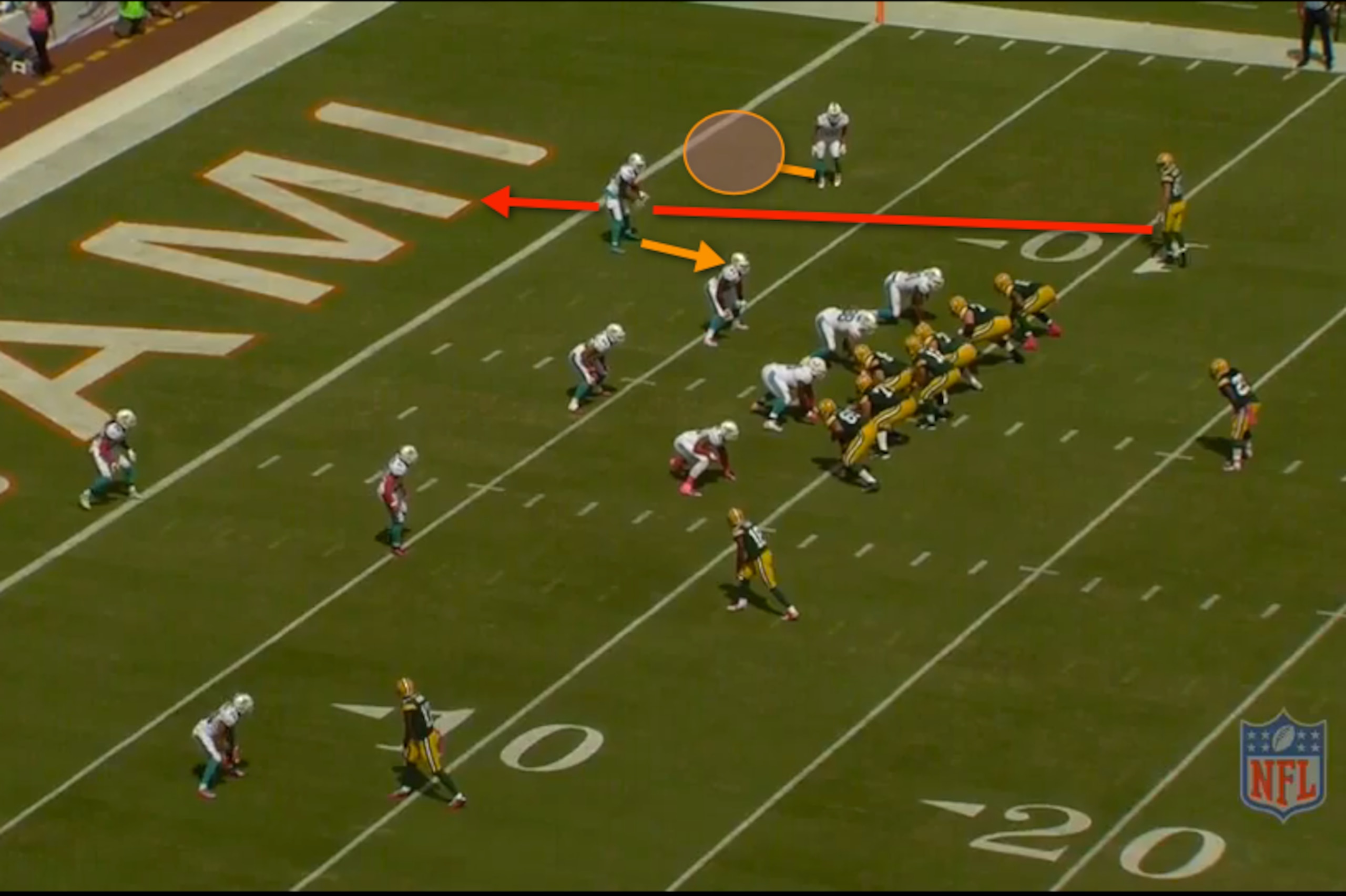
Louis Delmas also benefited from Jones’ return to the lineup. He was often used as the deep safety, and Green Bay did not have an open deep pass all game. That’s an accomplishment for Delmas, who has a reputation for giving up big plays.
If Delmas can continue to roam the deep third of the field well, Miami’s safety pairing could turn out to be a strength of the team. One area Delmas can improve is his ability to force turnovers. But, with Jones back, he might not be tested deep often enough to make a solid play on passes.
Entering the toughest stretch of games on the schedule, the Dolphins’ veteran secondary has to prove it's worthy of staying on the field with talented young players sitting on the sidelines. If Miami’s starters continue to struggle, the talent will need to be re-evaluated, and a youth movement could be a realistic option in 2015.
For Miami’s playoff hopes this season, that would be a worst-case scenario. As Week 7 approaches, the Dolphins must get more impactful play from their secondary members.
All stats used are from Pro Football Focus' Premium Stats (subscription required) or Sports-Reference.com. All contract information is courtesy of Spotrac.
Ian Wharton is a Miami Dolphins Featured Columnist for Bleacher Report, contributor for Optimum Scouting, and analyst for FinDepth.
.jpg?w=2560 "Titans Colts Football")