

Previewing the New York Giants' Fullback Battle
The Terminator vs. the Hynocerous.
No, it’s not the next main event to be featured by WWE Raw, though it certainly has the sound of it thanks to the nicknames of the two blue-collar fullbacks, John Conner and Henry Hynoski, set to battle for the starting fullback position on the 2014 New York Giants.
| No. | 45 | 39 |
| Height | 6’1” | 5’11” |
| Weight | 266 | 245 |
| Experience | 4 | 5 |
| College | Pittsburgh | Kentucky |
| NFL Rushing Stats | 5-20 yds., 0 TDs | 21-88 yds., 2 TDs |
| NFL Receiving Stats | 24-138 yds., 1 TD | 10-49 yds., 0 TDs |
Because of the non-contact nature of the spring drills, this battle has been one of the closest ones at the position since the 2007 offseason, prior to the arrival of Madison Hedgecock off waivers from the Rams.
So just what can we expect of the fullback position in this new offense? Running backs coach Craig Johnson told me that the days of the old-school style role are over.
"We’re going to ask them to probably be a little bit more multidimensional, be able to catch the ball out of the backfield, maybe even be able to run the ball at times and also be able to be a lead blocker," he said.
"The fullback is an interesting, great position right now in modern football for you to get your reps, you have to be able to do more than just block, and we’re trying to introduce those guys to that."
With that information to use as a base, let’s break down how each candidate stacks up.
Lead Blocking
Based on what the media were able to observe during three OTA practices and the full mandatory minicamp, there are more single-back sets, which on the surface indicates that the fullback won’t have as large a role in the offense as it has in the past.
Given the trends of the last three years, however, that might not be the case, as illustrated in the chart below.
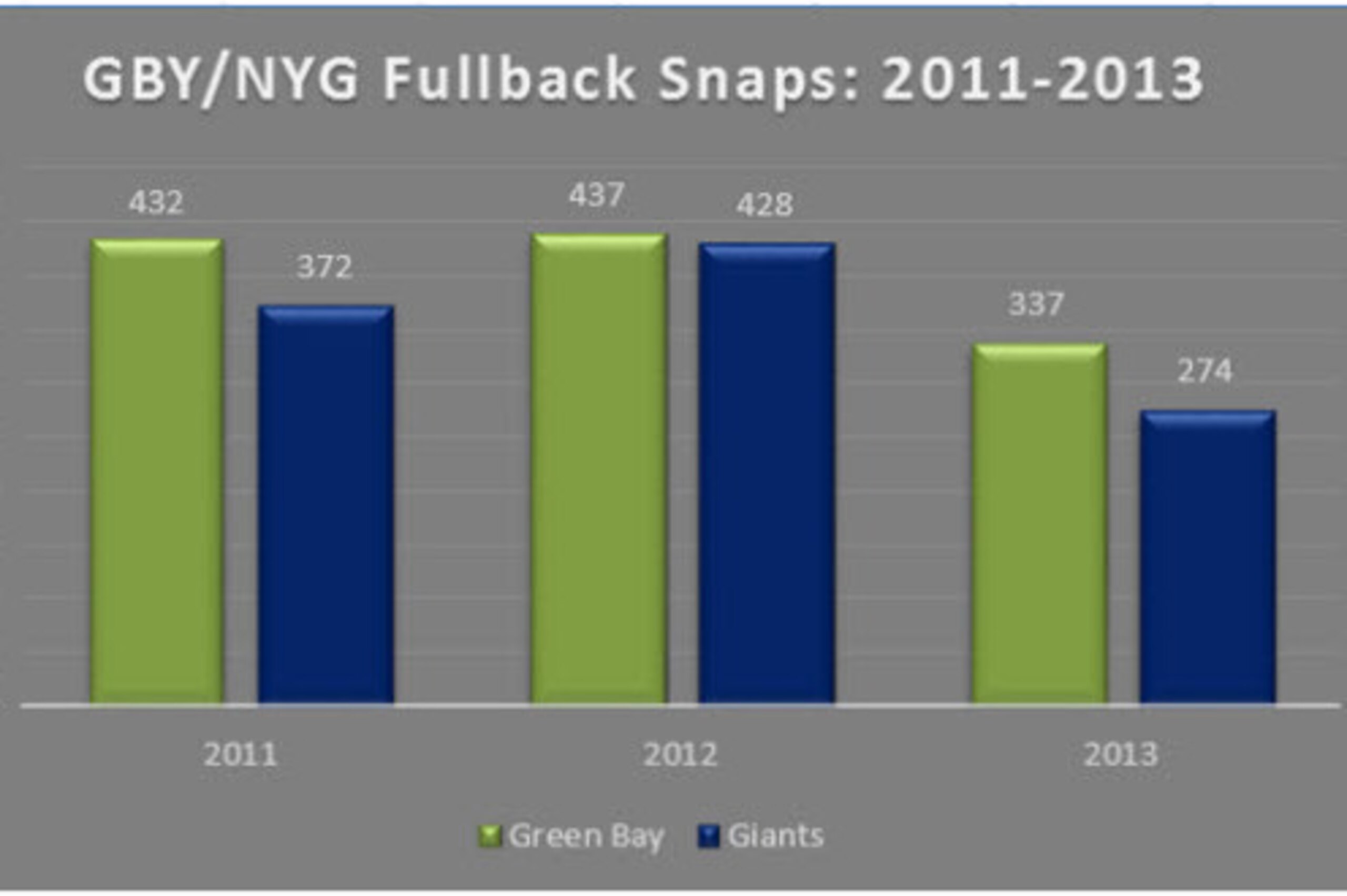
With the Giants’ tight end situation still unresolved and with Tom Coughlin telling Jonathan Clegg of The Wall Street Journal earlier this year that they plan to maintain a commitment to the run, it’s possible that because of the no-contact rules governing the spring practices, the two-back sets haven’t yet been installed.
Per Pro Football Focus (subscription required), Conner was the fourth-best fullback in the NFL last year, with a 9.0 overall grade, and the third-best overall blocker (run and pass protection) with an 8.7.
Speaking of blocking, Conner didn’t get to do much in the way of pass protection for the Giants last year, taking just 53 snaps in that capacity.
The reason for that probably has something to do with the fact that he joined the team when the season was in session and didn’t have an opportunity to really absorb the intricacies of the playbook. Still, he earned a respectable 1.5 grade in pass blocking.
Hynoski is no slouch as a blocker, as his career really took off in 2012 on the heels of a solid rookie season.
In 2012, he finished as the seventh-best fullback in the NFL (based on players who took at least 50 percent of their team’s snaps), with a 5.7 overall grade that included a combined run- and pass-blocking grade of 6.3, good enough for him to finish fifth in the NFL as a blocker.
As a run-blocker, Hynoski finished with a 2.4 grade that included two above-average performances (Weeks 5 and 6) and two subpar showings (Weeks 9 and 15). Of the Giants’ 18 rushing touchdowns, he led the way on 15 of them.
Hynoski received 55 snaps as a pass-protector in 2012, grading out with a 2.9. Per PFF, who named Hynoski as its Giants Secret Superstar from the 2012 season, Hynoski allowed just one quarterback pressure in 94 snaps (dating back to his rookie season).
Running the Ball
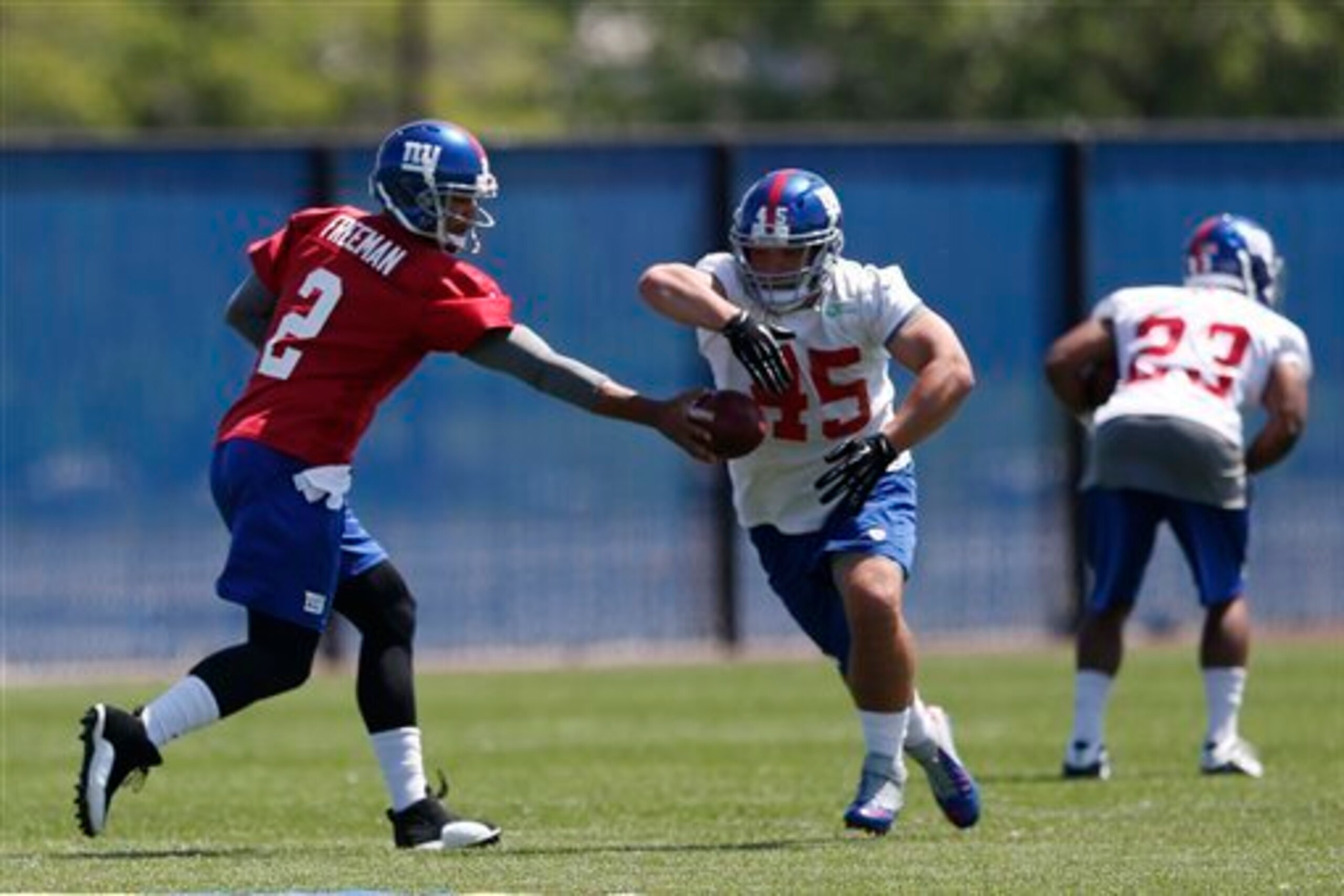
In Kevin Gilbride’s system, the fullbacks were rarely given a chance to run the ball. In Ben McAdoo’s system, it’s very likely that the fullback will get more than just a carry here and there to keep the defense off guard.
As a rusher, Conner has 21 career attempts for 88 yards (4.2 avg.), a long of 16 and two touchdowns—all of those numbers coming in his first two seasons with the Jets.
Pristine with his ball security, 45 of Conner’s career 88 rushing yards (51.1 percent) have come after contact (based a compilation of PFF's data), which means he’s not very easy to bring down.
Interestingly enough, Hynoski, who was a Pennsylvania State Class A high school rushing record holder with 7,165 career yards, hasn’t received very many chances at the NFL level to carry the rock.

A reason for that could very well be a lack of foot speed. Per Ed Valentine of Big Blue View, citing Sideline Scouting’s 2011 predraft analysis of Hynoski, the former Pitt Panther is “not a great runner; is rather slow and doesn’t have much shiftiness to him.”
According to NFL Draft Scout, Hynoski has been clocked in the 40-yard dash anywhere from 4.87 to 5.12, whereas Conner was clocked between 4.58 and 4.76.
In addition, per data culled from PFF's signature stats, Conner has a career breakaway percentage (pertaining to big-play runs of 15 or more yards) of 36.4 percent. Hynoski’s breakaway percentage stands at zero.
Catching the Ball
A common theory of many fans is that the fullback with the better receiving abilities should have the advantage in this competition.
I don’t completely agree because if you look at Packers fullback John Kuhn’s stats, his touches (both rushes and receptions) have decreased over the last three years to coincide with the arrival of more explosive talent, such as running back Eddie Lacy.

For the Giants, Rashad Jennings and Peyton Hillis (and, if he’s healthy, David Wilson) should offer a much better option as receiving backs out of the backfield, regardless of who wins the job.
Still, it’s not unreasonable to anticipate that the fullback will get a few checkdown passes thrown his way.
Although Conner hasn’t had many opportunities in that regard, he’s done well with the chances he has received, posting 10 career receptions (out of 18 targets) for 49 yards. That’s a completion rate of 55.5 percent, with just one dropped pass.
Of his receiving yards, 29 (59.1 percent) have come after the catch.
Last season for the Giants, six of the eight passes thrown to Conner were deemed as “catchable,” per PFF’s signature stats. Conner came up with all six of those receptions, earning a drop rate of zero percent.
Hynoski, who is believed to be the better receiver (probably because he’s had more opportunities to be used in that capacity), has posted 24 career receptions (out of 35 pass targets) for 138 yards (5.8 yards avg.) and one touchdown, with two of his receptions going for first downs.
Per data culled from PFF, Hynoski has had two drops out of 26 "catchable" passes, or a 7 percent career drop rate.
However, he tops Conner by a wide margin in yards after the catch.
Durability

A player taking up a roster spot isn’t going to do a team much good if he’s unable to get on the field.
Fortunately for Conner, he’s had a relatively clean injury history, with the exception of 2012, when knee and hamstring injuries ultimately cost the Jets' fifth-round pick his roster spot in a season where he missed three games.
From there he went to the Bengals to finish out 2012, only to lose his job to tight end Orson Charles the following summer.
When Conner later landed on his feet with the Giants in Week 4 of the 2013 season, the only time he made an appearance on the team’s injury report was in Week 12 with a hip ailment.
Conner didn’t miss a beat as far as games were concerned—in fact, he only missed that one practice. That’s not so bad considering he played in 245 snaps.
Overall, Conner has missed three games in his career due to injury, all with the Jets, which means he's only missed five percent of the games in which he's been on a roster and eligible to play in his career.
The same can’t be said of Hynoski. In three seasons, he’s missed 18 regular-season games, including 13 last year. That’s 37.5 percent of the regular-season games in which he’s been unable to play because of injury.

Hynoski’s injury history includes a neck issue during his rookie season and a fractured shoulder last year. He also had a knee injury—an MCL injury and a chip fracture to the lateral plateau in his left knee—but didn’t miss any time, as that injury was suffered during the offseason and he fought his way back by opening day.
The biggest concern with Hynoski going into this summer is how well he’s really recovered from the shoulder injury for which, as Paul Schwartz of the New York Post reported, Hynoski had surgery.
Depending on the timing and the severity, shoulder injuries can be a tough hurdle to overcome for a fullback, and certainly the Giants' recent history with fullbacks who suffered shoulder injuries has not been very good.
Jim Finn saw his career end after suffering an offseason shoulder injury while Hedgecock, who tried to play through a shoulder injury suffered during the 2009 preseason, was never the same player again.
According to Tom Rock of Newsday, Hynoski’s father, Henry Sr., also had his budding NFL career with the Cleveland Browns cut short thanks to a third-degree separated AC joint in his shoulder.
With all that said, every person's specific injury and degree of injury is different, just as everyone’s body responds differently to trauma and treatment.
The good news for Hynoski is that shortly after re-signing with the Giants following a brief flirtation with Detroit, he declared himself to be “100 percent healthy.”
While there’s no reason to doubt Hynoski's claim of being 100 percent, given that he knows his body better than anyone else, the fact remains that he has yet to put that surgically repaired shoulder to the test given the non-contact nature of the spring drills.
That first lead block and that first hit of training camp should tell a lot more about how healthy he really is.
An Unlikely Possibility
Although McAdoo told reporters at the end of the minicamp that, “The way I was raised, a fullback’s a big part of the things you do,” thus far from what the Giants have shown in their new offense, the fullback doesn’t appear to have as big of a role as it did under their old system.
So that raises an interesting question: Might the Giants abandon the fullback position altogether in favor of an extra tight end?
It wouldn’t be surprising, given the outcome of plays last year in the NFL by teams that used a fullback and those who didn’t.
According to data compiled on request by PFF, the following shows the production of NFL teams that used a fullback on a play and those that did not:
| Att | Yds | Yds/Att | Att | Yds | Yds/Att | |
| Short Yardage (3 yards or less) | 859 | 2,203 | 2.56 | 1,241 | 4,391 | 3.54 |
| Goal Line | 246 | 129 | 0.52 | 175 | 154 | 0.88 |
| All Plays | 4,685 | 17,477 | 3.73 | 8,804 | 38,355 | 4.36 |
As this data shows, there was an average of 0.98 yards more gained in short-yardage situations by teams that didn’t use a fullback to lead block than those that did. Similarly, there was a 0.36-yard difference down by the goal line by teams that didn’t use the fullback.
Now let's look at what the Packers did last year on short-yardage and goal-line situations to see if we can gauge what we might expect from McAdoo, who's been installing a lot of elements from that system, regarding the use of the fullback:
| Att | Yds | Yds/Att | Att | Yds | Yds/Att | |
| Short Yardage (3 yds or less) | 20 | 51 | 2.55 | 50 | 211 | 4.22 |
| Goal Line (Opp 3 or closer) | 8 | 4 | 0.50 | 7 | 12 | 1.71 |
| All Plays | 121 | 465 | 3.84 | 318 | 1489 | 4.68 |
Per this data, you can see that the Packers had better production without a fullback in short-yardage and goal-line situations.
For comparison's sake, let's look at what the Giants did last season.
| Att | Yds | Yds/Att | Att | Yds | Yds/Att | |
| Short Yardage (3 yds or less) | 30 | 97 | 3.23 | 22 | 65 | 2.95 |
| Goal Line (Opp 3 or closer) | 13 | 17 | 1.31 | 3 | 6 | 2.00 |
| All Plays | 178 | 522 | 2.93 | 200 | 804 | 4.02 |
What does this data tell us? Remember, Coughlin stresses a run/pass balance, which means that the offense's objective will be to achieve as close as possible to a 50/50 split between run and pass as can be.
As the data show, the old offensive philosophy was more inclined to use the fullback in short-yardage and goal-line situations than the Packers were last year.
For a team to make a bold leap and abandon a pure fullback, it would probably need either stability at the tight end position or a running back who, in the mold of say Marcel Reece of Oakland, can be that hybrid running back/lead blocker.
As of right now, the Giants tight end situation is unsettled, and it's unclear if they have a running back on the roster who can play that Reece type of role. Thus, I don’t think the Giants will abandon the fullback position, at least not this year.
Conclusion
For all the stats and analysis out there, the fact that, based on the spring practices at least, both Hynoski and Conner were rotating in and out with the starters indicates that neither has taken a lead in this race.
What I do think is that the Giants will not keep both on the roster because both appear to have similar skill sets.
I also don’t think money is going to be a factor. While it’s true that Hynoski received a larger than expected signing bonus (listed as $250,000), if he should lose the battle, that $250,000 cap hit will barely affect a team that right now, per the NFLPA public report, has $6,875,040 of cap space remaining.
Ultimately, it’s going to be decided on the field and will be based on knowledge and execution of the offense, consistency and, of course, health.
The Terminator vs. the Hynocerous: May the best man win.
All stats and advanced metrics are either provided by or calculated from data provided by Pro Football Focus (subscription required). All salary information via Over the Cap. All quotes and information obtained firsthand unless otherwise noted.
.jpg?w=2560 "Commanders Cowboys Football")
.jpg?w=2560 "49ers Seahawks Football")

.jpg?w=2560 "DAL Hiring New Defensive Coach")