Was Valtteri Bottas the Driver of the Day at Australian Grand Prix?
For the first time since the summer of 2013, there was no shortage of choices for Driver of the Day in the immediate aftermath of a Formula One race.
In truth, any number of drivers—Daniel Ricciardo, Kevin Magnussen, Nico Rosberg, Valtteri Bottas and Daniil Kvyat—could have left the Australian Grand Prix with the unofficial award, proving how promising the sport’s talent pool remains despite the doom and gloom that surrounds the influx of “pay drivers”.
How refreshing it was, too, that we were treated to variety for once, rather than the standout driver performances being dominated by Sebastian Vettel and Fernando Alonso.

.jpg?w=2560)

The obvious picks in Melbourne, of course, were Ricciardo, the Red Bull driver whose popularity meant he retained his status as a national hero even after disqualification from an assured second place, and McLaren driver Magnussen, who thanks to Ricciardo’s misfortune became the most successful debutante since Jacques Villeneuve burst onto the scene at the very same venue in 1996.
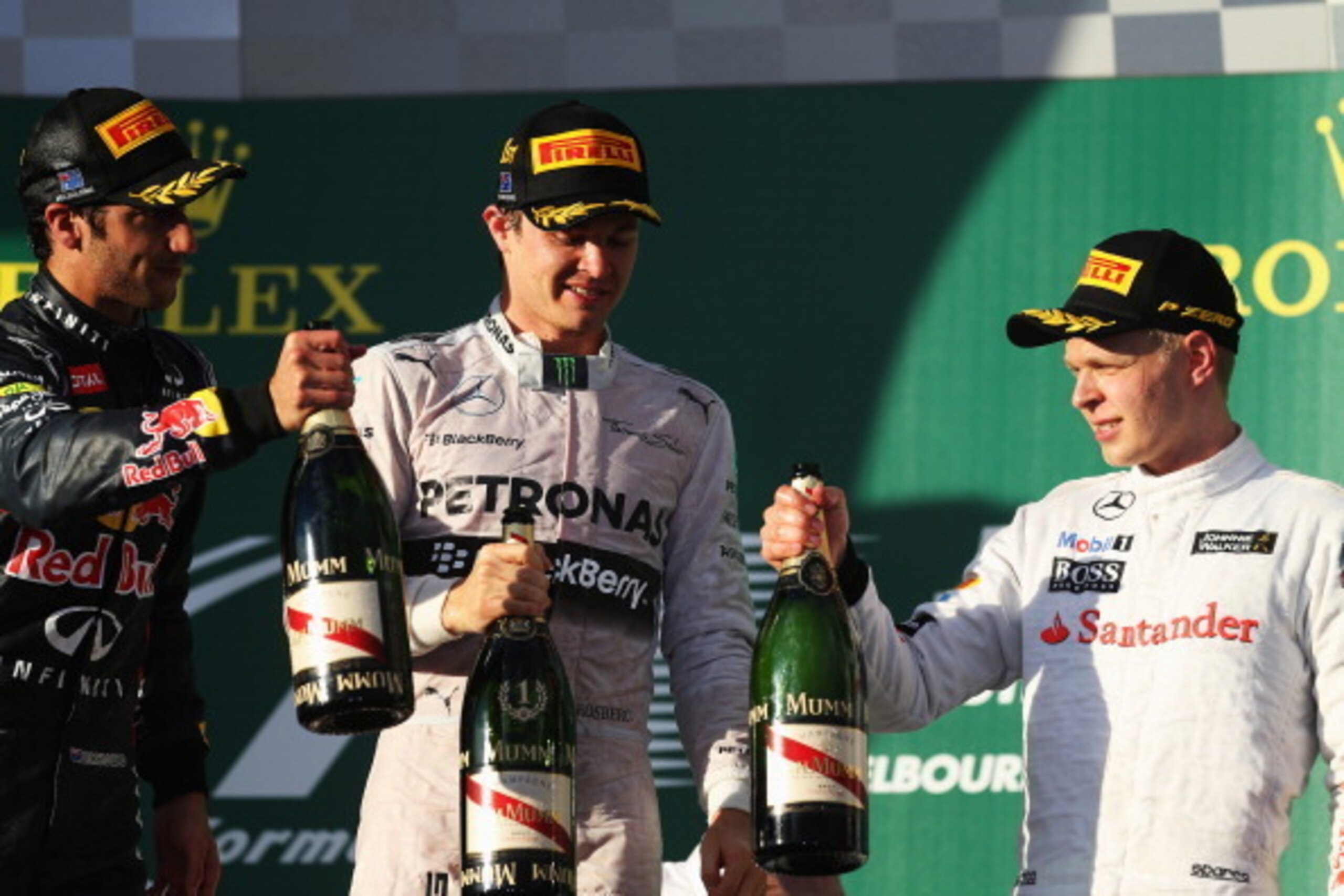
And that’s before you mention the winner, Rosberg, whose victory was never in doubt from the moment he exited the first corner of the race as the leader. An honourable mention, too, must go to Kvyat, who at the age of 19 became the sport’s youngest-ever points-scorer in his first ever grand prix, taking the record from a fellow Red Bull young driver graduate.
If, however, you were to suggest to Bottas that he should be a contender for Driver of the Day, he would have laughed in your face.
In finishing sixth (which was eventually converted to fifth following Ricciardo’s exclusion), Bottas had single-handedly scored more points in a single race than his Williams team managed to record over the whole of last season. From a personal perspective, Bottas had recorded his best F1 finish after opening his account with an assured drive to eighth position in last November’s United States Grand Prix.
But those were not reasons for Bottas to raise a Martini in the Albert Park paddock. In his view, the Australian Grand Prix was a missed opportunity.
Bottas, after all, began the weekend hoping to be the closest challenger to the pace-setting Mercedes cars of Nico Rosberg and Lewis Hamilton. His visible struggles with the rear instability during the wet qualifying session and later five-place grid penalty for a gearbox change, however, left him not at the front of the grid, where he should have been, but in the obscurity of the midfield that he grew to know as home for much of 2013.
His blistering start to the grand prix saw him run as high as sixth in the early stages before suffering a puncture after making contact with the wall on the exit of Turn 10 while sniffing around the rear of Fernando Alonso’s Ferrari—the defining moment of his race and possibly his career so far.
Although Bottas recovered from 16th to sixth, executing several magnificent overtaking manoeuvres in the process and finishing within seven seconds of Alonso, the disappointment of his early mistake—which denied him an almost certain podium finish—overshadowed any satisfaction taken from a solid top-10 result.
The Finn made the point of apologising for his error on the slowing-down lap before telling Sky Sports F1:
"I haven't really seen the result to know how far away they [the podium finishers] are, but I am quite mad at myself for the mistake.
I am not happy about that, but I guess I just need to learn from it and I am pretty sure I am not going to make that kind of mistake again. Apart from that the race was okay and we had good pace.
"
Bottas’ reaction to what was the first real mistake of his F1 career was highly impressive for a man competing in just his 20th race. This wasn't just mere disappointment; Bottas was morally offended and disgusted that he’d allowed himself to commit an error—the same error that the reigning world champion no less had made barely 24 hours earlier.
There were plenty of reasons for Bottas to celebrate, to reflect upon with satisfaction, but in focusing on the negatives, he displayed the two characteristics that every great F1 champion has possessed: self-awareness and a relentless desire for more:
His highly apologetic stance was a reflection of a man with a strong regard for team ethics. It's an important trait when you consider the amount of drivers that, in the past, used teams like Williams as little more than stepping stones to leading teams. Sergio Perez, who had a reputation for being arrogant in his Sauber days, the most recent example of a driver falling flat on his face after “winning” a move to a leading outfit.
Bottas’ mistake in Australia could later become to be known as the moment that the Finnish driver elevated himself to a whole new level of performance.
It is important that Bottas bottles his regret to ensure he never passes up an opportunity to score a strong result again. Like Ayrton Senna, who used the disappointment of his elementary crash at Monaco in 1988 as a lesson to inspire him to then go on a streak of six wins from the following eight races; or like Vettel, who recovered from the embarrassment of clumsily crashing into Jenson Button in the 2010 Belgian Grand Prix to then reach a level that saw him dominate for the next three years.
Call it not an eye-opener or a kick up the backside, but a reminder to be meticulous, to leave no stone unturned and to extract the most from any opportunity. And with Bottas adamant that he won’t make a mistake as silly as that again, you would be foolish to bet against him.
Although Rosberg, Ricciardo and Magnussen are perhaps more deserving of their Driver of the Day tags in Melbourne, you get the feeling that the 2014 Australian Grand Prix, for Bottas will, in the years to come, be remembered as the day that made the driver.
.png?w=2560)


.jpg?w=2560 "Monday Night Raw Blog 🔴")