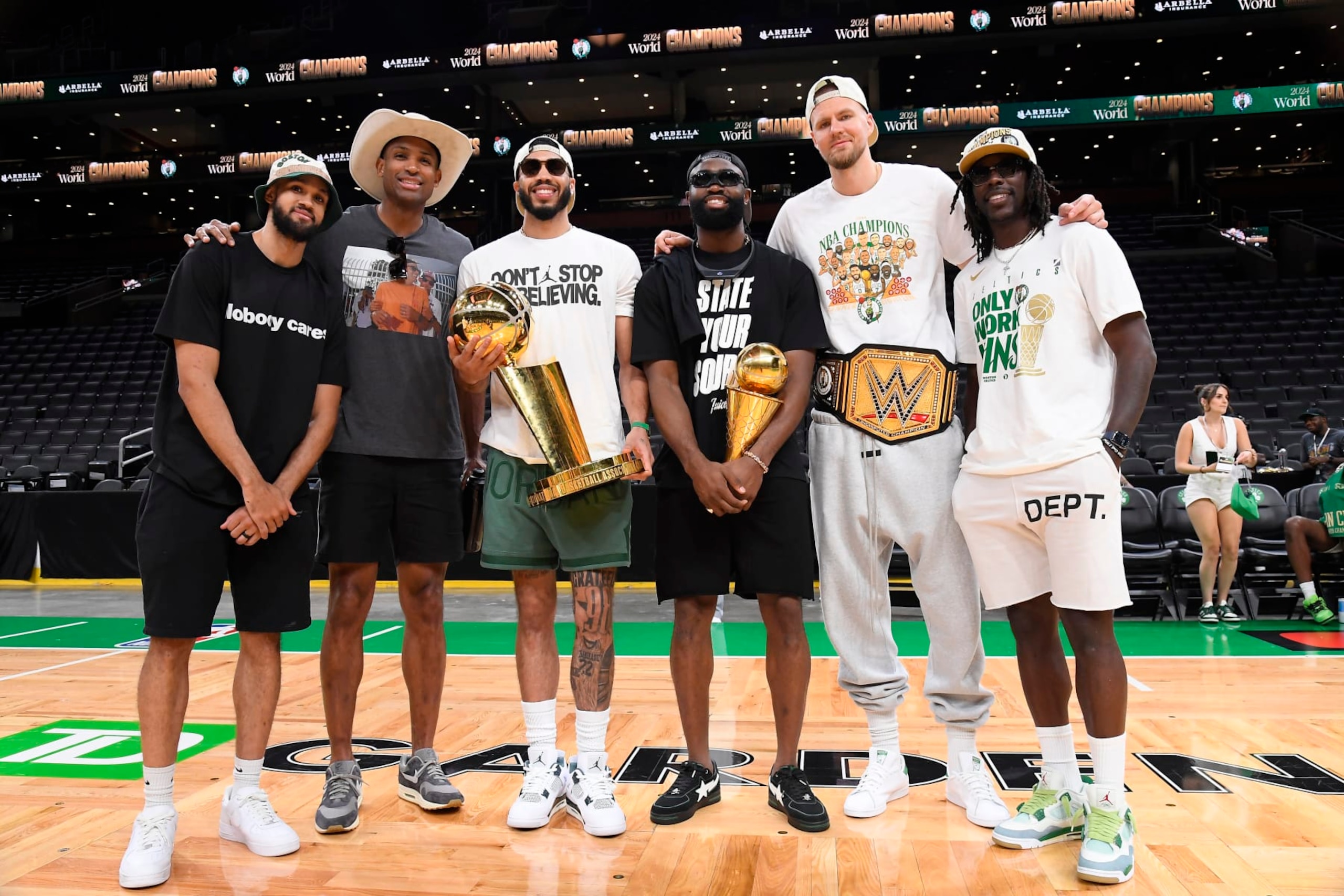

Grading Celtics' Early Moves in NBA Free Agency
The Boston Celtics are only a few weeks removed from securing their record-setting 18th NBA championship.
Their front office is already well into its pursuit of banner No. 19.
The squad's summer focus has been talent retention, which makes sense given the excellence of this group. The Celtics won 64 games and posted an absurdly high plus-11.7 net rating in the regular season, per NBA.com, then upped their win rate (16-3, .842 winning percentage) and maintained most of that efficiency (plus-8.6) during the playoffs.
It's easy to see what the Shamrocks would want more of the same.
Does shifting from the macro focus of keeping the band together to the micro analysis of specific deals make a difference, though? Let's spotlight three of the club's most notable moves so far to find out.
Jayson Tatum's Historic Extension
1 of 3
For the second consecutive summer, the Celtics put themselves on the hook for the richest contract in NBA history. Last year, it was Jaylen Brown setting the high mark with his five-year, $303.7 million deal. Now, it's his longtime running mate Jayson Tatum raising the bar with a five-year, $315 million pact.
As enormous as the pay rate is, this was one of the easiest calls any team will make this summer.
Tatum may not win many best-player-on-the-planet debates—none held outside of New England, at least—but the fact he has a place in that discussion says everything you need to know about his game. He's become a fixture on the All-NBA first team (three consecutive selections) and a permanent talking point in the MVP conversation (three straight top-six finishes).
This contract should span the duration of his prime, and if health remains on his side, it should include tons of high-end production and enviable team success.
Grade: A
Derrick White's New Deal
2 of 3
While the draft picks that delivered Tatum and Brown formed the foundation of Boston's title run, you could argue the Feb. 2022 trade for Derrick White was the franchise's first major step toward solving its championship puzzle.
He is your proverbial does-all-the-little-things kind of star role player. His defense is tremendous. His offense provides support in virtually all facets. He reads the game at a high level and reacts in real-time to provide whatever that night's contest requires of him.
There aren't many 30-year-old support players worth this kind of money (he agreed to a four-year, $125.9 million extension), but for this player on this team, that's money well spent.
Had the Celtics let him enter free agency next summer—when more teams have money to spend—he had a non-zero chance of striking it even richer. Securing his future now and locking into this championship core was a no-brainer.
Grade: A
Keeping Xavier Tillman Sr.
3 of 3
The Celtics spent the bulk of their playoff run without Kristaps Porziņģis, whose latest injury issue was a "rare" leg injury that required surgical attention after the Finals. Al Horford proved incredibly reliable throughout Boston's playoff run, but it's still worth noting his 38th birthday came a few days before the championship round tipped off.
This is an incredibly talented frontcourt, but it also feels like one of the more fragile ones you'll find.
It made a ton of sense, then, for the Celtics to invest in their big man depth, and they've done so with new deals for Xavier Tillman Sr., Luke Kornet and Neemias Queta. Any one of those investments could grab the spotlight here, but we'll focus on Tillman, who logged the most minutes of the three during the Finals (19).
The 6'8", 245-pounder brings toughness and defensive versatility to this group. His offensive output comes and goes, but since the Celtics have more than enough scoring around him, that's less of a worry in Boston than it would be elsewhere. Bringing him back on a two-year, minimum deal seems sensible.
Grade: B


.jpg?w=2560 "2 NFL Officials Suspended")


.jpg?w=2560 "Mahomes' Wife Trolls Kubiak 💀")
.jpg?w=2560 "Love's Body Already 'Tired'")
.jpg?w=2560 "Injury-stricken Seahawks signing veteran RB")