
2024 NFL Draft: Week 2 Buzz and Best Prospect Fits for League's Worst Teams
Welcome to Bleacher Report's newest feature, where we'll have our finger on the pulse on college football as it pertains to the NFL draft.
We'll evaluate how the 2024 draft class is taking shape by identifying trends and presenting a modified version of a mock draft. Each week's Top 10 will be based on reverse order from B/R's weekly power rankings.
Contributions from the B/R Scouting Department—comprised of Brandon Thorn, Cory Giddings, Derrik Klassen and Matt Holder—will provide a deeper look into the process, as they work their way through hundreds of prospects.
To start, the Deion Sanders-led Colorado Buffaloes have taken college football by storm. Coach Prime's business-like approach toward overhauling last year's roster and rebuilding primarily through transfers has been fascinating. In doing so, he brought along some legitimate NFL talent, including his son, quarterback Shedeur Sanders.
Conversely, transitions to new staffs and/or new situations haven't gone as smoothly for others. Wisconsin running back Braelon Allen would like a word.
All hope may not be lost on the NFL side of the ledger, but some teams already need to have one eye on the future after Week 1.
Draft evaluations never stop, so this is the place to start each weekend for the latest on the 2024 class.
Trending Up
1 of 12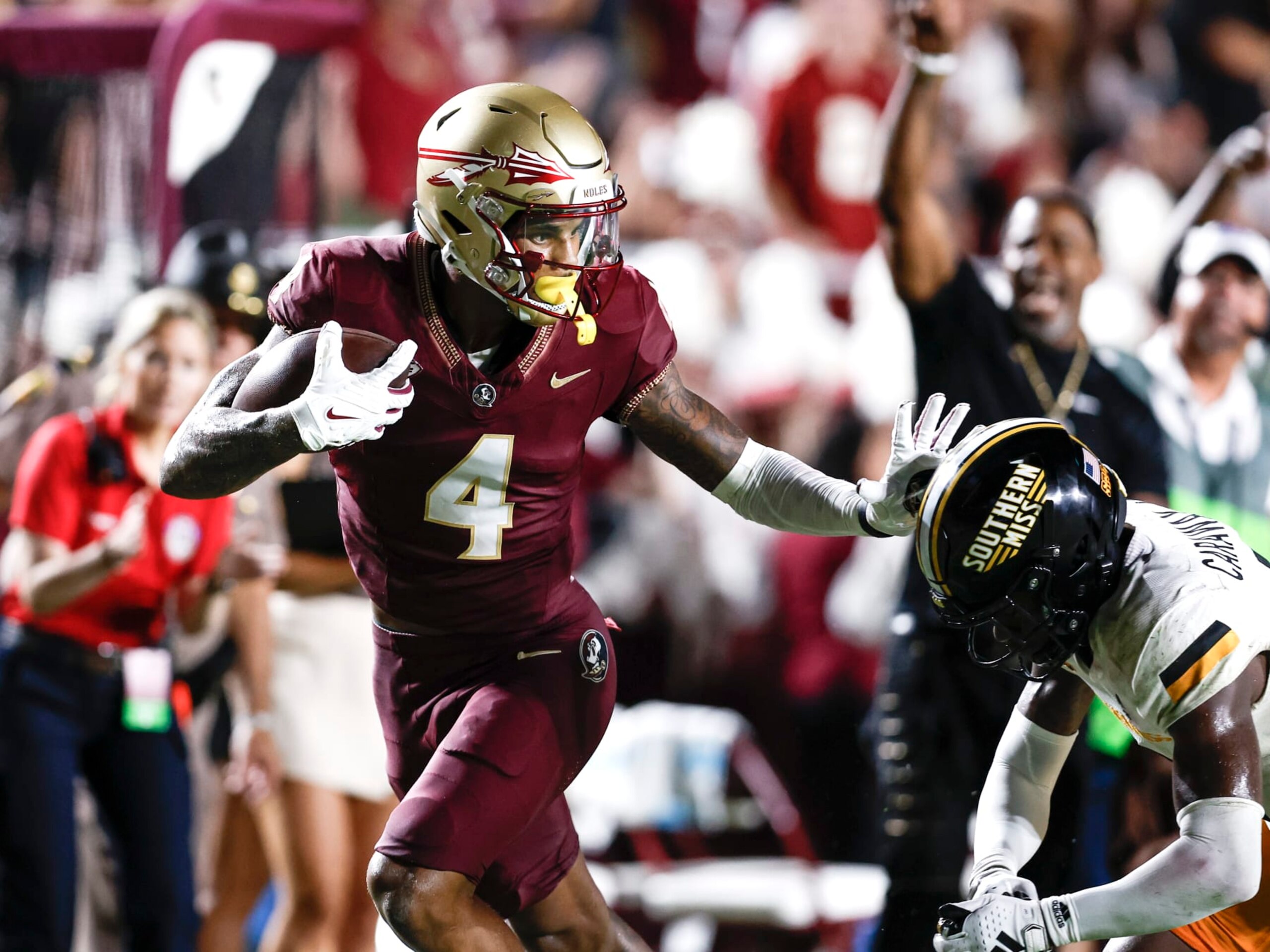
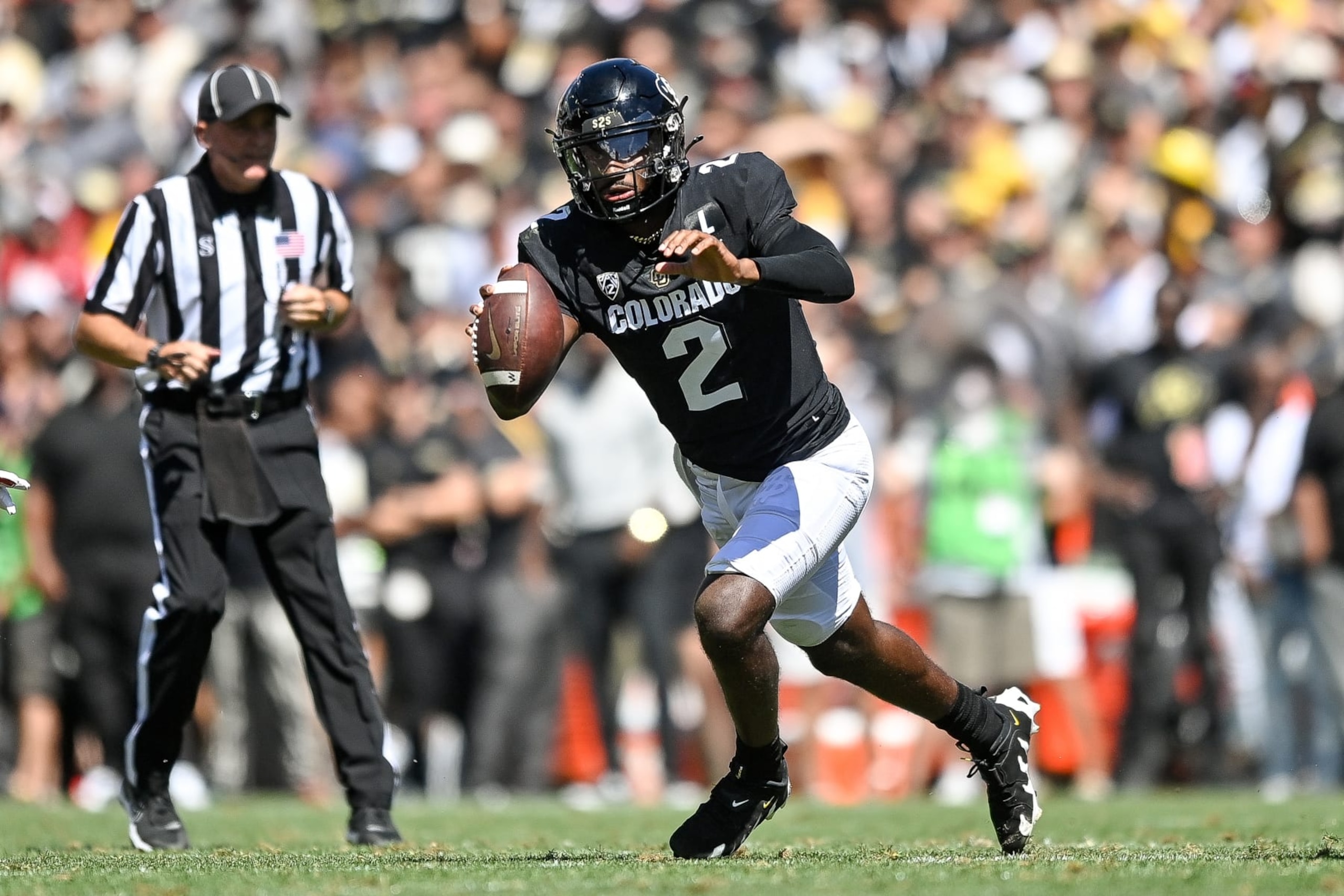
1. QB Shedeur Sanders, Colorado
Colorado wouldn't be where it's currently at without the play of Sanders. His father brought both him and a new brand of football to the program, but the younger Sanders' play is what has truly elevated the team.
"Sanders only needed two weeks to prove he has the right makeup to play quarterback in the NFL," Klassen said. "He showed impressive poise through two games.
"Not only is he unafraid of pass-rushers in general, he has done well to keep his eyes downfield when operating outside the pocket. There's still a lot left to see from Sanders, particularly with pre-snap operation and diagnosing coverage versus better defenses, but early returns are promising."
Sanders' 903 passing yards are the most through two games this season, and he has all of the tools to be a first-round quarterback prospect.
2. WR Keon Coleman, Florida State
With so many transfers happening every offseason, it's difficult to keep track of all the movement. However, some prospects are more important to follow than others.
Case in point: Florida State's Keon Coleman left Michigan State as the program's leading receiver to increase opportunities and, ultimately, his draft profile. He's done both, if his four touchdowns through the Seminoles' two games are any indication.
"At 6'4" and 215 pounds, Coleman shouldn't move the way he does," Klassen said. "The explosion and flexibility in everything he does would be impressive for someone with an average build, let alone someone built like Tee Higgins. Coleman also has all the strength and ball skills you would naturally associate with someone his size."
3. S Jaden Hicks, Washington State
Draft-eligible sophomores tend to be overlooked early in the annual scouting process while evaluators focus on upperclassmen. Washington State safety Jaden Hicks needs to be on everyone's radar right now, though.
"Hicks is impressive at 6'3" and 212 pounds," Giddings said. "He thrives when working in the box. The underclassman tackles well and shows ability to blitz from all over the field."
He's also turning out to be more than a box safety.
In Week 1, the Cougar didn't allow a catch in coverage, snagged an interception and defended two passes, according to Pro Football Focus. A week later, Hicks registered nine tackles, forced a fumble and broke up two more passes.
He was the best player on the field against the Wisconsin Badgers last Saturday.
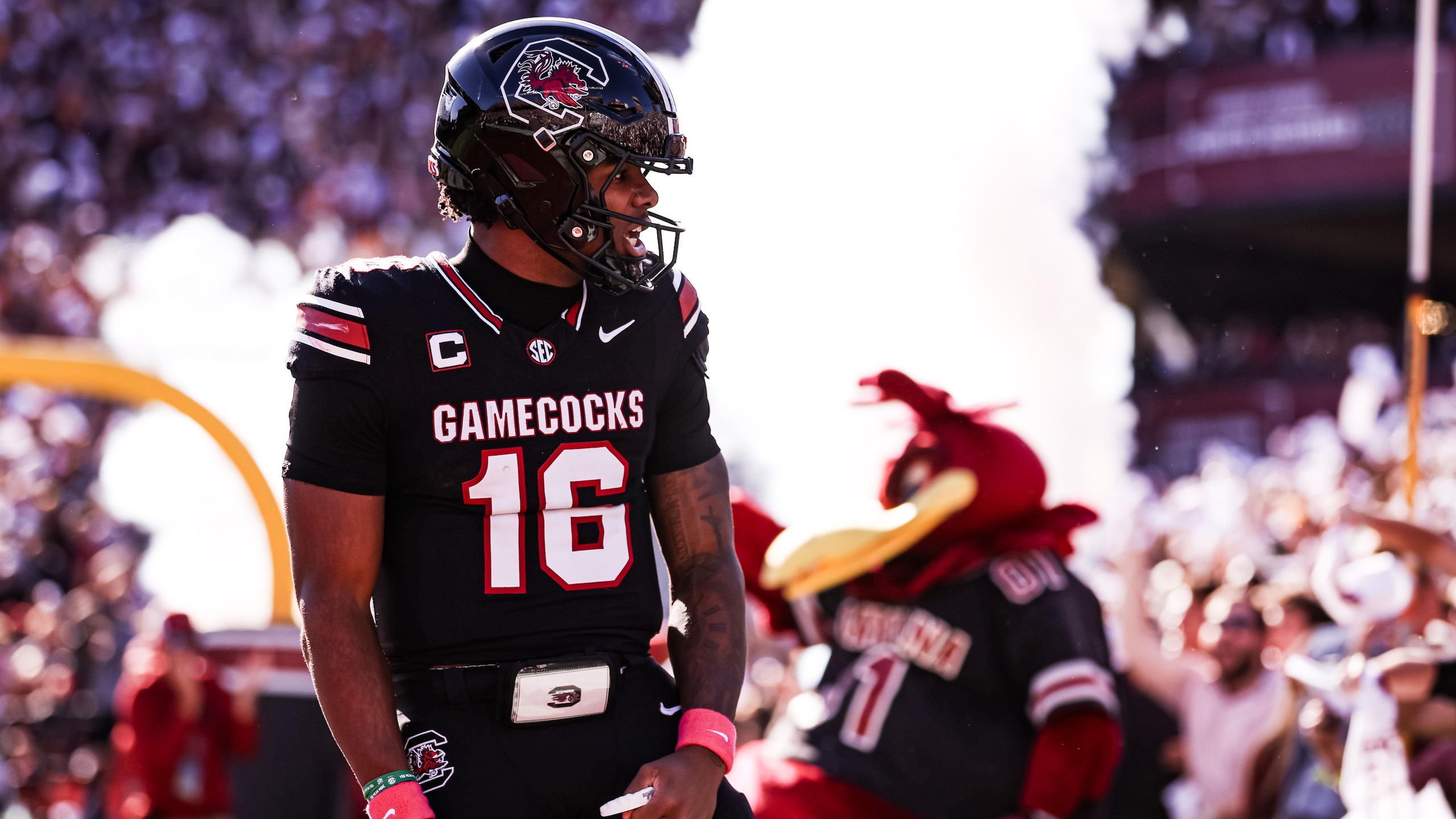
4. WR Xavier Legette, South Carolina
Xavier Legette, the Power Five's leading receiver, had only 423 receiving yards through his first four seasons with the South Carolina Gamecocks, including 167 last year. In only two games this season, the 6'3", 227-pound fifth-year senior has posted a whopping 296 yards.
"Last year's draft class featured a lot of small and/or slot-only players, but Legette is one of a handful of prospects bringing things back the other way," Klassen said. "Legette isn't the twitchiest route-runner, and he's not going to make plays in space, but his ball skills are fantastic."
In some ways, Legette is reminiscent of Terry McLaurin. Both thrived on special teams before exploding as receivers during their final seasons on campus.
5. DL Mekhi Wingo, LSU
Undersized defensive tackles can be dicey evaluations. Aaron Donald, Grady Jarrett and first-round rookie Calijah Kancey are rare difference-makers.
LSU's Mekhi Wingo may be next in line.
"When watching Wingo's 2022 tape, he was clearly dominant at the point of attack against the run and showed flashes of athleticism to give him upside as a pass-rusher," Holder said. "He just needed to develop a move to win consistently, which has been the biggest area of growth we've seen from him during LSU's first two games."
The 6'1", 295-pound defensive tackle is explosive off the snap and consistently resets the line of scrimmage. Even when the stats don't show much, he's been a constant disruptive force.
Trending Down
2 of 12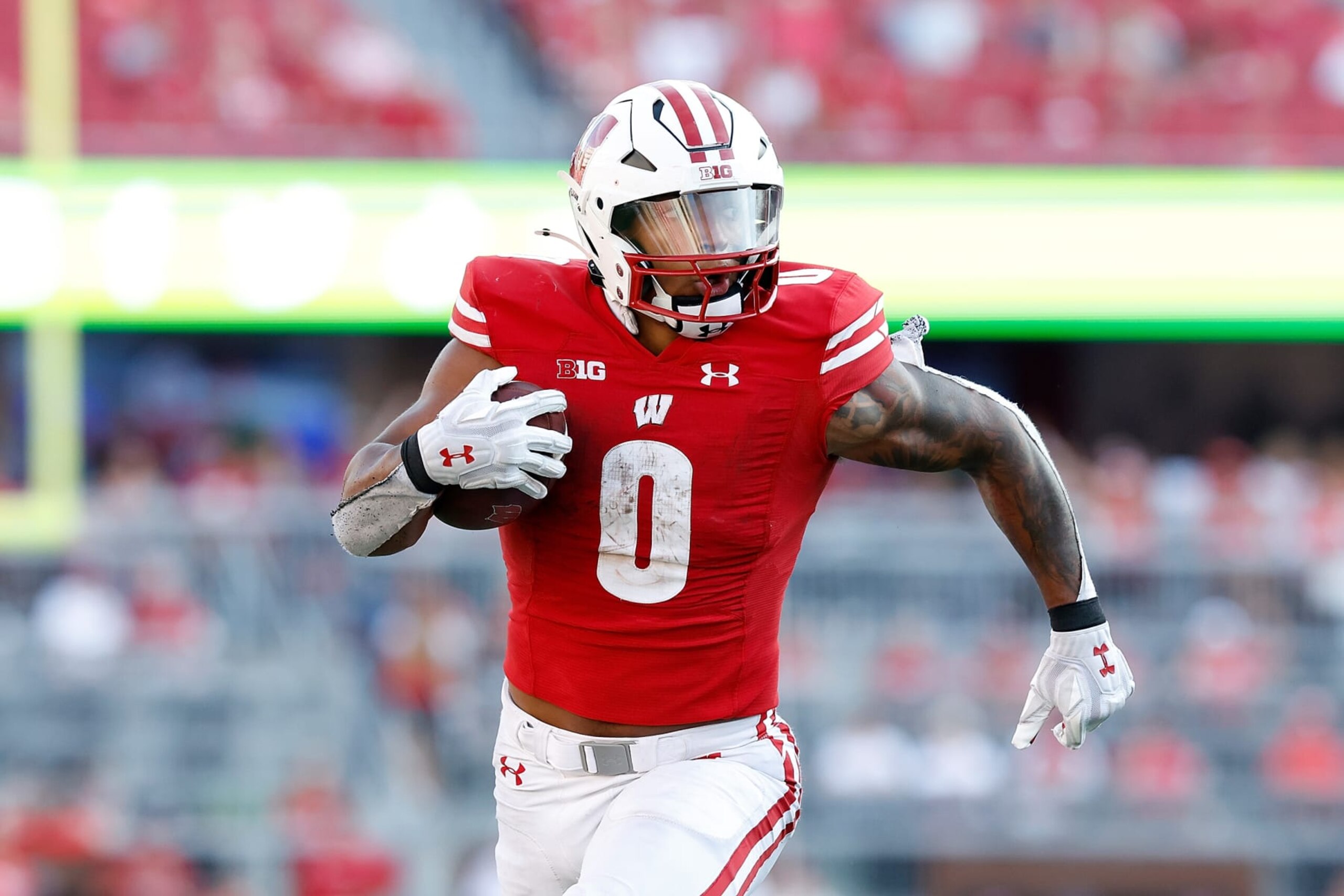
1. RB Braelon Allen, Wisconsin
Wisconsin's Braelon Allen has the potential to be the RB1 in next year's class and a first-round draft pick. The 6'2", 245-pound tailback is one of college football's best athletes and a productive runner who posted back-to-back 1,200-yard campaigns in the Big Ten before he turned 19.
However, the Badgers' new coaching staff doesn't seem to have a clue how to use him properly. The team is splitting carries between him and Chez Mellusi.
Wisconsin is finally using Allen more in the pass game, but not in any meaningful way beyond being a swing or checkdown option.
"Allen's stock is tanking through no fault of his own," Klassen said. "Wisconsin's transition to offensive coordinator Phil Longo's wide-open scheme has been a disservice to the big, bruising bell-cow.
"After averaging 19 carries per game last year, Allen is down to only 12 carries per game so far. If that continues, perhaps it prompts Allen to stay in college and transfer to a more fitting offense next year."
2. TE Ja'Tavion Sanders, Texas
Georgia's Brock Bowers is the clear TE1 for 2024 and a top-10 overall talent. From there, Texas' Ja'Tavion Sanders is generally viewed as next-best tight end prospect because of his perceived athleticism and receiving potential.
However, those traits may be somewhat overblown.
"Upon closer inspection, it's becoming tougher to see Sanders making a smooth NFL transition," Klassen said. "Sanders is a little light at a listed 243 pounds, which shows up big time in the run game.
"I'm also becoming less convinced Sanders is an elite athlete by NFL standards, which could be an issue for an F-only receiving tight end. Sanders is still a quality prospect, but the floor is open for TE2 auditions."
3. WR Johnny Wilson, Florida State
Because of his huge frame, Florida State's Johnny Wilson is an attraction among this year's draft cycle. The 6'7", 237-pound wideout moves relatively well for his size, too.
However, he's struggled to get open this season.
Wilson led the Seminoles with 897 receiving yards last year, but Keon Coleman has taken over as the team's top target this season. Meanwhile, Wilson dealt with drops in Week 1 and didn't register a single catch in Week 2.
"Just catch the easy ones, that's all Wilson has to do," Klassen said. "With his skyscraper size and movement skills, Wilson's potential is impossible to ignore. He must stop dropping simple slant and curl throws that hit him right in the hands.
"If he can manage that over the rest of the season, there will be no doubt Wilson finishes as one of the class' top receiver prospects."
4. CB Josh Newton, TCU
In TCU's high-profile Week 1 loss to the Colorado Buffaloes, two-way superstar Travis Hunter easily released, stacked and got downfield against TCU's Josh Newton. The first-team All-Big 12 cornerback has played well throughout his career, but he still has a few holes in his skill set.
"Newton is an average-sized defensive back (6'0", 190 lbs) who struggles to consistently tackle," Giddings said. "He's also gotten overextended with some of the faster and shiftier receivers he's matched up against this year."
To Newton's credit, he did bounce back with a shutdown performance last week, albeit against an FCS opponent.
5. OT JC Latham, Alabama
A few factors placed one of the class' most talented linemen on the list this week.
First, Latham didn't play well and looked out of sorts in Week 1. Second, he's bigger this season. Alabama now lists Latham at 360 pounds after he was listed at 326 last year. Finally, Latham didn't make the switch from right to left tackle as initially expected.
Despite those potential concerns, the 20-year-old blocker bounced back against the Texas Longhorns last weekend.
"When Latham faced younger edge-rushers in Texas' rotation, they were no match for him physically," Thorn said. "There was one rep against the 291-pound Vernon Broughton where the defensive lineman kicked out to a wide-9 technique, bull-rushed and walked Latham back in the pocket. Other than that specific rep, it was a clean, impressive performance after an underwhelming one to start the year."
10. Los Angeles Rams: OT Amarius Mims, Georgia
3 of 12
The Los Angeles Rams haven't made a first-round pick since they traded up for quarterback Jared Goff in 2016. They may have surprised with their upset victory over the Seattle Seahawks in Week 1, but expectations are still low for this team.
With the No. 10 overall pick, the Rams could starting fleshing out a roster that's been stuck in a haphazard rebuild since their Super Bowl LVI victory.
General manager Les Snead famously wore a T-shirt saying "f--- them picks" to the Super Bowl parade. The opposite should be true now. The Rams must capitalize on Matthew Stafford and Aaron Donald while they still have them.
Los Angeles' starting offensive tackles hold a combined salary-cap hit of $34.7 million for next season. That's not going to work. The Rams could save $15 million by waiving Noteboom with a post-June 1 designation next offseason, though.
Georgia's Amarius Mims is transitioning to left tackle this fall. The 6'7", 340-pound blocker already looks the part of a future high-end draft pick. Stafford should be happy with that kind of investment.
.jpg?w=2560 "Commanders 49ers Football")
.jpg?w=2560 "Colts Football")
.jpg?w=2560)
9. Pittsburgh Steelers: CB Kool-Aid McKinstry, Alabama
4 of 12
To call the Pittsburgh Steelers' secondary a work in progress may be kind.
Veterans Patrick Peterson and Levi Wallace started on the outside in Week 1 and struggled greatly against the San Francisco 49ers. Second-round rookie Joey Porter Jr. barely played. Keanu Neal and Damontae Kazee struggled at safety.
Aside from Minkah Fitzpatrick, the Steelers' last line of defense has a lot to figure out throughout the season. Cameron Heyward's groin injury certainly won't help matters, because Pittsburgh needs its front seven to dominate.
Another Alabama product could join Fitzpatrick next spring to provide a long-term solution for one outside corner spot.
Kool-Aid McKinstry entered this season as the CB1 of the 2024 draft class. The 6'1", 195-pound defender is long, athletic and physical. He also held himself and his teammates accountable after this past weekend's loss to the Texas Longhorns.
A corner's ability to still lead and not get down on himself after surrendering a play or two is vital to success. The modern game is built for defensive backs to get beat. How they respond serves as the litmus test to how good they can be.
8. Washington Commanders: QB Shedeur Sanders, Colorado
5 of 12
At one point during Week 1, social media users began to think the Washington Commanders, not the Arizona Cardinals, were the team ready to tank for USC quarterback Caleb Williams.
A strong fourth-quarter effort eventually pushed Washington past Arizona. But the team playing as poorly as it did against arguably the league's worst roster produces a lot of questions, starting with its decision behind center.
Sam Howell's progression will heavily dictate the franchise's overall direction. In his first two starts, the 2022 fifth-round draft pick completed 60 percent of his passes for 371 yards, two touchdowns and two interceptions. He also ran for two scores.
Until Howell proves otherwise, Washington must stay in the quarterback market. Shedeur Sanders could join one of his father's old teams, with the potential for a much better outcome. His ball placement and feel for the pocket would be immediate upgrades over Howell.
7. Tennessee Titans: OT Joe Alt, Notre Dame
6 of 12
How long Andre Dillard makes it as the Tennessee Titans' starting left tackle remains to be seen. But the former Philadelphia Eagles first-round bust didn't perform particularly well in his debut with the Titans. Tennessee also seems set on Peter Skoronski staying at left guard.
As such, reassessments of the Titans' front five will be necessary. A steady presence at left tackle could solidify the entire group, which makes Notre Dame's Joe Alt the ideal fit.
Other tackles in the class are more physically gifted than Alt. However, the 6'8", 322-pound junior is technically sound and rugged in the run game.
Prospects as tall as Alt usually struggle with leverage, but the 20-year-old plays with tremendous pad level. He gets low, keeps his hands inside and works to uproot defenders.
Under head coach Mike Vrabel, Tennessee's approach is going to be built upon fundamentally sound and physical football. The Titans will run the ball to set up everything else.
Alt could step in from Day 1 and provide the same presence that Taylor Lewan previously did, without some of the reckless play.
6. Denver Broncos: OT Olumuyiwa Fashanu, Penn State
7 of 12
The idea of slotting a quarterback here was tempting as everyone continues to wait for Russell Wilson to cook in Colorado. However, the Denver Broncos realistically can't get out of Wilson's current deal until 2025 at the earliest.
So, the Broncos should do the next-best thing by helping to maximize whom they currently have behind center.
Penn State offensive tackle Olumuyima Fashanu doesn't immediately jump off the page as a logical choice. After all, the Broncos already have Garett Bolles manning Wilson's blind side.
Two things must be taken into consideration, though.
First, the 2024 campaign is the final year of Bolles' current contract. The Broncos can release or trade him after this season and immediately save $16 million toward the 2024 salary cap. Second, the veteran tackle turns 32 next year.
Sometimes, a team just needs to take a special talent and worry about the rest at a later date.
As Thorn tweeted, Fashanu is just different. The 20-year-old's movement skills are effortless. A 6'6", 317-pound blocker shouldn't glide like Fashanu does.
Fashanu has the size, length, strength and natural ability to be a consistent All-Pro-level performer. Consistency is the last thing scouts need to see out of him.
5. Indianapolis Colts: Edge Jared Verse, Florida State
8 of 12
Early projections often concentrate on offensive tackle being the Indianapolis Colts' No. 1 priority because of uncertainty regarding Bernhard Raimann's development and the talent found among that specific position group.
However, Raimann's rapid improvement after an abysmal start continued through Week 1.
"I don't like to put a grade on a player in the media, but I'm really pleased with Bernie," Colts offensive coordinator Jim Bob Cooter told reporters Tuesday.
Indianapolis currently has much bigger concerns along its offensive interior. But the team isn't taking another guard in the top five.
Instead, general manager Chris Ballard should concentrate on another premium position.
Next offseason, the Colts need to make a decision on defensive end Kwity Paye's fifth-year option, while Dayo Odeyingbo will be entering the final year of his rookie deal. Tyquan Lewis is set to become a free agent after this season, so the Colts should target a pure pass-rusher with some juice in the draft.
Florida State's Jared Verse is a polished edge-rusher with burst, bend and a toolbox full of pass-rush moves. The biggest knock on the standout Seminole is that he'll turn 24 during his rookie campaign. However, Ballard has already selected multiple older draft prospects, including Raimann.
4. Chicago Bears (from Carolina): TE Brock Bowers, Georgia
9 of 12
Taking a tight end this early in the draft may be viewed as a a luxury. For the Chicago Bears, Brock Bowers should be viewed as a necessity.
At No. 4 overall, Bowers would tie Kyle Pitts as the highest-drafted tight end in NFL history. It's hard to think of another tight end who's more worthy of the status.
From the moment that Bowers stepped onto a collegiate field, he established himself as a premium talent, albeit at a less desirable position. Certain prospects supersede their positional value, though.
Bowers may not be on the same level as Pitts when it comes to raw natural tools, but the reigning John Mackey Award winner is one of the most natural receivers ever to play the position. As a true freshman, Bowers led the national championship-winning Georgia Bulldogs in receptions, receiving yardage and touchdown catches. He repeated that feat last year.
Much like the Bijan Robinson discussion from earlier this year, Bowers' inclusion among next year's elite prospects shouldn't be viewed through the lens of his position. Instead, they're both offensive weapons.
The Bears must place as much talent around Justin Fields (or a new quarterback) as they can. Bowers can play alongside Cole Kmet, while the Bears lean heavily on 12 personnel.
3. Chicago Bears: QB Drake Maye, North Carolina
10 of 12
If the Chicago Bears are on the clock at No. 3, they may have a decision to make regarding North Carolina quarterback Drake Maye.
As gifted as Justin Fields is, he didn't show much growth during the Bears' lopsided loss to the Green Bay Packers in Week 1. Chicago's front office needs to determine how much of that falls on Fields, offensive play-caller Luke Getsy and/or the supporting cast.
Fields' career is nearing a crossroads, since the Bears need to decide on his rookie fifth-year option next offseason. If the Bears view Maye as a superior prospect, they must seriously consider the possibility of selecting him at No. 3.
When comparing Maye to Fields, the former is a little bigger and more polished, particularly as a downfield passer. However, the collegiate standout has yet to make the leap everyone expected this year.
The current Bears regime didn't trade up to draft Fields. General manager Ryan Poles and head coach Matt Eberflus took over a year later. They aren't necessarily tied to their current quarterback.
While Maye should be the selection here, the Bears might not be the ones making the pick. Instead, this would be a great spot for a potential trade-down. Chicago just needs to decide what it wants to do with Fields over the next 17 weeks.
2. Arizona Cardinals (from Houston): WR Marvin Harrison Jr., Ohio State
11 of 12
The Houston Texans will be hanging their heads if the trade for Will Anderson Jr. costs them a top-five draft pick. Meanwhile, everyone within the Arizona Cardinals should be smiling from ear-to-ear if this draft order comes to fruition.
Even with the additions of two premium prospects in quarterback C.J. Stroud and edge-rusher Will Anderson Jr., Houston's roster is far from complete. After years of spinning their wheels as an organization, the Texans finally appear to be going in the right direction, although they're still stuck in first gear.
The Texans have significant needs elsewhere, including wide receiver. Wouldn't it be nice if the franchise could land the best wide receiver prospect since Calvin Johnson?
Instead, the Cardinals do here.
Ohio State's Marvin Harrison Jr. is built differently. He's a 6'4", 205-pound target with the body control, route running and precision of a much smaller receiver. He's the complete package, with the size, speed and skill set to be considered for the No. 1 overall pick.
The Cardinals will have a major decision to make at quarterback if they end up with next year's top selection (which they own in this projection). This particular pairing is a no-brainer, though, especially since wide receiver Marquise Brown is set to become a free agent after this season.
1. Arizona Cardinals: QB Caleb Williams, USC
12 of 12
The Cardinals are trying to sell everyone on Kyler Murray as their long-term answer at quarterback.
"I know he's a franchise quarterback, so those are good for head coaches typically," new Cardinals head coach Jonathan Gannon told reporters prior to the team's Week 1 loss to the Washington Commanders.
Offensive coordinator Drew Petzing added, "I certainly view him as a franchise quarterback and leader of this organization."
Arizona may hope to use its two first-round picks to add premium talent elsewhere. But as Mike Tyson once stated, "Everyone has a plan until they get punched in the mouth."
More often than not, Arizona will get punched in the mouth this season. Organizational goals will change once the season goes into the tank.
If the Cardinals hold steady at the top of the 2024 draft order, general manager Monti Ossenfort will have to reconsider the team's stance at quarterback and start driving up the value of the No. 1 pick by expressing interest in USC's Caleb Williams.
Williams is already considered a superior prospect to Murray at the same stage in their careers. The reigning Heisman Trophy winner is arguably the best quarterback prospect since Andrew Luck.
Arizona can't let a sunk cost ruin this selection. At minimum, it must drive up the trade value of the pick if it really is sold on Murray moving forward.
However, Williams may decide to return to Southern Cal for another year. His father already floated the idea that the 21-year-old and his representation could go that route "if there's not a good situation" atop the draft.
Unless Williams does return to school, he's the right choice for the Cardinals at No. 1.
.jpg?w=2560 "DOLPHINS-AIKMAN")



.jpg?w=2560 "Malik Beasley Negotiating Plea Deal (AP)")

.png?w=2560 "Week 8 Winners & Losers 📊")
