
Bryce Young Will Be the Most Polarizing Prospect at 2023 NFL Scouting Combine
Quarterbacks are almost always in demand during the NFL draft, and in some years, there's a clear-cut QB1 to be coveted. This isn't exactly the case heading into the 2023 event, as signal-callers such as Ohio State's C.J. Stroud, Alabama's Bryce Young and Florida's Anthony Richardson are all in the conversation.
Much will be decided in the coming weeks, beginning at the scouting combine—which kicks off February 28. Through combine workouts, interviews and, later, pro days, quarterbacks will look to separate themselves from the rest of the class.
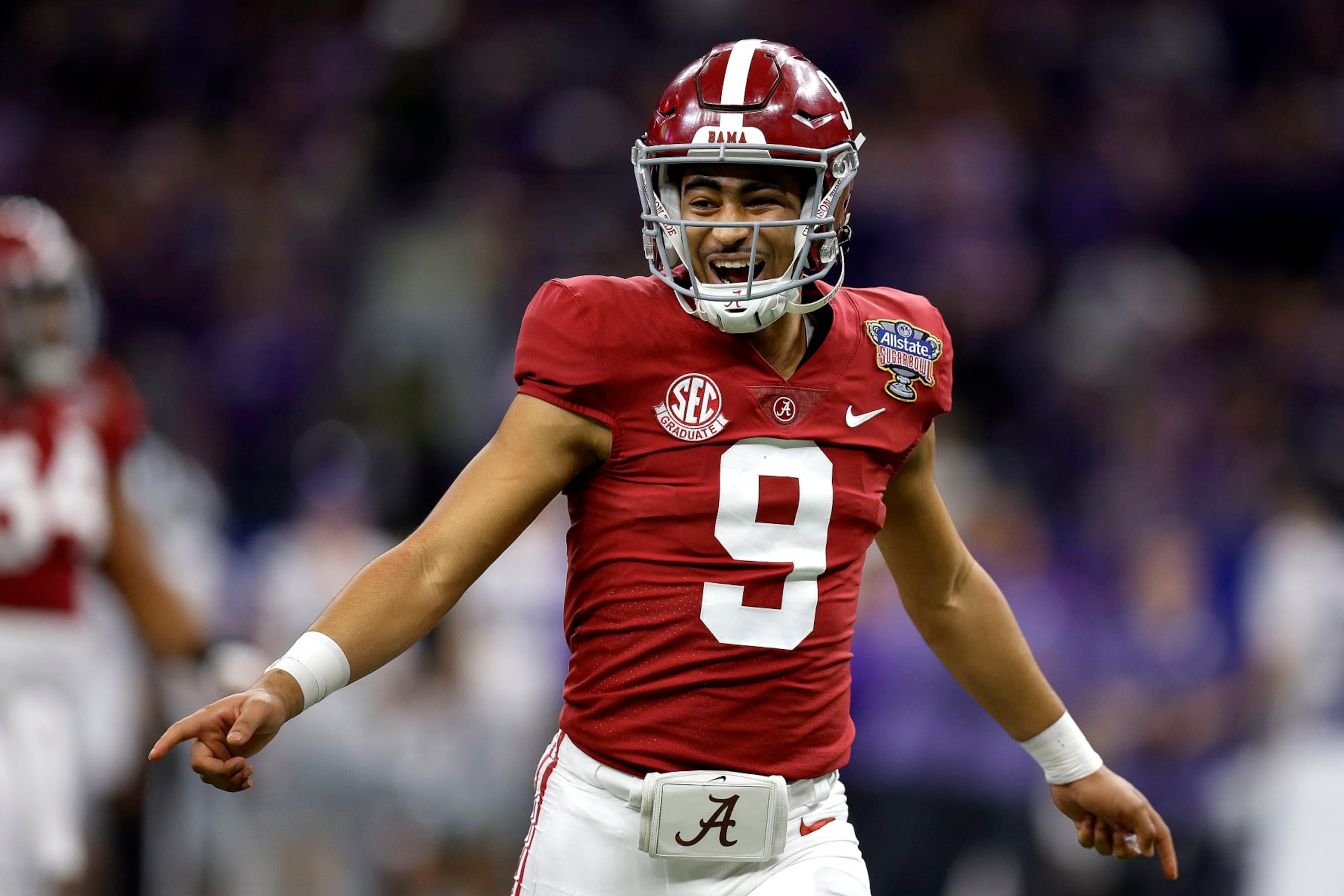
Young, a two-year starter and 2021 Heisman Trophy winner, may have a tougher time than most elevating his draft stock in the eyes of some teams. While his resume is extremely impressive, he remains the most polarizing prospect in the class as the predraft process shifts to Indianapolis.
TOP NEWS

New NFL contenders starting to emerge after Week 4
.jpg?w=2560 "Cardinals Giants Football")
NFL investigating 2 referees for separate viral exchanges
.jpg?w=2560 "Hill Injury Update Football")
Report: Chiefs Contact Hill's Agent
The reason? At (a listed) 6'0" and 194 pounds, Young simply doesn't possess an archetypal NFL quarterback frame. That alone could have him off some franchises' boards, at least initially, and Young's challenge over the next two-and-a-half months will be convincing teams that he can succeed as an NFL outlier.
Why Some Teams May Be Out on Young
Let's be perfectly clear: If Young were, say, 6'3" and 221 pounds—the combine measurements of Cincinnati Bengals quarterback Joe Burrow—he may have already cemented his spot as the top quarterback in this year's draft class.
The 21-year-old has played on some of the biggest stages with the Crimson Tide and has strung together many eyebrow-raising performances. In 2021, he finished with 4,872 passing yards, 47 touchdowns, seven interceptions and three rushing scores en route to the Heisman. This past season, he threw for 3,328 yards with 32 touchdowns, five picks and four rushing touchdowns.
Young finished his college career with a cumulative 165.0 passer rating. That's a higher rating than 2021 clear-cut first-overall pick Trevor Lawrence (164.3).
At 6'0" and under 200 pounds, however, Young carries legitimate size concerns. Shorter quarterbacks can struggle to see over the offensive line, and smaller signal-callers can have durability issues.
"It's frame you worry about. If a 325-pound guy falls on you, how does your body respond to it? How do you take the beatings over the course of a year?" NFL Media's Lance Zierlein said in a YouTube analysis of Young (h/t Chase Goodbread of the Tuscaloosa News).
At 5'10" and 207 pounds, Arizona Cardinals quarterback Kyler Murray is the best recent size comp for Young. The 2019 first overall pick is a two-time Pro Bowler, but he's battled injuries over the last two years, including a torn ACL that ended his 2022 campaign.
2018 first overall pick Baker Mayfield is another smaller quarterback (6'1", 215 lbs) who flashed early in his career—setting a then-rookie record with 27 touchdown passes—but he had an injury-plagued 2021 season that led to his ousting from the Cleveland Browns.
Doug Flutie, at 5'10", had some NFL success, including one Pro Bowl appearance. The 6'0" Drew Brees is a future Hall of Famer. Russell Wilson, at 5'11", is another likely Hall of Famer. However, smaller quarterbacks just don't carve out lengthy, prolific careers often.
Sustainability is part of the equation. Any franchise drafting Young won't do so simply with a few seasons in mind. It will be looking for a quarterback to earn and live up to that big second contract and to solidify the position for the next decade-plus.
Murray got his second contract after three years, and some might view that as a misstep by the Cardinals. The former Oklahoma star shined early in the NFL thanks to his dual-threat ability and elite physical skills, but he hasn't shown a ton of growth as a passer—his 2022 QB rating of 87.2 is in line with his rookie rating of 87.4—he hasn't won anything of note, and he's rehabbing a significant injury.
And Young is more of a traditional pocket passer who doesn't have the same top-tier traits as Murray.
"[Murray] had similar concerns, but he had a much stronger arm and better athletic ability. Add those size issues to Young's decline in processing in 2022—partly a result of injury and Alabama's poor offensive line—and his profile becomes risky," Derrik Klassen of the Bleacher Report Scouting Department wrote.
Young will require a specific offense to be successful, one that features good line play, gets receivers open outside the numbers and schemes clear throwing lanes between his blockers. This sort of system allowed Brees to become an elite quarterback with the New Orleans Saints, so it can be done.
Wilson's disastrous first season with the Denver Broncos (career-worst 84.4 rating) is a clear example of what happens when a smaller quarterback is thrust into a poorly fitting offense.
Not every franchise will be eager to dramatically alter its roster and offensive philosophies to accommodate Young's physical limitations.
Why Young Can Be Successful in the NFL
Now that we've gotten the concerns out of the way, let's examine why many teams will still be high on Young.
Some NFL decision-makers will (rightfully) focus on what a prospect can do instead of where his limitations lie—and there's a lot that Young does extremely well.
To a degree, his college numbers speak for themselves. However, his game tape might be even more magnificent than pure numbers would suggest. His ability to recognize coverages and knowledge of where he wants to go with the ball pre-snap are elite and reminiscent of Burrow.
"Bryce Young is one of the best 'processors' I've scouted over the past decade—he sees the entire field so well," ESPN draft analyst Mel Kiper Jr. tweeted.
Young is also extremely accurate, whether in the pocket or on the move. While he's not a run-heavy quarterback like Murray, he has plenty of escapability in his game.
Burrow isn't an elite quarterback because of his otherworldly physical traits. He's up there with the likes of Patrick Mahomes and Jalen Hurts because of his football IQ, accuracy, ability to buy time in the pocket and ball placement. These are all traits shared by Young, though of course, he's a smaller prospect.
An NFL team can compensate for Young's size by creating open passing lanes and utilizing play action to keep pass-rushers at bay—it will be harder for defenders to deflect Young's passes when they're five-plus yards from his release point.
His quick release is another tool a team can utilize. Because of his pre-snap recognition, fast processing and vision, he can deliver the ball before defenders even know it's coming.
Young is also the biggest playmaker at quarterback in this draft class, and one of the biggest in recent memory. Once he decides to uncork a pass, he doesn't hesitate, and that allows him to throw receivers open, even in a tight area of the field. In college, this frequently led to big gains or points.
At the next level, his decision-making and quick release will allow Young to avoid the frequent big hits that could lead to injury. He can also make a lot happen when plays begin to break down.
"Once Young decides a play is broken, either because of pressure or sticky coverage, he is quick to find an answer. Sometimes that is a timely checkdown, but more frequently it means a play outside the pocket, where his blend of athleticism, creativity and flexible mechanics creates magic," Klassen wrote.
Because Young can escape the pocket and always keeps his eyes looking for the open receiver, he can be nearly impossible to defend at times. He will also stand in the pocket in the face of a pass rush and deliver an accurate, catchable ball (though the one in this clip was dropped).
When you combine all of Young's assets—elite processing, vision, toughness, accuracy and an ability to win from inside or outside of the pocket—his smaller stature seems like much less of an issue.
Will Young experience the occasional batted pass? Sure, with 6'7" defenders regularly crowding the line of scrimmage, so do taller quarterbacks. A team only needs to be convinced that Young's skills outweigh his physical limitations to take a chance on him.
Why the Combine and Predraft Process Are Important
Because of everything Young has put on film, some teams are undoubtedly already high on him.
"The Alabama guy doesn't look bad, I tell you," Indianapolis Colts owner Jim Irsay told reporters.
However, the combine, Alabama's pro day (March 23) and team visits will still be important for Young. A lot of eyes will be on him during combine measurements. College teams don't always list accurate numbers, and if Young comes in smaller than advertised, teams could shy away.
This is likely to be less of an issue for other potential first-round quarterbacks such as Stroud (6'3", 218 lbs), Richardson (6'4", 232 lbs) and Kentucky's Will Levis (6'3", 232 lbs). With these signal-callers, teams will rely much more on their own evaluations and how they prioritize certain skill sets.
Stroud, for example, has plenty of big-game experience and a strong game-tape resume—he's also the top-ranked quarterback on the Bleacher Report Scouting Department's big board. Richardson has all of the desired athletic upside but lacks accuracy, while Levis projects as a quality pocket passer with pro-style experience but is a bit raw from a pre-snap and processing standpoint.
Each of these signal-callers has a combination of traits with which an NFL coach can work, even if they measure up a bit smaller than expected. While Young has a more complete, advanced game than any of them, it will be much easier for a team to dismiss him because of his size alone.
Young will also need to demonstrate that his skills can translate when he's not playing with a top-tier supporting cast like the one he had at Alabama. Scripted throwing sessions don't reveal much, but teams will want up-close analysis of his throwing platforms, delivery and release point.
Young's stock could rise or fall depending on his athletic testing. Is he faster or more explosive than what the film suggests, or less so? If his testing ultimately yields an athletic profile that more closely mirrors Murray's, teams may feel more comfortable in taking on the size risks.
Interviews will also be important. Franchises will want to know what sort of person Young is, how he prepares, what type of leader he can be and how determined he is to continue growing as a player. The buzz out of Alabama has been positive.
"He's done a really, really good job of affecting the players around him in a really positive way," head coach Nick Saban said on ESPN's SportsCenter last August (h/t Kaiden Smith of On3). "He's had a great attitude about continuing to try to improve and get better. He's not satisfied at all with where he was, and where he is, and where the team is, so I think those are all positive factors for us."
However, the college and NFL are different games with completely different environments. What works in college doesn't always work in the pros. Can Young command a locker room like Burrow, or will his leadership style fall flat, as Mayfield's did in Cleveland?
If Young checks all of the predraft boxes, he could easily enter draft weekend as the clear-cut QB1, size concerns or not. A lot has yet to be determined, though, which is why scouts, general managers and fans are likely torn on just how great he can be in the NFL.
Young can be special, as long as he lands in the right situation. The big question is whether a team capable and willing to provide that situation is also an outlier.
.jpg?w=2560 "Titans Giants Football")
.jpg?w=2560 "Dolphins Bills Football")