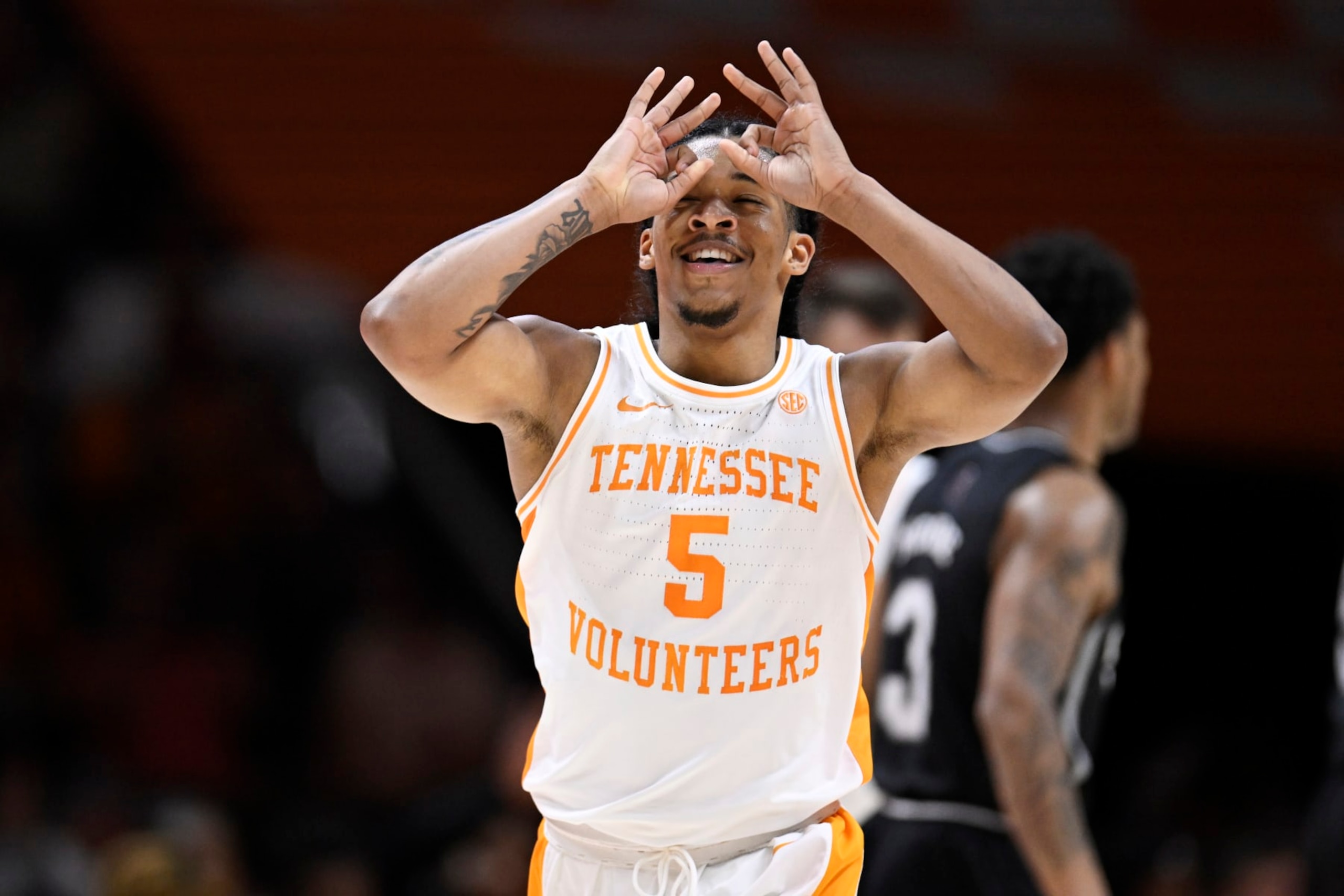


If it's true that defense wins championships, say hello to the top candidate to win the 2023 men's NCAA tournament: the Tennessee Volunteers.
They've never won it all before.
Heck, they've never even come close.
TOP NEWS
Ole Miss Men's CBB Punished for Violations
Biggest MCBB Spenders 💰
CBB Exhibition Gets HEATED ▶️
The Vols have gone to 24 NCAA tournaments with nary a Final Four appearance and only one trip to the Elite Eight (2010). And head coach Rick Barnes isn't exactly renowned for his March Madness masterpieces, holding a career record of 25-26 in the dance.
However, Barnes has fine-tuned a defense that currently rates as the most efficient in more than two decades of KenPom.com data.
The record-holder in adjusted defensive efficiency—which calculates how many points a team would be expected to allow in 100 possessions against an average opponent—is 2008-09 Memphis at 84.2. In John Calipari's final season with the Tigers, they allowed 58.8 points per game (56.9 heading into the NCAA tournament) and ranked top 12 in the nation in both steal percentage and block percentage. They were undeniably elite on that end of the floor.
But Tennessee has been even stingier, forcing turnovers, blocking shots and contesting everything en route to a rating of 81.8.
To be sure, there is some dumb luck baked into that record-setting pace.
Opponents are shooting 20.9 percent from three-point range, which is just impossibly bad. Per KenPom, the only team in the past 21 years to hold its D-I opponents below 26.4 percent from distance was 2004-05 Norfolk State. And that was a sub-.500 team that wasn't even good on defense; a total oddity that those Spartans hold that record.
As Pomeroy tweeted on Tuesday afternoon, "Either (Tennessee's defensive three-point percentage) will regress substantially, or Rick Barnes will be selling his 3-point defense magic beans for millions after the season."
Simply chalking up that three-point defense to dumb luck would also be quite dumb, though.
Tennessee—and Houston, for what it's worth, which is holding opponents to 25.1 percent on triples and is on a would-be-record-setting-if-not-for-Tennessee defensive pace of its own—isn't just sitting back in a 2-3 zone and praying for bricks.
Rather, you have to work your hind end off to get an open look against the ridiculously active hands of Tennessee's perimeter defense.
Zakai Zeigler (2.3 steals per game), Santiago Vescovi (2.2) and Jahmai Mashack (1.8) each rank top-55 in the nation in steal percentage. And when Josiah-Jordan James and his 114 career steals are able to play—he has been limited by injury to eight games thus far—that's another set of long arms clogging up passing lanes.
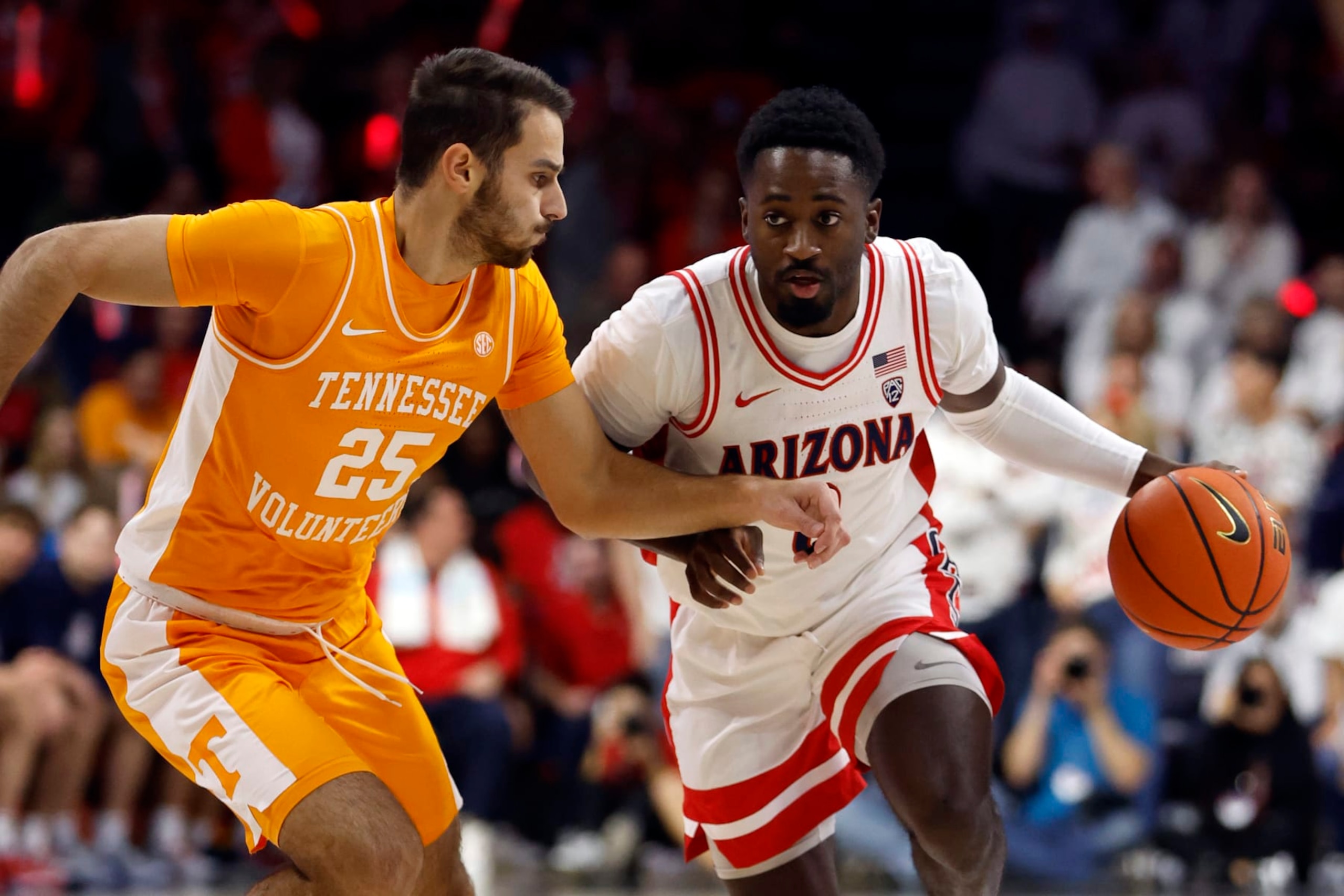
To get a sense of how hard it is to get three-point looks against Tennessee, here's what it took for Vanderbilt to make its six three-pointers (in 27 attempts) against the Vols on Tuesday night:
- Tennessee's 7'1" center Uros Plavsic got switched onto 6'6" Jordan Wright, who made a deep triple from the top of the key.
- Vandy needed seven passes off a baseline out-of-bounds play to find Noah Shelby in the corner, and he still just barely got it off over the outstretched arms of a closing-out Tyreke Key.
- Shelby ran through what really should have been called an illegal elevator screen and made a deep one with his heels hanging over the sideline.
- A Myles Stute three-point attempt was blocked by Key, but Colin Smith got the offensive rebound and kicked it out to Shelby for a triple.
- Stute created separation with a jab-step/step-back against Olivier Nkamhoua, who is not a perimeter defender by trade. (Easily the most well-earned of Vanderbilt's six triples.)
- Trey Thomas got open as the shot clock expired when Zeigler gambled with a double on Quentin Millora-Brown in the post.
If anything, the dumb luck is that the Commodores actually made those six three-pointers against the Volunteers.
Now for the kicker: That game was, without question, Tennessee's worst defensive effort of the season. The Vols forced an average of 16.8 turnovers in their first 15 games, but Vanderbilt—not exactly a top-tier offense—only had eight giveaways and scored more first-half points than any other team has against the Volunteers.
And yet, it was impeccable defense that won them the game.
After trailing 39-37 at the intermission, Tennessee outscored Vanderbilt 23-7 over the first 11 minutes and 20 seconds of the second half, turning a potential upset into a "Feel free to change the channel" situation. (Three of those seven points came on the aforementioned shot-clock buzzer-beater.)
The Volunteers only blocked one shot and tallied just two steals during that sequence, but watching Vanderbilt try to score was like watching someone try to successfully pull a Jenga block in the middle of a swarm of bees.
Aside from Thomas' buzzer-beating three-pointer, the only made field goal during that 23-7 run was Wright's driving floater, on which he finished amid four Volunteers, two of whom collided in mid-air while trying to block the shot.
After a while, the Commodores just gave up on even trying to penetrate and started chucking up threes any time they got a millimeter of space.
And, again, this was a poor 40-minute effort by Tennessee's standards.
Vanderbilt scored 68 points. Tennessee's previous 15 opponents—two of whom were title contenders Kansas and Arizona—were held to 51.2 points per game, while the Volunteers averaged slightly better than 10 steals and four blocks.
The 64-50 victory over Kansas in the Battle 4 Atlantis championship game was their most impressive performance. Kansas' National Player of the Year candidate Jalen Wilson shot 3-of-15 from the field. Gradey Dick was unable to create any separation, scoring a season-worst seven points. Kansas darn near finished that one with more turnovers (16) than made field goals (17), and Tennessee would've won by 30 if it hadn't committed 24 turnovers of its own.
Let's present that information another way: On a neutral court against a reigning national champion that otherwise has not lost a game this season, the Volunteers gave the ball away on 35.8 percent of possessions...and still won by 14.
There was also a game in Brooklyn against Maryland in which the Vols shot 28.8 percent from the field, missed 10 of their 21 free-throw attempts and still managed to win the game because of their defense. (And because of their offensive rebounding, which ranks as the best in the nation.)
It's a double-edged sword, of course.
Defending well enough to win while committing 24 turnovers or while shooting 28.8 percent from the field is swell. But between those two games and shooting 25.4 percent in the early loss to Colorado, the thought of betting on this offense to win a national championship is more than a little terrifying. We could have another UMBC-over-Virginia situation on our hands if that offense shows up while three-point defense regression rears its ugly head.
The thought of picking Tennessee to win it all is getting less terrifying by the day, though.
Those miserable offensive showings all came over a month ago. Tennessee has averaged 79.6 points over its last five games, including an eye-opening 87-point outburst against a Mississippi State defense that has otherwise held opponents below 55 points per game.
Best of luck to Kentucky trying to stop its bleeding if that offense shows up on Saturday alongside a usual dose of Tennessee's top-notch defense.
And if that offense shows up in March, the "Just Like Virginia" story we might be telling in a few months won't be that of a No. 1 seed losing the first round, but of a team that defended its way to the first national championship in program history.
Kerry Miller covers men's college basketball and Major League Baseball for Bleacher Report. You can follow him on Twitter: @KerranceJames.

.jpg?w=2560 "Grading SmackDown 🔠")

.jpg?w=2560 "Reported Details of Seahawks-K9 Split")
