
Explaining MLB Rules Under New CBA for 2022 Season
When Major League Baseball and the Major League Baseball Players Association struck a deal for a new collective bargaining agreement, several rule changes were added that will have a significant impact on the sport in 2022 and going forward.
None of the rule changes that will be implemented this season are going to significantly alter the way that fans watch the game. Some of them might not even be noticeable to a casual observer.
Per Joel Sherman of the New York Post, the league and union agreed this week to four rule changes for the 2022 season.
TOP NEWS
Brewers Stun Padres in Game 2 😧
Braves' Opener Shines vs. LA 💪
Aaron Boone Calls Out Yankees Catcher 🗣️
The most recognizable rule change will be the runner-on-second-in-extra-innings rule. This has been in use for the past two seasons and is designed to end games quicker so teams don't have to burn through relief pitchers.
One rule change that's not so much a change as just going back to the traditional way of doing things is doubleheaders. Both games of a doubleheader will be nine innings again after being seven innings in each of the past two seasons.
Here are some of the other key rule changes that will be used in MLB.
Expanded Rosters for Three Weeks
Due to the abbreviated spring training, teams are understandably concerned about the increased risk of pitcher injuries.
Instead of the usual six weeks of spring training, MLB has compressed it into three weeks this year before Opening Day on April 7.
In an effort to combat the amount of stress on all pitchers early in the season, Sherman noted MLB and the MLBPA agreed to expand rosters from 26 to 28 players through May 1.
"The belief is that (3.5) weeks is not enough time to get arms, especially starters, fully stretched out," Sherman wrote. "The rosters would return to 26 on May 2 and, at that time, teams would be able to have just 13 pitchers on the roster."
This change is actually similar to what is allowed when rosters expand in September. Teams are allowed to carry 28 players on the roster from Sept. 1 through the end of the regular season, but only a maximum of 14 pitchers.
The roster-expansion rule to start 2022 will allow teams to carry as many pitchers as they want.
"The Ohtani Rule"
No one would argue that making it easier to keep Shohei Ohtani in the games after he is done pitching is a good thing.
MLB seems to recognize this by essentially adopting a rule designed to let starting pitchers stay in the lineup even if they are doing throwing on the mound. This rule is also an offshoot of the league-wide adoption of the designated hitter.
The starting pitcher is limited to playing in the designated hitter spot after they get pulled from the mound, but it does make things simpler for a manager to avoid double-switching.
Even though the rule isn't technically named after the reigning American League MVP, he will be the biggest beneficiary of it in 2022.
According to Sherman, MLB hopes to use this rule as a way to help promote more two-way players.
For instance, in games Ohtani started as a pitcher, his day was over when Los Angeles Angels manager pulled him. He made 23 starts in 2022, with eight lasting five innings or fewer.
Ohtani was removed from the lineup as a hitter early in all eight of those starts of five innings or fewer.
MiLB Pace-of-Play Experimentation
As is often the case for Minor League Baseball, it will serve as a guinea pig for potential pace-of-play rule changes in MLB.
The 2021 MLB season set a new record for the longest average game time (3 hours, 10 minutes, 7 seconds).
Per Kevin Reichard of Ballpark Digest, all full-season affiliates will feature a pitch clock and larger bases. Low-A, High-A and Double-A leagues will ban defensive shifts. Select games at Triple-A and in the Low-A Southeast will use ABS technology to call balls and strikes starting on May 17.
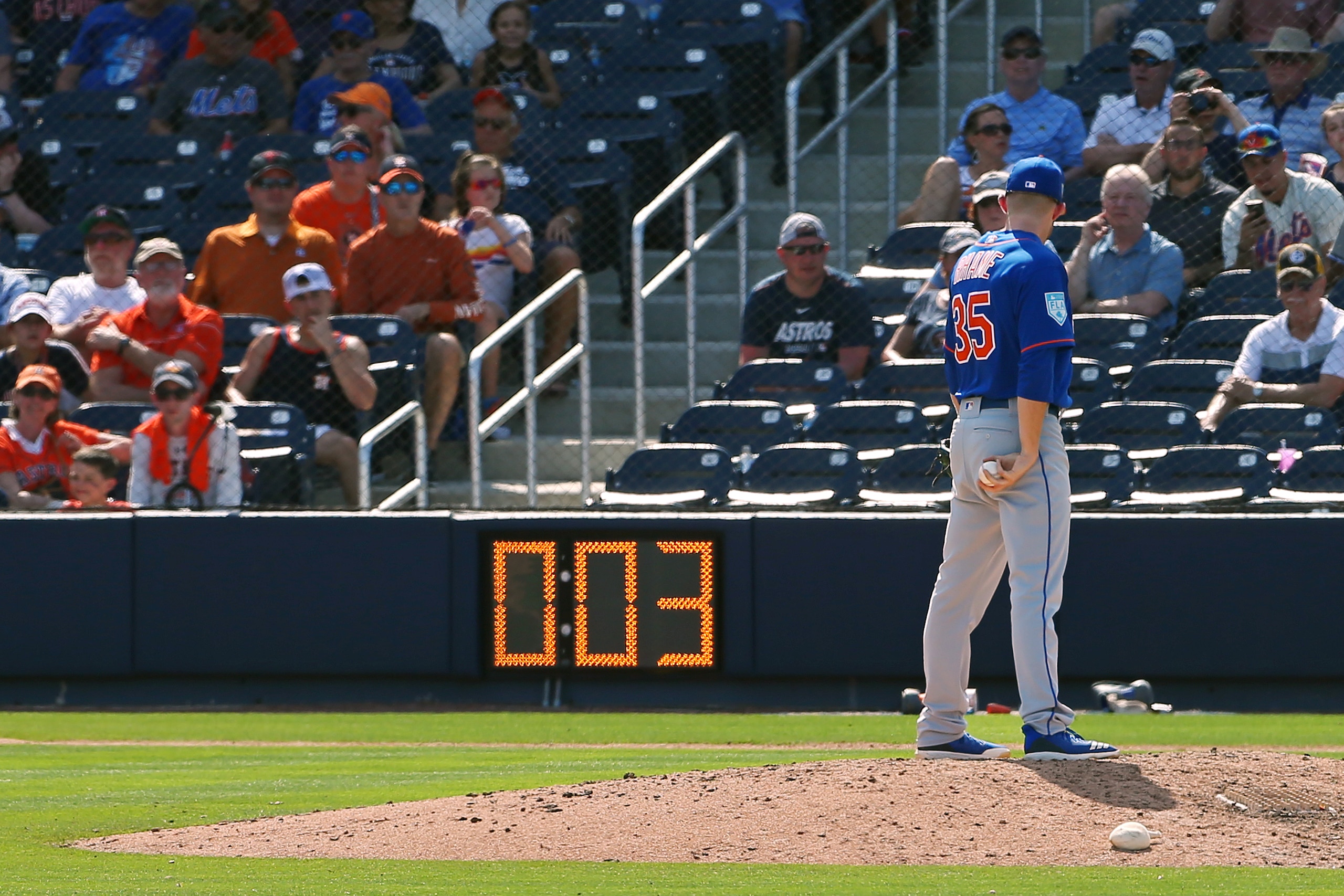
When MLB and the MLBPA were negotiating the CBA, ESPN's Jesse Rogers reported the league was hoping to implement a 14-second pitch clock with no runners on base and a 19-second pitch clock with runners on base.
"The two numbers were settled on after experiments in the minor leagues, including in low-A in 2021, in which game times were cut by about 20 minutes," Rogers wrote. "The minor leagues used 15-second and 17-second clocks, but MLB determined less time was needed for pitchers with the bases empty and more time with them occupied, according to sources, hence landing on 14/19."
The base sizes will be increased from 15 square inches to 18 square inches.
Eric Ingles of MLive.com noted MLB found the larger bases reduced the amount of injuries suffered by players and slightly increased the success rate of stolen bases.
Increasing the rate of stolen bases would also help MLB to increase offensive output across the league.
The automatic strike zone was first used by the independent Atlantic League, an official MLB partner, in 2019. MLB began using it last year in Low-A Southeast minor-league games and the Arizona Fall League.
Per MLB.com's Mark Feinsand, an 11-member Joint Competition Committee of four active players, six MLB-appointed members and one umpire will be formed with the goal of adopting rules changes for the league.
The earliest any of these potential changes could go into effect is 2023.


.jpg?w=2560 "NFL investigating 2 referees for separate viral exchanges")

.jpg?w=2560 "Report: Chiefs Contact Hill's Agent")
.jpg?w=2560 "OBJ Calls Out Giants 😳")
.jpg?w=2560 "Tyreek makes another cryptic post amid Chiefs rumors")