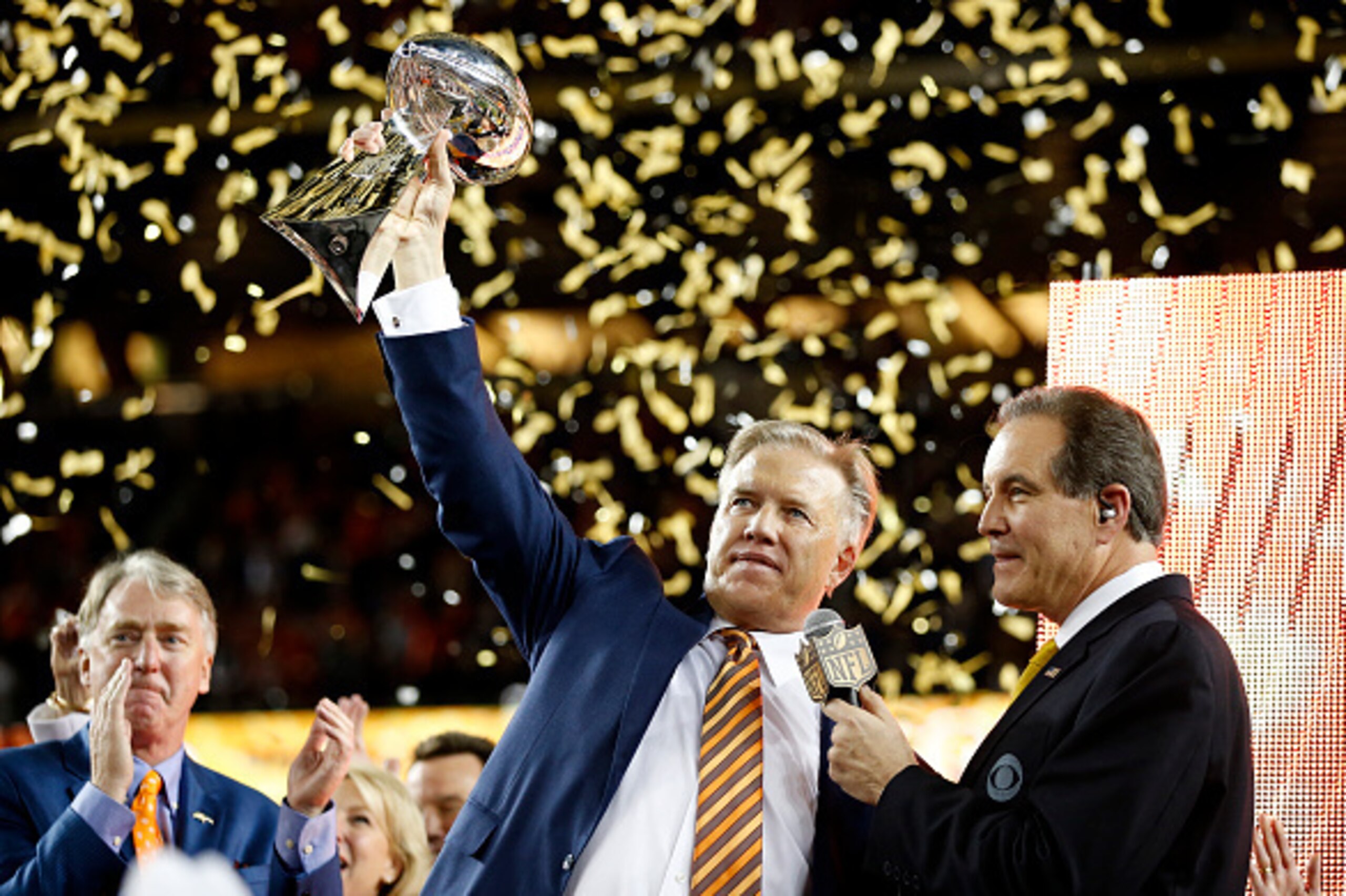
DENVER — John Elway is unique, even among the unique.
In the 50 years of the Super Bowl era in the NFL, there have been 31 quarterbacks to help their team win a title. Of those, 24 are retired. Of the 24, only Elway, Bart Starr and Doug Williams have ever tried to work for a team in an executive or coaching capacity.
Only Elway has had any real success, and based on his ceaseless desire to compete, he has no intention of stopping anytime soon. In five years with Elway as general manager, the Broncos have gone to the playoffs each year, made the Super Bowl twice and are now the defending champions.
TOP NEWS
NFL legend announces Parkinson's diagnosis
Caleb, Maye Put on Show ⚔️
.jpg?w=2560 "Rams Football")
Puka Dealing with Calf Injury
At the same time, the team faces the challenge of having to replace quarterback Peyton Manning and backup Brock Osweiler after Manning retired and Osweiler left in free agency.
Elway talked with Bleacher Report about this offseason and why he keeps going at a time when most of his contemporaries rest on their laurels.
Bleacher Report: So coming off one of the great highs of your career in winning a Super Bowl as an executive, you get the challenge of finding a new quarterback.
John Elway: There are challenges every year. That’s why this year in free agency and all that, there are challenges every year trying to keep things together. So that’s always a challenge. Was it a big surprise that we were in that situation? Yeah, because I thought…we drafted Brock [Osweiler] when we got Peyton [Manning] because we didn’t know exactly what Peyton was going to be. But also, if [Manning] wasn’t in good shape, we were going to a guy who was going to be here for a long, long time. Now, that didn’t work out, so it was a matter of, you have to fix the issue. There are going to be issues every year.
B/R: But you sat back and let this play out quite a bit when other people in your position might have panicked. The search for a complete solution went on for almost two months.
JE: Well, the first thing we did is we got Mark [Sanchez] and I feel good about Mark. So by getting Mark—and we’re a lot higher on him than a lot of people are—so once we landed Mark and he was here, we felt better about the situation. It was a matter of bringing somebody in for competition. But of the guys who were out there at the time, there were no difference-makers. So why would I overpay for a guy who wasn’t going to be a difference-maker?
B/R: Place this accomplishment of winning a Super Bowl in perspective with what you did as a player and even as an executive in the Arena Football League?
JE: As a player, you’re invested a lot more physically, so that’s why it’s a lot tougher. You’re right in the middle of it and you’re getting hit and you’re going through it physically. So it’s a lot more difficult. So the feeling of finally being able to get that done is, it feels like a great accomplishment. I would say as a GM, it’s more of a satisfying feeling that you were able to put the right people together because they’re the ones who ultimately do all the work. It’s satisfying to be able to put a team together and give them the best chance to be successful, whether it’s the players or coaches. Again, that’s why it’s satisfaction. Even though you’re setting the standards, it’s other people who are doing the work.
B/R: Right, I get that, but out of the 24 quarterbacks who have won Super Bowls and are now retired, you’re one of only three men to even try to work for a team again as a coach or executive. What you’re doing is extremely rare. The only ex-player of your caliber who has done anything like this is Ozzie Newsome. Most guys stand on laurels in your business.
JE: It’s a great challenge. I enjoy the competition side of it. That’s what made me as a player, that competitive side to it. That doesn’t go away just because you retire from football. The physical side of the game goes away, but the mental side doesn’t go away. For me, I’ve been just as competitive in the business world as I was on the field. I think the competitiveness helps me in this job because it’s about winning. Every decision we make is about trying to put the best football team on the field and win championships. So when guys come here, they know we’re here to win football games and not just pay people a lot of money. There are high expectations here. I think that always starts at the top. That’s how [owner] Pat [Bowlen] was before and it filtered down here and I just carry it on for him. The expectations, I believe, are a lot higher here than a lot of other places.
B/R: But that passion burns really hot for you. That desire hasn’t gone away at all and a lot of people lose that once they’re no longer playing. I can hear and feel the passion when you talk. These things are incredibly meaningful to you.
JE: They are because I take this job with great responsibility. If it’s not that important for me to win then that’s going to be passed down to everybody else that it’s not that important to compete. The competition is important. That’s why we do this. I really don’t need the money. I do it because I like to compete. I do it because I like to see the scoreboard on Sunday. I like those report cards, and in football, they come every Sunday.
B/R: But it’s really freaking hard, and it’s so hard that a lot of people who have accomplished what you have done as a player don’t try the coach or executive side. It’s one thing to like to compete. It’s another thing to put in all the work that’s required to do it. I’m always curious with you about where that comes from because even among a group of unique people, you are unique.
JE: Where does it come from? I don’t know. Maybe my dad started it back when he used to time me going to get his slippers back in the third grade (laughs). Set a world record every time. That’s what kept me going back to get them the next time.
B/R: So it was an imaginary clock.
JE (smiling): I didn’t know that. Back then you believe anything they say. I enjoy being good at what you do. That’s what I enjoy. Maybe later in life, am I going to have a tough time scaling it back when I stop doing this? Maybe.
B/R: Can you even scale it back?
JE: I don’t know. At some point, we’re going to find out.
B/R: I think that’s a long way away.
JE: Let’s hope so. There are challenges and expectations, and because this business is so big and where it has gone…there are people who say you can’t do this and you can’t do that. That’s the great thing about this business. I get motivated by people saying I can’t do something and that’s all they ever say in this business. You really think about it.
B/R: Well, the odds in this business are always stacked way against people. A lot of great plans and hard work fail in this business. The easiest bet in the world is that something people do in football is not going to work.
JE: There are so many things that you can’t control. That’s why as players you can control a lot more. That’s why it’s so important to have good players because the players ultimately control the outcome. Second in line are those coaches. That’s why it’s so important for them to have all the resources. I enjoy giving those resources because I was a player and my dad was a coach. I understand both sides of that.
B/R: You understand it better than most.
JE: Because I played and I know what I like in coaches, what was successful and what I saw, how things worked. Being a player and being in a locker room has helped me, gave me a big advantage being in the position I’m in. That’s why I think Ozzie is so good at the position he’s in. He’s been in the hunt before. I think players respect that because you’ve been there.
B/R: Do you still keep your relationship with players at arm’s length because of the position you’re now in?
JE: Somewhat, yeah, and because the last thing I want to do is give the coaches away. That’s what you pay the coaches for. I have relationships with players, but it’s not just one that can, in my opinion, be like being a teammate.
B/R: It can’t be close like that.
JE: No, it can’t. I have a lot of relationships with a lot of guys and that’s important and I enjoy that. But it’s also, unfortunately, the tough part about this business is that you insert agents. Because football is about team. It’s about teammates, and as soon as you start talking about money with an outsider, it’s about the individual. That’s the big difference between pro ball and college ball. In college ball, they’re all making the same amount of money—nothing. Or a scholarship. So those are the outside forces that make it hard.
B/R: Have you ever even tried to turn off the passion to compete?
JE: I’ve never really even tried. I got out of football for a couple of years and then I got into the Arena League.
B/R: You tried golf and you even toyed with the idea of going pro in golf.
JE: Nah, I knew that was never really going to happen. Everybody talks about a scratch golfer being able to make it in the pros. Those pros are not scratch golfers. That was always a realistic understanding of mine that I wasn’t going to be able to golf with those guys. That was something I never thought I was going to do. I never really said it. Other people would say it, but look at [former baseball player] Rick Rhoden on the senior tour. He has won the [Lake Tahoe American Century Celebrity Golf Championship Tournament] five times. He’s leaps and bounds better than any of us in that and he couldn’t make it on the senior tour. That kind of puts it in perspective.

B/R: In the past, quarterbacks who were taller than 6'5" weren’t considered great risks. It was primarily because of lack of mobility. Joe Flacco obviously broke that trend and you’ve now drafted two quarterbacks (Osweiler is 6'8" and Paxton Lynch is 6'7") with that size. Tell me why that’s changing?
JE: Better athletes. It’s like anything. You talk about tall golfers, too. People say you have more moving parts, or at least longer moving parts. Yeah, it’s a lot more moving parts when you throw the ball. It’s longer. They get out of sync. That’s kind of the old view. Dan McGwire is the only other really big one I can think of. Other than that, how many were there that didn’t work? Peyton is 6-foot-6. They’re getting bigger. Naturally, they are getting bigger, and they’re getting more athletic.
B/R: Is Lynch exceptionally athletic?
JE: Oh, he is. He’s very consistent with the way he throws it, the release, all that stuff. Very consistent and athletic. He can move around.
B/R: So he’s perfect for this offense?
JE: Oh yeah, you hope so. You think so. But you never know until you get out there and see what happens. But we feel good about him and, like I said, I feel good about Mark. I think he’s got a chance.
If a guy is talented who can move around and do different things…he’s had success in the playoffs. He’s been to the AFC Championship Game. He has won playoff games. Those are all things that you wonder about guys who haven’t done it and you don’t know how they will react when they get there. He’s proven he can do that.
Has Mark ever been in the perfect situation to prove what he can do? A lot of times, quarterbacks don’t get in the right systems that fit them. That’s a big part of this. So I think this is the type of offense that will benefit Mark and knowing what they did in New York and what they did in Philadelphia. He moved all around. You get him with the right coach in the right system and good people around him and you have a little chance.
.jpg?w=2560)