

Stubborn Seahawks Need to Change, Not Tune Out the 'Haters'
"Hold Me Back" by Rick Ross became an unofficial theme song for the Seahawks during their rise to contention a few years ago. Here's a link to the NSFW number. Seahawks players grooved to it from the parade podium after the Super Bowl. They sometimes dance to it on the field during timeouts. The chorus (to the toned-down remix, anyway) repeats a simple message like a hip-hop mantra:
These haters can't hold me back.
These haters can't hold me back.

.jpg?w=2560 "Steelers Saints Football")
.jpg?w=2560 "Rams Raiders Football")
These haters can't hold me back.
That's the prevailing attitude in Seattle after the Seahawks' 2-4 start. The defending two-time NFC champs are just going through a rough patch, losing games on a play here and a play there against some top-tier opponents, but the haters gotta hate by shoveling dirt on them.
It's an attitude echoed by Earl Thomas during Monday's media sessions. "Man, this is great, really. It is a part of the story. We are going to outlast this. This is why we are in this position in the first place. This is why we are the best, you know. These situations, they are not going to break us."
The Seahawks think they have the haters, the doubters, the naysayers and the NFL right where they want us.
There's only one problem: These "haters" are not, in fact, holding the Seahawks back. Superior opponents are holding the Seahawks back. The Seahawks are holding themselves back. Objective reality is holding the Seahawks back.
Thomas may say the Seahawks are "the best," but their offense ranks 17th in the league in points per game and 15th in yards per game. Their defense, their power train and calling card, ranks 11th in points allowed per game and fourth in yards allowed per game. The numbers, not the haters, place the Seahawks in the middle of the pack—the high middle, perhaps, but a long mile away from "the best."
The Seahawks are losing at home. They are getting beat in the fourth quarter. Two straight opponents have challenged the Legion of Boom late in the game and won. It was almost three straight, but Calvin Johnson fumbled at the goal line, and the refs played rulebook roulette with a batted touchback.
The Seahawks do not need to tune out the haters and weather the storm. It's time for listening and learning and adjusting.
Suddenly Stubborn
Oh no, another national columnist has climbed down from his East Coast Mount Olympus to psychoanalyze a football team based on a couple of quotes, some hearsay and their choice of hype music.
Yes, I am aware the Seahawks don't spend team meetings kissing each other's Super Bowl rings. They are working hard to get better. I am also aware that athletes must think of themselves as champions to become champions, and that haters-gotta-hate, us-against-the-world cliches are standard motivational tools used by every sports team in America.
But the Seahawks are showing the telltale signs of an institutionalized arrogance that rots away the core of great teams as surely as the salary cap and free agency conspire to sap talent and teams like the Falcons siphon away quality coaches.
"Arrogance" is a fighting word. How about "stubbornness"? The Seahawks rose to the top by not being stubborn. They elevated Russell Wilson over Matt Flynn, gave starting opportunities to a bunch of late-round nobodies like Richard Sherman, installed an option-happy offense and rode that "gadget" all the way to the Super Bowl. The team that tried all the new ideas three years ago now acts like it has all the right answers.
Stubbornness makes a team go out of its way to downgrade its offensive line by trading Max Unger and letting James Carpenter leave as a free agent, then ignore the line until the fourth round of the draft. Stubbornness addresses a talent drain at wide receiver that has gone on for years by snagging a 5'10" return man—a great return man in Tyler Lockett, but not an instant-impact offensive weapon—in the third round.
The Seahawks front office and coaching staff had so much success developing players like Sherman and plugging spare parts into their system that they got carried away with it. They even allowed the Legion of Boom to grow thin: They signed Cary Williams to replace Byron Maxwell (a downgrade) and have not drafted a defensive back in the first four rounds since Earl Thomas in 2010.
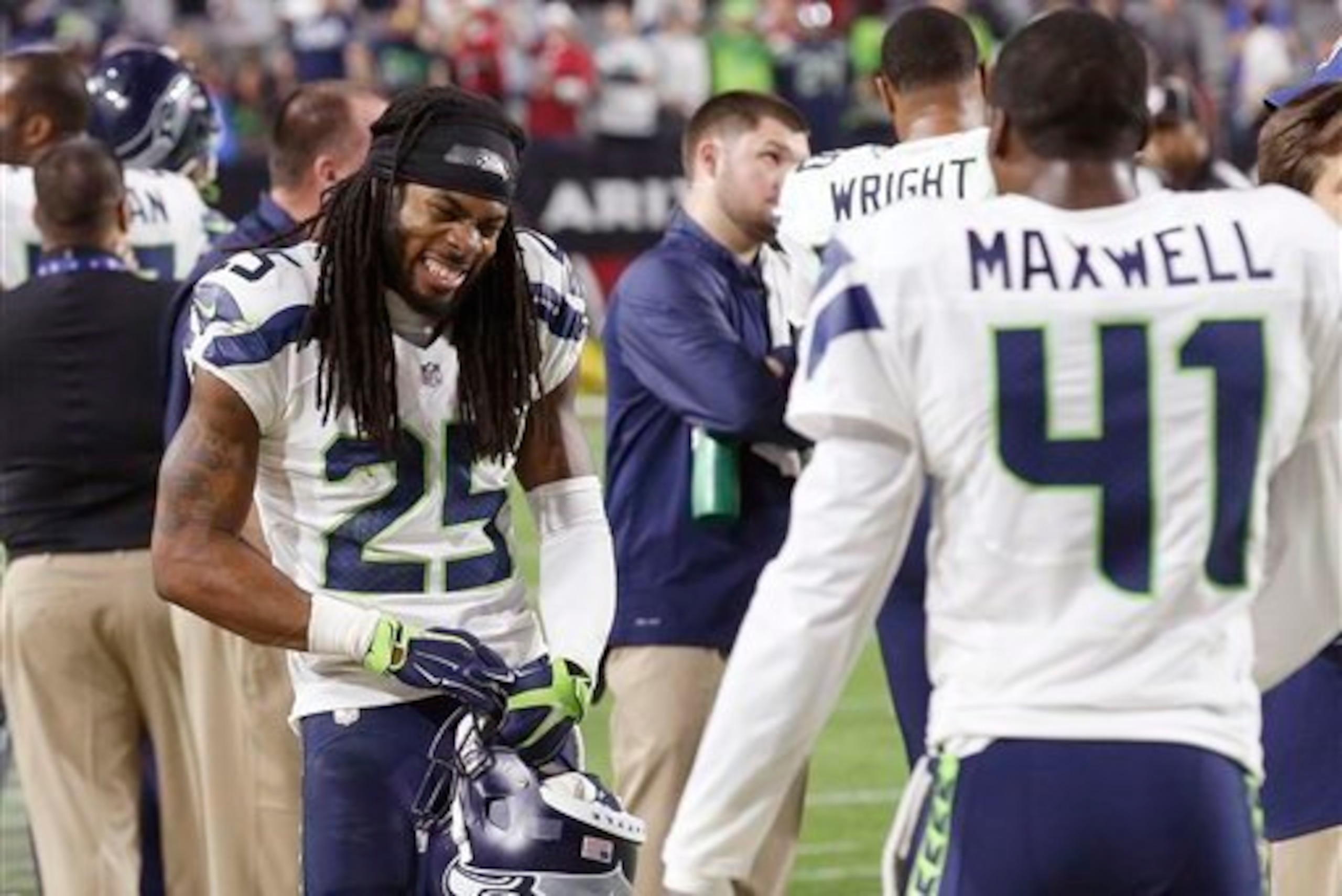
Stubbornness caused the Kam Chancellor situation: Even with the Legion depleted, the Seahawks chose to play financial hardball with a key player during a Super Bowl window. It felt good to declare "problem solved" when Chancellor returned and helped mop up the Jimmy Clausen-led Bears, even though his absence directly contributed to the Rams loss and was a factor in the Packers loss.
But Chancellor did not solve all of the Seahawks' problems.
He played poorly against the Bengals, missing tackles and assignments. A miscommunication in the secondary doomed the Seahawks in Sunday's loss, but there was more to that defeat than one Greg Olsen touchdown. Opponents are picking on Williams. They are seeking out nickel defender DeShawn Shead.
Sherman can be seen going for interceptions instead of breakups or tackles (and of course, you almost always know which side of the field to find Sherman on, because the Seahawks aren't into the whole "matchup corners" concept). Big holes sometimes open up in zones so Cam Newton and Devin Funchess can look like Aaron Rodgers and Jordy Nelson.
The Legion of Boom did not practice together at full strength all summer. They are now expected to pitch weekly shutouts. They are not playing at peak capability, and it shows in the fourth quarter, when the weak Seahawks offense keeps putting the mighty defense on the field to protect dwindling leads.
Stubbornness results in a failure of internal quality control. According to NFLGSIS.com, the Seahawks defense has recorded just one sack in the last three fourth quarters, plus overtime against the Bengals. The offense has converted just four third downs in the fourth quarter/overtime in the last three games. Wilson has been sacked six times in these situations.
The Seahawks were playing with the lead for virtually all of their last three fourth quarters. It's easy to see why they coughed up two of those leads and needed a fumble and a blown call to save the third. Their offense not only couldn't retain possession, but it often ceded field position (and once gave up a strip-six touchdown) through sacks. The defense then failed to mount much of a pass rush, letting Matthew Stafford, Andy Dalton and Cam Newton look like comeback maestros.
This is an end-of-game strategy issue that is solved during coaching meetings. It's an issue that should have been solved after the Bengals loss. The problem is that Pete Carroll and his staff haven't made a good late-game decision since there was a minute left in the Super Bowl.
Attitude Adaptation
Carroll never comes across as particularly stubborn or arrogant—not by the standards of NFL head coaches, anyway. He cited legendary UCLA basketball coach John Wooden during a press conference this week as he explained his philosophy for dealing with adversity.
"Coach Wooden told me one time that every year the players change," Carroll said. "You don't change your philosophy, you don't change your approach, because the players adapt as they go through their years, and things fit together. So you always stay with what you believe in."
Carroll then quickly amended Wooden's don't-change approach: The hardwood icon never had to coach unheralded prospects as they grew into millionaire superstars forced to adjust to opponents who placed them in the crosshairs and sussed out their weaknesses. "We have to be adaptable and fix and help and communicate and counsel all the way through all of that," Carroll said.
Adaptability is the key, and it starts at the top. Carroll and his coordinators can't do much to fix the roster right now, but they can fix the fourth-quarter play-calling and decision-making: More blitzes perhaps, or a return to the option-and-screen game that tore opponents apart in 2013 but hasn't been seen as much since Percy Harvin left town.
Carroll can also fix a mindset.
The Seahawks aren't handling their role as a perennial powerhouse very well. No, this isn't about the tabloid versions of minor car accidents or Wilson and/or Sherman's appearance in every third commercial on television. It's about internalizing the reality that records don't carry over from 2013 and 2014. Reputations don't either—not in the NFL. But weaknesses, the little mistakes and tendencies that opponents spent the offseason pinpointing and scheming to attack—those carry over, unless you spot them first and work overtime to fix them.
"Maybe they should bag that tradition," wrote Dave Boling of the Tacoma (Wash.) News Tribune about the "Hold Us Back" dance. A symbolic gesture like that might be worth it. Tuning out haters is fine. Ignoring all criticism and advice is bad. The entire organization needs to make sure that's not what they are doing.
It's not too late for the Seahawks to change. They just need to realize they have to.
Mike Tanier covers the NFL for Bleacher Report.
.jpg?w=2560 "Cowboys Packers Football")
.jpg?w=2560 "Titans Ravens Football")

.jpg?w=2560 "🚨 Week 8 AP Top 25 Poll")


.jpg?w=2560 "Mahomes Told Teammate to Leave Meeting")