

Why FB Henry Hynoski Is Still Critical to the NY Giants Offense's Success
For years, it has seemed that the so-called death of the fullback position in the NFL has been grossly exaggerated.
Or has it?
It’s a valid question if one considers how the fullback position has evolved over the last few years—especially regarding the New York Giants, who still employ a pure fullback in Henry Hynoski but didn’t use his skills as much last year.
.jpg?w=2560 "Saints Giants Football")
According to the depth charts kept by OurLads, only 22 teams list a starting fullback. What’s even more interesting is that only 12 of the 16 teams in the AFC East, NFC East, AFC North and NFC North—divisions where frequent inclement weather late in the season would usually warrant having a power-running game—are listed as carrying a fullback on their rosters.
Why the decline in keeping a pure fullback? Simple: The days of the brute-force fullback, the big 260-plus-pound bruisers with the ability to knock a guy into next Tuesday, have disappeared thanks to the spread offense taking hold in the NFL.
In its place is a hybrid—a player who can still block the big boys at the point of attack and at the second level, but who can also make use of his hands as a receiver out of the backfield to discourage linebackers from cheating in.
In other words, a tight end.

When it comes to the Giants, head coach Tom Coughlin hasn’t been so quick to eschew having a pure fullback on his teams, even though the conversion to a hybrid West Coast offensive system saw Hynoski’s snaps drop from 428 in 2012 (his last 16-game season) to 209 in 2014, a 52 percent reduction.
The reason for the drop has to do with a heavier reliance on the tight ends, who of course are assumed to be better receivers—though that point is probably debatable where the Giants are concerned.
With offensive coordinators looking to keep opposing defenses guessing, the tight ends are now being asked to perform not just the in-line blocking but also some of the responsibilities that used to belong to the fullback.
The following table breaks down the Giants' 2014 run-game snaps for the tight ends and Hynoski to illustrate that point:
| Larry Donnell | TE | 889 | 294 |
| Adrien Robinson | TE | 77 | 53 |
| Daniel Fells | TE | 434 | 274 |
| Henry Hynoski | FB | 209 | 167 |
The numbers shown in the above table alone certainly would be a good starting point if one were to argue that Hynoski—Pro Football Focus’s second-highest-graded run-blocking fullback by the way—should be removed from the equation.
Eliminating Hynoski from this year’s offense would not be in the Giants’ best interest because while his role might have diminished in terms of snap counts and responsibilities, there are two areas on offense where his old-school blocking style can help make life a lot easier for his team.
Inside the Giants' 20-Yard Line
When a team is pinned deep in its own territory, ideally it looks to create some breathing room by running the ball. This is because running the ball decreases the odds of a turnover and an easy score for the opposing defense.
Here is an example taken from the second quarter of New York's Week 17 game against the Philadelphia Eagles. The Giants were facing a 1st-and-5 from their own 10-yard line:
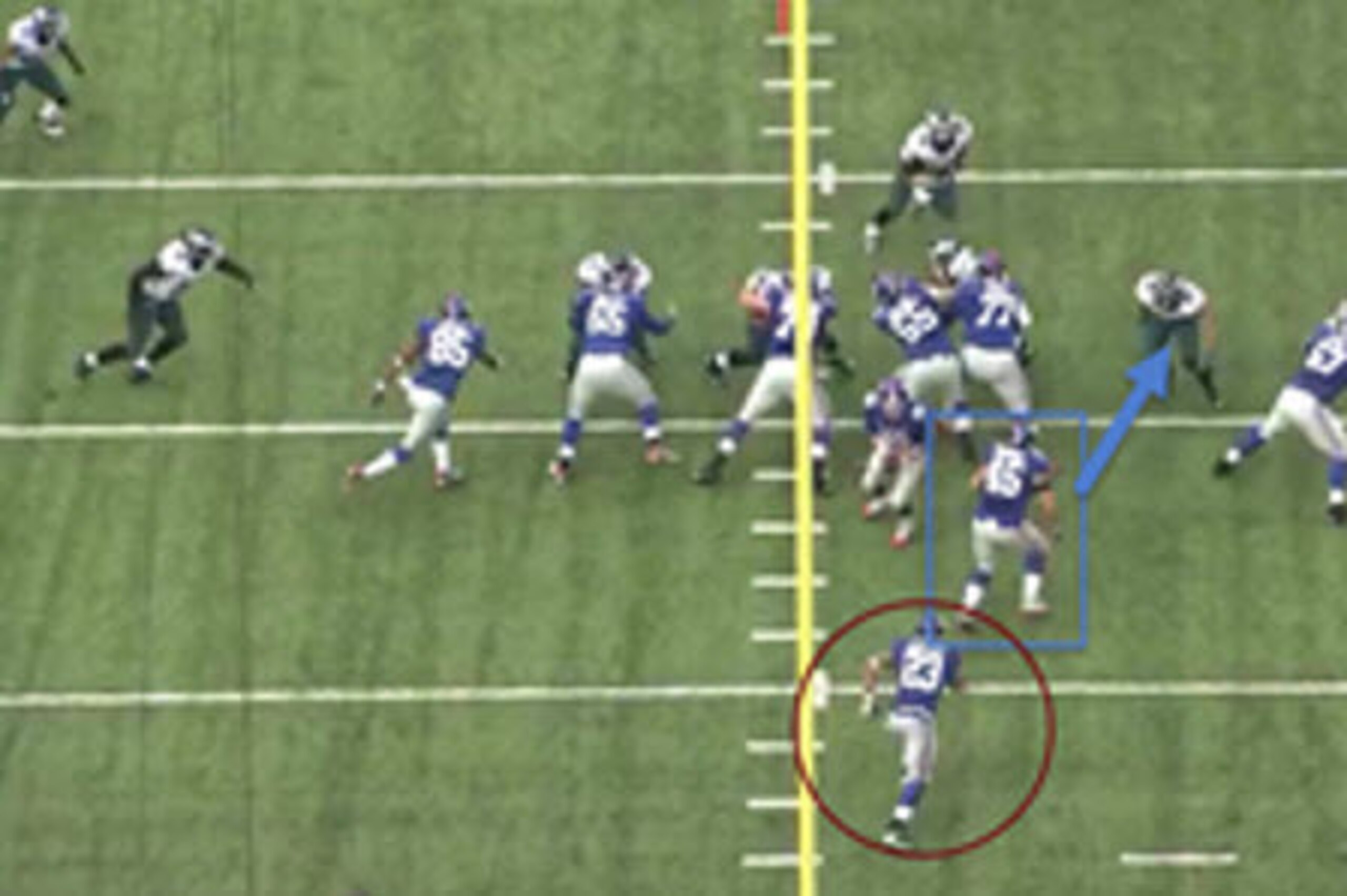
On the play, a five-yard rush by Rashad Jennings, Hynoski (blue square) steps into a hole to seal off a linebacker.
If Hynoski doesn’t make this block, which was a textbook-looking play on his part, Jennings (red circle) is guaranteed to be dropped for a loss of yardage:
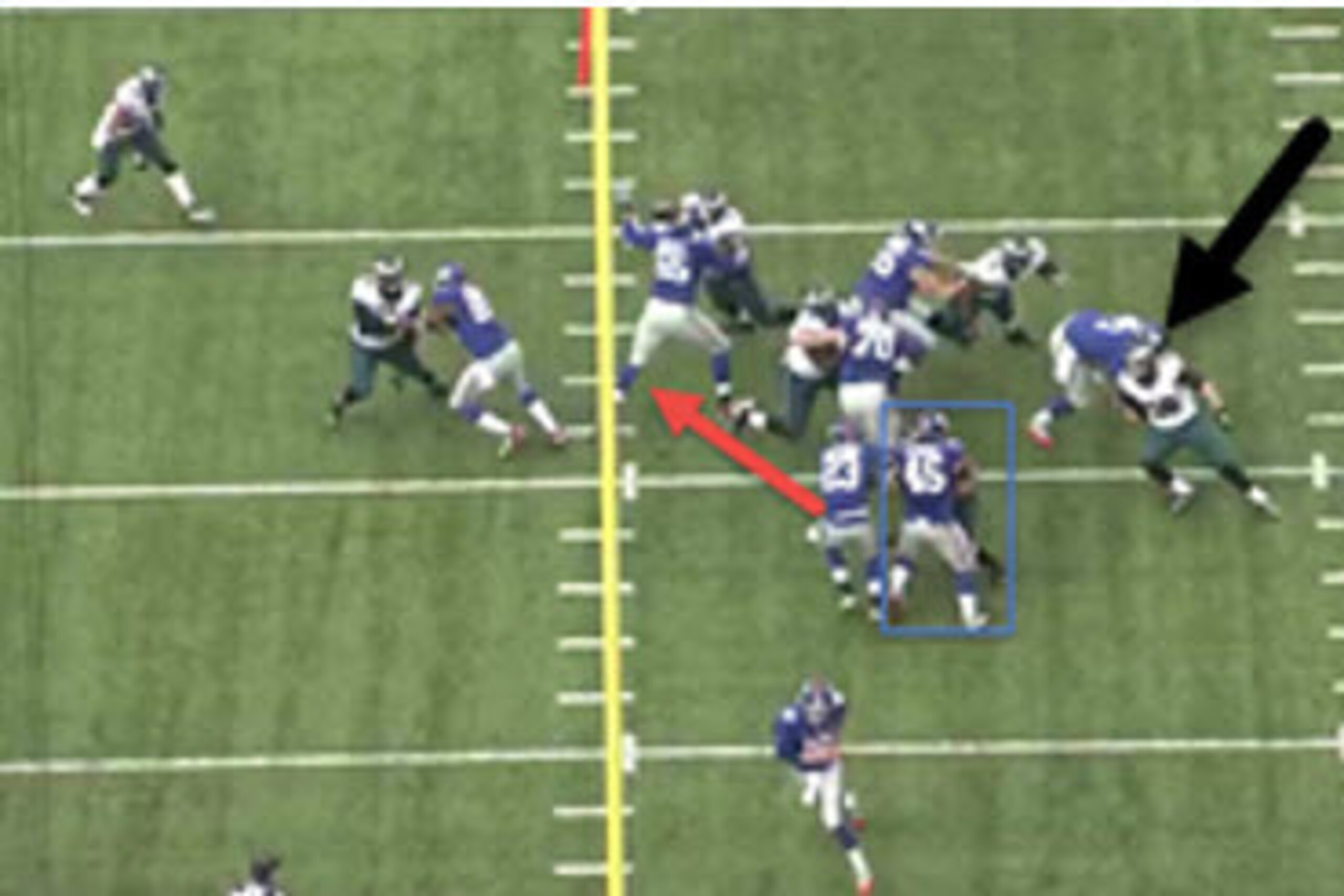
In the above frame, notice how Hynoski has created a solid base and has not only squared up against his man but stonewalled him. Jennings, meanwhile—who initially began to follow Hynoski’s lead block—changed direction after seeing John Jerry (black arrow) beaten at the point of attack.
Goal-Line Situations
The NFL might be a pass-happy league—and certainly watching receiver Odell Beckham Jr. make a defensive back look foolish as he snags a pass from Eli Manning and streaks his way down the field unabated might be the biggest thrill of late for Giants fans—but when it’s all said and done, it comes down to the trenches.
Take for instance goal-to-go situations. Last year, the Giants had 34 such possessions where it was the end zone or bust. On those possessions, they scored 31 times, 26 of which were touchdowns, according to the team’s year-end stat book.
Nine of those scores came on rushes of five or fewer yards, and of those plays, Hynoski was on the field to contribute in six of them.
Let’s look at one of those goal-line contributions, this one on a two-yard touchdown run by Jennings:
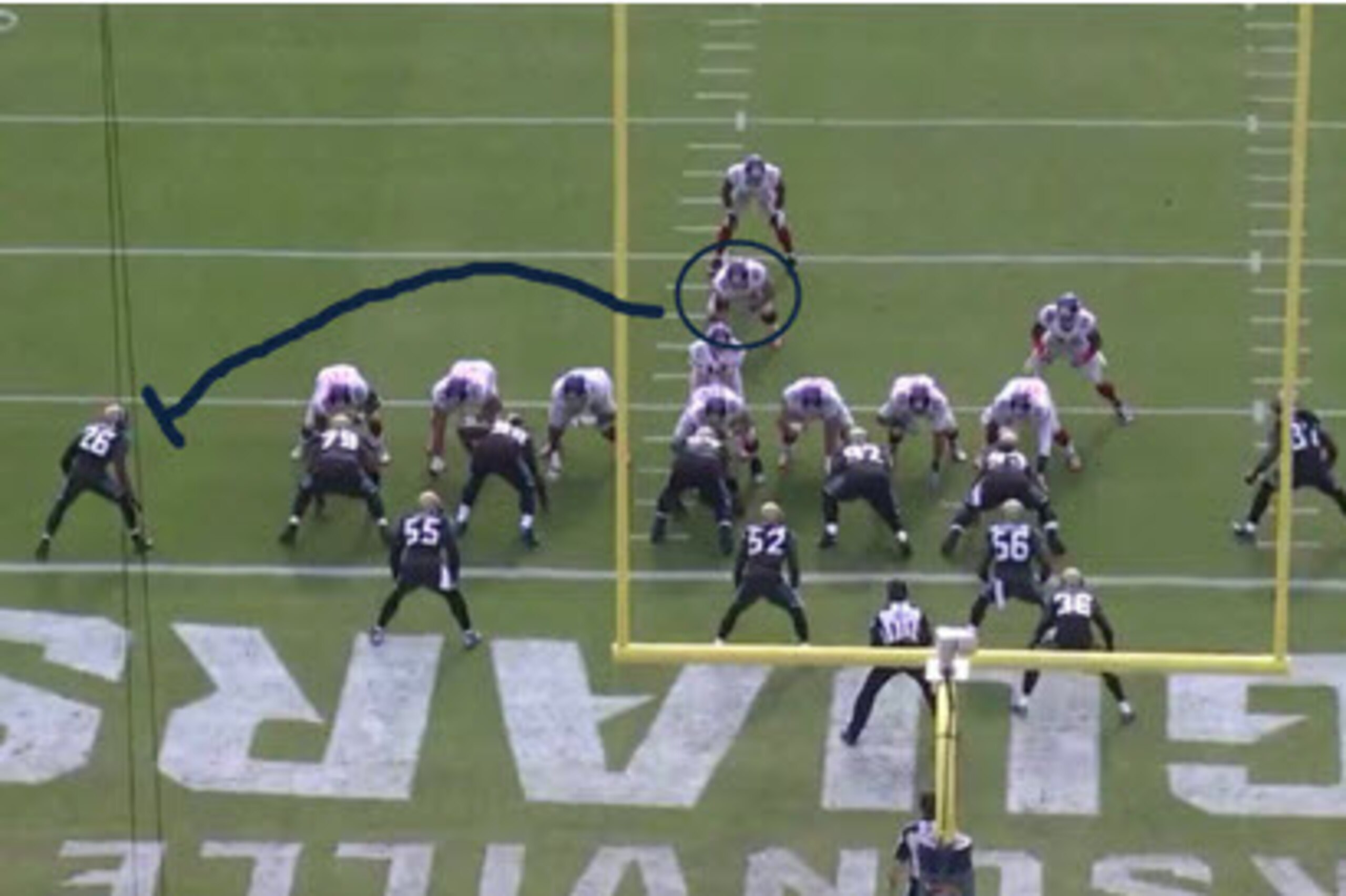
Hynoski, who is in the I-formation, seals off safety Josh Evans, the uncovered man on the weak side:
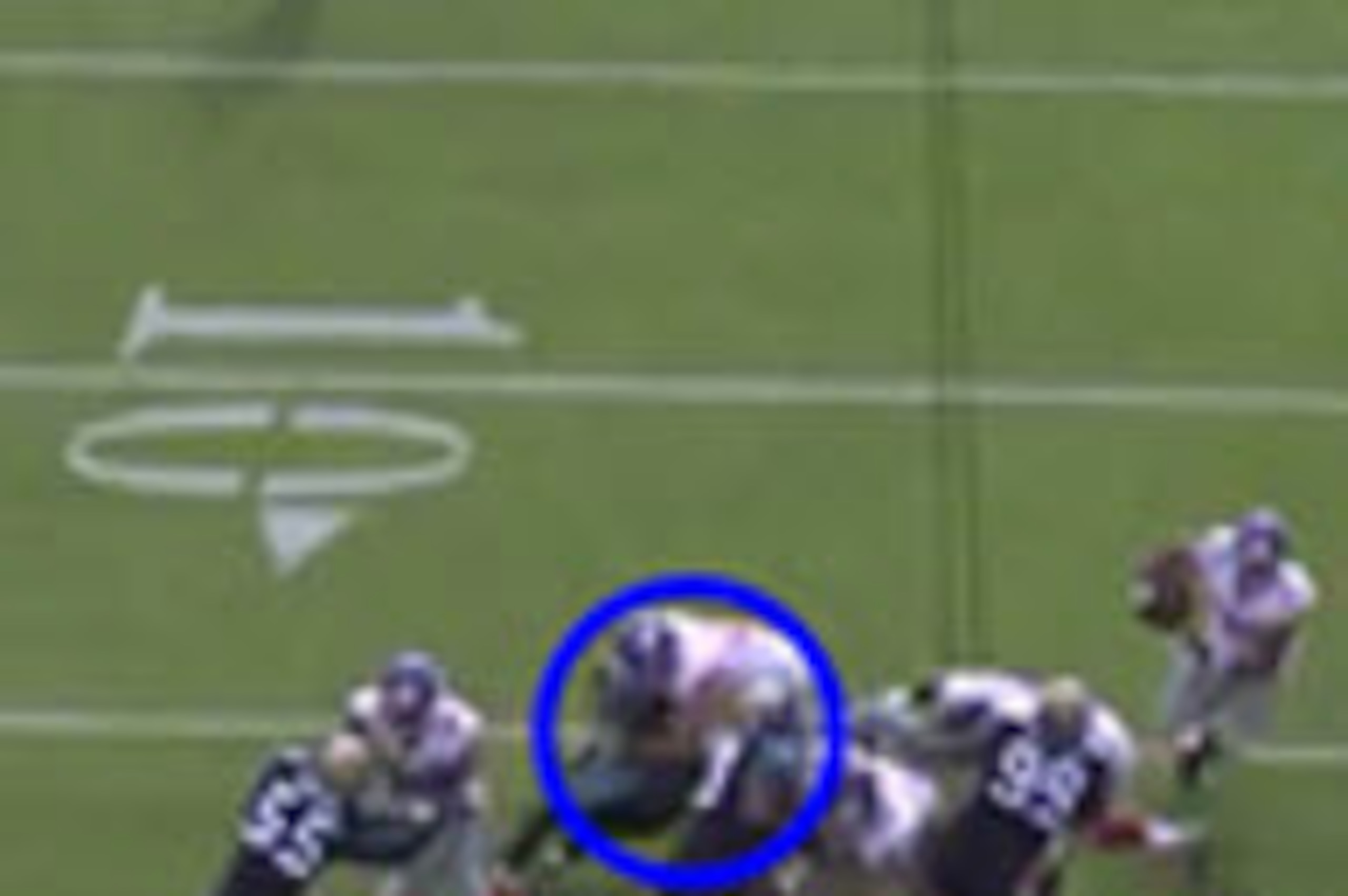
As usual, “Hank the Tank” gets his man, on this play folding Evans like an accordion. Jennings, who spots the crease up the middle, decides not to follow the lead blocking of his fullback and actually had to work a little harder to get into the end zone.
Had Jennings followed Hynoski’s block (and that of tight end Daniel Fells on linebacker Geno Hayes), Jennings might have been able to score more easily.
Long Live the Fullback?
It’s worth noting that the last time a Giants tight end had a better run-blocking grade than Hynoski was in 2012, when Martellus Bennett's plus-8.6 bested Hynoski’s plus-2.4 mark.
Despite his reduction in snaps, Hynoski made every one count when he was on the field.
Named to USA Football’s 2012 All-Fundamentals Team thanks in part to his attention to detail with his fundamentals and knowledge of his assignments, Hynoski is about as cerebral of a player as one will find on the Giants.
There is also another factor to consider. While Hynoski might not have the speed of a tight end given his bulk, his pass-receiving ability—which for some odd reason was not put on display last year—is comparable to that of his tight end teammates.
| Hynoski | 35 | 24 | 68.5% | 138 |
| Fells | 172 | 108 | 62.7% | 1,274 |
| Donnell | 92 | 66 | 71.7% | 654 |
With that said, the Giants made a minimal financial commitment to Hynoski for the next two years.
According to Over the Cap, the two-year, $2.1 million deal Hynoski received in March only includes $500,000 in guaranteed money, half of which is his signing bonus and the other half of which is part of his 2015 base salary.
In the second year of his deal (2016), Hynoski is due to earn a base salary of $1.025 million.
While not a gross amount of money compared to some of the other inflated earnings one might see on a football team, no Giants fullback has ever made it to a contract year that paid out more than $1 million in base salary.
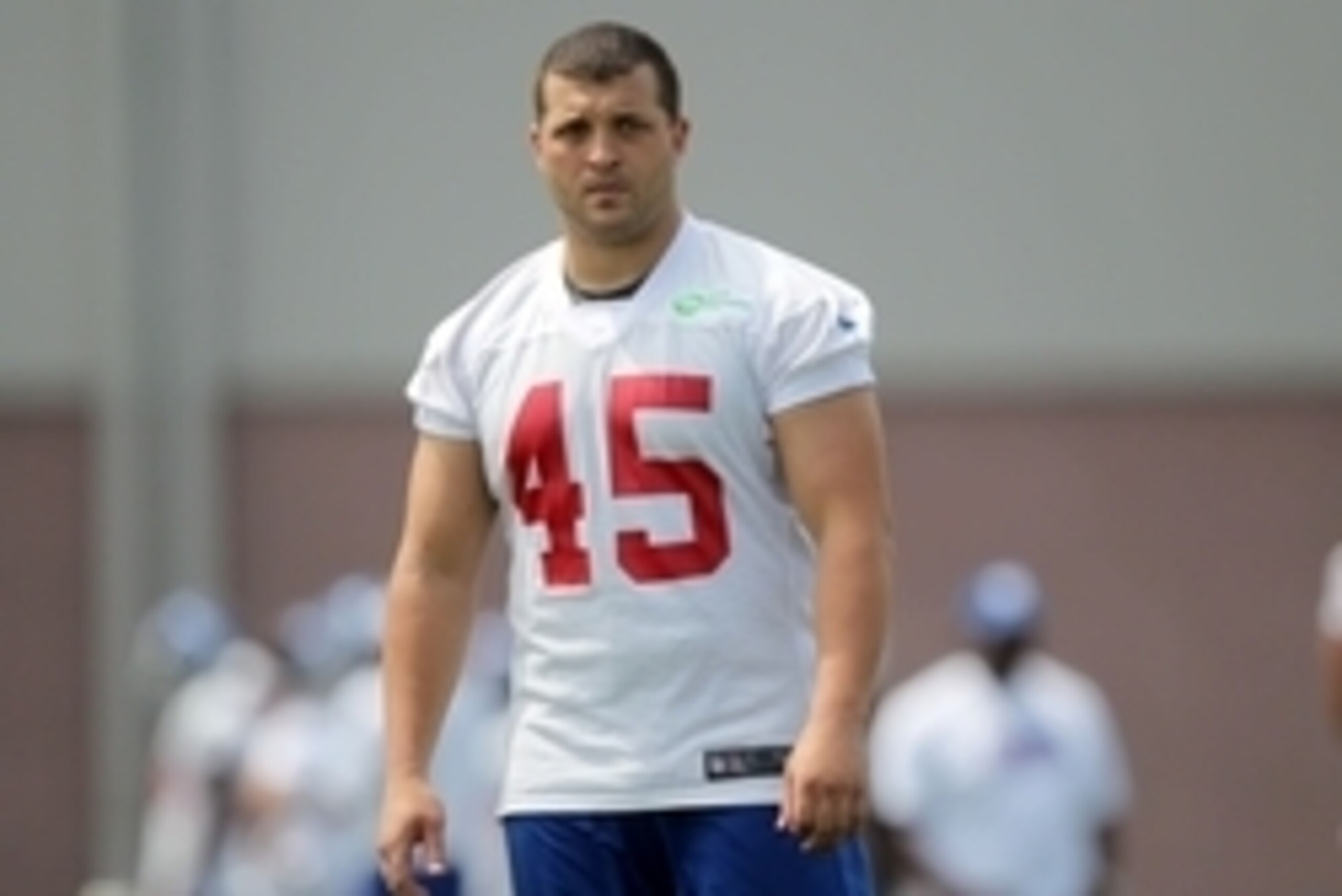
Will Hynoski be the first? That obviously won’t be answered for a while yet, and it could all depend on what happens with the tight end situation.
The Giants added two intriguing youngsters to the tight end competition: Matt LaCosse of Illinois and Will Tye of Stony Brook.
LaCosse in particular is someone to keep an eye on because he played a little bit of everything—including fullback—in college for an offense that averaged 3.7 yards per carry (413 rushes on 1,527 yards) and posted 16 rushing touchdowns.
If LaCosse makes the team and shows he can block from the fullback spot and stay healthy as well, there is the chance that by next year, he might get that “slash” role in the offense.
If nothing else, Hynoski—a gentleman off the field but a scrapper on the field—isn’t going to make it easy for LaCosse or anyone for that matter to unseat him, which is a big reason why he’s been so successful thus far in his NFL career.
Unless otherwise noted, advanced analytics and player grades via Pro Football Focus.
Patricia Traina covers the Giants for Inside Football, the Journal Inquirer and Sports Xchange. All quotes and information were obtained firsthand unless otherwise sourced.
.jpg?w=2560 "Vet FAs Who Can Help Contenders")