

Wimbledon Upset Shows Rafa Nadal's Old-School Style Is Losing Effectiveness
Long before Rafael Nadal was packing up his gear in his second-round Wimbledon loss to Dustin Brown, it was clear that the Spaniard was out of his element once again. Make that out of his proper time.
The easy charge is that Nadal is too broken down or old to keep dominating tennis. It’s a discordant tune that will become a tiresome chorus each and every time he loses at majors. But perhaps a greater factor is that the ATP tour is no longer the same arena of combatants and styles. The way that players are winning is different, and Nadal’s old-school style, just a half decade removed from being cutting-edge, has become the anachronism.
.jpg?w=2560)

It’s the way of change or progress for people and institutions, and tennis is no exception. A few years ago Nadal could impose a more methodical style and pace to control his opponents. He could seemingly bend time and slow clocks.
Now the whole world has accelerated as if it’s in a hurry to assimilate culture and sports into a world of faster technology, polarizing comments, social media and athletes who want to play faster than ever before.

Tennis 2015
The ATP is bolder and more aggressive, spawning more quick-strike athletes who accept the risk-reward, all-or-nothing kinds of incentives that are taking place in men’s tennis.
Nadal is having a hard time keeping up with the explosive nature of the flamboyant athlete, guys like his most recent Wimbledon conquerors “electric” Brown and “charismatic” Nick Kyrgios, who embody more of the professional basketball “boom” mentality that is chipping away at old-school baseline warriors like Nadal:
Attack early and finish quickly. Every shot is a potential force for power and immediate winning. Don’t let the baseliners turn it into a yawner. Make ‘em run on defense and cut ‘em off with something bold. Then scream like you’re primeval.
Nadal, well known for his tics and routines, is a rhythm player, bonded by years of training and preparation to impose his style and way of playing. For several years, he’s been the most important force in tennis in how the game has been played.
The Foreshadowing
In January 2014, there were plenty of rumblings and concerns about slow court speeds and what needed to be done to speed up the game at the Australian Open. And that tournament was a kind of symbolic transition for a superstar like Nadal who was dominating the tour and looking to win his third major in four attempts (and perhaps four of five when we include winning the 2014 French Open).
That 2014 Australian Open semifinal saw Nadal punch out a masterpiece against more elderly rival Roger Federer. Then, just as suddenly, as if his back were the cause of pushing him into the Twilight Zone of a new era, he was knocked around by Stan Wawrinka’s bold, go-for-broke mentality. Never mind that Wawrinka was a year older than Nadal. It was the way that he swung from his heels, scoffing at percentages and paradigms that had been established by the likes of Nadal and Novak Djokovic.
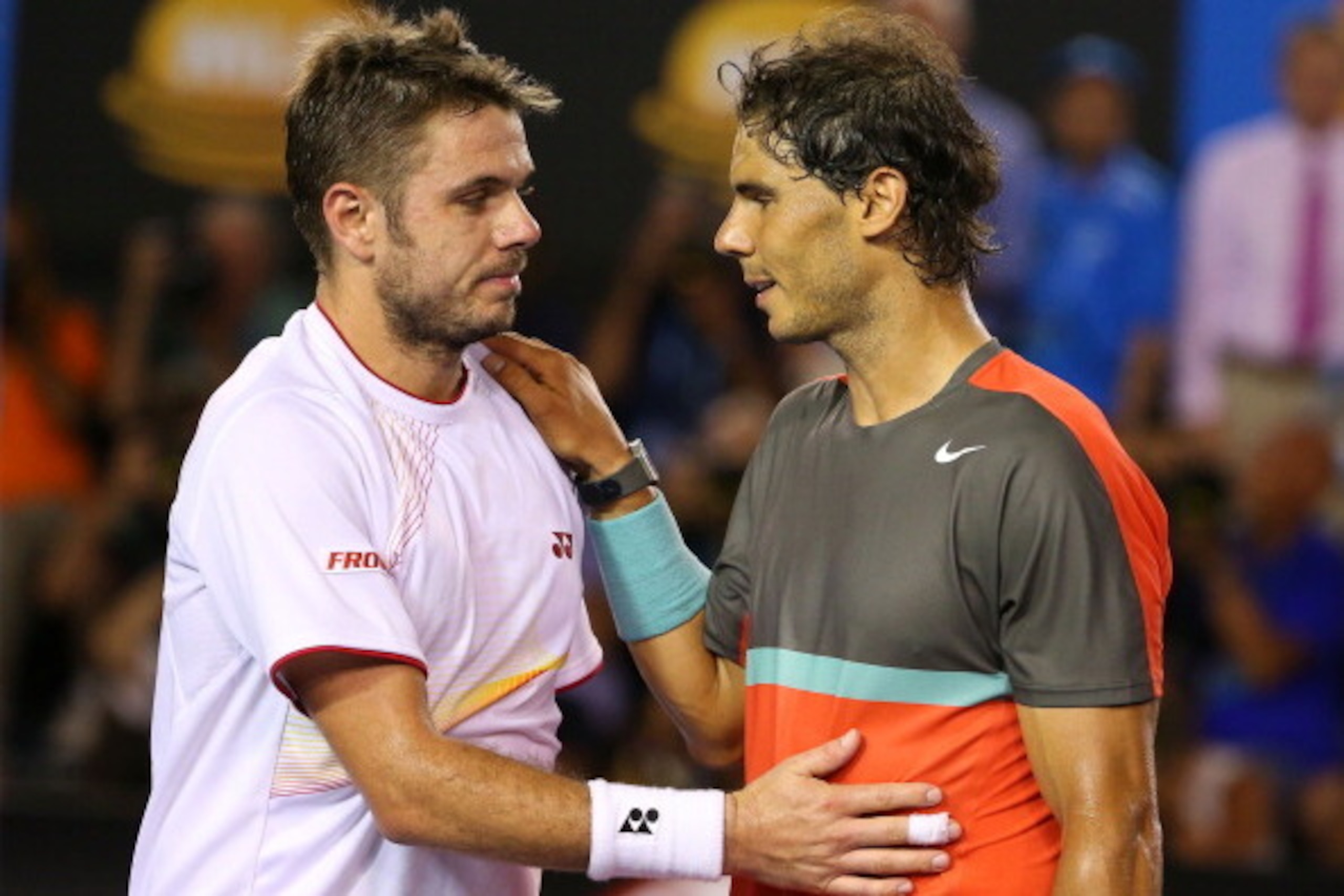
There have been other signs that bigger servers and quick-strike tennis would be rewarded. Lightweight Alexandr Dolgopolov whacked his way past Nadal at Indian Wells in 2014. Wawrinka, Kei Nishikori and Marin Cilic experienced more success with their quick-strike approaches over the subsequent months, and they represented more of the alternative attacks that are slowly if not appreciably having greater success on the tour.
There’s no question that Wawrinka’s 2015 French Open title has shown that yesteryear's most dominant champions can be vulnerable to a risky, big hitter. Expect more of these opportunities to come.
Maybe highlight players like Grigor Dimitrov will click into gear when they discover the rewards to offensive strikes. Perhaps young Kyrgios will find paydirt with his raw athleticism and improvisational attacks. Is there a better chance that a big server like Milos Raonic will find success in the near future? It’s a spirited kind of approach if not completely established or very consistent, yet.
The Reality
So there was Nadal, gamely trying to fight back against another explosive talent, a journeyman not even ranked in the top 100, but nevertheless a dangerous opponent who could certainly be acclaimed as a grass-court specialist. Nadal, by comparison, was in slow motion, as if even his stubborn attempts to control time and pace between serves simply had no more effect on his opponent's energetic nature.
Even when Nadal tried to reply with some quick play of his own, he was awkward at times, pushing volleys sideways and long off of the court, and then not exactly in rhythm to execute more than a handful of passing shots. Truth be told, Nadal was not bad, just out of touch, outdated and unable to play like it was Wimbledon 2010.
It’s not that Nadal is unaware of his predicament. He has tried to finish points quicker, but this does not play to his strengths and past familiarity on how to win. In the past he’s upgraded his strings, and recently he’s tried to play with a new racket, but it’s tough. He’s trying to change weapons and fight in a new terrain.
The immediate outlook is not so promising. Nadal’s Wimbledon ship sailed four years ago, and it’s going to be awfully tough at the U.S. Open Series and into the fall where deep draws of fast-paced players are brandishing bigger tools with visions of global conquests. BBC Sport noted this remark from Nadal:
Nadal is presumably healthy and fit, and he’s had plenty of time to look at old blueprints and contemplate adjustments (see U.S. Open 2013). He understands that the wind is blowing in a more offensive direction, but it’s hard to keep up.
Old habits die hard, especially with aging champions who must fight against the currents of time.
The Spanish superstar has a few years of winning tennis left in the tank, but it might be less about his age or the wear and tear. Can he upgrade what he did in 2013, finding the right blend of baseline aggression and effective serving?
Where once the tour was exclusively about beating Federer, Djokovic and Andy Murray, Nadal must now also keep up with the likes of Wawrinka, Brown, Kyrgios and others who can bring a less predictable and more uncharted, albeit inconsistent, nature to tennis.
Nadal must adapt his old-school style into the wrinkles of the future, and perhaps he will still find a few more championship windows to break down.

.jpg?w=2560 "Titans Football")

.jpg?w=2560 "Rookies Who Could Earn Starting Job ⭐️")