Why the Miami Dolphins Should Consider Benching Brian Hartline
With Week 9 and the halfway point of the NFL season quickly approaching, the Miami Dolphins find themselves at a critical juncture in their season. At 4-3, the Dolphins have been inconsistent with their play and must start to execute at a high level to surge down the remaining stretch of games to reach the playoffs.
Winning five games in the remaining nine contests is far from impossible for Miami, and that total would put the Dolphins in the thick of the playoff discussion. A total of nine wins could also save the jobs of the Dolphins’ coaching staff, which piloted an epic collapse at the end of the 2013 season with the playoff-clinching game in its hands.
.jpg?w=2560 "Chargers Mack")
.jpg?w=2560 "Green Bay Steelers Football")
.jpg?w=2560 "Giants Football")
To attain a 9-7 record or better, the Dolphins offense has to become more consistent and explosive. Many factors will go into this goal, including better offensive line play and more consistent red-zone production from quarterback Ryan Tannehill. But the most glaring weakness for the Miami Dolphins offense each week has actually come from the most accomplished Dolphin, Brian Hartline.
Hartline has produced well for a former fourth-round pick, having more career yards than all but three receivers taken from the 2009 draft class, per Pro-Football-Reference.com. His back-to-back 1,000 receiving yards in 2012 and 2013 was just the fifth time that has happened in Miami’s storied franchise history and is nothing to be shrugged off.
In 2012 and 2013, Hartline was one of Tannehill’s two favorite receiving targets, earning an average of 132 targets each season. His normally sure hands led Omar Kelly of the Sun-Sentinel to nickname Hartline as Tannehill’s “blankie” because Tannehill would always look to Hartline in pressure situations.
"Brian Hartline shall now be referred to as "The Blankie" because of how much Ryan Tannehill relies on him. He's clearly his safety blanket.
— Omar Kelly (@OmarKelly) August 6, 2013"
His value to the Dolphins was apparent when former general manager Jeff Ireland rewarded Hartline with the 20th-highest contract for a wide receiver, per Over the Cap. Hartline excelled in former offensive coordinator Mike Sherman’s scheme, which lacked complexities that would make Miami’s offense more formidable.
Under offensive coordinator Bill Lazor, the Dolphins have established an offensive identity as a run-centric team that assaults the short and intermediate parts of the field when passing. Miami’s offensive play-calling has gone from 65 percent passes in 2013 to a more balanced 57 percent, per Team Rankings. That leaves Miami with the 20th-most passing plays in the NFL.
With less passing plays per game, the Dolphins receivers are getting fewer opportunities to make an impact. There has been no player who has taken a bigger step back than Hartline, at least statistically. Take a look at the chart below, which projects Hartline’s production for the remainder of the season if his pace continues.
| 2009 | 56 | 31 | 506 | 3 |
| 2010 | 73 | 43 | 615 | 1 |
| 2011 | 66 | 35 | 549 | 1 |
| 2012 | 131 | 74 | 1,083 | 1 |
| 2013 | 132 | 76 | 1,016 | 4 |
| 2014 | 80* | 45* | 491* | 2* |
We can see that Hartline is headed toward major declines in targets, receptions and yards gained. Looking at this data is easy, but figuring out exactly why Hartline has seen this dip is a difficult task.
Hartline had suffered a torn PCL in his left knee in the Dolphins’ final game in 2013, according to Adam H. Beasley of the Miami Herald. But his injury didn’t require surgery, instead healing with time and rest. That’s important because fellow Dolphins receiver Brandon Gibson did show rust when he returned from his knee injury.
But Hartline’s struggles do not seem to be stemming from any lingering damage, at least in a way that can be seen on film.
To figure out why Hartline is struggling to be the same consistent threat for the Dolphins I went through every Dolphins game this year and charted every route. Along with that data—and some other indicators—the Dolphins should absolutely consider reducing Hartline’s snaps as the No. 2 receiver for the remainder of the season.
Route Productivity
Route productivity is a term specially created for this study and describes how often a receiver is open at the top of his route. At this time, there is no baseline data to compare Hartline to, but the data below helps show Hartline’s struggles as an outside receiver this season.
In order to justify being a starting wide receiver, Hartline needs to be able to create consistent separation from the cornerback by the time Tannehill reaches the top of his drop. If Hartline is not open or at the apex of his route, Tannehill must either move on to his next read or choose to wait until Hartline reaches his spot. For a rhythm-based offense, Hartline must be reliable.
One area that Lazor’s offense significantly differs from Sherman’s is the use of deeper routes. Since Miami’s offensive line has improved (especially the tackles) since last year, Tannehill has been able to take deeper drops in the pocket, which allows the receivers more time to get open. As Tannehill hits his fifth step, the ball has to come out, or he must climb the pocket and buy time.
A five-step drop will usually include a 9 route (a go route), a deep post or a deep in route to the middle of the field. That route should force the safety to react, drawing two defenders to one player. The other receiver then is more likely to see single coverage on a complementary route, which gives better chances of a completion.
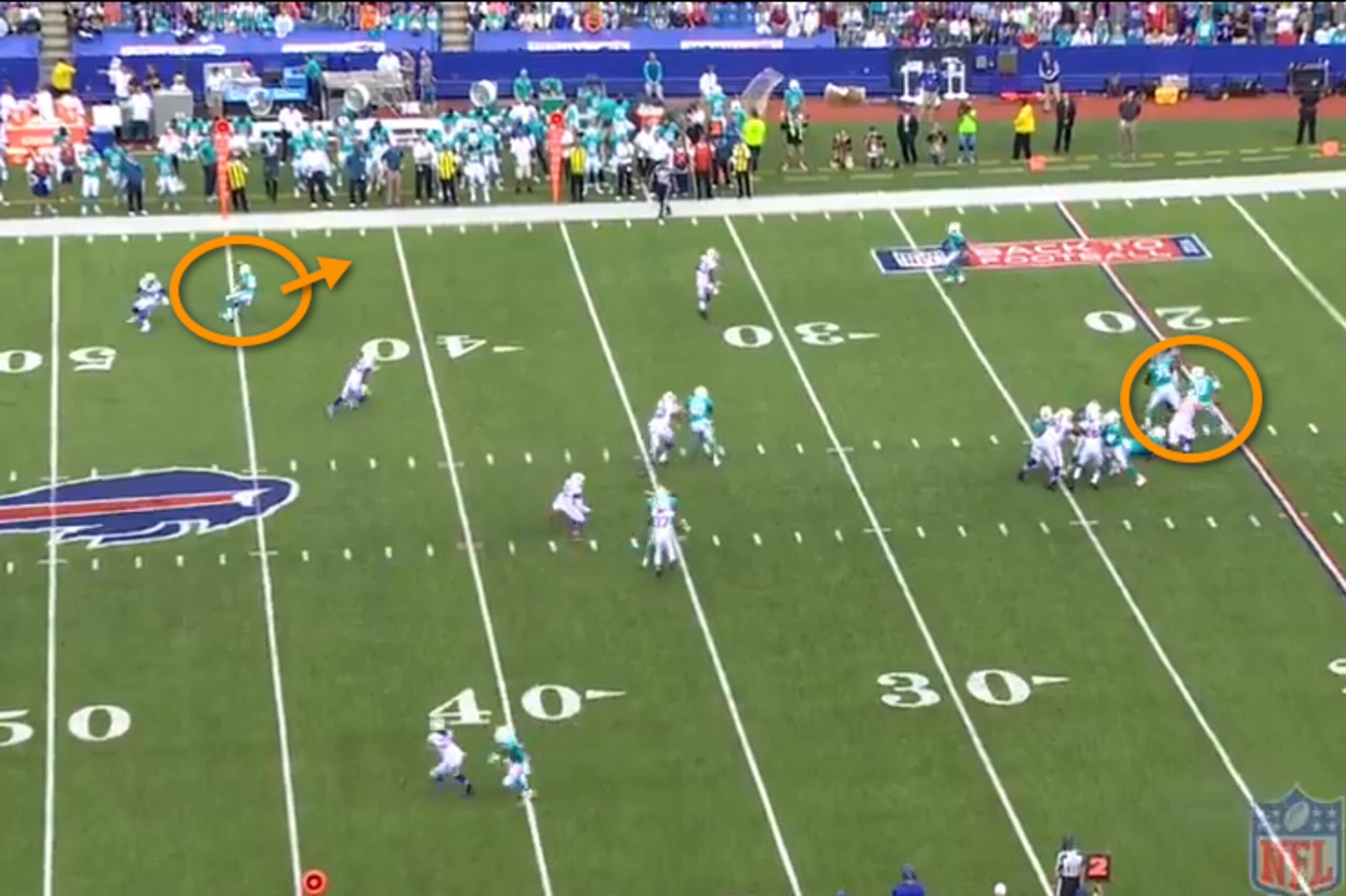
Mike Wallace is by far the best receiver Miami has on the roster, and his ability to stretch the defense always draws the attention of the safety, leaving the other side of the field with one-on-one matchups. That’s where Hartline must win against coverage, and he has to be open at Tannehill’s progression point.
At most, three reads on a five-step drop can happen. For example, that would be Wallace, Clay and then Hartline. If Wallace and Clay are covered, Hartline has extra time to get to his spot on the field and must be in an advantageous position against the cornerback.
Take a look at the table below, which shows every route ran by Hartline through Week 8.
| Route Ran | No. of Times Open | No. of Attemps | Open Percentage |
| Quick In/Out (1) | 4 | 11 | 36% |
| Slant (2) | 8 | 16 | 50% |
| Comeback (3) | 7 | 16 | 44% |
| Curl (4) | 7 | 21 | 33% |
| Deep Out (5) | 1 | 7 | 14% |
| Dig (6) | 5 | 23 | 22% |
| Corner (7) | 1 | 12 | 7% |
| Post (8) | 1 | 11 | 9% |
| Go (9) | 6 | 39 | 15% |
I’ve taken out any clear-out routes that only serve a purpose to open up underneath screens and any plays that were obviously not more than a dump-off pass.
We can see that Hartline primarily runs go routes (called a “9”), dig-routes (“6”) and shallow crossing routes. The percentage listed above is not how often he’s targeted, but it is how often he creates at least one yard in separation or is in an advantageous position against coverage.
Although there isn’t a baseline of all No. 2 wide receivers to compare to Hartline, the fact that he’s created space on just 27.5 percent of all of his routes this season is disturbing.
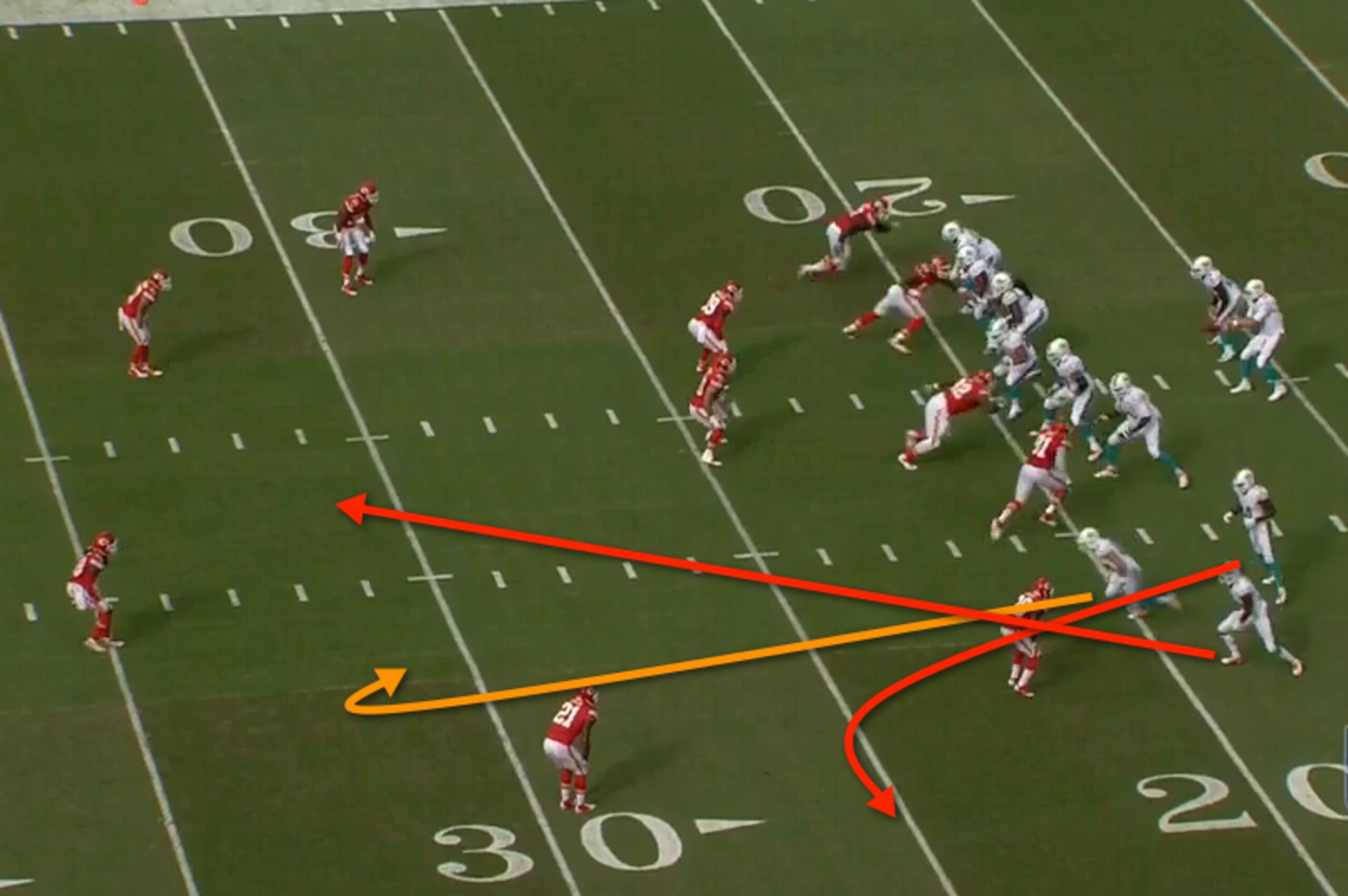
He’s been able to perform on comebacks, slants and crossing routes this year, but his inability to be a threat past 10 yards has hampered the offense’s ability to push the ball downfield. According to Pro Football Focus (subscription required), Hartline is averaging .90 yards per route run, which ranks 85th out of 87 qualifying players in the NFL.
If Hartline were excellent after the catch, there’d be more credence to why he’s been on the field for 431 plays this season. His 61 yards after the catch rank 150th in the NFL, and he’s tied with Daniel Thomas, who has only been active four games for the Dolphins this year.
Separation
On film, Hartline is neutralized early and often at the line of scrimmage. Cornerbacks are often lined up directly on Hartline, forcing him to either break press coverage or use his feet to get the cornerback to overcommit one direction. Hartline does not have the foot speed or lateral agility to be effective in this regard, and cornerbacks sit until he breaks downfield.
With Hartline having to waste steps to try to win at the line, valuable seconds are wasted, and he rarely is at the apex of his route when Tannehill is looking for his status. Although Tannehill could try to anticipate and lead Hartline open at times, those passes are extremely dangerous when a receiver has one speed and cannot make an athletic play on the ball.
The disappointing part of Hartline’s usage and performance has been how often Lazor has Hartline run deep. The vertical routes help clear out the safety and cornerback so that the slot receiver or tight end has a better chance to be open underneath. But, the receiver should occasionally win those go routes to keep the defense off balance, and Hartline has utterly failed to do so.

Surprisingly, Hartline has not been a good route-runner this season. He’s consistently not sharp in his cuts, instead rounding them off and allowing the cornerback to jump on the inside of his deep in routes across the middle of the field. It’s not fair to say this is a lazy tactic; rather it seems Hartline knows he needs to play faster than he physically can.
When Hartline wins off the line of scrimmage, he’s very good at staying open. But he is so poor at beating press coverage and outmuscling his opponent that he’s taken out of too many plays just as his route begins.

Hands
The epitome of why Hartline was an effective player in past seasons was undoubtedly his hands. He was more dangerous as a receiver and was targeted often because he rarely made a costly drop. Per PFF, his drop rate of 6.17 percent in 2013 was a respectable 19th in the league. 2014 has yielded much different results, as Hartline has four drops and the eighth-worst drop percentage with a 16.67 percent mark.
The official drops statistic is usually more forgiving than not, as Hartline had at least two drops in the Jacksonville Jaguars game alone, so the fact that Hartline has been so unreliable is worrisome. If a possession receiver cannot provide a steady presence, then that player is essentially wasting valuable snaps for an offense.
On the two passes Tannehill has targeted Hartline deep, Hartline dropped a touchdown against the Buffalo Bills and failed to make a play on an interception by Sam Shields of the Green Bay Packers. Hartline lacks the athleticism needed to make catches in tight coverage, especially on vertical routes, and it really hinders the offense useless on 3rd-and-long situations.
Hartline’s hands have never been in question like now, so it begs the question of whether these problems are occurring due to concentration issues or a lack of confidence. Either way, for Hartline to be a productive member of the offense, he needs to show that he deserves to be a bigger part of the game plan.
He’s not a legitimate decoy receiver like Wallace was in 2013 since he only requires one cornerback to smother his routes.
Other Options
As deep as the Dolphins are at wide receiver, only Mike Wallace brings a different dimension to the group. Hartline, Gibson and Rishard Matthews are all similar players, fitting the possession-type mold. None is very athletic or brings significant coverage mismatches.
Jarvis Landry has established himself as the Dolphins’ slot receiver for the foreseeable future. He could play outside, but his toughness, hands and ability to create more yards are sorely needed in the slot.
Although Gibson has had his fair share of consistency issues this year, with two official drops (again, seems low), he’s got the physical profile and experience to be outside receiver in place of Hartline. He was able to play well with the St. Louis Rams in his time there despite bad quarterback play.
Miami could also use Rishard Matthews, who seems to be in Philbin’s doghouse but has been solid in every opportunity he’s received the last two seasons. Matthews has good balance and hands and will at least be more proficient at catching the ball than Hartline has been this year.
The point of this study certainly was not to scapegoat Hartline for the offensive inconsistency that Miami has had, but rather to figure out why his production has slipped so much. Saying that he is just not a fit in Lazor’s offense is somewhat correct, as he does not possess the speed needed to make defenses give him special attention.
At the crux of Hartline’s issues is that he is not a gifted enough athlete to be what the Dolphins so desperately need, which is an alpha-male wide receiver (like Dez Bryant). Hartline has a role on any roster when he’s running better routes and catching the ball, but the reality is that role should be the third- or fourth-best receiver on the team, not the No. 2.
Miami will have to improvise and rotate between other options at Hartline’s position. He’s deserving of some role and snaps, but as long as he continues to receive the majority of snaps as the X receiver, the Dolphins will struggle creating explosive plays.
All stats used are from Pro Football Focus' Premium Stats (subscription required) or Sports-Reference.com.
Ian Wharton is a Miami Dolphins Featured Columnist for Bleacher Report, contributor for Optimum Scouting and analyst for FinDepth.
.jpg?w=2560 "Seahawks Cardinals Football")
.jpg?w=2560 "Commanders Cowboys Football")