Rookie Anthony Barr Emerging as a Defensive Force for the Minnesota Vikings
One of the most important factors in the steady improvement of the 2014 Minnesota Vikings defense is the emergence of rookie linebacker Anthony Barr. His play has not only been a big positive for the unit, he is certainly exceeding expectations at such an early stage in his career.
Though the Vikings drafted Barr in the top 10, projecting immediate returns as a rookie seemed too hopeful for a number of reasons.
Inexperience was the first. Coming into his rookie season, Barr had played a grand total of two seasons on defense in college. He transitioned to that side of the ball from the offensive backfield after his sophomore season. Even then, Barr was primarily used as an edge-rusher on the line of scrimmage.
TOP NEWS
.jpg?w=2560 "Seahawks Chiefs Football")
Trevon Diggs Cut by Seahawks
.jpg?w=2560)
B/R's Expert Week 7 NFL Picks 🔮
Picking Each NFL Division Winner 🔮
So when Minnesota made him a first-round draft choice, calling him a bit of a project seemed appropriate.
Though he is still technically an outside linebacker, this is an all-new position. Playing off the line of scrimmage brings a whole new outlook to a linebacker. It changes how he reads a play. It widens the range of possible responsibilities. On top of all that, playing off the ball greatly increases the amount of information the defender must process before and after the snap.
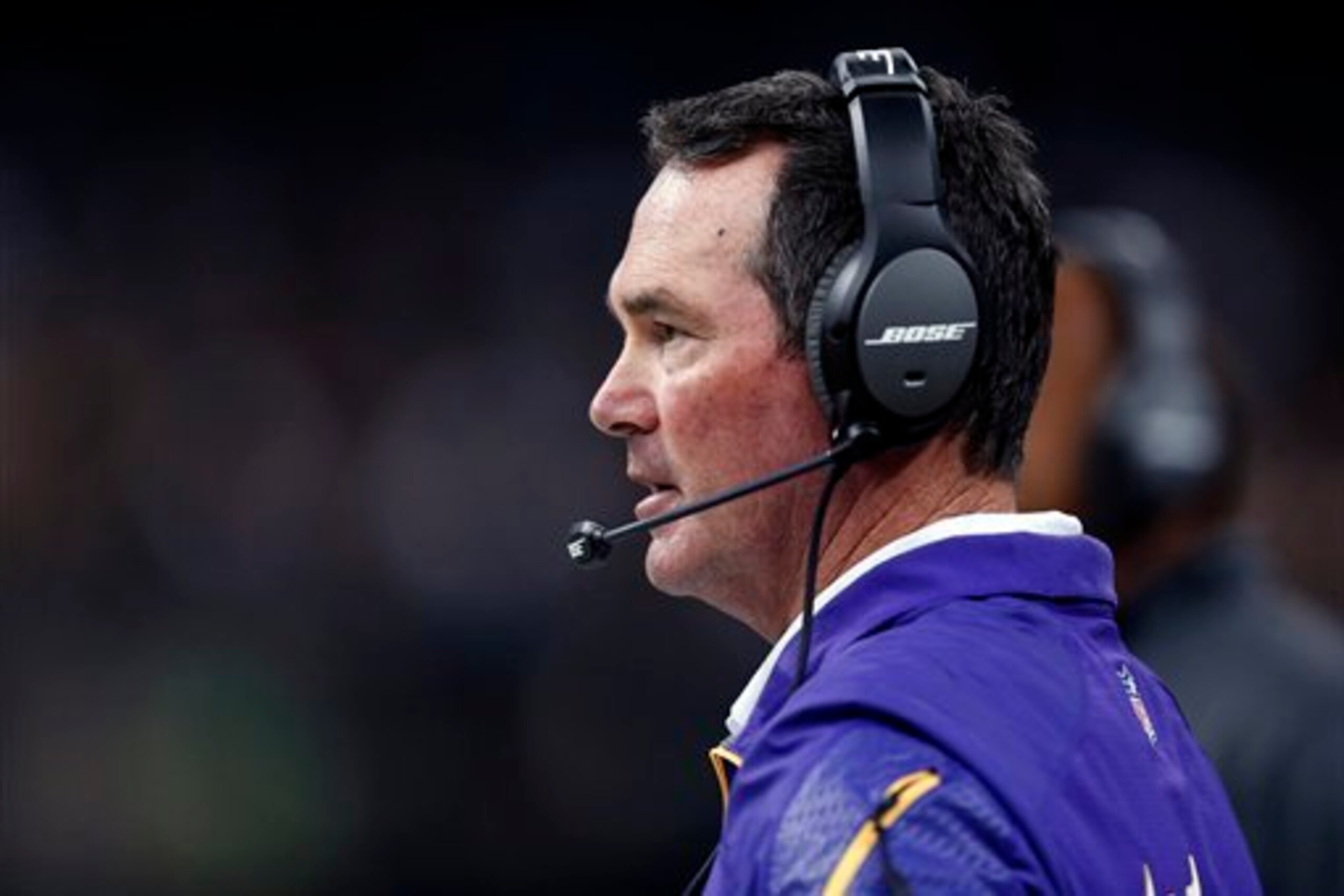
The head coach had a vision for him, though. Barr had transitioned to a new position before. He would have to do it again. But this time, he may have found his eventual home.
The way Zimmer is using Barr speaks to why the linebacker was so highly valued by the Minnesota coaching staff and front office. He has a specialized role that matches up with his strengths as a defender in a way that no other Vikings linebacker can play.
Depth charts call Barr a strong-side or “Sam” linebacker. That terminology doesn’t entirely fit with the way Zimmer organizes his defense, but the names stick anyway. Chad Greenway, the weak-side or “Will” linebacker actually plays on the offense’s strong side, stacked behind the 3-technique defensive tackle.
That puts Barr on the offense’s weak side, usually determined by the placement of tight ends. Theoretically, this decreases the amount of blocks Barr takes on directly and allows him to pursue unimpeded, utilizing his speed.
His athleticism also gives the Vikings flexibility in terms of coverage. This alignment from the Buffalo game is one Minnesota frequently uses against “Twins” looks, where the only two receivers line up on the same side of the formation:

Instead of having his cornerbacks follow receivers across the formation, Zimmer will float Barr out over the slot. On this play, cornerback Captain Munnerlyn stays on the left side of the defense.
Barr’s athletic talents and ability to play in space enable Zimmer to align the defense this way. Doing so gives the defense more variability, not tipping coverages to quarterbacks before the snap. The Vikings can still play games with Barr as a rusher.
Zimmer frequently does that in many ways. On third downs, he relies heavily on double-A-gap pressure or at least the threat of it.
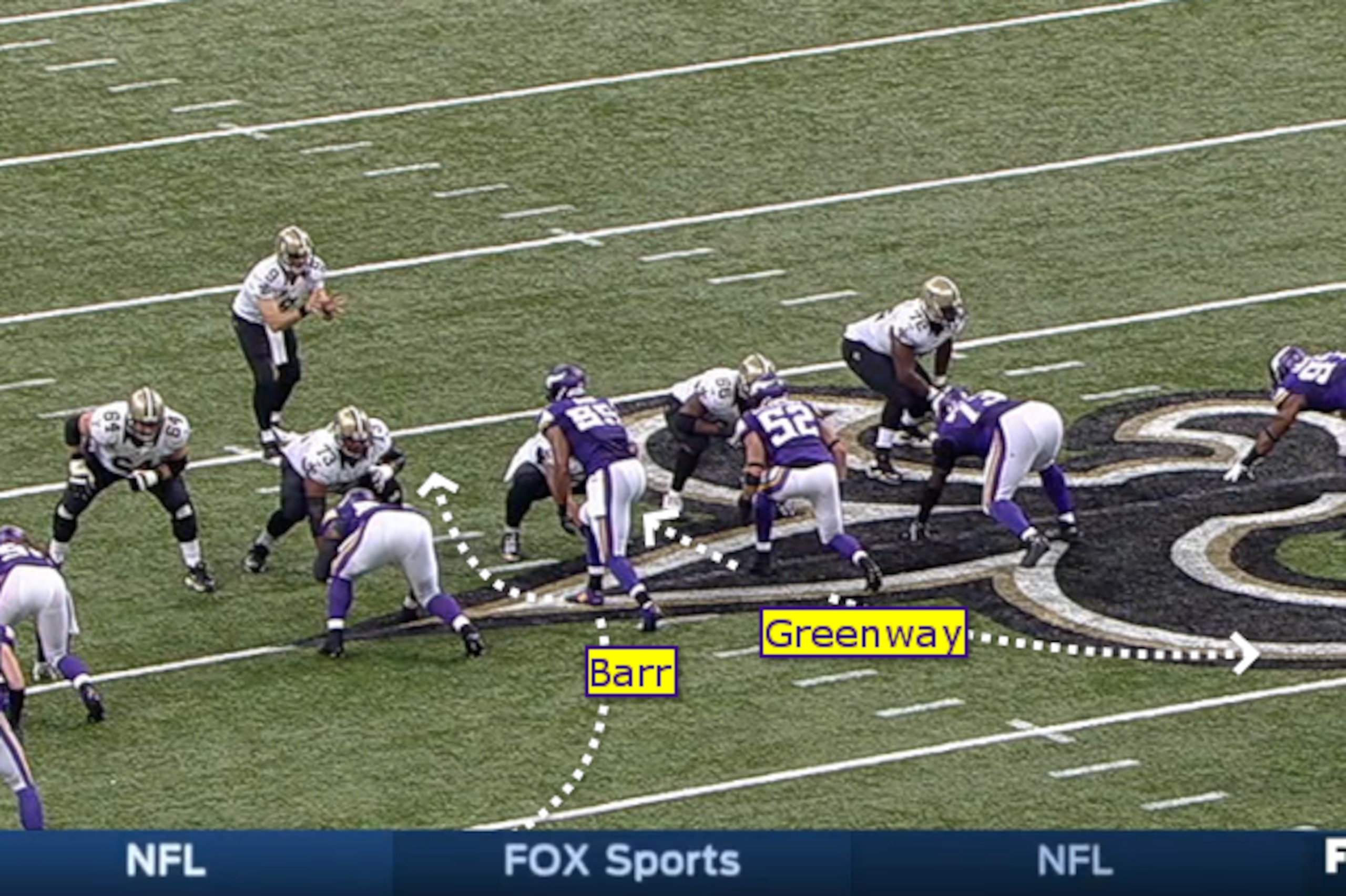
If a quarterback having Barr close enough to hear the linebacker breath doesn’t rattle him a little before the snap, he is either Aaron Rodgers or is deaf.
Not all of these looks lead to both linebackers blitzing. Both can go, both can back out into coverage at the snap or just one could rush. No matter the case, it has an effect. Barr has the athleticism to make it work too.
This is the second step in how Zimmer envisioned Barr in his defense. As an interior rusher or a blitzer, Barr has too much initial explosion and quickness for interior pass-blockers. Blitzes bring out the best in his athleticism, because he was never a highly technical rusher off the edge.
Finding the best role for the young linebacker was the first step for the Vikings in grooming him into a top player.
After the responsibility was passed onto Barr, he took the assignment and ran with it. Six games in, he has blossomed into one of the defense’s most impactful players, one the Vikings could not do without at this point in the season.
Beyond the Vikings’ insightful usage to maximize his talent, there are two reasons why Barr has made such a palpable impact in such a short time.
The first is rather obvious. Barr is a phenomenal athlete, the type teams don’t find at the linebacker position very often. He showed off that athleticism with a spectacular third-down stop against Detroit in a play that provides another little peek into the mind of Zimmer when it comes to Barr’s usage.
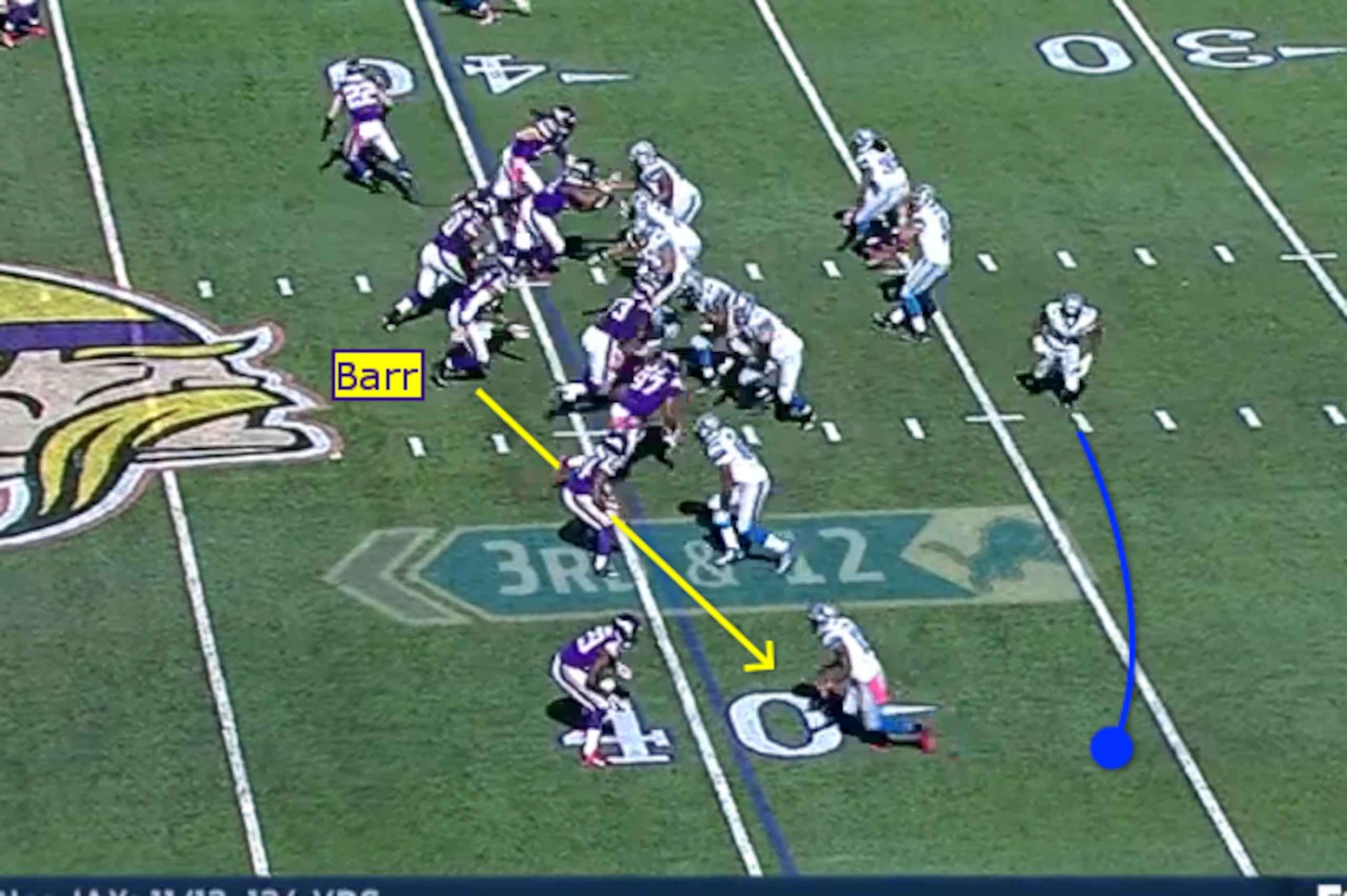
When Matthew Stafford receives the snap, both linebackers bail from the A-gap blitzes they showed. Bluffing the blitz still has its effect. The quarterback is persuaded to find his hot route and the receiver who can bail him out of heavy pressure. That is exactly what Zimmer wants from the Detroit Lions.
Notice the starting positions of the back and Barr. Theo Riddick, a fine athlete in his own right, actually has a head start on the linebacker.
This is where Barr’s uncommon athletic talents come into play. He chases down Riddick to the sideline, meeting him right at the line of scrimmage for a third-down stop.
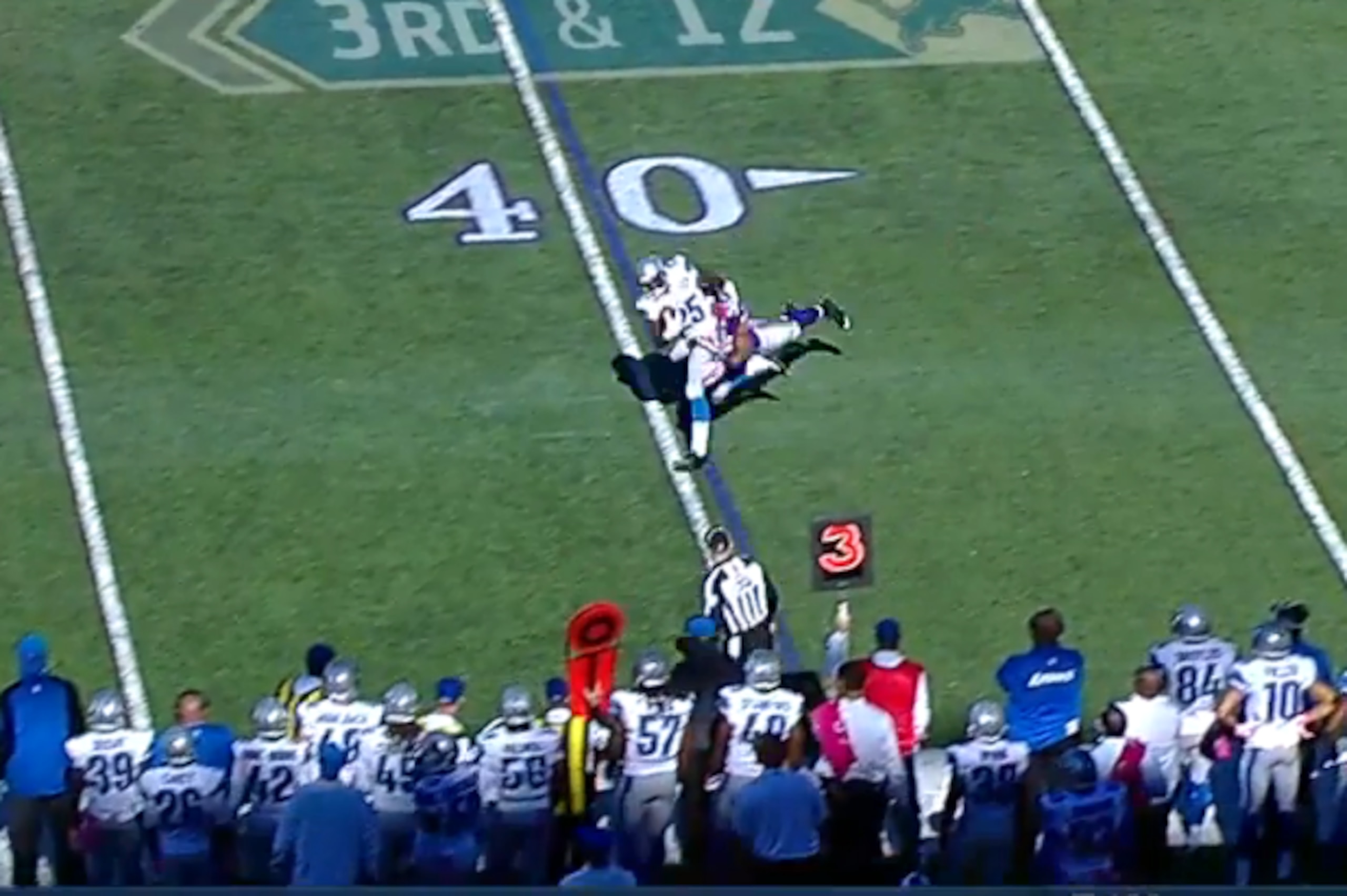
Few NFL linebackers can be expected to make the play Barr did here. They just lack the range to chase down a back when isolated like this. His ability to chase down Riddick on this play allows Zimmer to play those games at the line of scrimmage, knowing Barr has the speed to recover.
The way he closes in the open field has been the driving force behind a number of plays. Clearly the Vikings saw beyond the way he was used at UCLA, as a rusher primarily, wanting to utilize his open-field speed.
Athletic talents such as Barr are not easily found, and they can be easily projected for NFL production. His on-field play is showing that.
As previously mentioned, the Vikings are emphasizing Barr’s blitzing ability instead of asking him to rush from the edge like a traditional defensive end. His quick first step, ability to slip through the cracks and closing speed to finish plays are wreaking havoc whether he shows blitzes from the line of scrimmage.
One particular play against Buffalo showed the versatility of his blitzing ability. He perfectly timed a blitz from off the ball, flying past the line of scrimmage with momentum already built up. It’s another wrinkle that brings out the best in his athletic talents.
When Barr blitzes, interior rushers simply cannot match his explosive speed and shot-area quickness. No other linebacker on the roster can make the same type of impact via the blitz.
The second reason Barr has made an immediate impact is less obvious but even more encouraging for his future.
Barr has truly learned to play the role of a traditional linebacker. He understands assignments in terms of gap discipline. He picks up on keys to diagnose plays quickly. He is also pursuing with smart angles. None of this points to a rookie in a new position.
Another play from the Detroit game showcases these qualities.
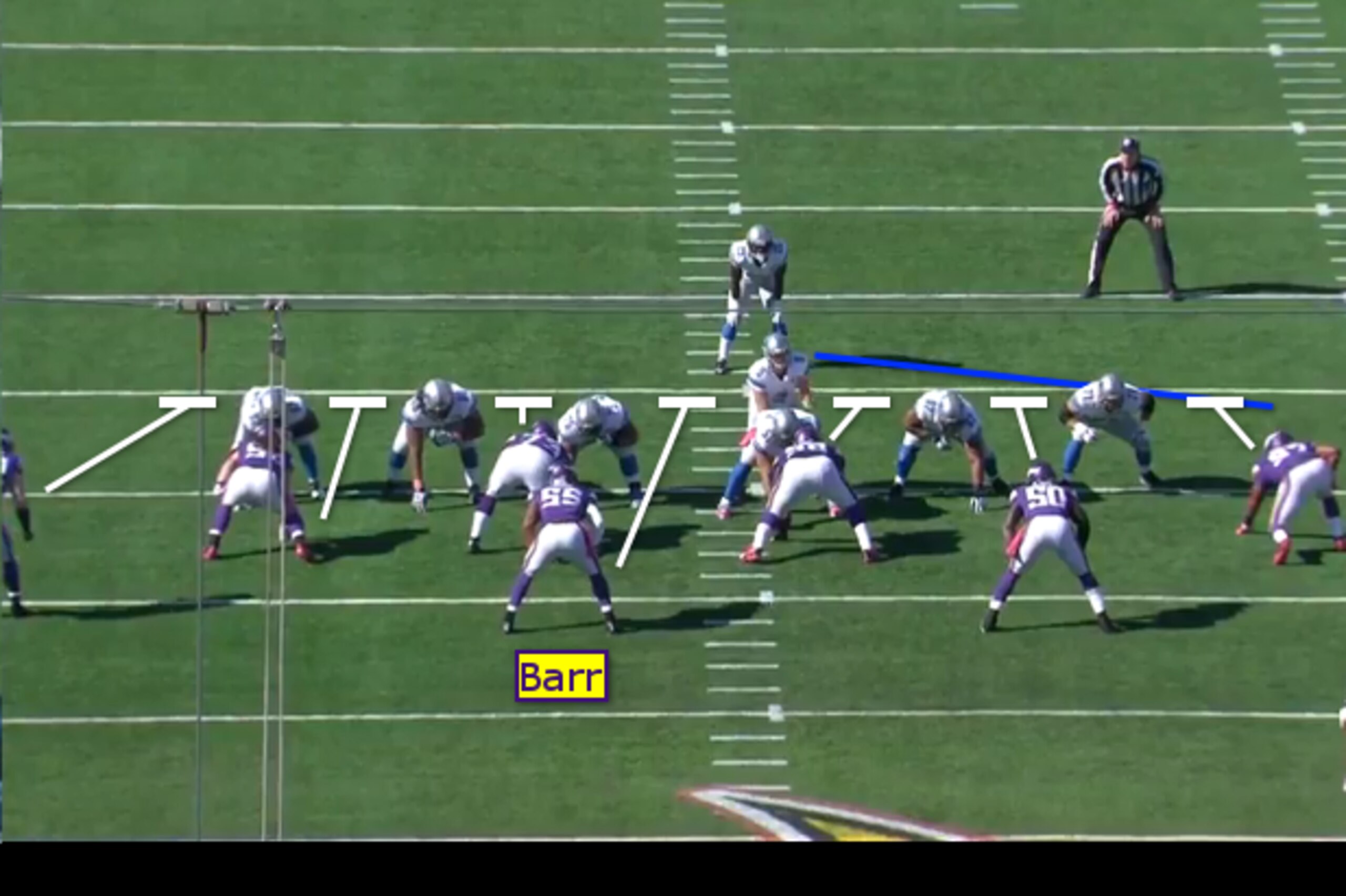
From the end-zone angle, the gap responsibilities are clearly defined. That will be important in analyzing how Barr addresses this run play.

Detroit runs an outside zone, which usually means offensive linemen will climb up the field on a combo block and get to linebackers. If Barr had failed to recognize the play and get moving, the blocker would have stonewalled him at the second level.
As the right guard moves up the field unimpeded and meets Barr, notice the way the linebacker fires his hands into the block, not letting the guard into his chest. Also, Barr gets his helmet across the block as he tracks the direction of the runner. He still maintains his gap but gives himself the leverage to pursue outside if the ball-carrier does not cut back.
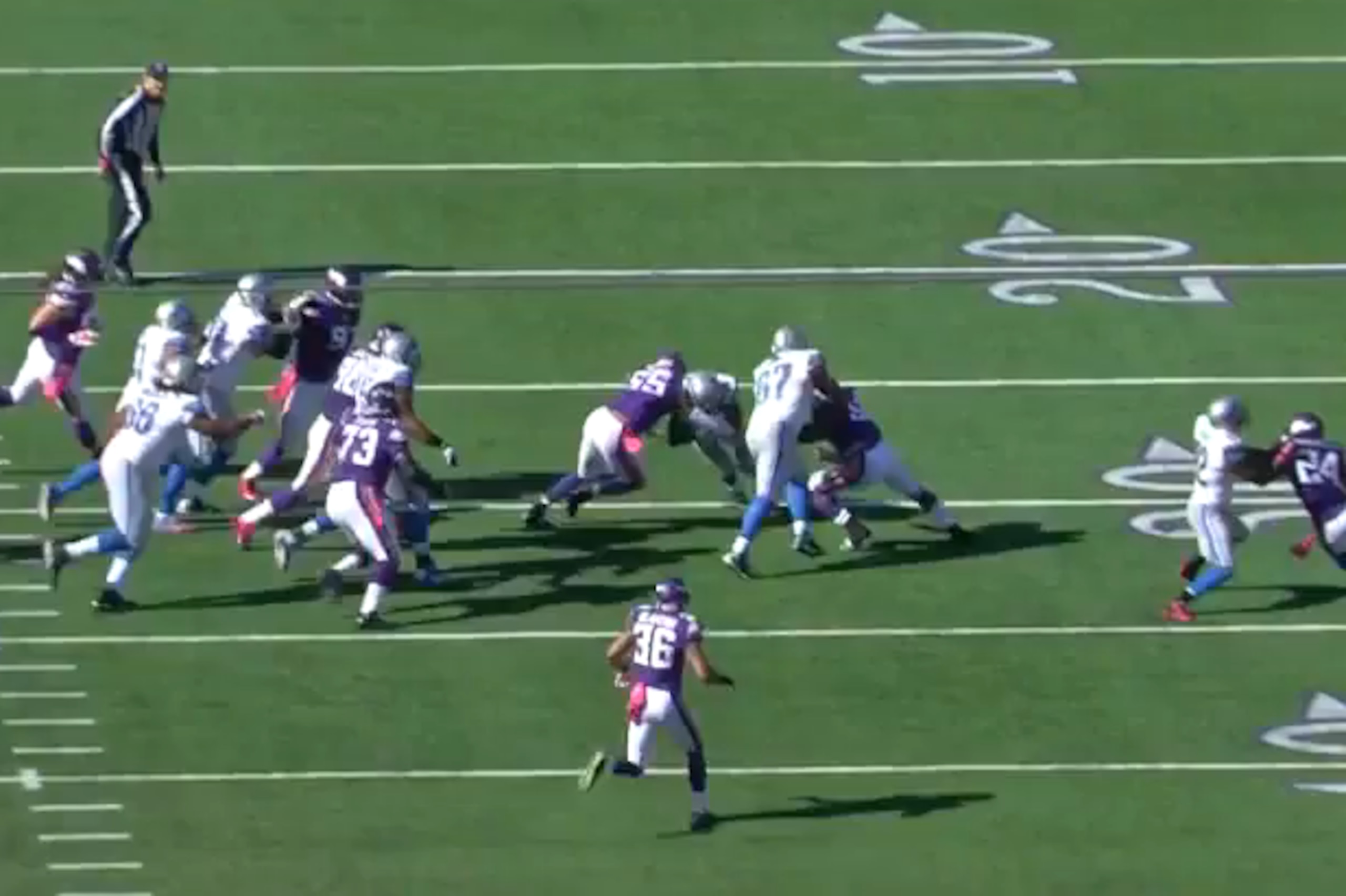
After freeing himself from the guard immediately, he tracks down the ball-carrier and makes the tackle in the hole.
Every part of this play shows his development in the finer points of linebacker play. He moves forward to handle his gap, takes the block on with his hands, uses proper positioning and finishes the play by shedding the block and closing from inside out.
His play in space also demonstrates this. Through seven games, Barr has become an absolute destroyer of screen passes.
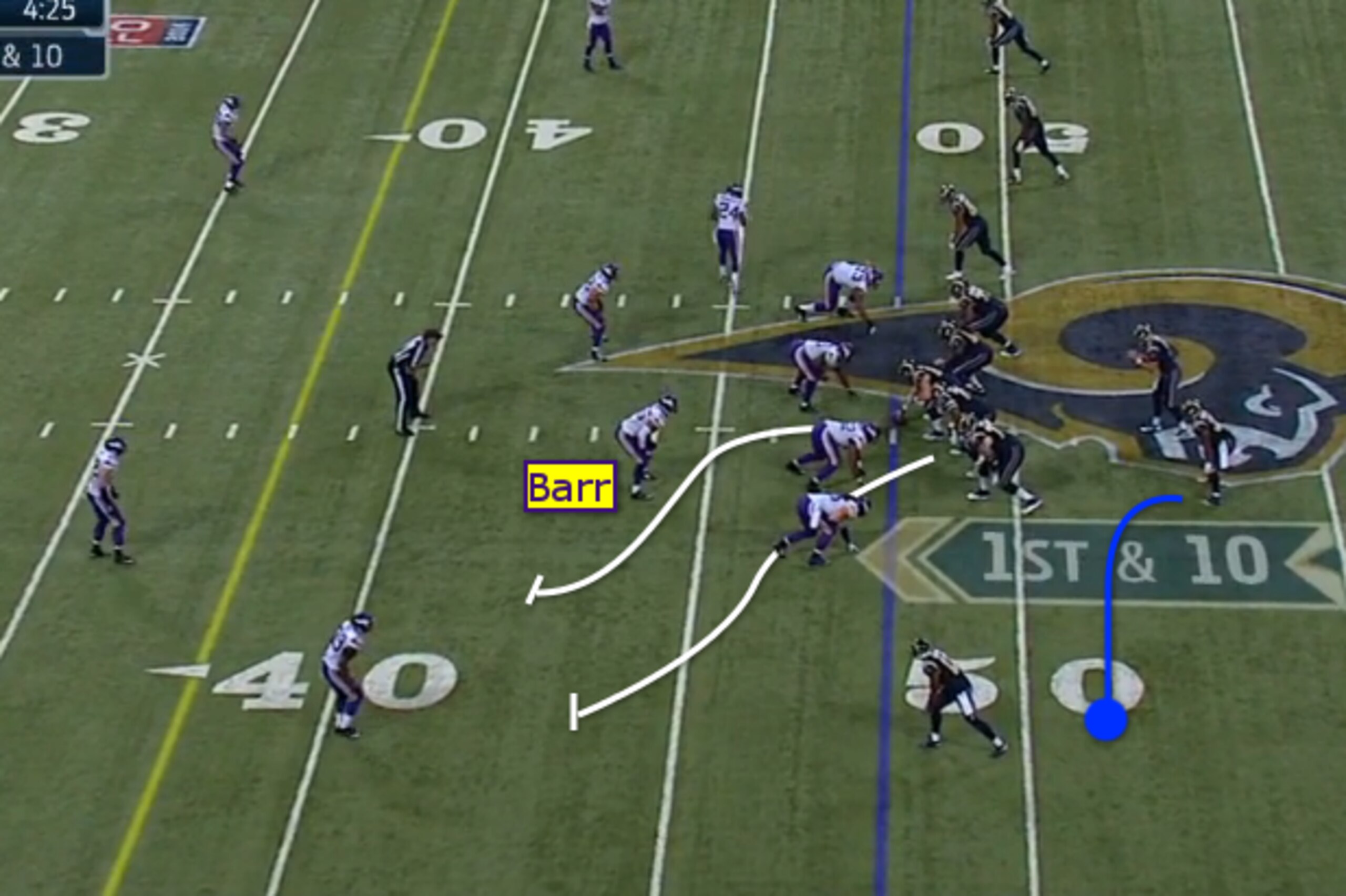
The responsibilities happen to be just as simple as they first appear in this coverage. Barr has the running back. St. Louis wants to slip the back out into the flat and lead with a pair of linemen, a fine play call when a defense tends to track other route-runners in man coverage.
Minnesota does that too, leaving Barr all alone with two blockers bearing down on him.

Too many linebackers either freeze up or try to do too much in this situation. That means they either play indecisively or try to make the wrong play.
Barr picks up on the play quickly and makes a beeline right through the two blockers. In the worst-case scenario, he gets blocked by one of the blockers and can’t make the play. The goal must be to find his way over top of the first blocker to either turn the back to the inside or take out both blockers.

In the end, he actually splits the two and makes the tackle. While the end result exceeds expectations, his angle to the perimeter and the way he takes on these blocks are the stuff of veteran linebackers.
He not only sees the ball-carrier and wants to get to the ball, but he also understands how to do so with the added dimension of lead blockers.
Where does all this come from?
Barr is an intelligent individual who understands the game of football beyond rote memorization of a playbook. He truly understands what he sees on the field and what that means. At the linebacker position, that is of utmost importance as offenses scheme misdirection plays and mix their run-blocking schemes, always wishing to slow down defenders' mental processing.
Maybe Barr’s quick transition to the defensive side of the ball at UCLA should have been a bigger tip-off to this. In his first season after the switch for the Bruins, he racked up 21.5 tackles for loss and 13.5 sacks. That number of big plays doesn’t come solely from athleticism and a little luck.
Some steps still need to be taken, which should speak to how dominant a linebacker he could become with time to grow further into this role.
Barr is still raw in coverage. His recognition of routes and footwork moving backward are expectedly a work in progress. Finishing more plays with fundamentally-sound tackling is a must as well. Expect those parts of his game to keep developing as he continues to absorb NFL coaching at a new position.
He will probably not win Defensive Rookie of the Year unless the number of splash plays (sacks and interceptions) picks up. His value to the Vikings should not be understated, though. Barr adds a dimension to Zimmer’s defense that no other player can, and his immediate impact is one of the team's most encouraging signs at this point in the 2014 season.
.jpg?w=2560 "Grading SmackDown 🔠")