


I am in the midst of a series examining the relative strengths and weaknesses of the AL East teams on a position-by-position basis. The players at each position are being ranked in relation to their peers within the division, with each team being assigned points based on where their player ranks in comparison to the other players.
Today, the series continues with a look at the right fielders.
The best player will earn 10 points for his team, with the remaining players being assigned points as follows: 7-5-3-1.
At the end of the process, I will accumulate all of the points for each team and create a divisional power ranking.
Analysis / Ranking:
1 of 6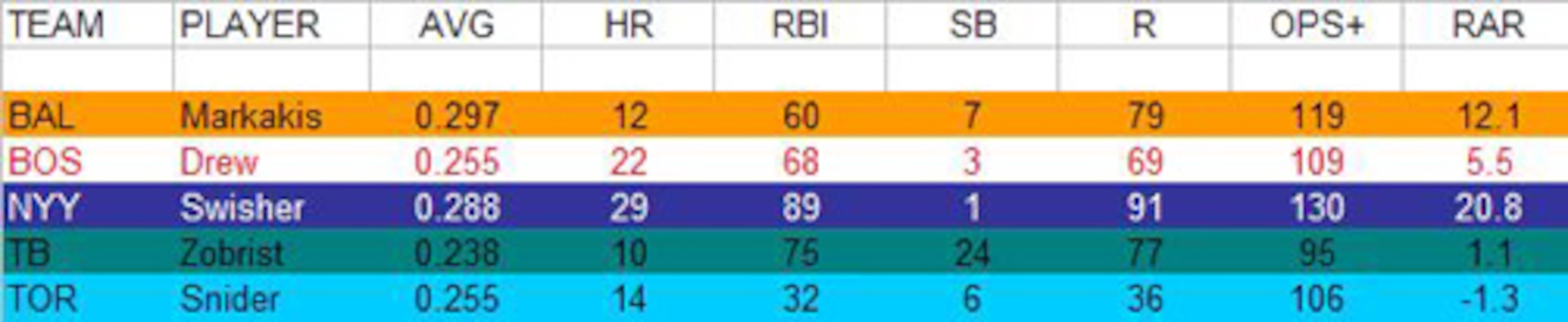
Here are the 2010 statistics for each of the five projected starters entering the 2011 season.
The chart presents the five basic stats used in fantasy baseball, plus OPS+ and Runs Above Replacement (RAR).
The rankings contained herein are based on these stats, plus projections as to what the upcoming year may have in store.
1. Nick Swisher, NYY
2 of 6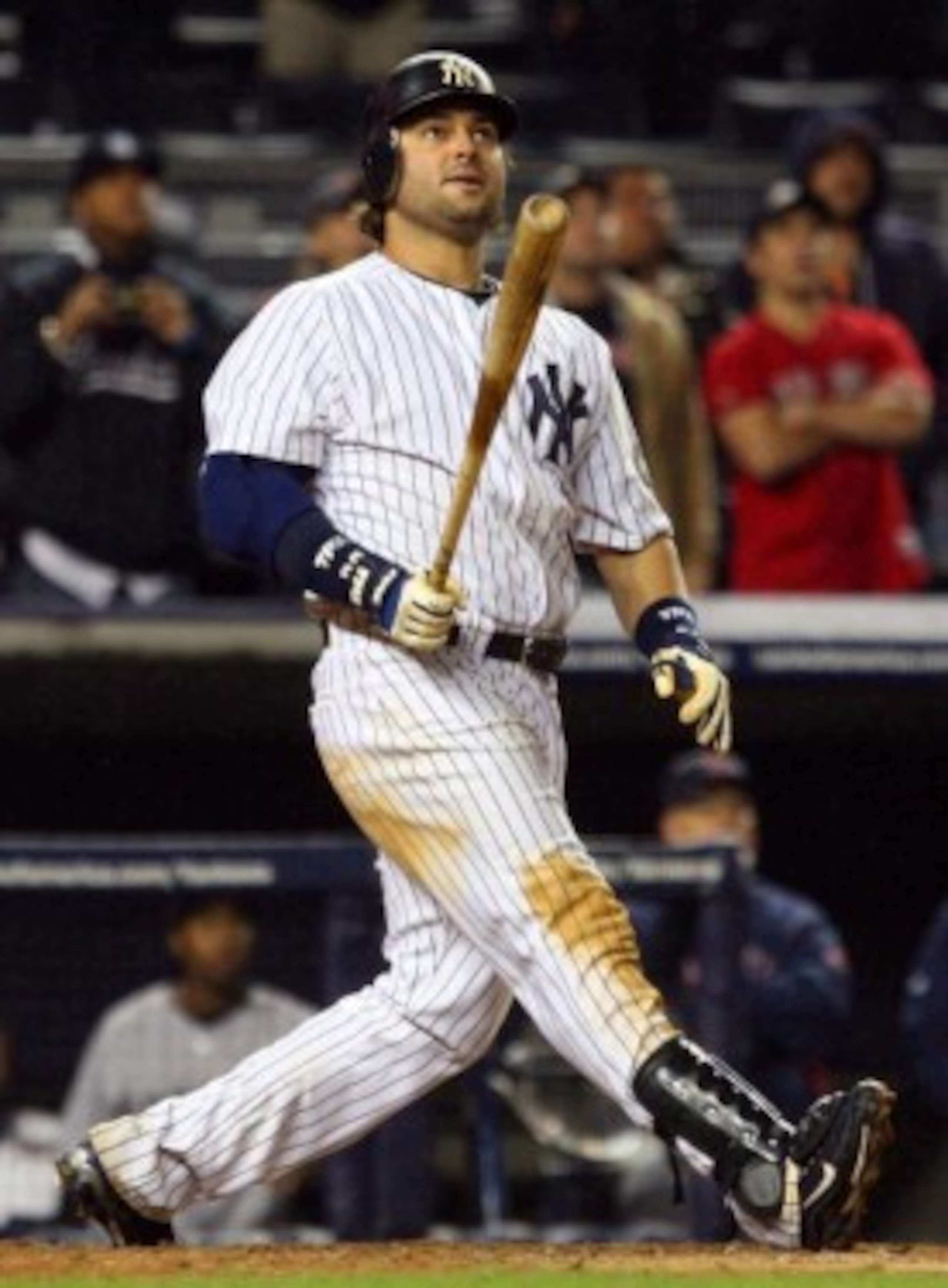
It’s becoming clear that Swisher’s one season in Chicago was an outlier, and that he is a safe investment in terms of the power and production that can be expected. He has hit at least 20 home runs and scored at least 80 runs in each of the last five years, and he has driven in at least 78 runs in each of those years with the exception of 2008 (when he drove in 69 runs).
His batting average is another matter all together. During the first six years of his career he compiled a .245 batting average, but last season he posted a .288 batting average—on the strength of a .335 BABIP and a huge spike in his contact rate (34 percent).
Swisher routinely draws a lot of walks and posts a healthy OBP, though it should be noted that his walk rate was down considerably last year.
For fantasy owners: It is likely Swisher will again hit 20+ homers and score 80+ runs, but you can expect a regression in terms of his batting average this season, as he is not likely to post another .330+ BABIP.
Projection: .250, 26 HR, 82 RBI, 85 R
2. Nick Markakis, BAL
3 of 6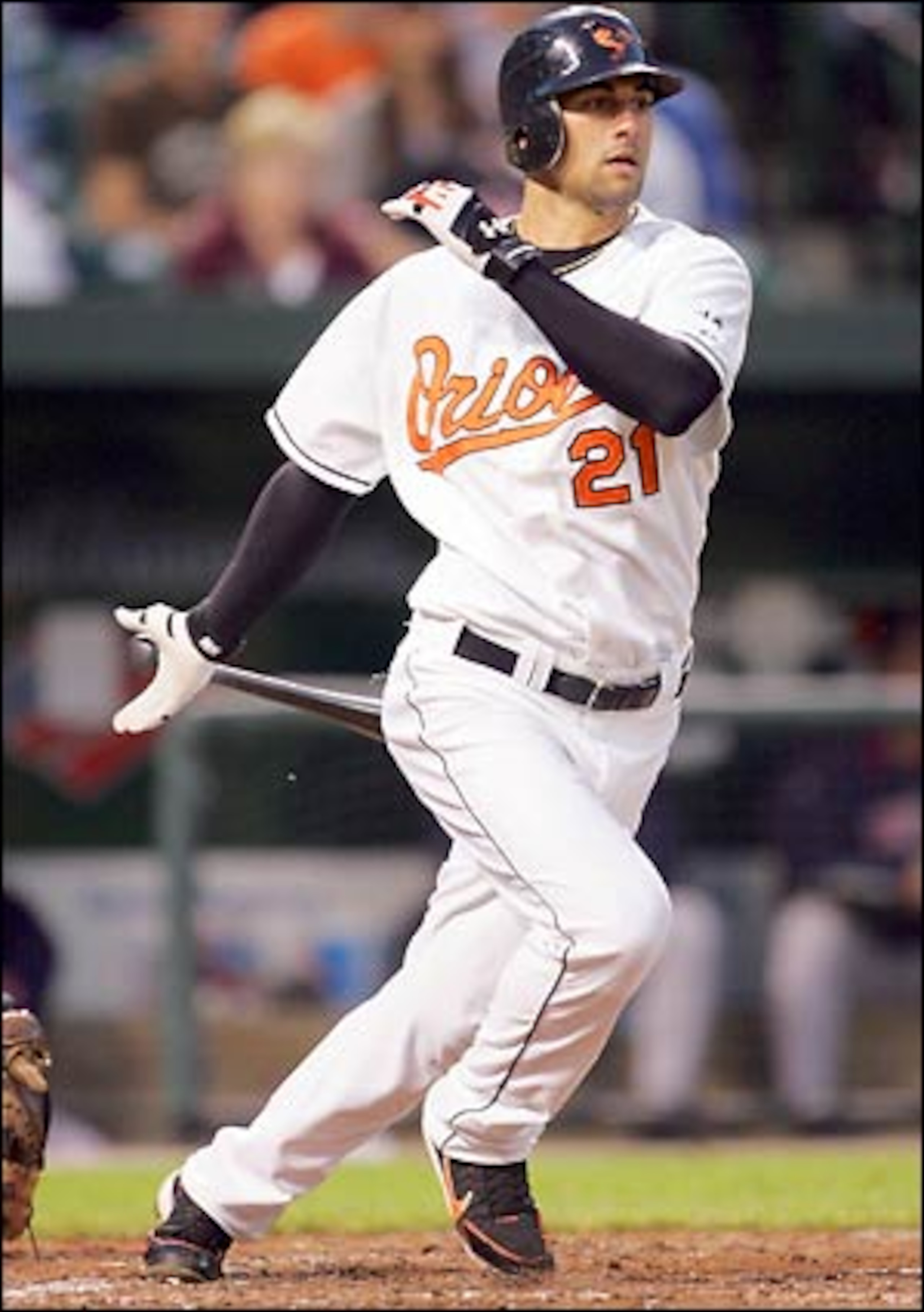
Markakis was on the verge of becoming a star back in 2007, but while his batting average and OBP have remained stable over the last three years, his power has diminished consistently each season. The fall-off in his power is directly related to a precipitous drop in his HR/FB ratio (from 12 percent to just six percent).
Is it a coincidence his power has tanked as the league’s drug testing efforts have increased? We will probably never know the answer to that question, but the coincidence begs the question to be asked.
Regardless, he continues to exhibit strong skill sets aside from the power outage. He has hit .290+ in each of his five seasons in the major leagues, and has hit 40+ doubles in each of the last four years. He walks more than the major league average, strikes out less than average and has accrued an 84 percent contact rate and 33 percent hit rate for his career. These are all signs that he will likely maintain his batting average and continue to score 80+ runs. The questions that linger are how many home runs he will hit and how many runs he will drive home.
For fantasy owners: Many of the folks in Charm City believe Markakis has struggled (in large part) due to the absence of protection in the Orioles batting order over the last few years, but that hasn’t stopped Luke Scott and Ty Wiggington from slugging 20+ home runs.
No, the true reason for the declining power is this: the raw data shows he has stopped pulling the ball. When he first came into the league, he was a hitter who used the entire field, but he has evolved into a hitter who goes the other way too frequently—to his, and the team’s, detriment.
It says here that he needs to make a conscious determination to start pulling the ball more often…maybe Buck Showalter can be an influence in this regard. Watch him early in spring training, if you can. If he starts pulling the ball more often, you can bet on a return of his power. If not, then you should expect numbers very similar to last year, which isn't necessarily a bad thing…

3. J.D. Drew, BOS
4 of 6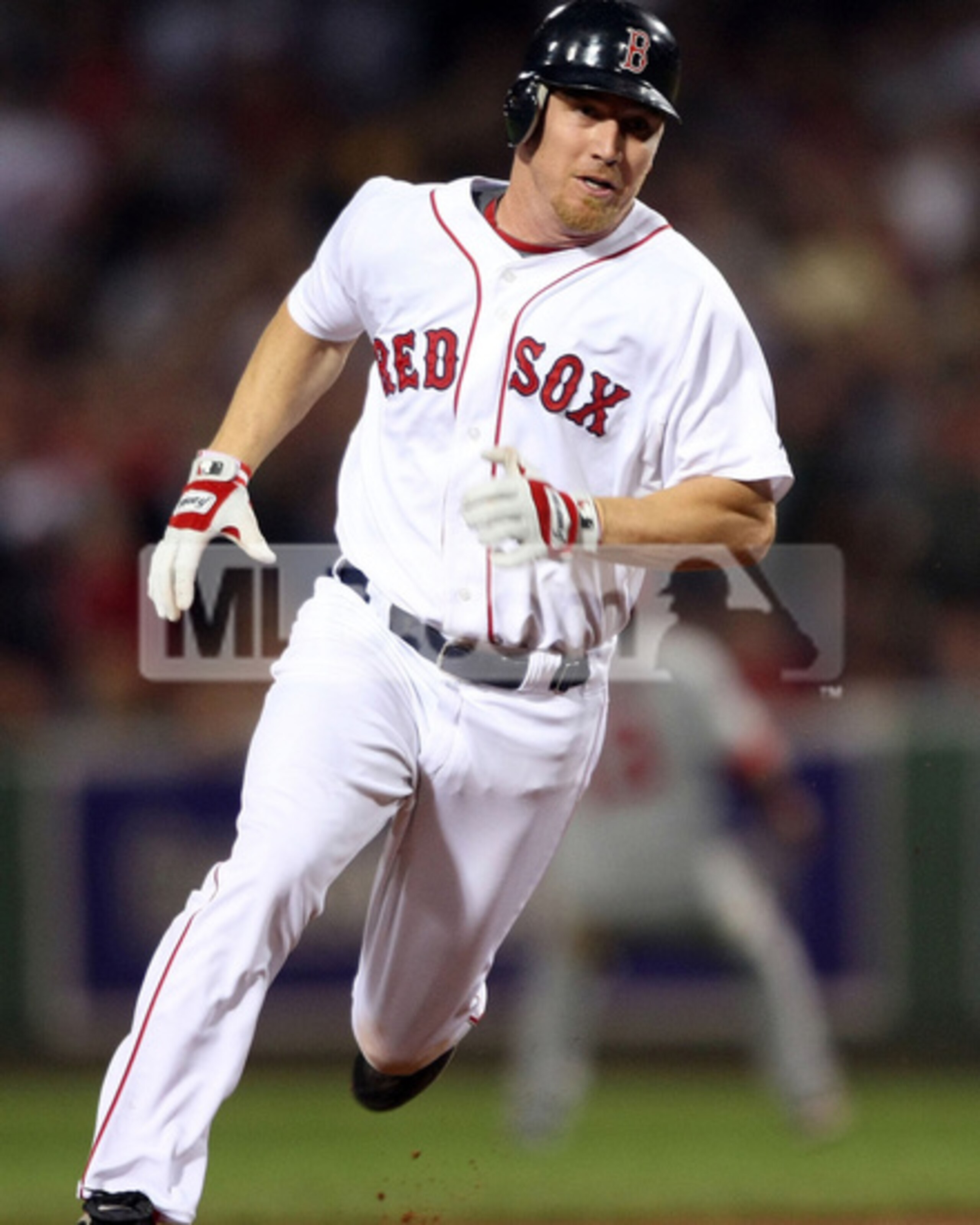
The folks in Boston have to hope that Drew’s production will rebound in 2011—the last year of the five-year, $70 million deal he signed with the Red Sox before the 2007 season. The problem is the oft-injured outfielder has already started to complain about problems with his hamstring—potentially a harbinger of problems ahead.
Thank goodness Ryan Kalish is waiting in the wings!
For fantasy owners: Drew has been pretty consistent during his tenure in Boston. The Red Sox have been able to pencil in .275/20/65 with confidence since 2008, and he has largely lived up to those relatively pedestrian expectations. The Sox front office would be happy to see him post those numbers again this season—with the unspoken hope that he would be more productive in his contract year. I just don’t see that happening. His second-half stats from last year were brutal. I expect him to hit .265, with 20 HR and 65 RBI before handing the job to Kalish next year.
4. Ben Zobrist, TB
5 of 6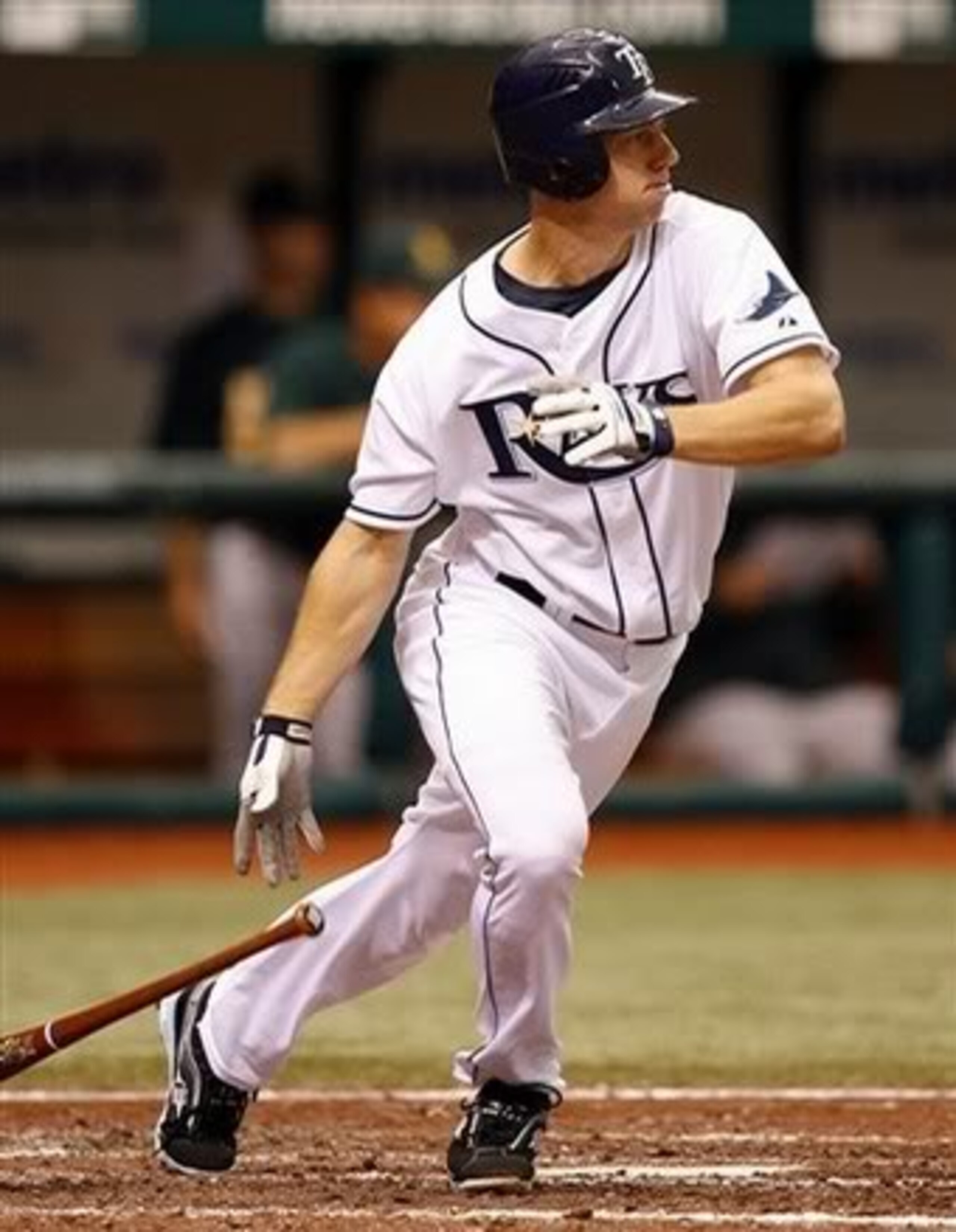
Zobrist offers a stable skill set—the problem is that he hasn’t been able to take advantage of what appears to be a pretty good set of skills (with the exception of his 2009 season).
He has averaged an 80 percent contact rate, while performing considerably better than major league average in both strikeout and walk rates. His hit rate has averaged 29 percent in the major leagues (or in his major league equivalents). In consideration of his peripherals, it’s hard to understand why it isn’t consistently in the low 30’s. In 2009, it was 33 percent—and that manifested itself in a .297 batting average.
For fantasy owners: Beyond his batting average, the other area of concern with Zobrist is the lack of power he exhibited last year—when he hit only 10 HR in 541 AB. His HR/FB ratio fell from 18 percent (in 2009) to six percent (last year).
At this point in time, we have watched Zobrist for two-and-a-half years in the major leagues, and it appears his productivity in 2009 was an outlier. It appears to me he will settle in to a stat line of .255, with 12 HR, 80 RBI, 80 R and 20+ SB. Plan accordingly.
5. Travis Snider, TOR
6 of 6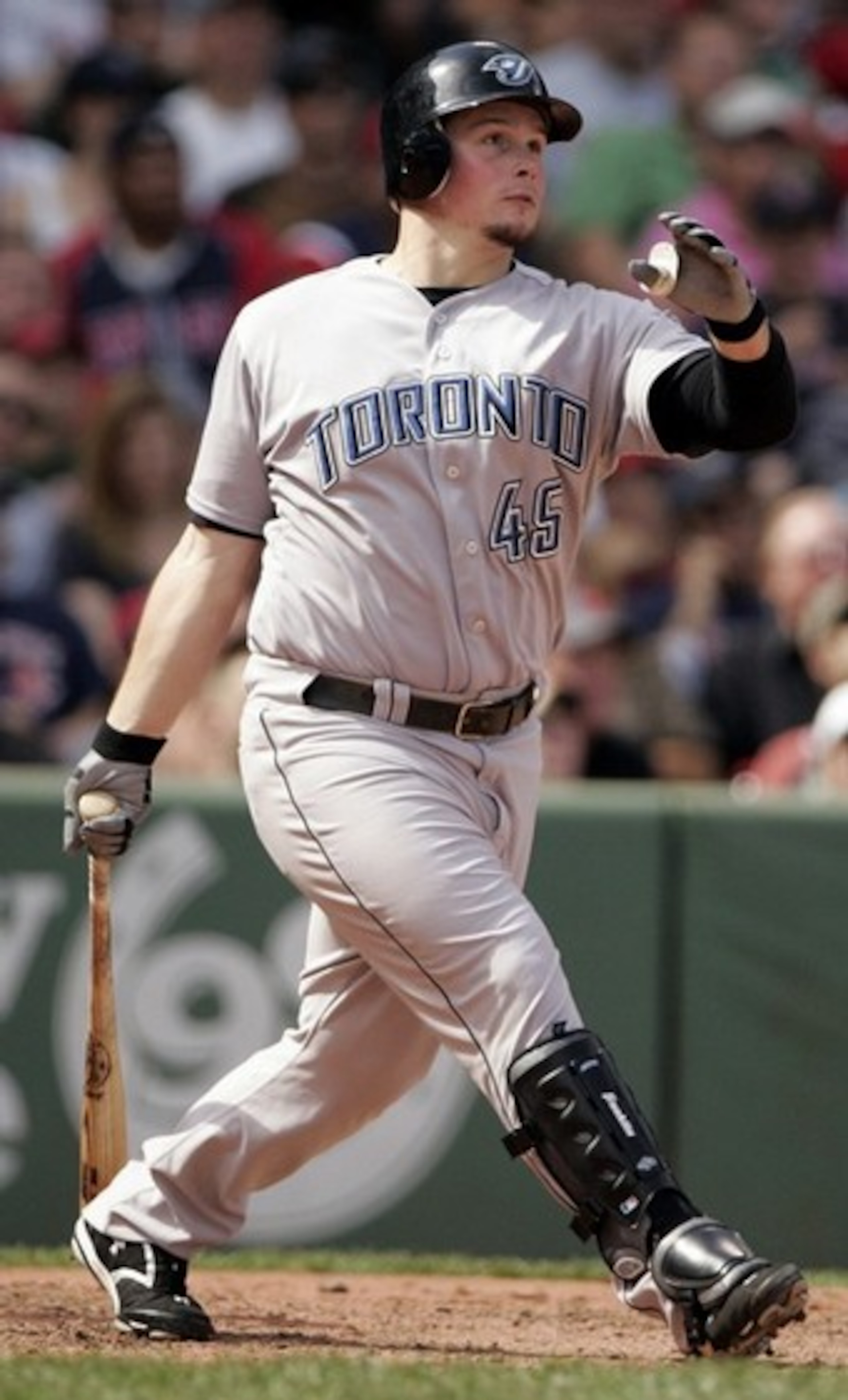
I saw Snider quite a bit a couple of years ago when he was playing ball in Manchester, NH (Double-A). His power potential was obvious, but he frequently struggled to make contact against Eastern League pitching. It seemed obvious to me that he needed more time in the minor leagues.
Then, the Blue Jays promoted him to the big leagues.
I said at the time the decision was a big mistake, and I remain convinced it was just that. He has shown big league power, yet he has also shown he can’t put the bat on the ball with any consistency in The Show. He has compiled a .320 BABIP in the big leagues—just imagine the kind of damage he would be doing if he did not strike out 27 percent of the time!
For fantasy owners: Snider strikes out too much. He doesn’t walk enough. Yet he has compiled a nice BABIP thus far in his young career. Paradoxically, his batting average rose last year while his strikeout rate spiked, his walk rate plunged and his batting eye sunk to an embarrassingly-low number (0.13). A repeat of that performance will have a dramatically different result in 2011.
While most pundits see his batting average improving, I don’t. In fact, based on the second-half peripherals from last season, I see his average regressing. I won’t own him in any of my fantasy leagues because I project him at .235, 23 HR and 50 RBI, and I just don’t want that BA in my lineup.



.jpg?w=2560 "Raiders Could Start Mendoza")

.jpg?w=2560 "Rodgers Iced Out on Plane 💎")
.jpg?w=2560 "Packers Safety Slams Refs 🤬")

.jpg?w=2560 "🚨 Week 8 AP Top 25 Poll")

