Maria Sharapova: What Are Her Grand Slam Chances in 2011?
 Tennis fans have in Maria Sharapova the unusual figure of someone who, potentially, is an all-time great. Despite having only three Grand Slam titles to her name, she has chosen wisely in her winnings, having bagged a Wimbledon, US Open and Australian Open, in alternate years (2004, 2006, 2008). But since her last victory at a major three years ago her performance at the very highest levels has been dismal by her lofty standards—she has failed to reach a single quarterfinal since her victory in Melbourne in 2008.
Yet for her, playing at the very highest level, in matches at the biggest occasions, would probably elicit some of her finest tennis. The problem is, she has failed to reach a deep enough stage of a Slam to demonstrate any of that aura, Grand Slam mental finesse that characterises her game. As of this year, her loss to Andrea Petkovic 6-2 6-3 at Melbourne was simply another instance of her dogging inconsistency—in fact her tournament at Australia this year was not bad, indeed one could in moment begin to see again that old Sharapova determination. But tennis is the sport of the gods, a sport left all too often to the fates: one bad day would ruin it all.

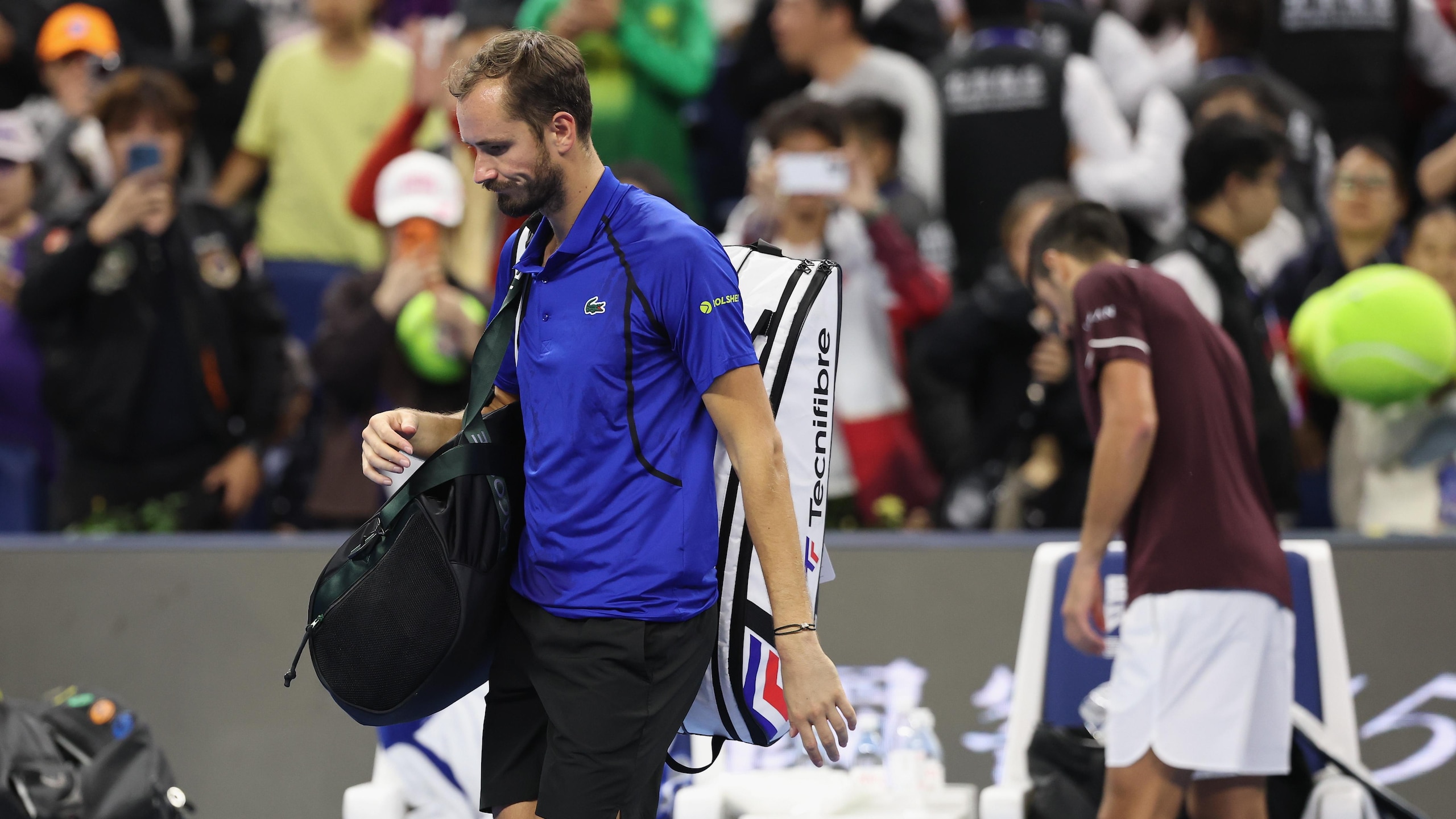

So it proved at Melbourne. Her loss to Petkovic was perhaps symptomatic of a problem across the whole women's game—the inability of any one of the top players—except the battle-hardened Kim Clijsters—to string together seven stunning matches at major level. Favourites have been tossed here and there four times a year for the last three years at majors, and so often have they failed to promise.
It's no different with Sharapova. For a Jankovic, or Wozniacki, inexperience more often would serve as an explanation—why the Dane should have failed to win her semifinal at Melbourne, a favourite, and up a set against Li Na, is perhaps explicable quite entirely in these terms. But Sharapova hasn't even reached a semifinal in three years. The reasons for her dip, both from the rankings, and from the tennis elite, must be more sinister.
Well, there was that shoulder injury in 2008, which kept her out of action for most of the year, and the first half of 2009, ruining the fine prospects her victory at Melbourne had sized up. Since then, she hasn't been the same player, and has not looked, in all the last two-and-a-half years, anywhere near the player who had crushed Justine Henin 6-4 6-0 in the quarterfinals at Australia in 2008. It would be readily admitted—Sharapova has lost that champion aura.
Surely, however, one thing should be going in her favour, as she seeks to make amends this year for a dismal last three—that oft-pronounced notion that women's tennis has failed to progress technically or dynamically since the years of Sharapova, Henin and Williams early last decade. With Sharapova still only 23 this year, there must certainly be much opportunity yet in her career, for at least one more major. Of course, a win at Roland Garros would truly sweeten her season—but what are her chances at any major?
Well it may not be entirely true that women's tennis has failed to progress—as much as the failures of Safina, Jankovic or Ivanovic to cement their No. 1 rankings have been disappointing, it is not entirely reflective of a regression in dynamism. Indeed with such recent standouts as Schiavone, or the new No. 1 question mark, Wozniacki, along with the resurgence of Kim Clijsters, there is an increasing variety in styles, and narratives, to pursue.
Sharapova certainly stands right in there with a shot—a former champion, with that native self-confidence and belief in her abilities as such. But still, technicalities will get in her way—probably most glaring would be her serve, and defensive movement, the two weaknesses in her game which the very best have consistently exploited over the years. Barring the liabilities of her lanky (albeit attractive, admittedly) physique, her aggressive game would win a Grand Slam any day.
At the end, she would need a good draw, some good matches to get her going in the early rounds—but above all she would need to regain that elite aura of the Grand Slam champ. Admittedly, we have some kind of catch-22 here: winning can only be got by winning. To get down to the nitty-gritty, one would most expect a victory at Wimbledon or Flushing Meadows—one should in favour of the former recall the close, highly competitive set she played against Serena in the fourth round at Wimbledon last year. Faster surfaces will by and large enhance her aggressive capabilities.
Much work would have to be done, of course—but Sharapova, despite her recent failures and shortcomings at the Slams, is far from a spent force—merely a temporarily troubled one. At only 23, I'd give her all the chance, if not this year, then in the next few, to get back to the very top. As much as one might criticise her, it cannot be doubted that she has shown speedy recovery in the last few months; but as for this season, one would tentatively predict, at least, a deep run at either Wimbledon or the US Open.
.jpg?w=2560 "Texans-Mixon Released Football")
.jpg?w=2560 "Commanders Eagles Football")


.jpg?w=2560 "Mahomes' Wife Trolls Kubiak 💀")

.jpg?w=2560 "Viral Rams Coach Vid 🖕")