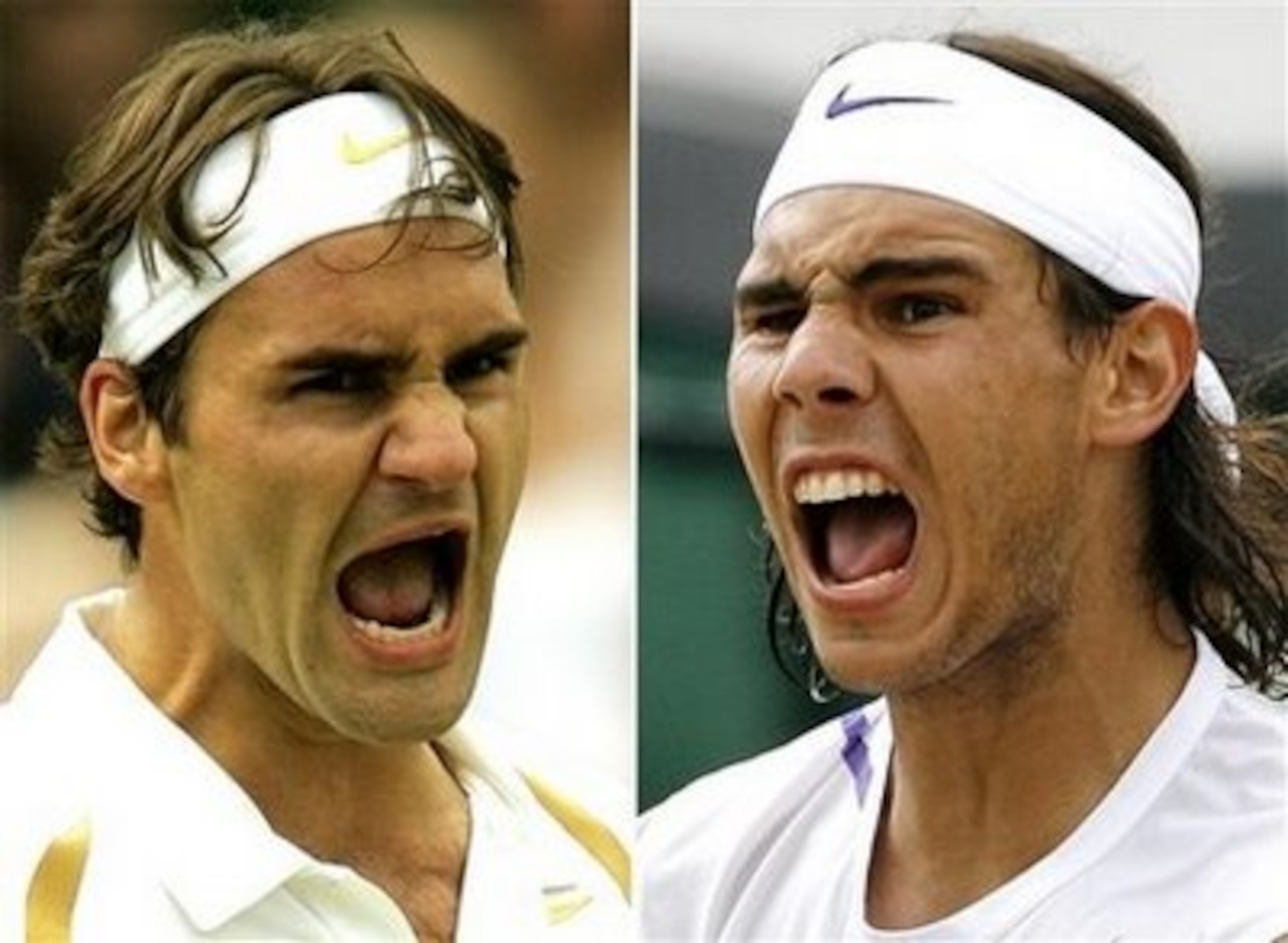

Roger Federer vs. Rafael Nadal: the Most Compelling Rivalry in Tennis
Great rivalries engage fans, stir the media, and swell attendance.
It does not matter if the contenders meet in the ring, on the gridiron or on the fabled lawns of Wimbledon.
When the two rivals stare each other down before the game begins, the outcome rivets our attention.
In the Open Era of tennis, fans flocked to watch Borg vs. McEnroe, Evert vs. Navratilova––or feel free to insert your own favorite rivalry here.
But never in the history of the game has there been a more compelling rivalry as the one between Roger Federer and Rafael Nadal.
We are witnessing perhaps the two greatest men ever to play the game of tennis continue their domination over a very talented men’s field as they leapfrog each other for the top spot.
Currently, Nadal has grasped the brass ring, determined to hold on for the duration.
But Federer is playing some of his most inspired tennis since losing in the semifinals of the U.S. Open to Novak Djokovic.
At age 29, Federer is determined to play on, adding to his already considerable legacy.
Federer and Nadal have met 22 times with Nadal leading in their head to head 14-8.
12 of their matches have been on clay, seven on hard courts, and three on grass courts.
Playing practically perfect tennis against Roger Federer evolved into an art form for Rafael Nadal.
Nothing inspires him more or engages his senses more completely than striving to match his considerable strengths against the man many proclaim as the best player ever to wield a tennis racket.
The quixotic mission to overtake Federer that has driven Nadal for the his entire career continues to spur both men to even greater heights.
Many hoped to see another chapter written in this stirring saga at the 2011 Australian Open. But Nadal, injured, fell to his countryman David Ferrer in the quarterfinals before the two could meet again on the field of battle.
2004 ATP Masters Series Miami, Round of 32 Winner: Nadal
1 of 22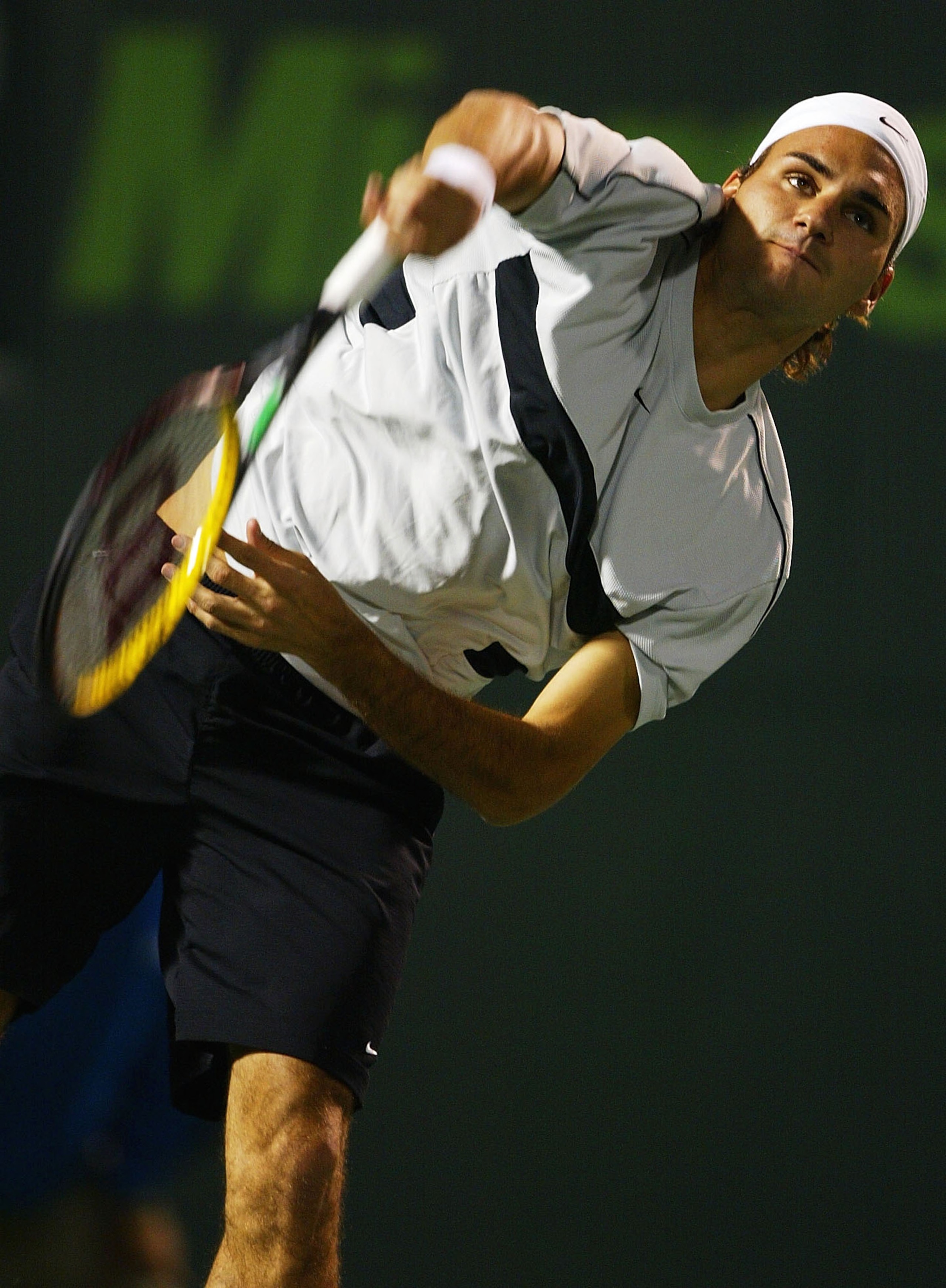
2004 ATP Masters Series Miami Round of 32: Nadal won 6-3, 6-3.
Head to Head: Nadal 1 - Federer 0
It all began in March 2004 when newly dominant 22-year-old Roger Federer, feeling ill and stripped of strength, struggled mightily past Russian Nikolay Davydenko during the round of 64 of the Nasdaq-100 Miami Masters.
His next opponent was newcomer 17-year-old Rafael Nadal, ranked No. 36 in the world.
Nadal was a hard-hitting left-hander from Spain, a country renowned for its prowess on clay. This, however, was a hard court event.
Anointed World No. 1 a month earlier, Federer arrived in Miami having won 28 matches during the previous nine months, including his first Wimbledon crown in 2003 and his first Australian Open title in 2004.
Even weakened, the Swiss expected to win this match.
Nadal had other plans. Playing nearly flawless tennis against Federer, Nadal defeated him 6-3, 6-3.
While admittedly shocked, the tennis world should have stood still or spun backwards, because never was a tennis match more prophetic.
Nadal never faced a break point and he made 81 percent of his first serves. He even won 13 of 14 net points, punctuating his win with an overhead smash at the net!
He played a nearly perfect match against the World No. 1 player.
Keen observer Roger Federer must have suffered a shiver of recognition.
What did Nadal learn during that initial monumental Miami match in 2004?
Besides being told to go to Roger’s backhand and to continue to attack, Nadal was informed that Roger was the number one player in the world and that there was no shame in losing to him.
This was the psychology employed. Simple enough when you are humble, proud, and 17.
The rivalry was off and running.
2005 ATP Masters Series Miami, Finals Winner: Federer
2 of 22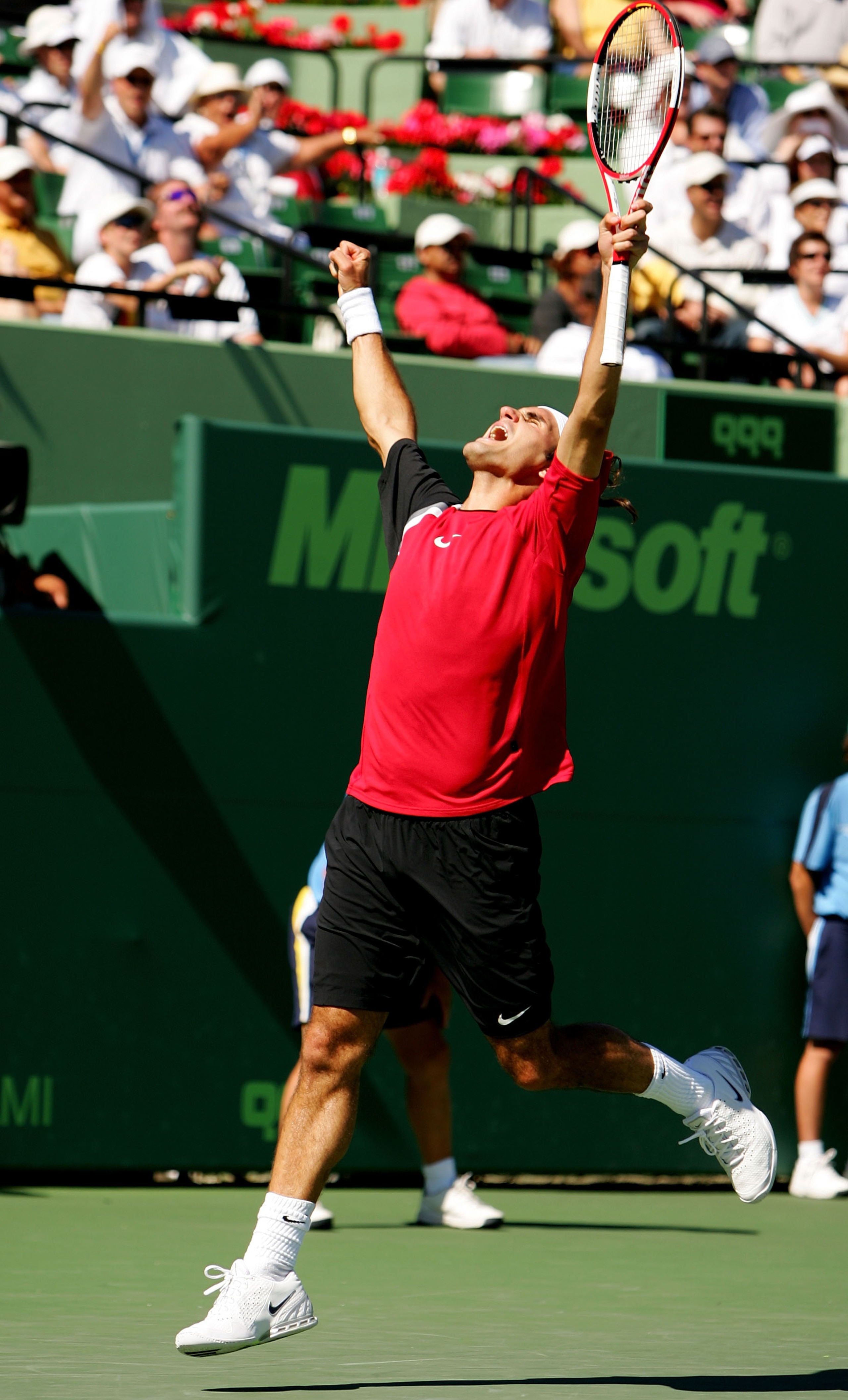
2005 ATP Masters Series Miami Finals: Federer won 2-6, 6-7, 7-6, 6-3, 6-1.
Head to Head: Nadal 1 - Federer 1
Federer and Nadal met a second time in Miami a year later. The Swiss was riding another dominating year as number one.
Again Nadal, playing extraordinary tennis, won the first two sets.
This time, however, they were engaged in a five-set final because in 2005, the ATP still concluded its Masters Events finals with a best-of-five format.
Federer regrouped in time to win the third-set tiebreaker, then came back to win the last two sets.
Even though Nadal lost, many considered it a break-through performance.
Roger Federer battled back from two sets down to win the Nasdaq-100 Open in Miami.
The World No. 1 defeated Rafael Nadal of Spain 2-6, 6-7 (4/7), 7-6 (7/5), 6-3, and 6-1 to keep his winning streak alive but admitted he had been lucky.
Federer extended his overall winning streak to 22 matches and his record victory streak in ATP finals to 18.
It was the fifth title that year for Federer, and his second straight ATP Masters Series title, having defended his Pacific Life Open title at Indian Wells two weeks ago.
Nadal, who had a 15-match winning streak snapped, was aiming for his first ATP Masters Series title.
The rivalry was now even, but not for long.
2005 Grand Slam French Open, Semifinals Winner: Nadal
3 of 22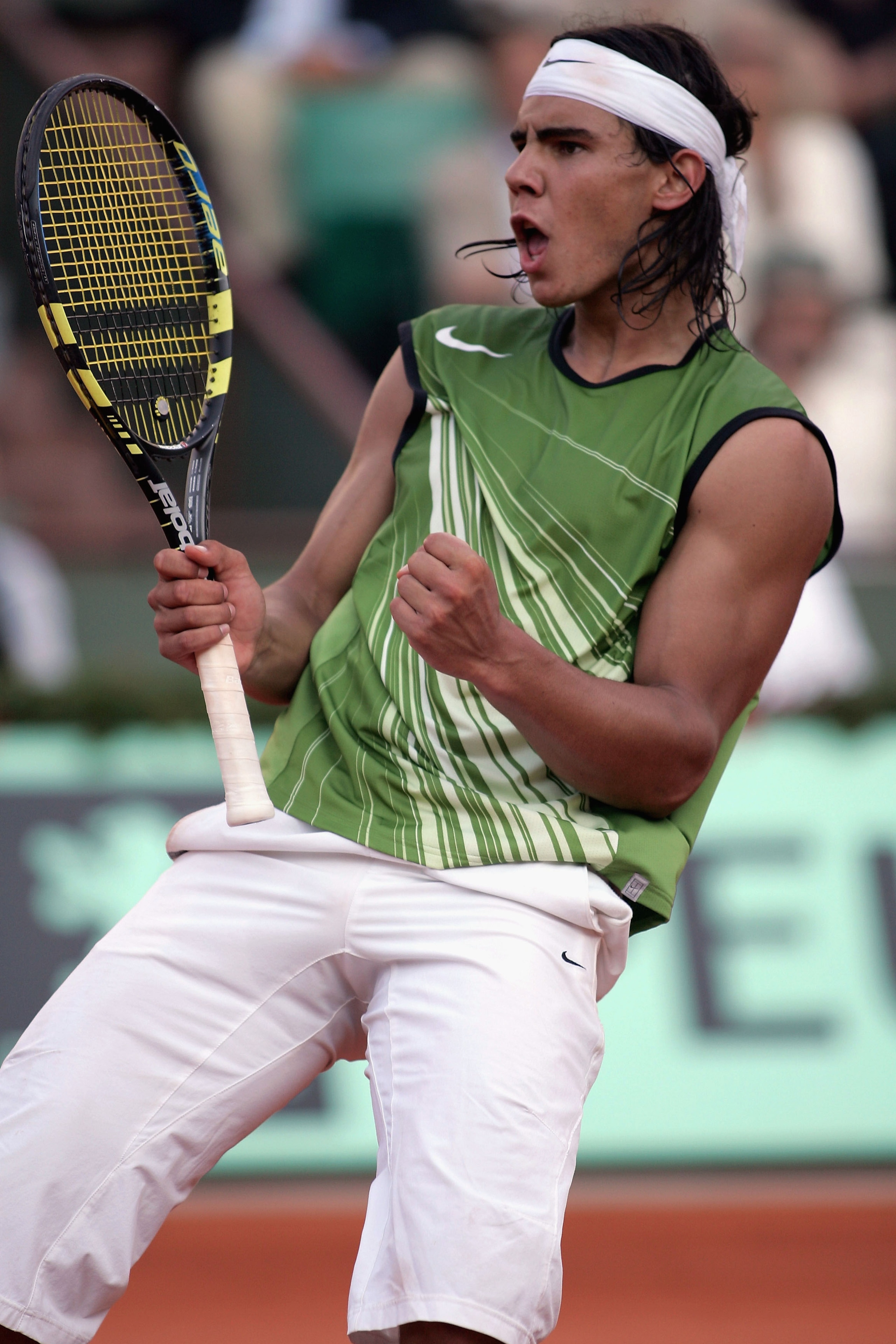
2005 Grand Slam French Open Semifinals: Nadal won 6-3, 4-6, 6-4, 6-3
Head to Head: Nadal 2 - Federer 1
In 2005, Roger Federer came to the French Open trying to win the only Grand Slam title to elude him––at Stade Roland Garros in Paris.
The Swiss made his way convincingly through the draw, finding himself face to face with the young Majorcan Nadal in the semifinals.
It was the first time they met on clay and Federer had no reason to doubt his ability to win on that surface, since he spent considerable time honing his skills on the red dirt growing up.
But Nadal defeated the top-seed in four sets, extending his own winning streak to 23 matches.
Rain delayed the start of the match for over an hour and a half. As darkness descended Federer, leading 3-1 in the fourth set, hoped they would postpone the conclusion because he was having difficulty seeing the ball.
But the match continued and Nadal broke Federer’s serve twice, going on to win the final set and the match.
At age 19, Nadal would go on to win the final and claim his first grand slam singles title.
The Majorcan would tie Wilander by winning the French Open on his first try. It marked the beginning of a winning streak on clay to match the great Bjorn Borg.
The story of the match was Federer’s unforced errors and his errant forehand. The Swiss committed 62 unforced errors, 34 coming on his forehand contrasted with 41 winners. However, Nadal committed 32 unforced errors with 27 winners.
Nadal eased ahead in their head to head.
_0.png?w=2560 "CFB Top 25")

.png?w=2560)
2006 Dubai, Final Winner: Nadal
4 of 22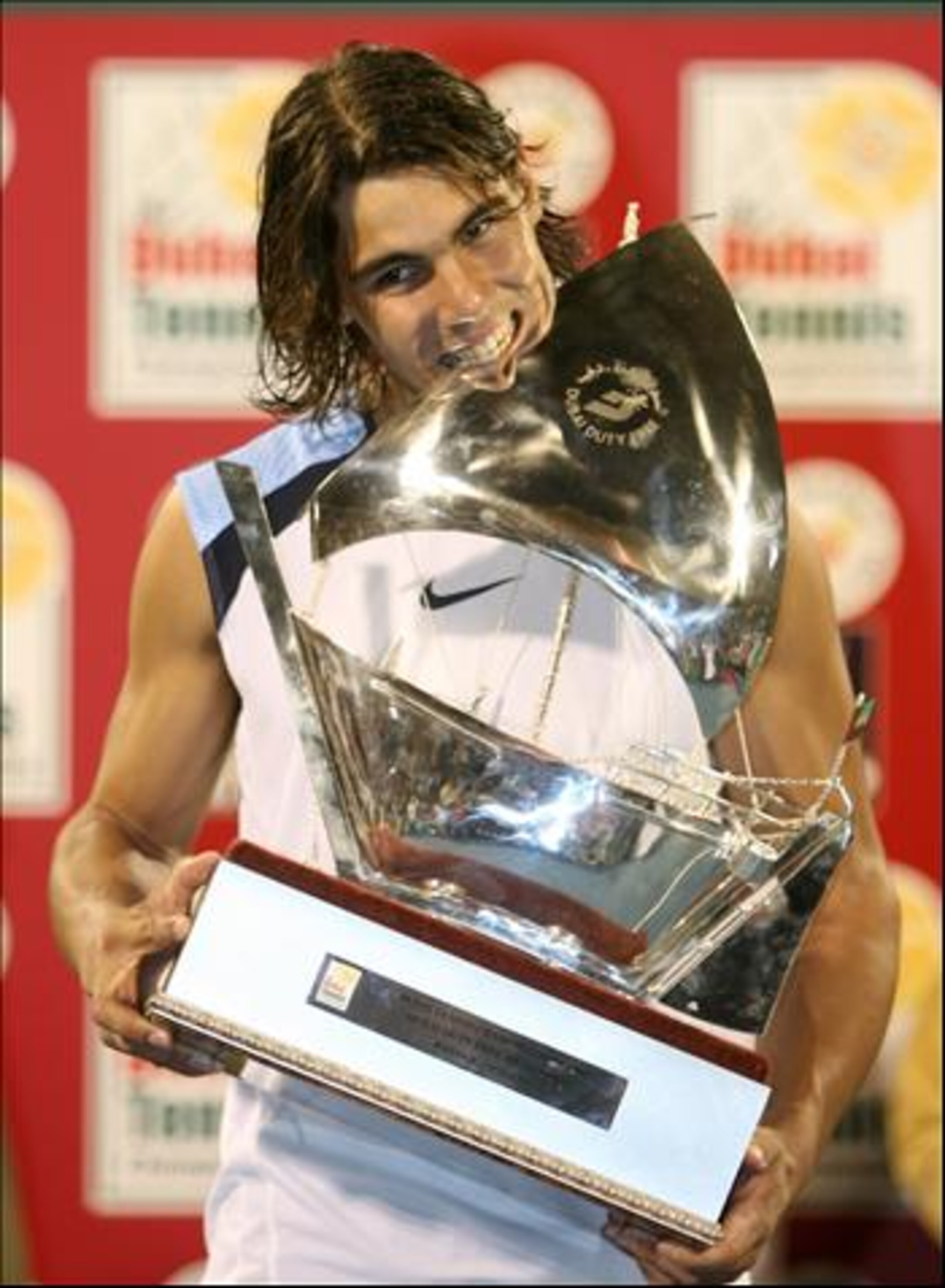
2006 Dubai Finals: Nadal Wins 2-6, 6-4, 6-4
Head to Head: Nadal 3 - Federer 1
Nadal, now World ranked No. 2, spent the last part of 2005 sidelined with a foot injury.
Ranked No. 1, Federer entered Dubai having won this event the past three years.
The Swiss was also undefeated in 2006, including winning his second Australian Open.
Nadal, however, soon ended Federer’s 56 match winning streak on hard courts.
Federer won the opening set against Nadal. His serve was clicking and the Swiss was moving well.
Nadal could make no inroads; but he did not quit.
Instead he roared back in the second set, asserting himself, being aggressive on all points.
He broke Federer in the ninth game and took the second set.
The third set was a repeat of the second, with Nadal clamped down hard on the Federer forehand.
Federer’s first serve percentage dipped dramatically.
At that point, Nadal led in their head to head, winning three of their first four matches. The win marked Nadal’s 13th career singles title.
2006 ATP Masters Series Monte Carlo, Finals Winner: Nadal
5 of 22
2006 ATP Masters Series Monte Carlo Finals: Nadal Wins 6-2, 6-7, 6-3, 7-6
Head to Head: Nadal 4 - Federer 1
It took a while. Three hours and 50 minutes for the number two seed Rafael Nadal to defeat the number one seed, Roger Federer.
In the process, the Majorcan saved 14 of 18 break points against him.
At one point, Federer was up 3-0 in the fourth set tiebreaker with two serves on his racket.
But Nadal, winning the last nine points came back to take the tie break, the set, and the match.
The win gave the teenager Nadal his fifth ATP Masters Series title and consecutive titles in Monte Carlo, having won the title in 2005.
For Federer, the loss was his second in 35 matches in 2006, losing both times to Nadal.
Once again, Federer’s unforced errors undermined his winners and the Swiss could not overcome Nadal’s sheer determination to win the match.
Federer’s resurgence in the second set was stilled as Nadal took a medical timeout to tape blisters on his left hand.
The Majorcan came back strong in the third set.
Federer could not find enough consistency to win, ending this campaign with 78 unforced errors in the match.
Nadal surged ahead in their head to head meetings.
2006 ATP Masters Series Rome, Finals Winner: Nadal
6 of 22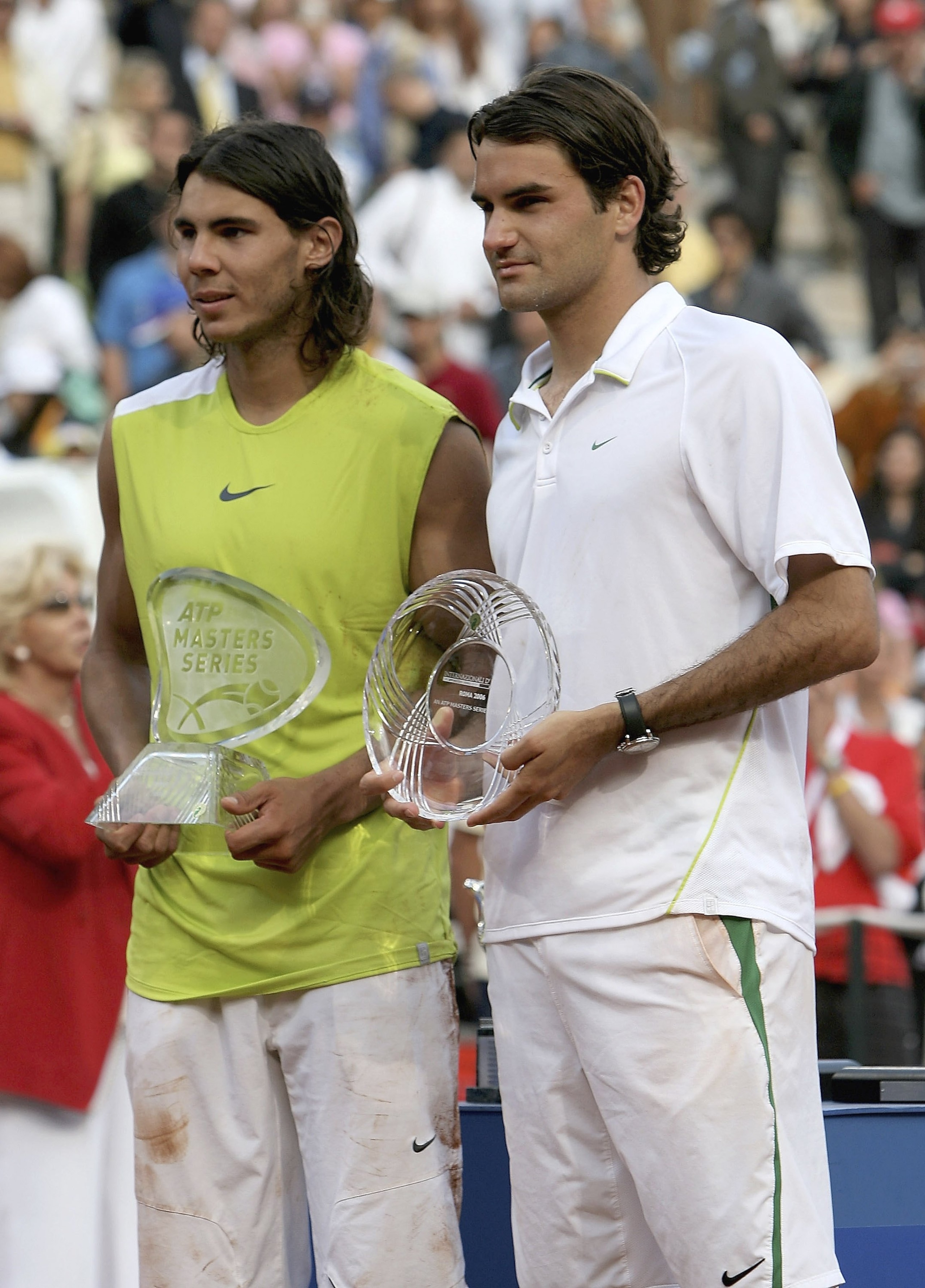
2006 ATP Masters Series Rome Finals: Nadal Wins 6-7, 7-6, 6-4, 2-6, 7-6
Head to Head: Nadal 5 - Federer 1
This one remains a classic, the first of many classics the number one and two players in the world would unfold on a tennis court, barely able to contain the sheer will, determination, and talent two men holding rackets can wield.
Lasting over five hours, it was one match neither man deserved to lose.
Unfortunately—or fortunately depending on your point of view—there are no ties in tennis.
This match would soon end the practice of five set finals in the Masters Series events because after this epic, both Federer and Nadal pulled out of the next ATP tournament in Hamburg.
What this match carved in granite was Nadal’s supremacy on clay.
No one could out muscle Nadal on the red dirt. This match set the standard and when Nadal staved off two match points, down 6-5 in the fifth set, holding on to send it to a final set tie break.
In the tie break, Nadal came back from 5-3 down to win the last four points of the match.
From this point forward it seemed Federer forever acquiesced on the clay—even though Federer would manage to win a couple of their clay court match-ups.
Nadal would advance––sending his unbeaten streak on clay to 53 matches, tying him with Guillermo Vilas’ record set in 1977.
Nadal also equalled Bjorn Borg’s record of 16 titles won as a teenager.
For Federer, all three of the matches he lost in 2006 came at the hands of Nadal. Rome gave Federer a chance to see what it took to defeat Nadal on clay.
The two play each other with solid and intense aggression, yet always tinged with the greatest respect.
It appeared that Nadal was beginning to dominate in their rivalry.
2006 Grand Slam French Open, Final Winner: Nadal
7 of 22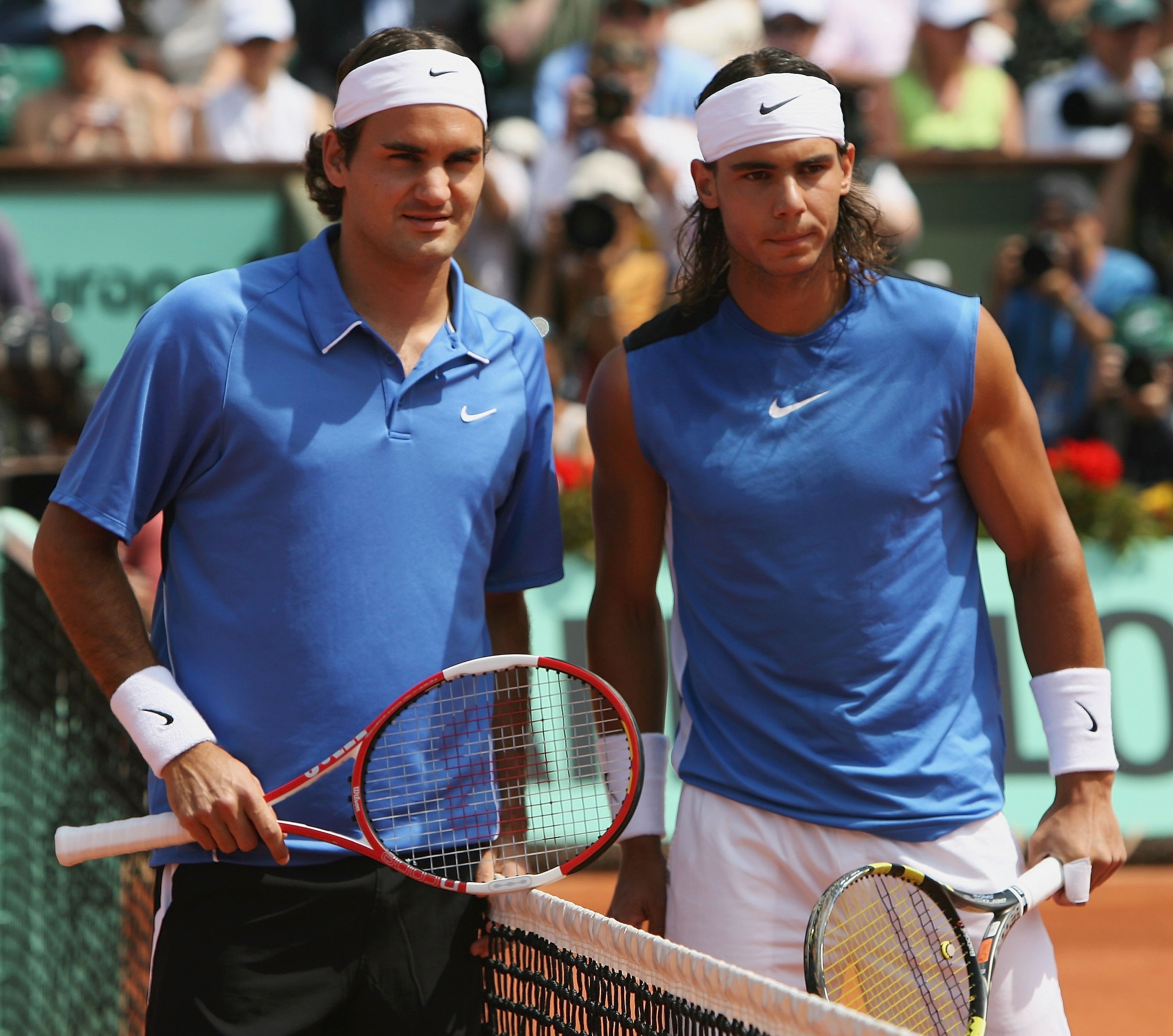
2006 Grand Slam French Open Final: Nadal Wins 1-6, 6-1, 6-4, 7-6
Head to Head: Nadal 6 - Federer 1
Some men would get a complex if his chief rival had defeated him in six out of seven head-to-head contests.
Regardless of his ranking, Federer began to get that complex facing this barely 20-year-old from Majorca who kept letting the air out of the Swiss balloon, deflating the Federer invincibility––on clay that is.
For the first time, Federer faced Nadal in the finals of the French Open in 2006.
It was nothing like the classics the two enacted in Monte Carlo or especially in Rome. The 1-6, followed by 6-1 first two sets could hardly be called sterling tennis.
It was a beastly hot day, wilting and dusty—heavy only with anticipation as Federer hoped to win his first French Open title.
It looked as though Federer might pull ahead by breaking the Nadal serve at the start of the third set, but when Nadal served down 1-2 and 0-40, Federer called attention to a ball of Nadal’s that skimmed the line.
The point was replayed and Nadal won the next four points in a row to pull himself out of harm’s way.
Nadal rewarded Federer with a break of the Swiss' serve. The Majorcan went on to capture the third set.
The two now fought the wind in addition to the heat as they battled toe to toe in the fourth set.
The set finally went to a tie break, where Nadal remained solid taking the breaker and the match.
Nadal won his second consecutive French Open title, this time over Federer.
Federer made his first French Open final––now he waited to win one.
Nadal was now 60-0 on clay, sporting a new and impressive whipped forehand cross court volley.
Could life get any better for Nadal?
2006 Grand Slam Wimbledon, Final Winner: Federer
8 of 22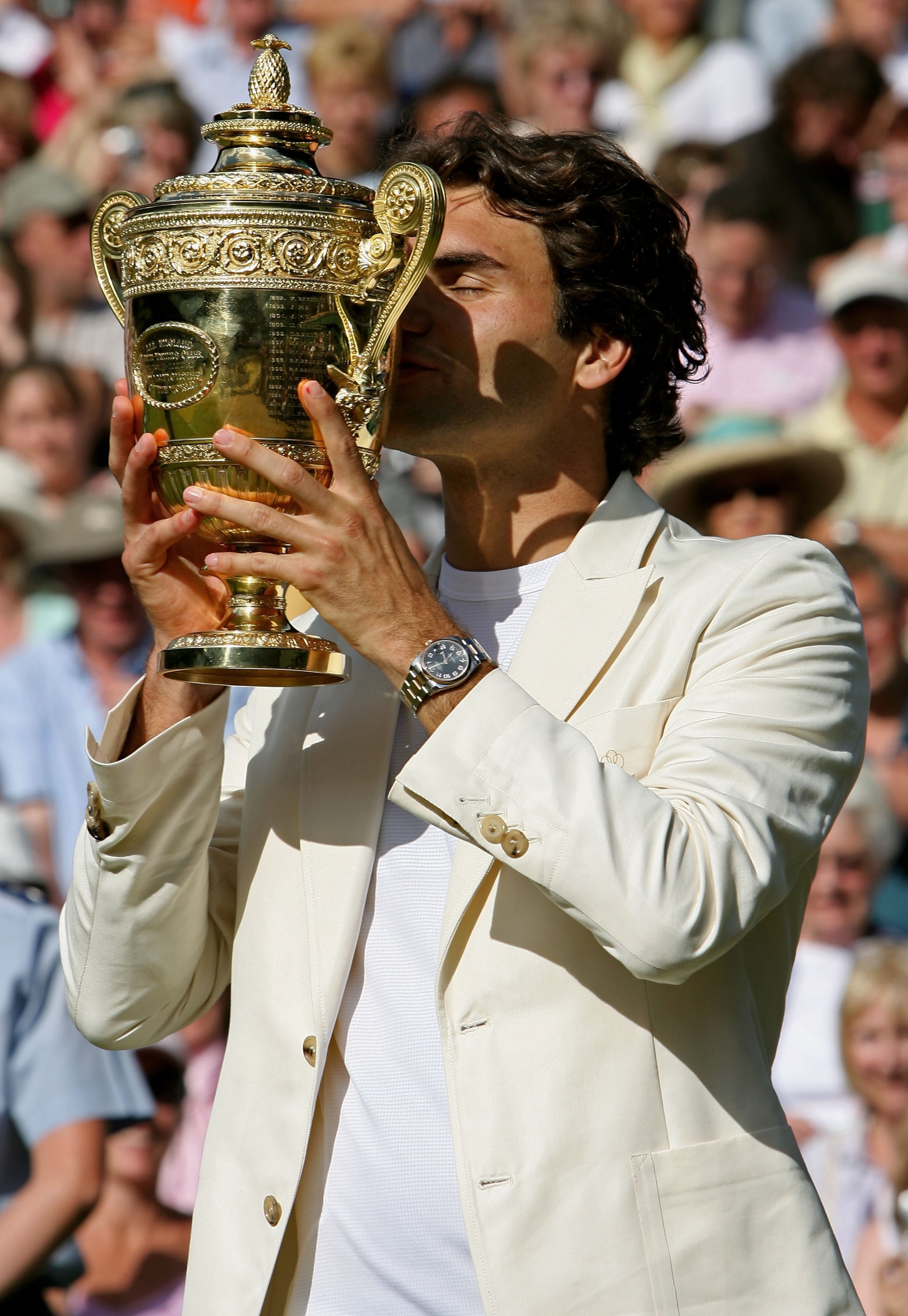
2006 Grand Slam Wimbledon Final: Federer Wins 6-0, 7-6, 6-7, 6-3
Head to Head: Nadal 6 - Federer 2
Federer had to feel that Nadal was an interloper. The Majorcan’s domain was clay, the red dirt of Stade Roland Garros, not the pristine green lawns of the All England Club.
Grass was where Federer ruled.
To find Nadal across the net as his opponent in the final at Wimbledon in 2006 was not the most pleasant of surprises.
For Nadal, it was the beginning of his advancement from clay to all surfaces, starting with grass.
What is more, the Majorcan knew that the man standing on the service line waiting to send the ball over the net was one of the best ever to dominate on this surface.
Playing Federer in the final was a great way to begin the process of learning to win on grass.
Federer won the first six games and took the first set in 25 minutes by breaking Nadal three times, utilizing a vicious return of serve.
The Swiss also capitalized on his own 93 first-serve percentage to hold his own serve with ease.
Typically, Nadal fought back in the second set, breaking Federer on his first serve. Then Nadal held on to consolidate, seemingly on his way to level the match.
Nadal, however, could not serve out the second set and Federer broke him to send it to a tiebreak––which the Swiss won, giving him a 2-0 lead in the match.
Nadal just could not handle the low-skidding balls Federer sliced at his feet.
Federer lost the third set in another tiebreak, but he came back strong in the fourth set to put doubt to rest.
Federer claimed his fourth consecutive Wimbledon championship, sending his grass match winning streak to 48.
He had not lost a match at Wimbledon since June of 2003. The man from Switzerland felt a sense of relief, finally winning another match from Nadal.
2006 Tennis Masters Cup Shanghai, Semifinals Winner: Federer
9 of 22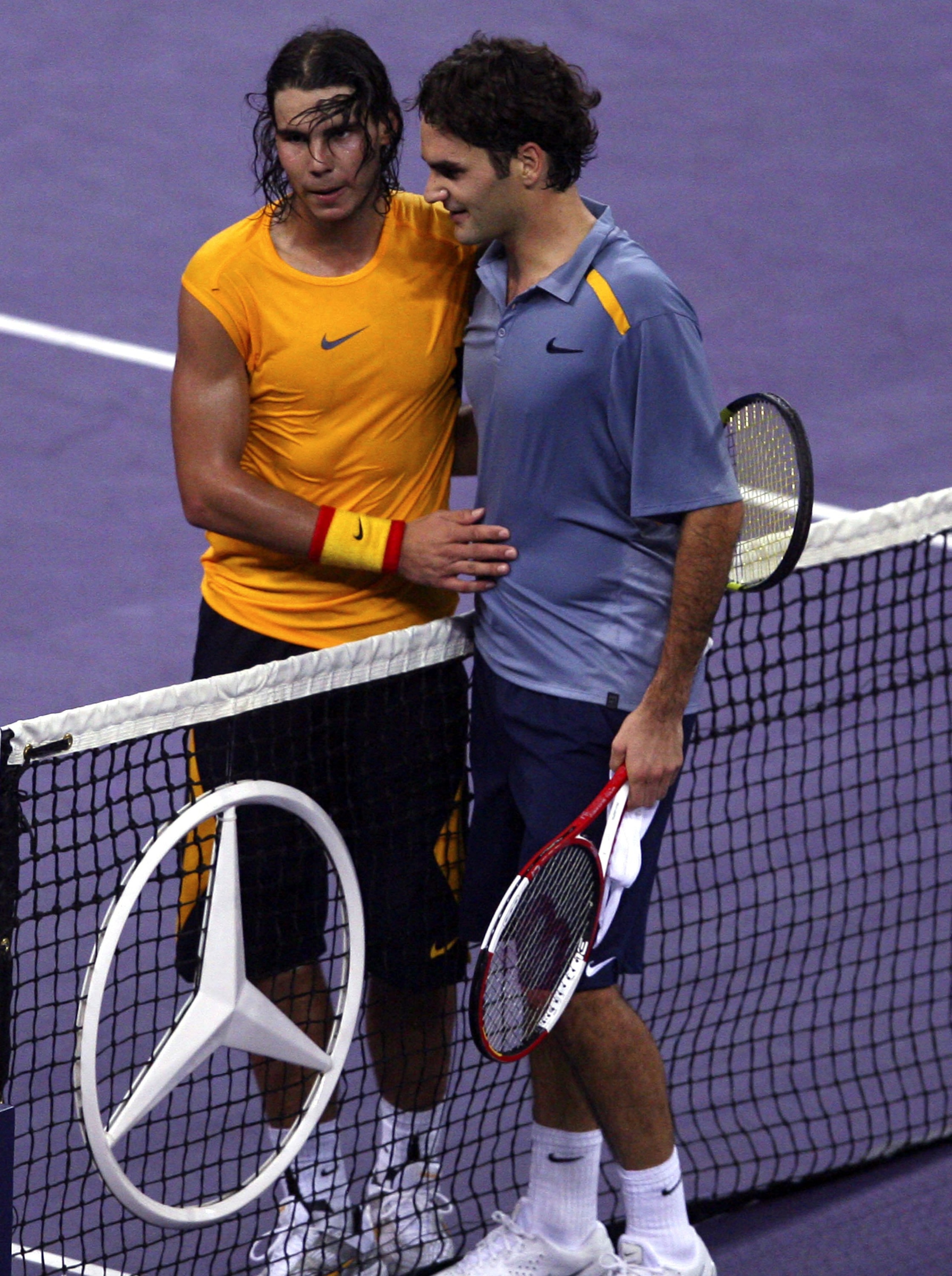
2006 Tennis Masters Cup Shanghai Semifinals: Federer Wins 6-4, 7-5
Head to Head: Nadal 6 - Federer 3
Federer would end 2006 with another victory over Nadal––this one at the year-end championships held in Shanghai.
Nadal, who lost to American James Blake, ended up second in his round robin group.
This meant that Nadal faced Federer in the semifinals.
Federer defeated number two Rafael Nadal 6-4, 7-5 in the semifinals on Saturday.
The Swiss had won all three Red Group matches to extend his unbeaten Tennis Masters Cup round-robin record to 15-0.
Federer concluded 2006 with a 92-5 record on the season becoming the first player in over 20 years to win over 90 matches in one season. Ivan Lendl was the last.
Nadal had not fared well after Wimbledon. In fact, he had not won another title that year after the 2006 French Open.
Nadal battled his way through to make the semifinals but could go no further.
Federer won his third Master’s Cup Title, defeating James Blake.
The Swiss finished the season with 12 titles and 16 finals appearances from his 17 tournaments, winning $1.52 million for his unbeaten run in Shanghai.
Federer closed the gap on their head to head, winning the last two.
2007 ATP Masters Series Monte Carlo, Finals Winner: Nadal
10 of 22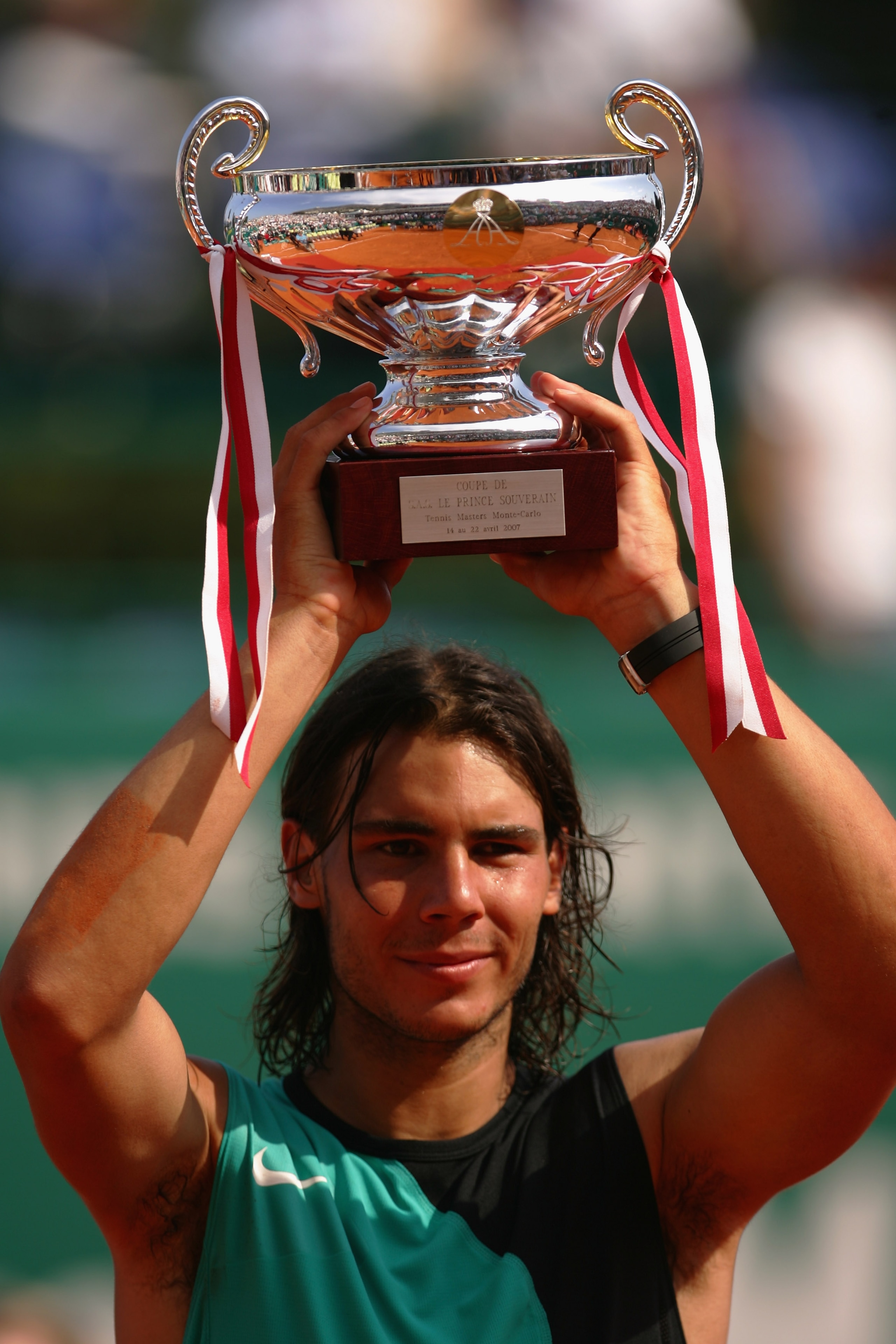
2007 ATP Masters Series Monte Carlo Finals: Nadal Wins 6-4, 6-4
Head to Head: Nadal 7 - Federer 3
Once the clay court season began in 2007, Nadal’s confidence and mastery resumed.
Just like at the French Open, Nadal did not lose in Monte Carlo.
He met Federer in the 2007 final, and again, Federer failed to overcome the Majorcan on the red clay. Nadal won his third straight championship in Monte Carlo.
By winning it three times, Nadal pulled even with the Romanian Ilie Nastase, who did the same thing from 1971-1973.
Federer’s forehand went missing during the match and the Swiss failed to capitalize when he had break point opportunities on Nadal’s serve.
The Majorcan needed only one break of serve in each set to send Federer packing.
To date the Swiss had never beaten Nadal on clay.
Prior to the final, Federer had been dominant, overcoming David Ferrer and Juan Carlos Ferrero but once again had no answers when facing Nadal.
Nadal continued to dominate in their rivalry.
2007 ATP Masters Series Hamburg, Finals Winner: Federer
11 of 22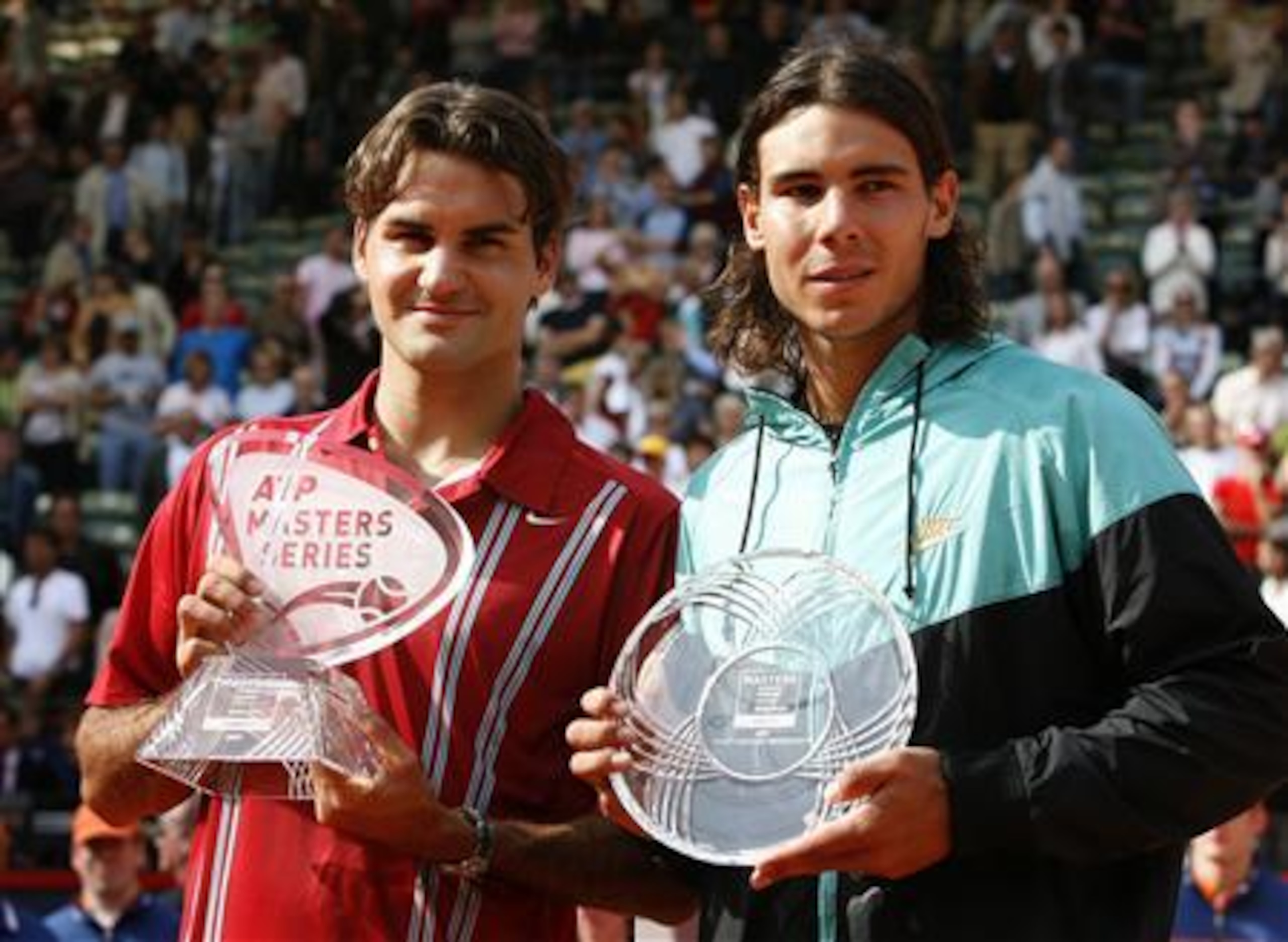
2007 ATP Masters Series Hamburg Finals: Federer Wins 2-6, 6-2, 6-0
Head to Head: Nadal 7 - Federer 4
All good things must come to an end eventually.
When Federer finally defeated Nadal on clay in 2007, the win ended the Majorcan’s 81 match winning streak on clay.
Even though Nadal won the opening set, he could not sustain his edge and Federer came back to defeat the Majorcan by winning the last two sets 6-2, 6-0.
The Swiss won the last eight games of the match, securing his win in an hour and 54 minutes with a vastly improved first serve percentage.
Federer had been in a bit of a slump coming into Hamburg after going four tournaments without a win, which was the worse slump of his career since turning number one in February 2004.
Coming into the French, Federer had the opportunity to hold all four Grand Slam titles at the same time.
But, of course, that meant winning the French Open.
For the first time, winning in Hamburg gave the Swiss new hope of his chances of winning in Paris.
Nadal had won 13 consecutive tournaments on clay and had not lost on the surface since losing to Russian Igor Andreev in 2005.
Federer defeating Nadal on clay marked a new era in their rivalry.
2007 Grand Slam French Open, Final Winner: Nadal
12 of 22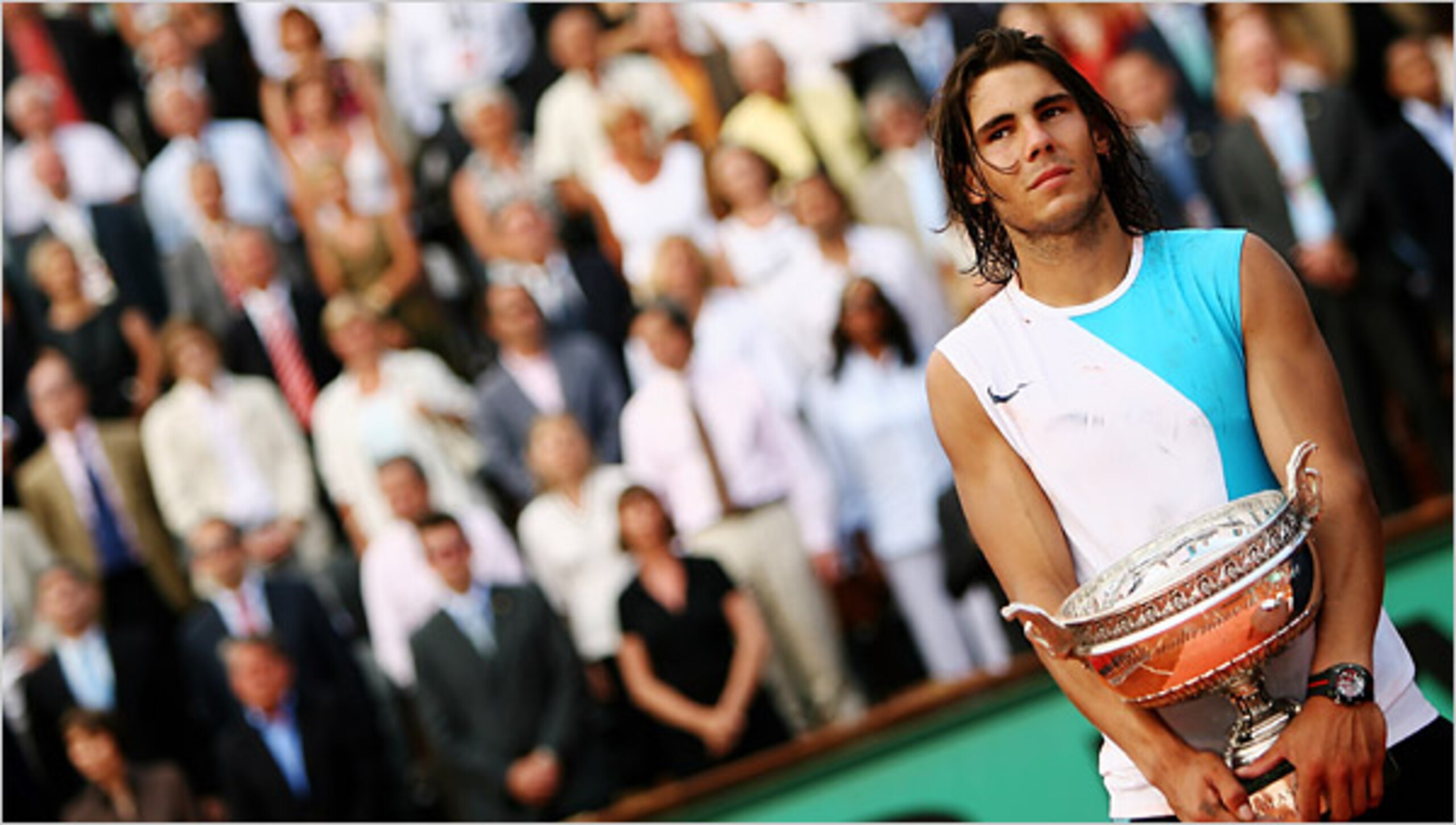
2007 Grand Slam French Open Final: Nadal Wins 6-3, 4-6, 6-3, 6-4
Head to Head: Nadal 8 - Federer 4
After winning the tournament in Hamburg, Federer let himself hope and believe he could defeat Nadal at Stade Roland Garros in Paris.
This would give the Swiss the only Grand Slam jewel missing from his crown.
It would also allow Federer the chance to own all four grand slam championships simultaneously on his way to a calendar year grand slam.
All wonderful ambitions for the the No. 1 player in the world.
Certainly, Federer had his chances in this match.
But the Swiss capitalized only once on 17 break chances, as Nadal escaped 16 times while Nadal converted on four of his 10 chances to break the Federer serve.
Federer also suffered with 59 unforced errors while Nadal had less than half as many, with 27.
Nadal was merciless in attacking the Federer backhand.
Federer did win a set, which was the only one Nadal lost in the entire championship.
Nadal won his third consecutive French Open Championship.
Federer, with 10 career grand slam singles titles, could only watch as Nadal celebrated another victory once again with no answers for defeating Nadal on the red clay of Stade Roland Garros.
2007 Grand Slam Wimbledon, Final Winner: Federer
13 of 22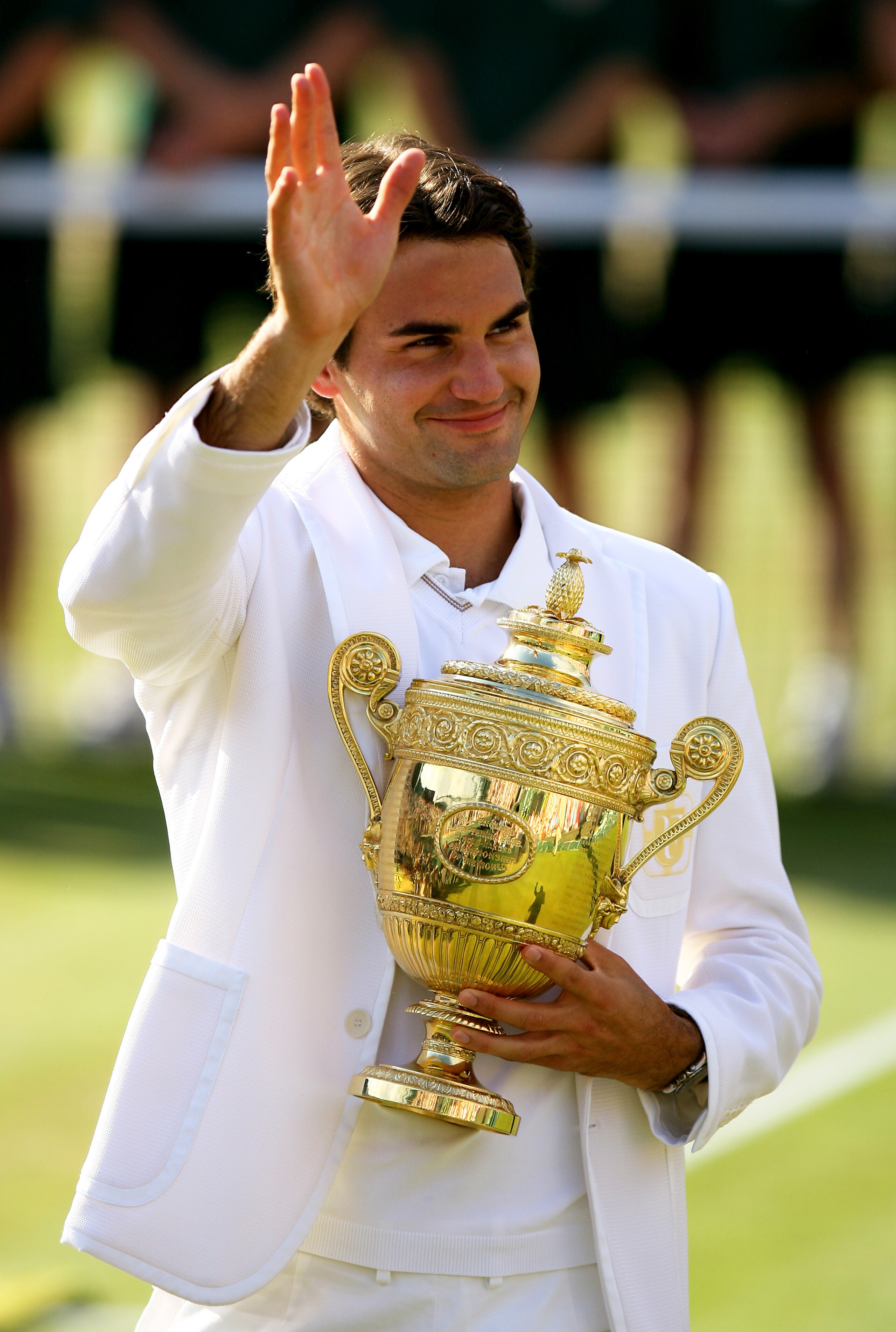
2007 Grand Slam Wimbledon Final: Federer Wins 7-6, 4-6, 7-6, 2-6, 6-2
Head to Head: Nadal 8 - Federer 5
After another gut-wrenching disappointment in Paris, Federer journeyed to Wimbledon to renew his tennis energies, now sapped by the sluggish red clay.
The green lawns remained Federer’s favorite place to play the game and win.
Just like last year, however, Federer again found himself facing Nadal in the finals at the All-England Club.
Last year it took Federer four sets, this year however, it would take another five set epic between the two rivals ranked No. 1 and No. 2 in the world.
The 2007 Wimbledon Final was regarded at the time as one of the best finals ever played on the Centre Court at Wimbledon. It would be replaced by the Federer-Nadal rematch during the 2008 Wimbledon final.
Federer took the opening set tiebreak but Nadal was not deterred, coming back strong to win the second set. It was only Federer’s second set loss in the entire tournament.
The Swiss had a chance to break Nadal in his opening game but Federer could not convert. It became increasingly obvious that his inability to shake Nadal loose was wearing on the Swiss Maestro’s nerves.
Federer eventually prevailed in the third set tiebreak. All seemed right with the Swiss world until Federer’s serve was broken in his opening game of the fourth set.
Nadal went on the win the fourth set, sending this match into a fifth and final set.
Federer railed against Hawkeye to no avail. Federer, unaccustomed to five sets at Wimbledon, soon found himself in the midst of one.
But the Swiss was up for the challenge, saving a break on his own serve, broke Nadal’s serve twice to win the set and the match.
Federer continued to dominate Nadal on grass.
2007 Tennis Masters Cup Shanghai: Semifinals: Winner Federer
14 of 22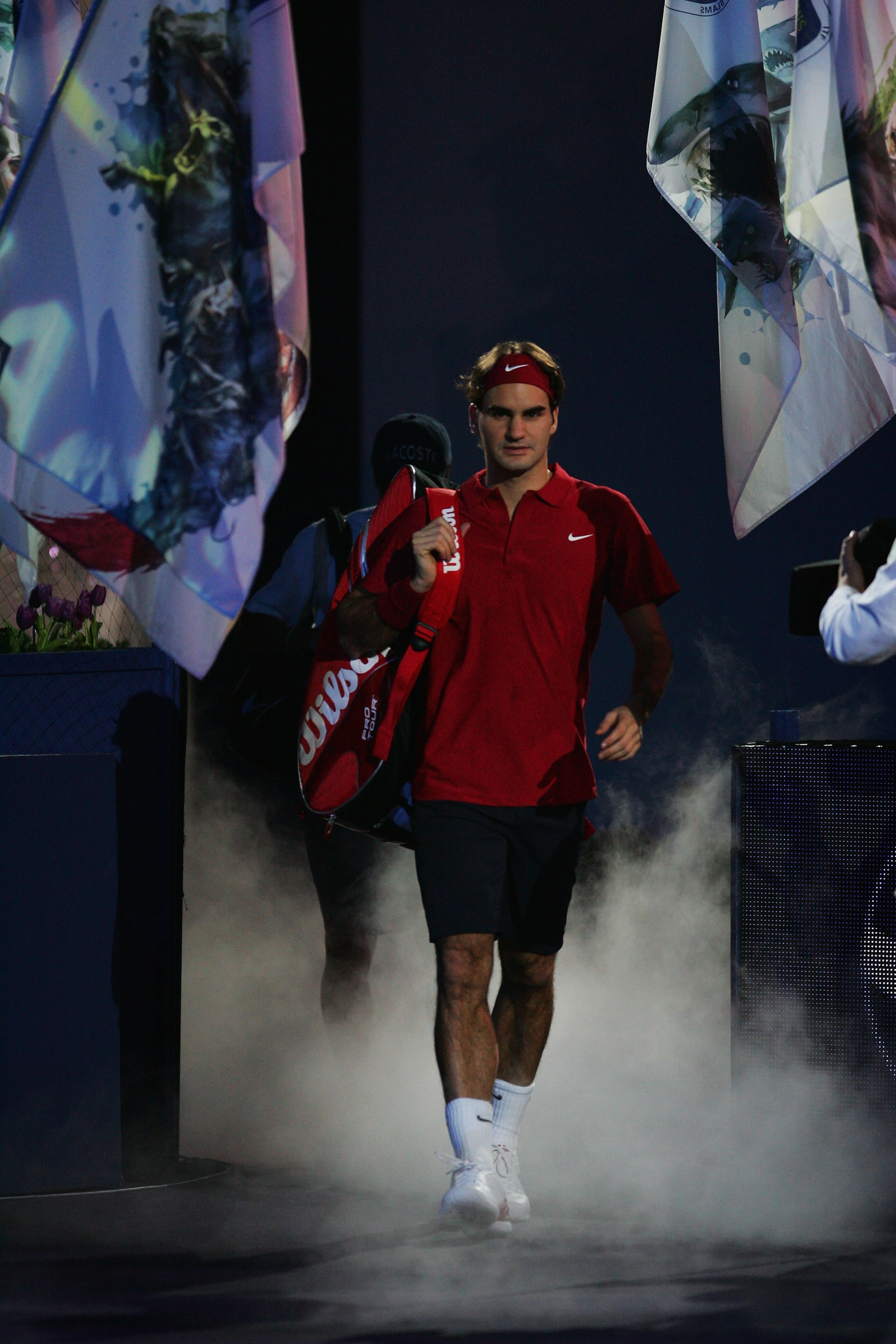
(14) 2007 Tennis Masters Cup Shanghai - Semifinals - Federer Wins 6-4, 6-1
Head to Head Nadal 8 - Federer 6
Once again Rafael Nadal was not playing well at the end of the season in 2007.
Hard courts proved to be too difficult for the Majorcan whose knees could not sustain or rebound from the pounding they received during the last half of the tennis year.
Federer’s defeat of Nadal in the semifinals of the year-ending Masters Cup in Shanghai was a surprise to no one.
Federer served his way into another championship match, which the Swiss would win.
But the dominance of the Federer serve gave Nadal no inroad and he remained blanked on trying to win by breaking the Swiss.
While the first set was competitive, the second set was singularly lopsided. At one point, Federer won 20 out of 21 points.
Nadal left the court seeming down and out while Federer looked forward to another sterling year, starting with the Australian Open in January of 2008.
It appeared to Federer and the world that the rivalry with Nadal was drawing almost dead even.
2008 ATP Masters Series Monte Carlo, Finals Winner: Nadal
15 of 22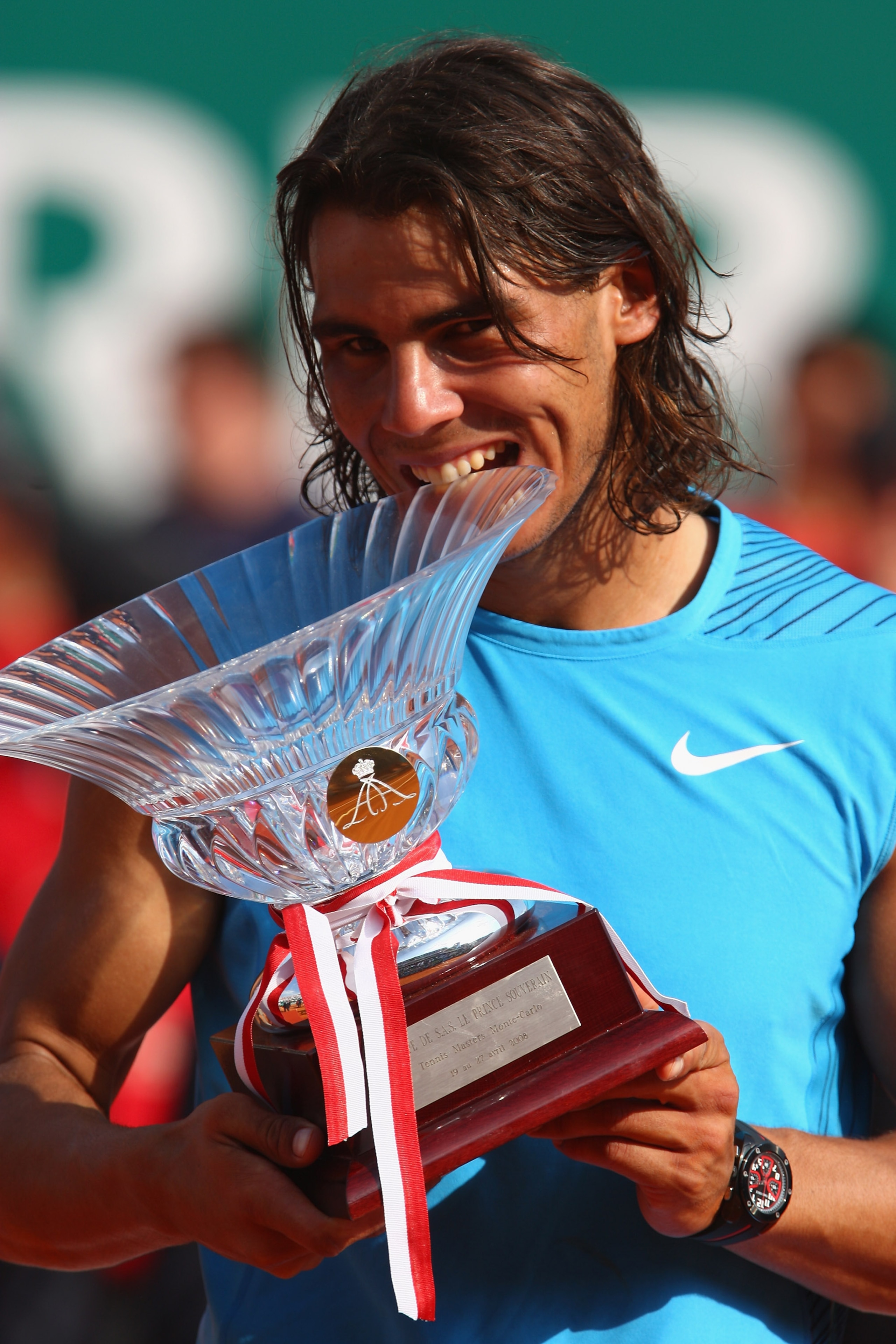
2008 ATP Masters Series Monte Carlo Finals: Nadal Wins 7-5, 7-5
Head to Head: Nadal 9 - Federer 6
2008 proved to be a disastrous year for Federer in general and specifically for the Roger-Rafa rivalry. In their four meetings in 2008, Federer lost each time, ballooning the apparent distance between them.
The Swiss began the year losing in the semifinals of the Australian Open to Novak Djokovic, later admitting he had contracted mononucleosis.
In the Monte Carlo final, Federer had many opportunities to prevail, but could not rise to the occasion, letting Nadal off the hook, leading 4-3 in the first set and leading 4-0 in the second.
Once again, Nadal never dropped a set. Federer committed too many unforced errors, especially on his forehand and allowed Nadal back into the match.
Nadal now had a 7-1 lead over Federer on clay. The win marked the Majorcan's fourth consecutive win in Monte Carlo, again over the No. 1 ranked player in the world and his 24th title overall.
For Nadal, it was his 98th victory in 99 tries on clay with the World No. 2 losing once to Federer at Hamburg in 2007.
In returning to clay once again, Nadal won his first title of 2008. It would not be his last.
2008 ATP Masters Series Hamburg, Finals Winner: Nadal
16 of 22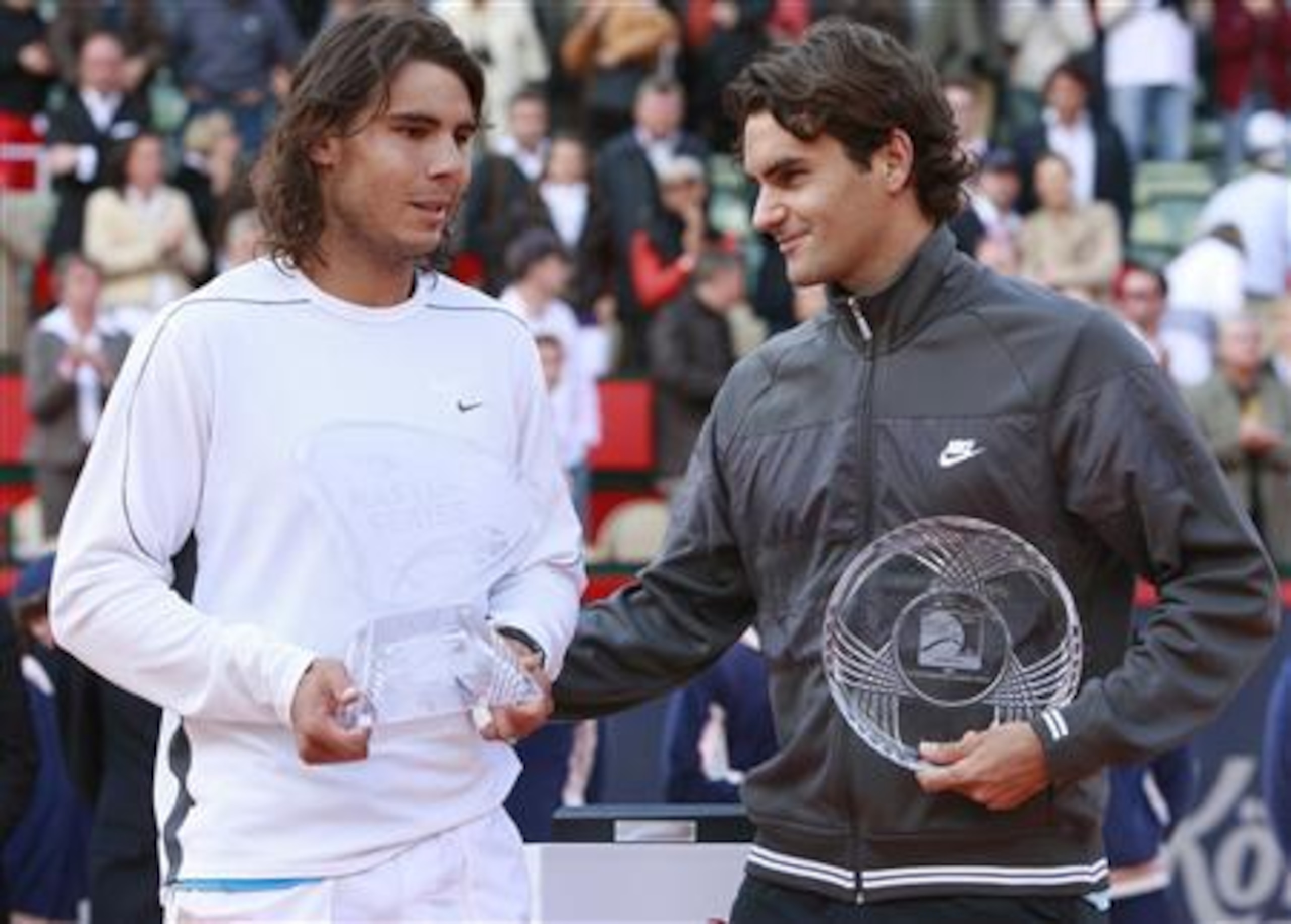
2008 ATP Masters Series Hamburg Finals: Nadal Wins 7-5, 6-7, 6-3
Head to Head: Nadal 10 - Federer 6
Nadal finally captured the only title on clay that had eluded him throughout his young career: The Masters Series at Hamburg.
The World No. 2 defeated the man who denied him the title a year ago, Roger Federer.
The Swiss suffered his first loss at Hamburg.
The match was again typical of their recent encounters as Federer shot out to a 5-1 lead in the first set, only to suffer a complete meltdown, losing the next six games and losing the set 7-5.
It was painful to watch for Federer fans trying to will the Swiss to conquer his 2008 demons.
Federer broke Nadal in the second set but was unable to hold his advantage, settling for a tiebreak which the Swiss won 7-3. Federer finally was on the scoreboard.
Nadal, however, broke the World No. 1 in the fourth game of the third and final set, winning out in a little under three hours.
This win cemented Nadal as the favorite to win the upcoming 2008 French Open.
The rivalry was definitely tipping heavily in Nadal's favor.
2008 Grand Slam French Open, Final Winner: Nadal
17 of 22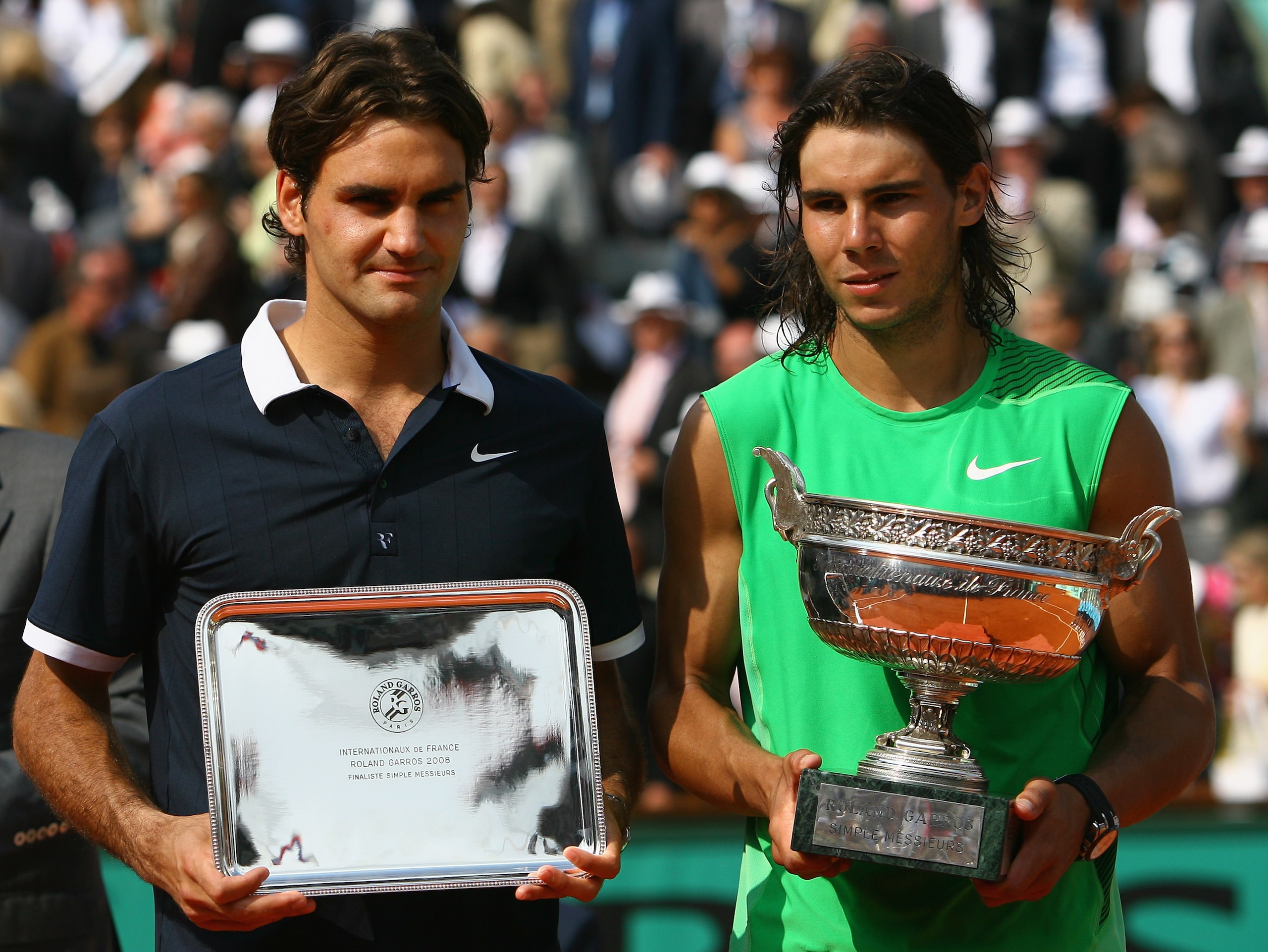
2008 Grand Slam French Open Final: Nadal Wins 6-1, 6-3, 6-0
Head to Head: Nadal 11 - Federer 6
It was hardly a match at all. It was one of Federer's worst defeats ever, especially in the finals of a major.
All the hype leading up to the tournament that suggested Federer had a chance to win seemed patently ridiculous in the aftermath of this seismic beat-down.
Nadal won his fourth consecutive French Open title, equaling Bjorn Borg's record at Stade Roland Garros. It gave Nadal 28 consecutive wins on the red clay in Paris.
It seemed to all the world that no one would ever be capable of defeating Nadal at the French Open.
Federer was powerless to have an impact on Nadal's game.
The Majorcan's precision and drive were impenetrable on the day as the crowd sat in stilled silence, watching the dismantling of the World No. 1 by his arch rival.
The only thing Federer could look forward to were the green lawns of Wimbledon, always a salvation to the Swiss after another harsh clay season ended.
The head to head match up made their matches seem less and less like a true rivalry.
2008 Grand Slam Wimbledon, Final Winner: Nadal
18 of 22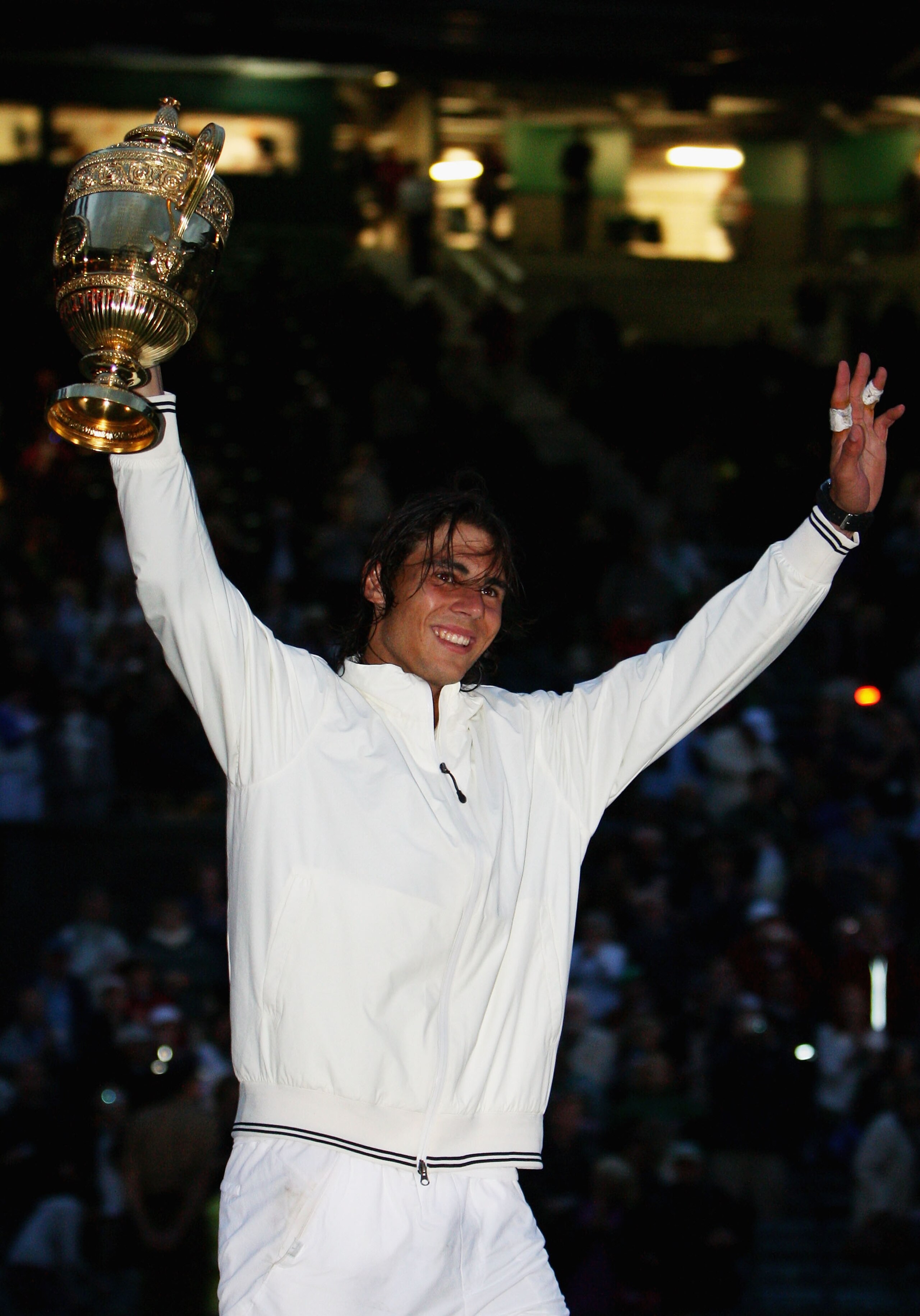
2008 Grand Slam Wimbledon Final: Nadal Wins 6-4, 6-4, 6-7, 6-7, 9-7
Head to Head: Nadal 12 - Federer 6
The final blow of the 2008 season came during Federer's beloved Wimbledon as the great Swiss was going for this sixth consecutive championship.
It seemed the gods conspired against the Swiss that day as the rains came and darkness descended, all working to deny Federer another victory on Centre Court at the All-England Club.
From the beginning, however, nothing went Federer's way as he lost the first two sets to Nadal 6-4, 6-4. It looked very bleak for the Swiss.
But Federer fought back winning the next two sets dodging the rain and the assault from the baseline by an ever-improving Nadal. Federer refused to give in all the way to a fifth and final set.
It seemed the only fitting way to end this classic match between the world's two greatest male tennis players on historic Centre Court.
The rains came again in the fifth set and play was continued despite the growing darkness and no lights to illuminate proceedings on the hallowed grounds.
Eventually the two traded serves all the way to 7-7 in the fifth. Wimbledon, as we all well know, has no tiebreak in the fifth set.
Federer's forehand seemed to desert him at that point and Nadal pounced, breaking Federer's serve. Then all the Majorcan had to do to win was serve it out.
Nadal did exactly that admitting in the end that he could see nothing during that final game.
Federer was distraught over losing that match which denied him so many more records as his winning streak at Wimbledon and on grass ended at 40 and 65 respectively.
This match served, however, to define their rivalry as many called it the greatest tennis match ever because the whole world watched the drama unravel over hours and hours of coverage.
2009 Grand Slam Australian Open, Final Winner: Nadal
19 of 22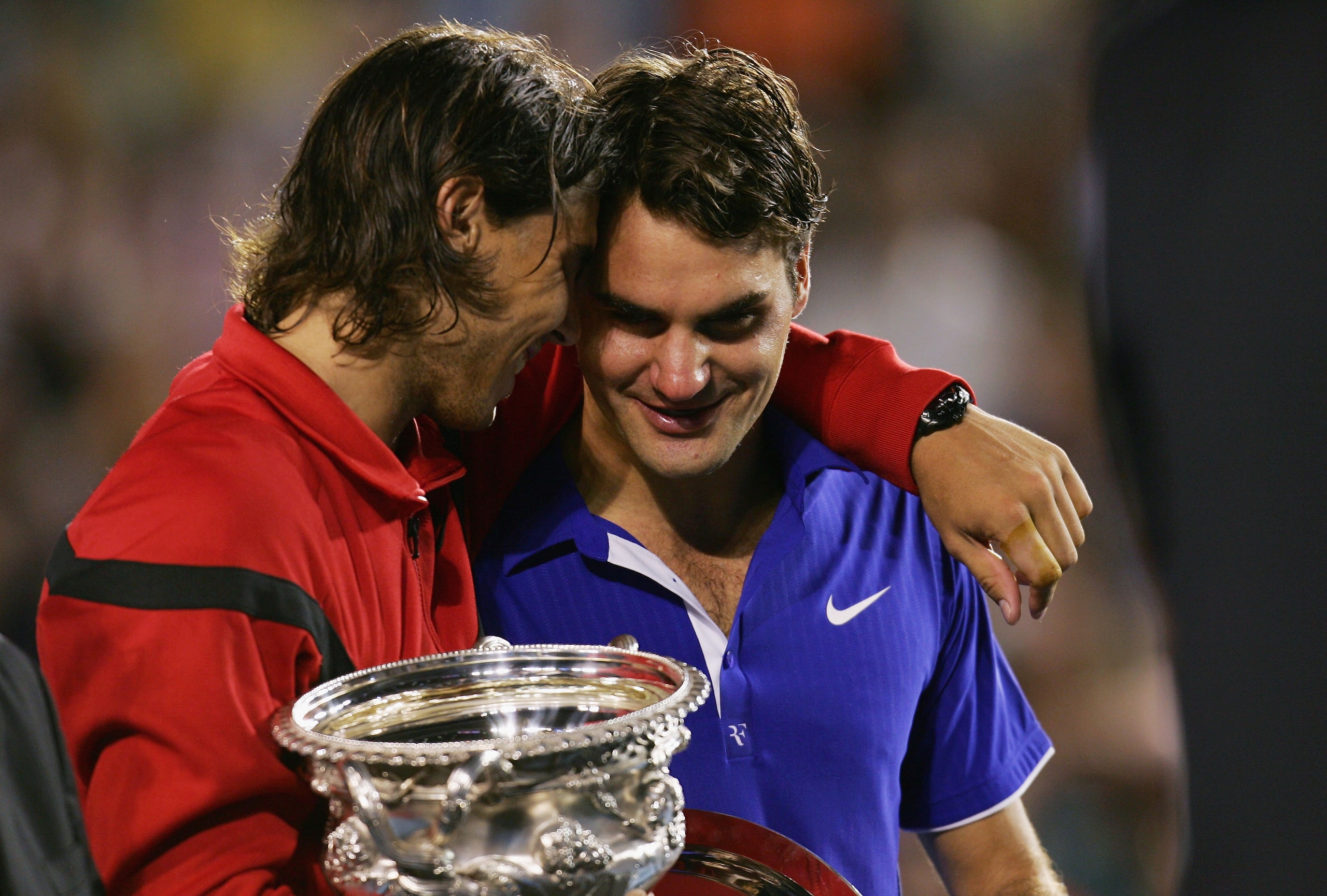
2009 Grand Slam Australian Open Final: Nadal Wins 7-5, 3-6, 7-6, 3-6, 6-2
Head to Head: Nadal 13 - Federer 6
2009 would find Federer again in the finals of the Australian Open, but still not the winner.
After surviving a particularly “down” year for Federer in 2008 with “only one” slam title—the U.S Open—Federer wished to start out the year by reasserting his dominance, especially after losing his No. 1 ranking to Nadal in August of 2008.
Seeded number one, Rafael Nadal had never made the finals of any major played on hard courts, including Australian Open.
The new World No. 1 wished desperately to change this, starting in 2009.
Federer's confidence remained in shock, having lost to Nadal the last four times they had played.
The seeds of doubt planted by Nadal in Federer's psyche had sprouted into a massive growth blocking the ability of the Swiss to play with aggression and confidence.
The two players made their way systematically through the draw finding themselves facing each other again in a major final.
Federer would surge ahead in a set, only to fall back quickly as his serve or his forehand failed the Swiss time and again.
The two top seeds played another five-set thrilling match which Federer lost 7-5, 3-6, 7-6, 3-6, 6-2.
Rafael Nadal won his first Australian Open title and his first slam on hard courts.
Federer went back to the drawing board to parse his rivalry with Nadal––after losing to the Majorcan for the fifth consecutive time.
2009 ATP World Tour Masters Madrid, Final Winner: Federer
20 of 22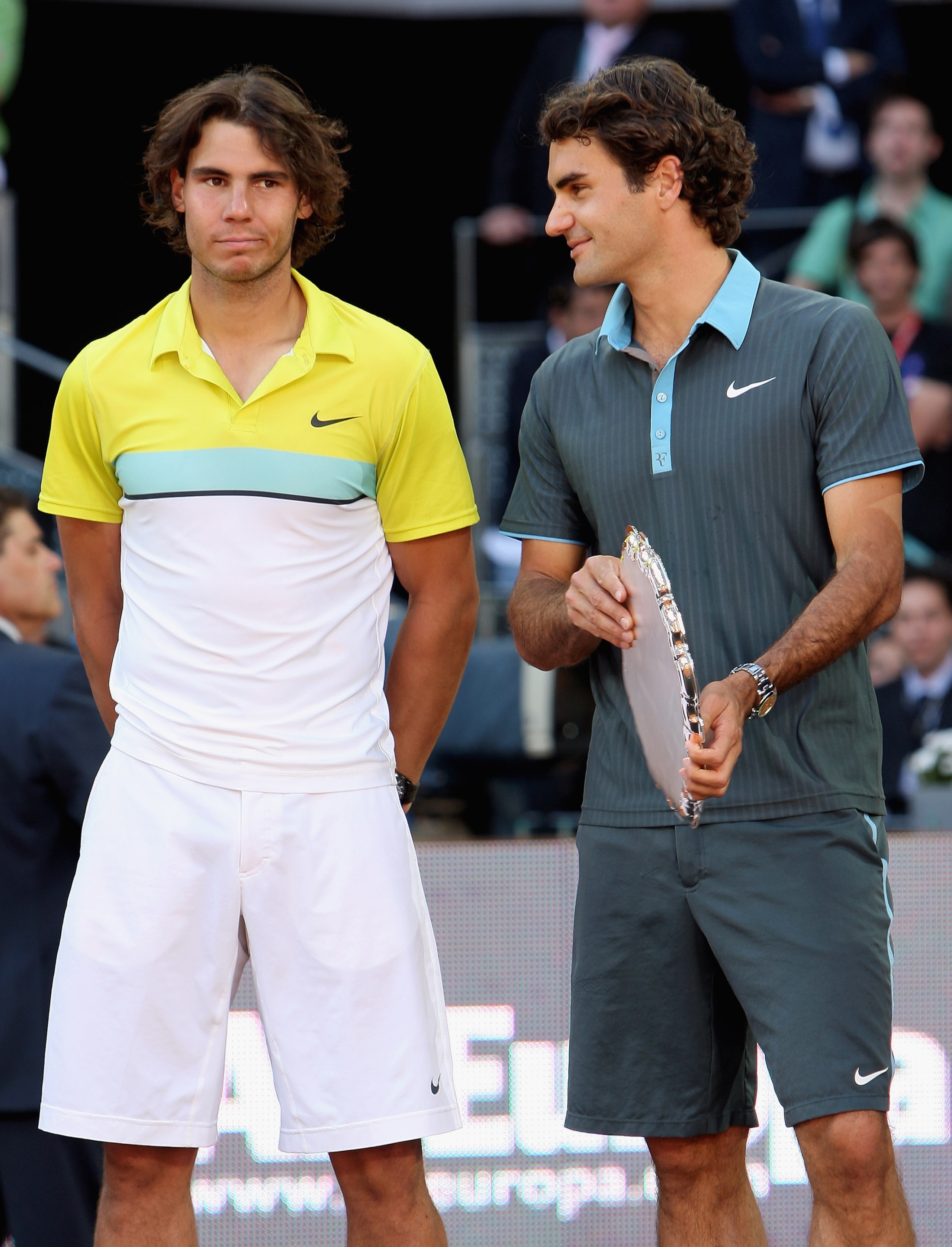
2009 ATP World Tour Masters Madrid Final: Federer Wins 6-4, 6-4
Head to Head: Nadal 13 - Federer 7
After five straight defeats by Nadal, Federer finally scored a victory at the 2009 Masters in Madrid.
Novak Djokovic extended Nadal in battle for over four hours in the semifinal.
Federer then delivered the knock out punch in the final, dismissing the World No. 1 in straight sets.
Federer managed to serve well and control his often errant forehand during the final and gave an impressive display of prowess and power.
Regardless of the outcome of this match, Nadal remained the favorite heading into the French Open which started very soon after the conclusion of the Madrid final.
The win bolstered Federer's confidence as he also headed off to the French Open in 2009, where the unexpected awaited him as Nadal's winning streak would come to an end––but not at Federer's hands.
Nadal would fall victim to a pumped and positive Swede, Robin Soderling.
The Majorcan's stranglehold on the French Open championship would come to an abrupt end in 2009.
2010 ATP World Tour Masters Madrid, Final Winner: Nadal
21 of 22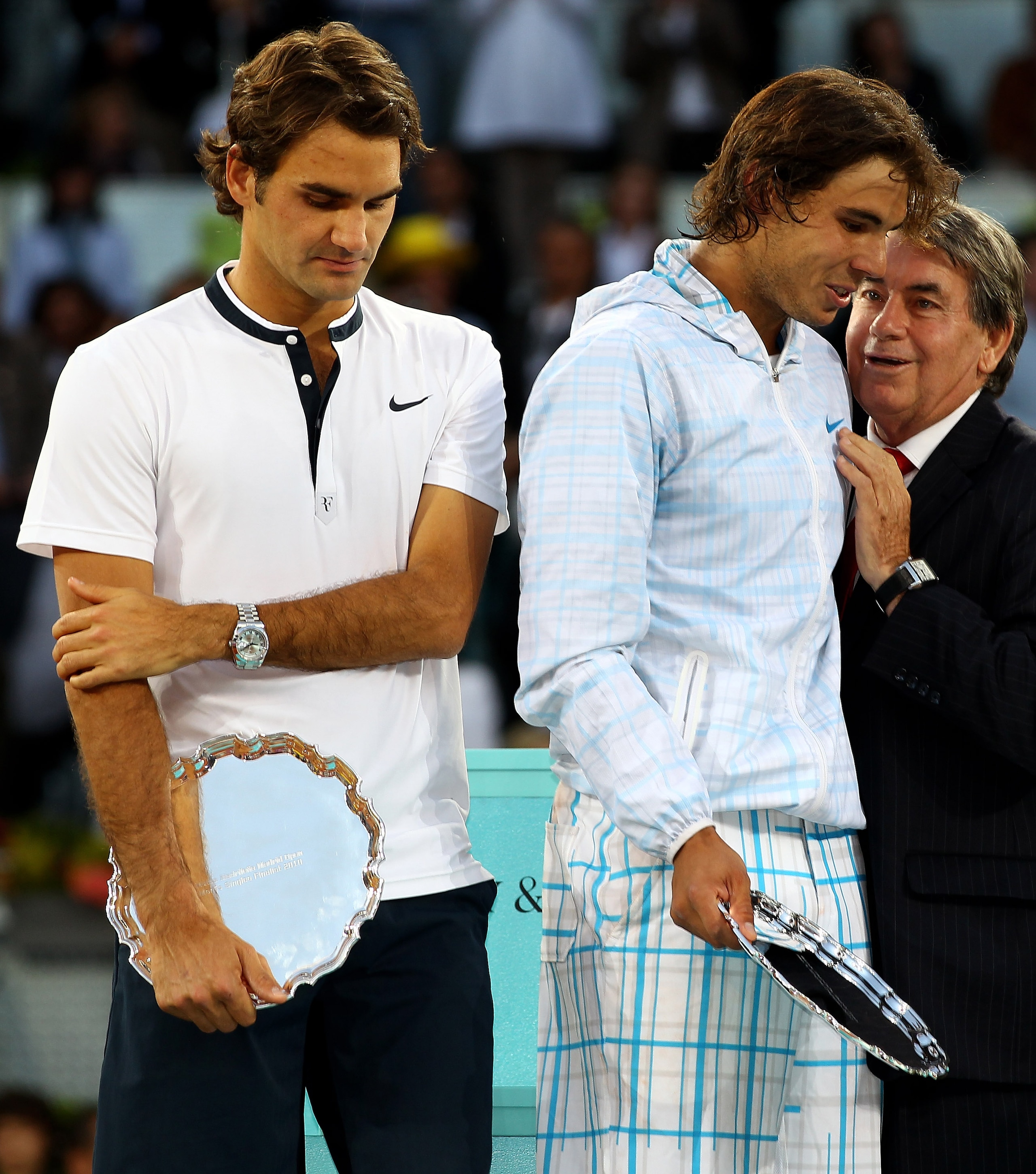
2010 ATP World Tour Masters Madrid Final: Nadal Wins 6-4, 7-6
Head to Head: Nadal 14 - Federer 7
After seeing 2009 degenerate into a nightmare, Nadal was grateful to see the clay season begin again in 2010. Losing in the fourth round of the French Open and then not being able to defend his Wimbledon championship in 2009 was very difficult.
Nadal also lost his number one ranking to Federer in 2009.
Federer seemed poised to do some very great things in 2010, especially after winning the season's first slam at the Australian Open. But things were not running smoothly in the Federer camp as the season wore on.
Federer came into Madrid as the defending champion in 2010. Winning this tournament in 2009 was the beginning of a winning streak Federer needed to fight his way back to the tennis top spot.
Nadal won the ATP Tennis Masters Madrid, defeating Federer in straight sets 6-4, 7-6. It was a close, hard-fought contest.
In the process, Nadal established his record as the player with the most tournament wins on clay, winning 18 titles.
He is also the first player in history to win in the same year at Monte Carlo, Rome and Madrid, the three major clay tournaments before Roland Garros.
Nadal managed to climb to second place in the ATP world rankings after the Madrid finals.
The other bad news for the Swiss was that Nadal could dethrone Federer for the top spot if the Majorcan could win for the fifth time in Paris and if the Swiss did not reach semifinals.
Both of these things just happened to come true.
2010 Barclays ATP WTF, Final Winner: Federer
22 of 22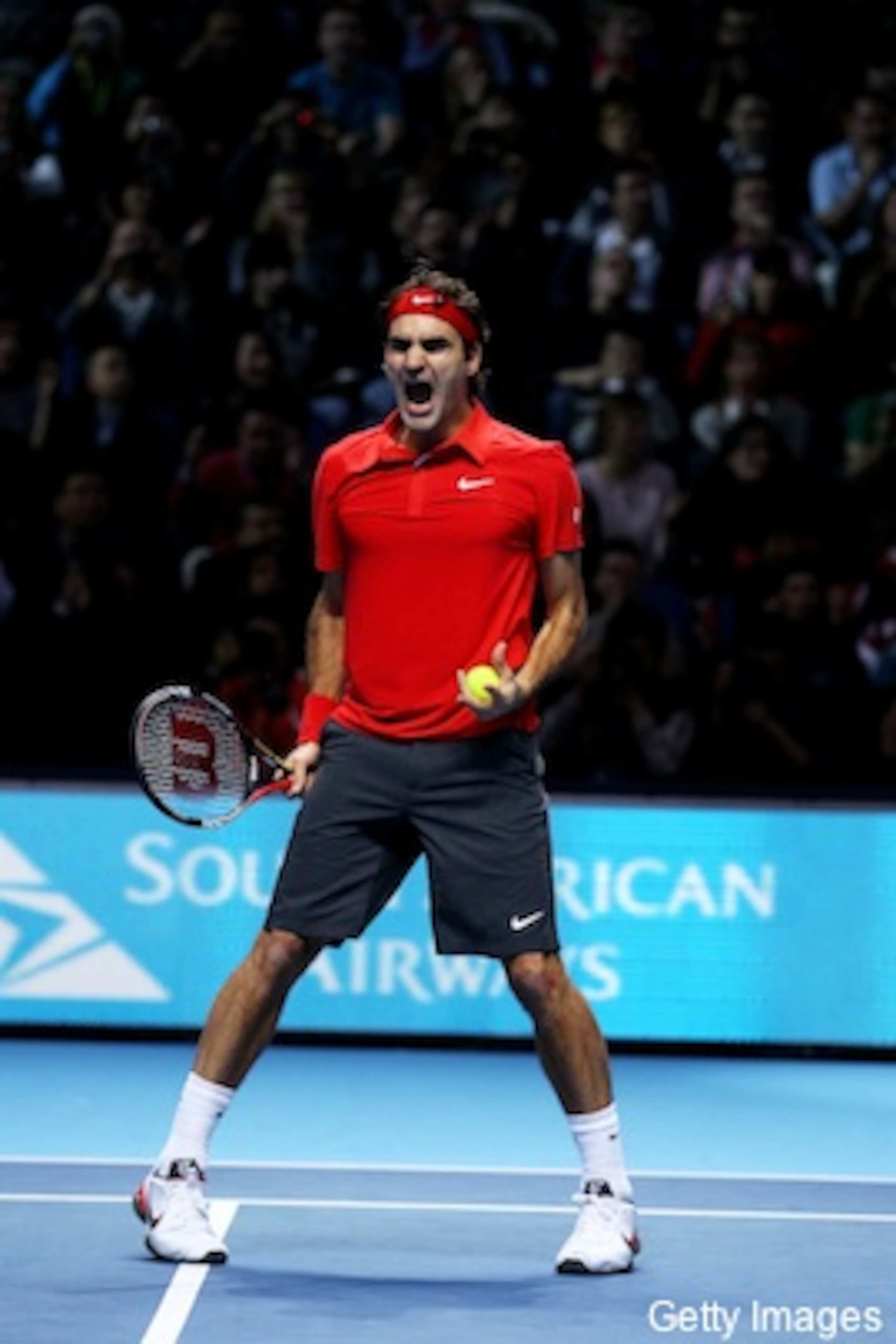
2010 Barclays ATP WTF Final: Federer Wins 6-3, 3-6, 6-1
Head to Head: Nadal 14 - Federer 8
Federer revived his career after failing to make another slam final after the Australian Open in 2010.
When Djokovic dismissed him in the semifinals of the U.S. Open, Federer hired coach Paul Annacone to work with him.
He began to turn what was left of the 2010 season around.
Federer reached the final of the Shanghai Masters and won his 64th and 65th titles back-to-back in Stockholm and Basel, before losing in the semifinals in Paris.
The Swiss produced an undefeated run in London—through his round robin matches as well as the semifinals and finals—and looked fit and confident in beating both Djokovic and Nadal to win his fifth year end championship.
Federer's fifth win also denied Nadal his first win at the year-ending event.
Working diligently under the careful eye of Federer's new coach Annacone, the Swiss seemed to find his way back to the grace and determination of earlier years.
The return to the era of attacking tennis plus the addition of a newly tooled back-hand top-spin drive allowed Federer to dominate, ending his year on a new-found high.
Federer by this win announced to the world that he was once again a player to be reckoned with and that the rivalry with Nadal was once again afoot.
.jpg?w=2560 "Colts Football")





